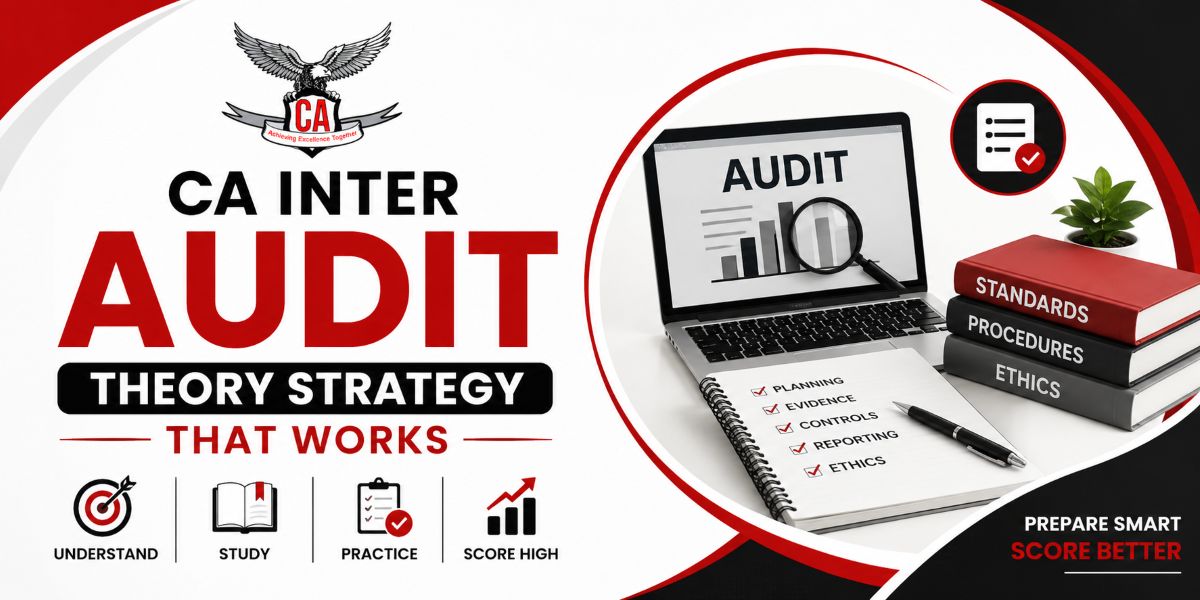
How to Study CA Inter Audit: Theory Paper Strategy That Works
How to Study CA Inter Audit: Theory Paper Strategy That Works
CA Intermediate Auditing and Ethics is one of the most misunderstood subjects in the CA curriculum. Many students classify it as a purely theoretical paper and assume success depends on memorization. As a result, they spend weeks reading the study material repeatedly, only to discover during exams that they struggle to recall concepts, structure answers, or apply auditing principles to practical scenarios.
The truth is that CA Inter Audit is not a memory test. It is an application-oriented theory paper that rewards understanding, presentation, and consistent revision. Students who approach Audit strategically often score much higher than those who simply try to memorize every paragraph.
This guide explains a practical and proven strategy for studying CA Inter Audit effectively, improving retention, and maximizing marks in the examination.
Why CA Inter Audit Feels Difficult
Before discussing preparation strategies, it's important to understand why many students find Audit challenging.
Unlike Accounting, Taxation, or Costing, Audit does not involve extensive numerical problem-solving. Instead, it introduces professional concepts, procedures, standards, ethics, and responsibilities.
Students often struggle because:
- The syllabus appears vast.
- Similar terms seem confusing.
- Multiple chapters contain interconnected concepts.
- Memorization without understanding leads to poor retention.
- Answer writing requires professional language.
The difficulty is usually not the subject itself but the way students approach it.
Understanding What ICAI Expects in Audit
Many students study Audit as if they need to reproduce textbook paragraphs exactly.
This is not entirely correct.
ICAI expects students to:
- Understand audit concepts.
- Apply professional reasoning.
- Use proper audit terminology.
- Present answers in a structured manner.
- Demonstrate conceptual clarity.
The examiner wants evidence that you understand why an audit procedure exists, not just that you have memorized its definition.
Build Concepts Before Memorization
One of the biggest mistakes students make is trying to memorize Audit from day one.
This approach rarely works.
Understand the Logic Behind Every Chapter
Ask questions such as:
- Why does this audit procedure exist?
- What risk is it trying to reduce?
- How does it protect stakeholders?
- What role does the auditor play?
For example, when studying audit evidence, don't simply memorize definitions.
Understand why an auditor requires evidence before expressing an opinion on financial statements.
Once the logic is clear, retention improves naturally.
Focus on the Bigger Picture
Audit is essentially a process.
An auditor:
- Plans the audit.
- Assesses risks.
- Collects evidence.
- Evaluates controls.
- Forms an opinion.
- Reports findings.
Understanding this workflow helps students connect chapters instead of studying them in isolation.
Create Chapter-Wise Summary Notes
Audit contains significant theoretical content.
Reading the full study material repeatedly is inefficient during revision.
What to Include in Notes
For every chapter, create:
- Key concepts
- Important definitions
- Professional terms
- Procedures
- Frequently tested points
- Relevant Standards on Auditing
Keep notes concise.
A chapter that takes 30 pages in the study material should ideally become 2–3 pages in your revision notebook.
Use Keywords, Not Paragraphs
The goal is quick revision.
Instead of writing long explanations, focus on trigger words that help you recall complete concepts during exams.
Learn Audit Through Practical Examples
Students often remember concepts better when they connect them to real-life situations.
Example: Internal Controls
Rather than memorizing internal control definitions, think of a business where one employee receives cash, records transactions, and deposits money.
Would that create risk?
Yes.
Internal controls exist to reduce such risks.
Practical thinking transforms abstract theory into something easier to understand and remember.
Example: Audit Evidence
Imagine buying a second-hand car.
Would you purchase it based solely on the seller's statement?
Probably not.
You would inspect documents, verify ownership, and check the vehicle condition.
That verification process resembles audit evidence collection.
Simple examples improve understanding significantly.
Prioritize High-Weightage Areas
Every chapter matters, but some areas appear more frequently in examinations.
Students should pay particular attention to:
- Audit Planning
- Risk Assessment
- Audit Evidence
- Internal Controls
- Audit Documentation
- Audit Reports
- Standards on Auditing
- Professional Ethics
Mastering these areas often provides a strong scoring foundation.
However, avoid selective studying. ICAI can ask questions from any chapter.
Develop an Effective Revision Strategy
Revision is where most Audit preparation succeeds or fails.
The 3-Revision Rule
A useful approach is:
First Revision
Understand concepts.
Second Revision
Strengthen recall and connect chapters.
Third Revision
Focus on examination-oriented preparation and answer writing.
Most students who struggle with Audit simply do not revise enough.
Weekly Revision Schedule
Instead of waiting until the final month, revise continuously.
For example:
- Study new chapters on weekdays.
- Revise older chapters on weekends.
- Review summary notes regularly.
This prevents forgetting earlier topics.
Master Audit Answer Writing
Knowing concepts is important.
Presenting them properly is equally important.
Use Structured Answers
A good Audit answer usually follows this format:
- Introduction
- Relevant concept or provision
- Explanation
- Application (if required)
- Conclusion
Structured answers are easier for examiners to evaluate.
Use Professional Language
Avoid casual explanations.
Use terms such as:
- Audit evidence
- Internal control
- Material misstatement
- Audit procedure
- Risk assessment
- Professional judgment
Proper terminology improves answer quality.
Highlight Keywords
Underline:
- Definitions
- Standards
- Important terms
- Professional phrases
This improves presentation and makes answers examiner-friendly.
Practice Questions Instead of Only Reading
Many students spend months reading Audit and very little time writing answers.
This is a major mistake.
Why Practice Matters
Practice helps students:
- Improve recall
- Learn answer structure
- Manage exam time
- Identify weak areas
Even if you know a concept, writing it under exam conditions is a different skill.
Use Mock Tests Regularly
Mock tests simulate actual examination pressure.
They help students evaluate:
- Conceptual understanding
- Writing speed
- Presentation quality
- Time management
Many CA Intermediate students use chapter-wise tests and full-length mock examinations available through platforms such as CATestSeries.org to assess their preparation and improve answer-writing performance before the actual exam.
Common Mistakes to Avoid
Several mistakes repeatedly affect Audit scores.
Relying Only on Memorization
Understanding should come first.
Memorization without comprehension often fails during application-based questions.
Ignoring Presentation
Even correct answers can lose marks if poorly structured.
Delaying Revision
Audit requires continuous revision throughout preparation.
Avoiding Writing Practice
Reading creates familiarity.
Writing develops examination readiness.
Studying Audit Only Before Exams
Audit retention improves when studied consistently over several months rather than during the final few weeks.
A 60-Day Audit Preparation Plan
Students looking for structure can follow a simple framework:
Days 1–30
- Complete syllabus coverage.
- Build chapter-wise notes.
- Understand concepts deeply.
Days 31–45
- First complete revision.
- Practice chapter-wise questions.
- Strengthen weak areas.
Days 46–55
- Attempt mock tests.
- Improve answer writing.
- Revise professional terminology.
Days 56–60
- Focus on summary notes.
- Revise Standards on Auditing.
- Strengthen confidence.
This balanced approach helps students avoid last-minute panic.
Final Thoughts
CA Inter Audit is often considered difficult because students treat it as a memorization-heavy subject. In reality, the highest-scoring students focus on understanding concepts, connecting chapters, revising consistently, and practicing answer writing.
The goal is not to memorize entire pages. The goal is to understand audit principles well enough to explain them professionally during the examination.
When you combine conceptual clarity, structured revision, practical examples, and regular mock tests, Audit becomes far more manageable—and significantly more scoring.
Frequently Asked Questions
Is CA Inter Audit completely theoretical?
No. Although Audit is a theory paper, it requires conceptual understanding and practical application rather than pure memorization.
How many revisions are required for Audit?
Most students benefit from at least three complete revisions before the examination.
Which chapters are most important in CA Inter Audit?
Audit Planning, Audit Evidence, Risk Assessment, Internal Controls, Audit Reports, Standards on Auditing, and Professional Ethics are generally considered high-priority areas.
Should I memorize Audit answers?
You should understand concepts first and then remember key points, professional terminology, and important provisions.
Are mock tests necessary for Audit?
Yes. Mock tests help improve answer-writing skills, time management, and examination confidence.
How can I improve retention in Audit?
Use summary notes, revise regularly, connect concepts to practical examples, and practice writing answers frequently.
Can self-study be enough for CA Inter Audit?
Yes. Many students score well through disciplined self-study, consistent revision, and regular practice.