CA Inter Corporate Law: Table of Content and Priority Topics 2026
CA Inter Corporate Law: Table of Content and Priority Topics 2026
CA Intermediate Corporate and Other Laws is one of the most important theory subjects in the CA curriculum. Many students enter the subject expecting it to be purely memory-based, only to realize later that ICAI tests understanding, interpretation, and application of legal provisions rather than simple memorization.
One of the biggest challenges students face is deciding where to begin. The syllabus appears extensive, sections seem endless, and legal language can initially feel intimidating. Without a structured approach, students often spend too much time on low-priority areas while neglecting chapters that frequently contribute significant marks.
This guide provides a complete overview of the CA Inter Corporate Law syllabus structure, explains the table of contents, identifies priority topics for 2026 preparation, and helps students create a more effective study strategy.
Understanding the CA Inter Corporate Law Paper
Corporate and Other Laws forms part of Group 1 of the CA Intermediate examination.
The paper aims to develop understanding of:
- Corporate legal framework
- Company administration
- Governance requirements
- Legal compliance
- Business law principles
Unlike CA Foundation Law, the Intermediate syllabus goes deeper into company law provisions and practical business applications.
Students are expected to:
- Understand legal concepts
- Interpret provisions
- Apply laws to practical situations
- Present structured answers
CA Inter Corporate Law: Broad Syllabus Structure
The Corporate Law portion generally focuses on provisions of the Companies Act and related corporate governance concepts.
Major topics include:
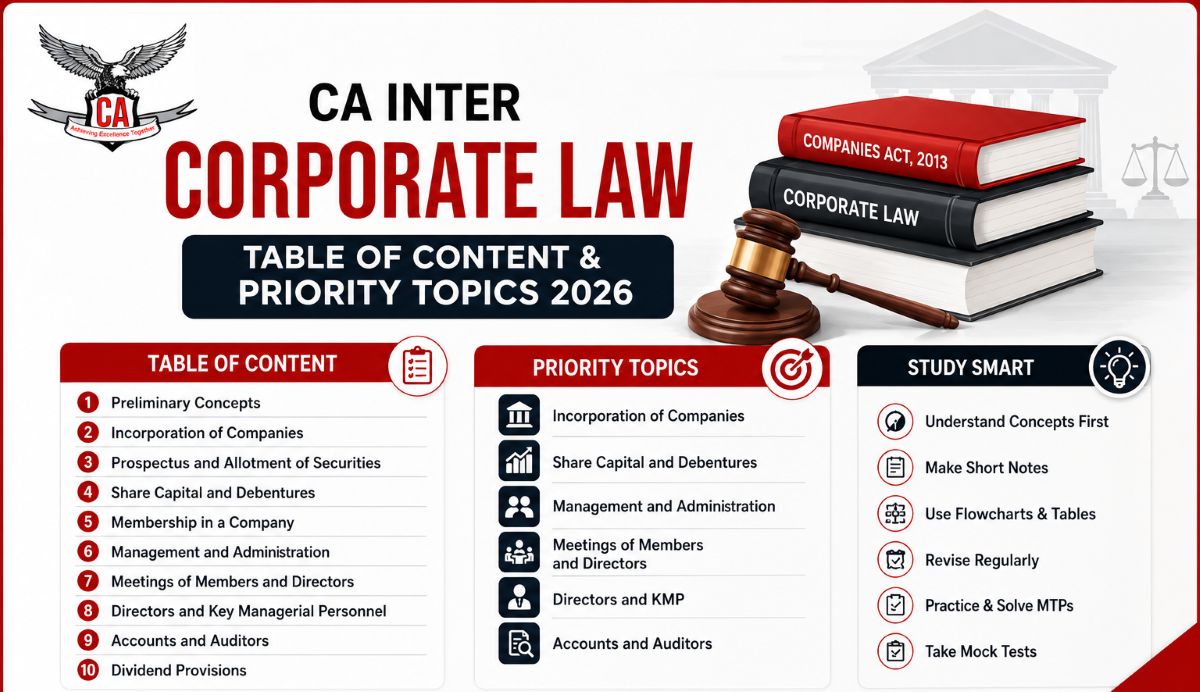
- Preliminary Concepts
- Incorporation of Companies
- Prospectus and Allotment of Securities
- Share Capital and Debentures
- Membership in a Company
- Management and Administration
- Meetings of Members and Directors
- Directors and Key Managerial Personnel
- Accounts and Auditors
- Dividend Provisions
Each chapter builds upon previous concepts, making systematic study extremely important.
Why Understanding the Table of Contents Matters
Many students immediately start reading chapters without understanding the overall syllabus flow.
This creates confusion.
A better approach is to understand how the chapters connect.
The Corporate Lifecycle Approach
The Companies Act follows the life cycle of a company:
- Formation
- Capital Raising
- Membership
- Management
- Governance
- Financial Reporting
- Audit and Compliance
When students understand this sequence, Corporate Law becomes much easier to remember.
Instead of memorizing isolated provisions, they understand how companies operate in real life.
High-Priority Topics for CA Inter Corporate Law 2026
Although every chapter is important, some areas consistently require greater attention because of their conceptual importance and examination relevance.
Incorporation of Companies
This chapter forms the foundation of Corporate Law.
Students should understand:
- Types of companies
- Memorandum of Association
- Articles of Association
- Incorporation process
- Legal status of a company
Many later chapters build upon these concepts.
Share Capital and Debentures
This is one of the most important scoring areas.
Focus on:
- Types of share capital
- Issue of shares
- Rights issue
- Bonus issue
- Buy-back provisions
- Debenture concepts
Questions from this chapter often involve practical application.
Management and Administration
Students frequently underestimate this chapter.
Important areas include:
- Statutory registers
- Annual returns
- Filing requirements
- Corporate records
- Compliance obligations
The chapter contains numerous practical provisions.
Meetings of Members and Directors
This chapter is highly important because it combines conceptual understanding with procedural requirements.
Focus on:
- Notice requirements
- Quorum provisions
- Types of meetings
- Resolutions
- Voting procedures
Students should learn both concepts and procedural details.
Directors and Key Managerial Personnel
This area is frequently tested because directors play a central role in corporate governance.
Key concepts include:
- Appointment of directors
- Powers of directors
- Duties of directors
- Resignation and removal
- Key managerial personnel
Practical case-based questions often arise from this chapter.
Accounts and Auditors
This chapter connects closely with future CA subjects.
Students should understand:
- Financial statement requirements
- Auditor appointment
- Auditor powers
- Auditor responsibilities
- Reporting obligations
Strong understanding here helps later in CA Inter Audit.
Medium-Priority Topics
Some chapters generally require attention but may not demand the same level of preparation intensity as core corporate governance topics.
Membership in a Company
Important areas include:
- Membership rules
- Transfer of shares
- Transmission of shares
- Rights and liabilities of members
Prospectus and Securities
Students should understand:
- Prospectus requirements
- Misstatements
- Allotment procedures
- Investor protection concepts
These topics are important but usually more manageable after mastering incorporation and share capital chapters.
Topics Students Often Find Difficult
Certain chapters repeatedly challenge students.
Legal Terminology
Students often struggle with technical legal language.
The solution is not memorization.
Instead:
- Understand meanings.
- Create simple explanations.
- Use practical examples.
Section Numbers
Many students attempt to memorize section numbers from the beginning.
This creates unnecessary pressure.
First understand concepts.
Section references can be strengthened during revision.
Similar Provisions
Certain rules appear similar across chapters.
Creating comparison tables helps reduce confusion.
How to Study Corporate Law Effectively
Success in Corporate Law depends more on strategy than study hours.
Start with Concept Building
Avoid reading provisions mechanically.
Ask:
- Why does this provision exist?
- What corporate problem does it solve?
- How does it protect shareholders?
Understanding improves retention significantly.
Create Chapter Summaries
For each chapter, maintain:
- Key concepts
- Important provisions
- Exceptions
- Frequently tested points
This makes revision far more efficient.
Use Flowcharts and Tables
Corporate Law contains many procedures.
Flowcharts simplify:
- Incorporation process
- Share issue process
- Meeting procedures
- Compliance requirements
Visual learning often improves recall.
Answer Writing Strategy for Corporate Law
Knowing the law is only half the battle.
Presentation matters.
Follow a Structured Format
For practical questions:
- State the provision
- Explain the relevant rule
- Apply the rule to the facts
- Give a conclusion
This structure demonstrates legal understanding clearly.
Use Professional Language
Terms such as:
- Company
- Shareholder
- Resolution
- Board of Directors
- Compliance
- Statutory Requirement
should be used appropriately throughout answers.
Highlight Keywords
Underline:
- Legal provisions
- Important terms
- Key conclusions
This improves answer presentation.
The Importance of Revision
Corporate Law cannot be mastered through one reading.
First Revision
Focus on understanding.
Second Revision
Focus on recall.
Third Revision
Focus on examination-oriented preparation.
Students who revise consistently generally perform much better than those who attempt last-minute preparation.
How Mock Tests Improve Corporate Law Scores
Mock tests help students:
- Improve answer structure
- Identify weak chapters
- Enhance time management
- Build confidence
Many CA Intermediate students use chapter-wise assessments and mock examinations available through CATestSeries.org to evaluate their preparation and improve examination performance before attempting the actual ICAI exams.
Common Mistakes Students Should Avoid
Ignoring Difficult Chapters
Many students postpone meetings, directors, and share capital chapters.
These are often among the most important topics.
Memorizing Without Understanding
Conceptual clarity should always come first.
Avoiding Writing Practice
Corporate Law is a descriptive paper.
Writing practice is essential.
Delaying Revision
Regular revision prevents forgetting earlier chapters.
Final Thoughts
CA Inter Corporate Law becomes significantly easier when approached systematically. Instead of viewing the syllabus as a collection of legal provisions, students should understand it as the complete life cycle of a company—from incorporation to governance, management, compliance, and reporting.
By focusing on high-priority topics, understanding concepts before memorization, revising regularly, and practicing answer writing, students can transform Corporate Law from a difficult theory subject into a scoring paper.
The key is not studying more chapters. The key is studying the right chapters in the right way.
Frequently Asked Questions
Which chapter is most important in CA Inter Corporate Law?
Share Capital and Debentures, Directors, Meetings, Incorporation, and Accounts & Auditors are generally considered among the highest-priority chapters.
Is Corporate Law difficult for CA Inter students?
It can feel difficult initially because of legal terminology, but conceptual understanding makes the subject much easier.
Should I memorize section numbers?
Focus on concepts first. Section numbers can be strengthened during later revisions.
How many revisions are required for Corporate Law?
Most students benefit from at least three complete revisions before the examination.
Are practical questions important in Corporate Law?
Yes. ICAI frequently tests application-based understanding through practical scenarios.
How can I improve answer writing in Corporate Law?
Use a structured format: provision, explanation, application, and conclusion.
Are mock tests useful for Corporate Law?
Absolutely. Mock tests improve presentation, time management, confidence, and examination readiness.