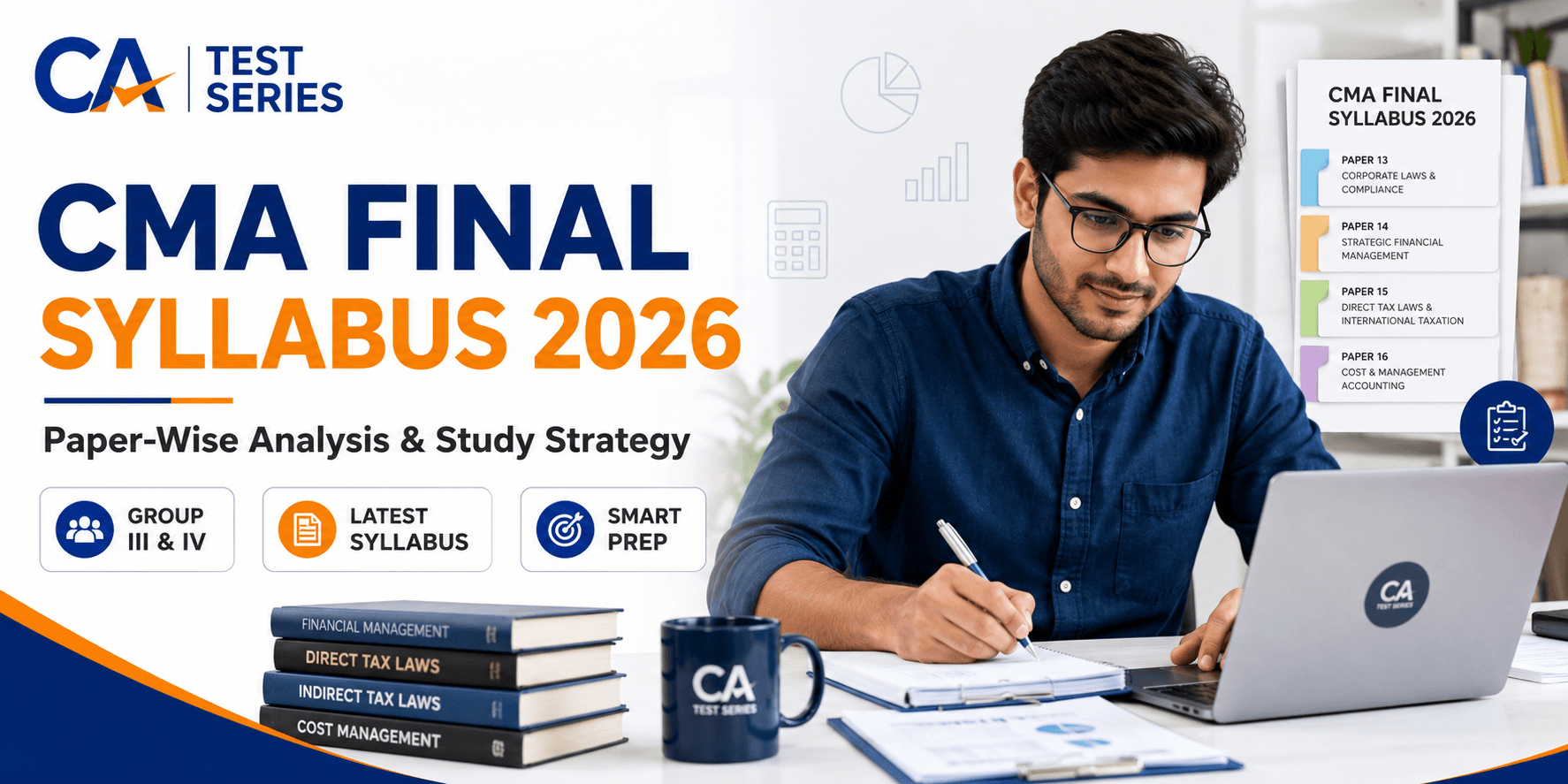
CMA Final Syllabus 2026: Paper-Wise Analysis and Study Strategy
The CMA Final Syllabus 2026 covers advanced areas of corporate law, finance, taxation, strategic cost management, auditing, financial reporting, and business decision-making. For students preparing for the CMA Final exam, understanding the syllabus is only the first step. A successful preparation strategy should also consider paper-wise weightage, difficult topics, regular revision, amendments, question practice, and mock tests. This guide explains the CMA Final subjects for 2026 and provides a practical study strategy to help students prepare in a more structured and exam-focused manner.
CMA Final Syllabus 2026 – Complete Overview
The CMA Final course under the applicable ICMAI syllabus is divided into Group III and Group IV. Students study eight papers in total, including one elective paper in Group IV. Each subject requires a different approach because some papers are theory-heavy, while others focus on numerical calculations, taxation, accounting, or practical application.
Group | Paper | Subject |
| Group III | Paper 13 | Corporate and Economic Laws |
| Group III | Paper 14 | Strategic Financial Management |
| Group III | Paper 15 | Direct Tax Laws and International Taxation |
| Group III | Paper 16 | Strategic Cost Management |
| Group IV | Paper 17 | Cost and Management Audit |
| Group IV | Paper 18 | Corporate Financial Reporting |
| Group IV | Paper 19 | Indirect Tax Laws and Practice |
| Group IV | Paper 20 | Elective Paper |
Students should always check the latest official ICMAI study material, supplementary updates, and examination notifications before beginning their preparation.
CMA Final Syllabus 2026 – Group III Subjects
Paper 13 – Corporate and Economic Laws: Corporate and Economic Laws covers important areas such as the Companies Act, Insolvency and Bankruptcy Code, corporate governance, CSR, SEBI regulations, Competition Law, FEMA, cyber security, and other economic regulations. The paper requires both conceptual understanding and practical application of legal provisions. Students should prepare short notes containing important sections, conditions, exceptions, penalties, and procedures while regularly practising case-based and descriptive questions.
Paper 14 – Strategic Financial Management: Strategic Financial Management is an advanced practical paper covering investment decisions, security analysis, portfolio management, financial risk management, foreign exchange, derivatives, and international finance. Students should develop strong conceptual knowledge before attempting complex numerical problems. Maintaining a formula notebook, practising calculations regularly, and analysing mistakes from mock tests can significantly improve accuracy and speed.
Paper 15 – Direct Tax Laws and International Taxation: This paper covers advanced direct taxation along with international taxation topics such as DTAA, transfer pricing, Advance Pricing Agreements, safe harbour provisions, and GAAR. Tax laws can change based on amendments applicable to a particular examination term, so students should combine the main study material with the latest ICMAI supplementary updates. Regular case-study practice is also important for learning how multiple tax provisions apply to practical situations.
Paper 16 – Strategic Cost Management: Strategic Cost Management focuses on advanced costing and decision-making techniques. Important areas include relevant costing, pricing decisions, transfer pricing, target costing, activity-based management, benchmarking, linear programming, transportation, game theory, PERT and CPM, forecasting, and other quantitative techniques. Students should practise numerical questions consistently and maintain an error log to identify repeated calculation or conceptual mistakes.
CMA Final Syllabus 2026 – Group IV Subjects
Paper 17 – Cost and Management Audit: Cost and Management Audit includes cost audit, management audit, internal and operational audit, forensic audit, internal controls, and anti-money laundering. Since much of the paper is theory-oriented, students should use active recall instead of repeatedly reading full chapters. Short notes, flowcharts, keyword lists, and regular answer-writing practice can make revision faster and improve the structure of descriptive answers.
Paper 18 – Corporate Financial Reporting: Corporate Financial Reporting covers advanced accounting areas such as Indian Accounting Standards, financial instruments, valuation, business combinations, consolidated financial statements, sustainability reporting, and government accounting. Students should first understand the accounting principles involved and then move gradually towards complex examination-level questions. Clear working notes and repeated practice of full-length problems are essential for improving accuracy.
Paper 19 – Indirect Tax Laws and Practice: This paper mainly covers GST and Customs. Important GST areas include supply, time and place of supply, valuation, input tax credit, refunds, returns, and dispute-related provisions, while Customs covers valuation, procedures, duty drawbacks, refunds, and export-related schemes. Because indirect tax rules may be updated, students should regularly check applicable amendments and incorporate them into their main revision notes.
Paper 20 – Elective Paper: Students can choose one elective paper according to the applicable syllabus and their professional interests.
Strategic Performance Management and Business Valuation: This elective is suitable for students interested in performance management, strategic decision-making, and business valuation.
Risk Management in Banking and Insurance: This option focuses on financial institutions, banking and insurance risks, regulations, and risk-management frameworks.
Entrepreneurship and Startup: This paper covers entrepreneurship, innovation, startup development, funding, business planning, and growth strategies.
Students should choose an elective based on personal strengths, career goals, syllabus comfort, and available preparation resources rather than selecting a paper simply because others consider it easier.
CMA Final 2026 Exam Pattern and Weightage
Understanding the CMA Final exam pattern 2026 helps students prepare according to actual examination requirements. Each paper carries 100 marks, and current preparation resources indicate that students need to prepare for both objective and descriptive or application-based questions.
Exam Feature | Details |
| Marks per Paper | 100 Marks |
| Duration | 3 Hours |
| Paper Type | Objective and Descriptive/Application-Based |
| Minimum Marks per Paper | 40% |
| Required Group Aggregate | 50% |
| Groups | Group III and Group IV |
Students should use section-wise weightage to decide how much time to spend on different topics, but lower-weightage chapters should not be completely ignored. Objective questions can test concepts from across the syllabus.
Best Study Strategy for CMA Final Syllabus 2026
A successful CMA Final study plan should combine complete syllabus coverage, revision, question practice, and regular testing. Students should avoid finishing the entire syllabus before beginning revision because early topics may be forgotten by the time the final paper is completed.
Create a 6-Month Study Plan: During the first three months, focus on completing the first detailed study of all planned papers and prepare concise revision notes alongside your regular learning. Use months four and five for first and second revisions, previous questions, chapter-wise tests, and difficult numerical problems. The final month should focus primarily on full-syllabus mock tests, amendments, formulas, important provisions, weak topics, and rapid revision.
Balance Theory and Practical Subjects: Pair practical subjects such as Strategic Financial Management, Strategic Cost Management, and Corporate Financial Reporting with theory-based papers such as Corporate and Economic Laws or Cost and Management Audit. This keeps the study schedule balanced and ensures that numerical practice and theory revision continue throughout the preparation period.
Practise Questions Regularly: Reading alone is not enough for CMA Final preparation. After completing each chapter, solve relevant objective, descriptive, numerical, and case-based questions. Regular practice helps students check whether they can independently recall concepts and apply them under examination conditions.
Best Resources for CMA Final Preparation
ICMAI official study material should remain the main reference for syllabus coverage. Students can supplement it with previous-year papers, model question papers, practice questions, short revision notes, chapter-wise tests, and full-syllabus mock examinations.
Platforms such as CA Test Series can support preparation through chapter-wise practice, full-syllabus mock tests, answer evaluation, and performance feedback. Mock-test analysis is particularly valuable because it can reveal conceptual weaknesses, calculation errors, poor answer presentation, and time-management problems before the actual examination.
Common CMA Final Preparation Mistakes to Avoid
One common mistake is beginning preparation without confirming the latest syllabus and applicable amendments. Students also frequently spend too much time reading while avoiding question practice, ignore lower-weightage topics completely, delay revision until the final weeks, and take mock tests without analysing their mistakes. A better approach is to maintain an error log, revise weak areas after every test, and use performance feedback to decide what should be studied next.
CMA Final Syllabus 2026 Preparation Checklist
Task | Status | Revision | Mock Test |
| Review latest syllabus | Pending/Completed | — | — |
| Complete Group III syllabus | Pending/Completed | Yes/No | Yes/No |
| Complete Group IV syllabus | Pending/Completed | Yes/No | Yes/No |
| Update tax and law amendments | Pending/Completed | Yes/No | — |
| Complete first revision | Pending/Completed | Yes/No | Yes/No |
| Complete second revision | Pending/Completed | Yes/No | Yes/No |
| Attempt chapter-wise tests | Pending/Completed | Yes/No | Yes |
| Attempt full-syllabus mocks | Pending/Completed | Yes/No | Yes |
| Review test mistakes | Pending/Completed | Yes/No | — |
| Complete final revision | Pending/Completed | Yes | Yes |
Conclusion
The CMA Final Syllabus 2026 is extensive, but a structured preparation strategy can make it much more manageable. Students should understand the paper-wise syllabus, prioritize topics according to weightage and personal difficulty, follow updated ICMAI resources, revise repeatedly, and practise questions under realistic examination conditions. Combining official study material with chapter-wise tests, full-syllabus mock exams, and detailed performance analysis can help students identify weaknesses early and improve their exam strategy. Consistent preparation, smart revision, and regular testing are ultimately more effective than trying to complete large portions of the syllabus through last-minute study.