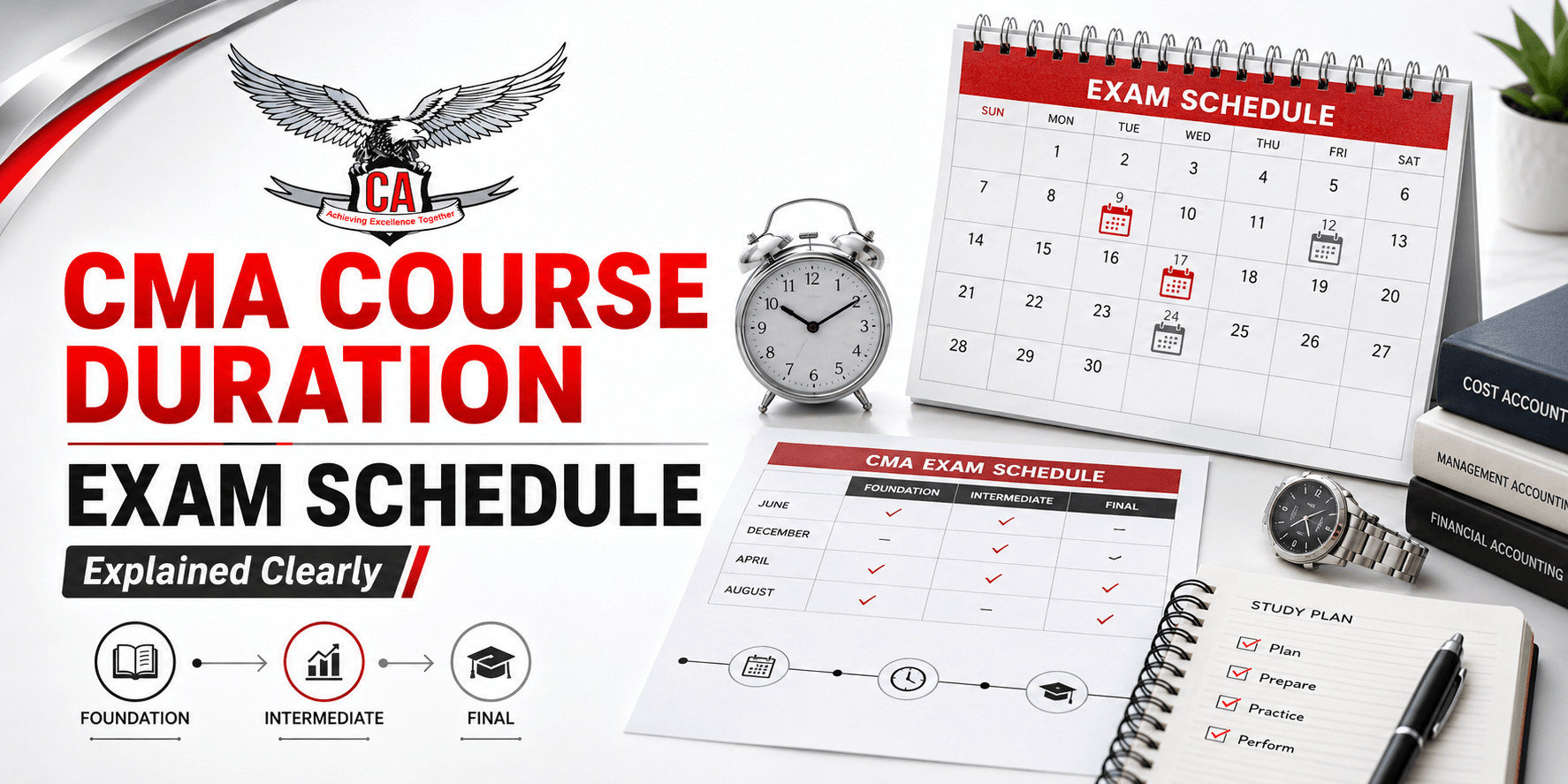
Understanding the CMA Course Duration is essential for students planning to become Cost and Management Accountants in India. The total timeline depends on your entry route, exam attempts, group strategy, registration dates, and practical training. Students starting after Class 12 generally take longer than graduates entering directly at the Intermediate level. Since ICMAI examinations are organised around the June and December terms, proper planning can help students avoid unnecessary delays and complete the course efficiently.
CMA Course Duration at a Glance
The CMA course consists of Foundation, Intermediate, and Final levels. Eligible graduates can directly enter the Intermediate course and skip Foundation, making their academic journey shorter. The following table provides a practical overview of the CMA course duration in India.
Entry Route | Starting Level | Levels to Complete | Approximate Duration | Practical Training | Exam Terms |
| After Class 12 | Foundation | Foundation, Intermediate, Final | Around 3–4 years | 15 months | June and December |
| Graduate Direct Entry | Intermediate | Intermediate and Final | Around 2.5–3.5 years | 15 months | June and December |
ICMAI accepts course registrations throughout the year, but students targeting the June examination term should generally register by January 31, while those targeting December should register by July 31.
CMA Duration After Class 12
Students entering CMA after Class 12 normally begin with Foundation and then progress to Intermediate and Final. Considering exam preparation, result cycles, mandatory training, and possible waiting periods between examinations, the CMA duration after 12th can generally be planned at around three to four years for students who progress consistently.
CMA Duration After Graduation
Eligible graduates can directly register for CMA Intermediate and avoid the Foundation stage. This reduces the number of examination levels they need to complete, although practical training and Final requirements still apply. A direct-entry student may therefore complete the CMA journey in approximately two and a half to three and a half years, depending on attempts and preparation.
What Affects the CMA Course Duration?
There is no single fixed timeline for every CMA student. Two candidates joining at the same time may qualify in different years because entry routes, examination attempts, group selection, training completion, and registration deadlines can all affect the overall CMA course timeline.
Number of Exam Attempts: Clearing examinations in the first attempt is one of the most effective ways to keep the CMA duration shorter. Because the regular examination cycle follows June and December terms, missing or failing an examination can potentially add around six months before the next opportunity, depending on the student's remaining papers and eligibility.
One Group or Both Groups: CMA Intermediate and Final are divided into two groups. Students who are fully prepared may attempt both groups together and potentially complete a level faster, while students appearing for one group at a time may need additional examination terms. The right choice should depend on preparation quality rather than speed alone.
Practical Training: Practical training is an important part of the CMA qualification. Students covered by the current ICMAI training scheme are required to complete 15 months of practical training, and training can begin from the Intermediate stage. Starting it at the right time can allow students to complete examination preparation and professional training in parallel.
CMA Course Duration by Level
The time required at each CMA level depends on syllabus size, examination strategy, and the student's academic background. A practical preparation plan should therefore consider Foundation, Intermediate, Final, and training separately.
CMA Stage | Typical Planning Time | Key Consideration |
| Foundation | Around 4–6 months | Registration and exam-term timing |
| Intermediate | Around 8–18 months | One group vs both groups |
| Practical Training | 15 months | Can begin from Intermediate |
| Final | Around 6–18 months | Group strategy and training eligibility |
CMA Foundation Course Duration: CMA Foundation is the entry stage for most students joining after Class 12. A focused preparation period of approximately four to six months may be suitable for many students, although actual preparation time depends on their understanding of accounting, mathematics, business law, economics, and related subjects.
CMA Intermediate Course DurationL CMA Intermediate consists of eight papers divided into two groups. Students preparing for one group may commonly allocate four to six focused months, while those attempting both groups together may require a longer and more intensive preparation period. Clearing both groups in one term can reduce the academic timeline if the student is adequately prepared.
CMA Final Course Duration: CMA Final is the last examination stage and also contains two groups. Students may require approximately six to twelve months or more for preparation depending on whether they attempt one or both groups and whether they are balancing studies with practical training or employment.
Complete CMA Course Timeline
The overall journey differs mainly according to the student's entry route. Planning practical training alongside Intermediate and Final preparation is one of the most effective ways to avoid an unnecessary gap before qualification.
Stage | After Class 12 | Graduate Direct Entry |
| Foundation | Required | Not required for eligible graduates |
| Intermediate | Required | Starting level |
| Practical Training | Begins from eligible Intermediate stage | Begins from eligible Intermediate stage |
| Final | Required | Required |
| Estimated Overall Duration | Around 3–4 years | Around 2.5–3.5 years |
CMA Timeline After Class 12
A student starting after Class 12 generally completes Foundation, moves to Intermediate, begins applicable training, clears Intermediate and Final examinations, and completes the remaining professional requirements. Timely registration and first-attempt success can help keep this route close to the shorter end of the estimated timeline.
CMA Timeline Through Direct Entry
Graduates who meet ICMAI's eligibility requirements can start directly from Intermediate. Since Foundation is removed from their academic path, they may save one examination stage, but they must still complete Intermediate, Final, and applicable training requirements before completing the professional journey.
CMA Examination Schedule Explained
The CMA examination schedule directly affects course duration because students who miss an application or registration deadline may need to wait for a later term. ICMAI's regular admission framework is structured around June and December examination terms, giving students two major opportunities each year to progress.
CMA June and December Exam Sessions
Students planning for the June term should generally complete the applicable admission or registration process by January 31, while candidates targeting December should generally complete it by July 31, unless ICMAI announces an official extension. Students should always confirm the latest dates before submitting applications.
CMA Examination Schedule 2026 at a Glance
The June 2026 examination term has already been completed. As of July 21, 2026, ICMAI's examination updates page lists the June 2026 Intermediate, Final, and Foundation timetables, while a detailed December 2026 timetable is not yet listed there.
CMA Level | June 2026 Examination | December 2026 |
| Foundation | June 14, 2026 | Detailed timetable awaited |
| Intermediate | June 11–18, 2026 | Detailed timetable awaited |
| Final | June 11–18, 2026 | Detailed timetable awaited |
Students preparing for December 2026 should avoid relying on estimated examination dates and check the latest official ICMAI notification before making final travel or study plans.
How to Complete CMA in the Minimum Possible Time
The fastest realistic route to completing CMA is to choose the correct entry pathway, avoid missing examination cycles, begin practical training at the appropriate stage, and prepare according to your actual capacity. Trying to move faster without sufficient preparation can result in repeated attempts and ultimately increase the total course duration.
Plan Your Exam Attempts Carefully
Students should prepare around the June and December terms and decide whether to appear for one or both groups based on syllabus completion and revision quality. Attempting both groups may save time when preparation is strong, but one well-prepared group can be better than two poorly prepared groups.
Use Mock Tests and Performance Analysis
Timed mock tests help students evaluate conceptual understanding, answer-writing ability, accuracy, and time management before the actual examination. Students can use relevant CA Test Series mock tests, practice resources, and performance feedback to identify weak areas and create a more focused revision plan before the next examination.
Common Reasons CMA Course Duration Gets Extended
The most common causes of delay include missing registration cut-offs, skipping examination sessions, requiring multiple attempts, delaying practical training, and preparing without a structured study plan. Tracking deadlines and reviewing performance regularly can prevent many of these avoidable delays.
Important Checks Before Applying for a CMA Exam
Before submitting an examination form, students should confirm their registration validity, applicable exam-form deadline, group eligibility, practical or skills training requirements, and admit-card details. Completing these checks early reduces the risk of administrative problems affecting the planned examination attempt.
CMA Course Duration vs CA Course Duration
CMA and CA both have Foundation, Intermediate, and Final stages, but their training structures and examination schedules differ. CMA students covered by the applicable ICMAI scheme complete 15 months of practical training, while the CA New Scheme provides for two years of practical training.
Factor | CMA | CA |
| Main Levels | Foundation, Intermediate, Final | Foundation, Intermediate, Final |
| Approximate Duration | Around 3–4 years | Varies by route and attempts |
| Practical Training | 15 months under applicable scheme | 2 years under New Scheme |
| 2026 Exam Pattern | Mainly June and December terms | Frequency varies by level |
For 2026, students should note that ICAI announced that CA Final would return to twice-yearly examinations from the May 2026 examination onward, so current official schedules should always be checked before comparing course timelines.
Conclusion
The CMA Course Duration generally ranges around three to four years for students starting after Class 12, while eligible graduates using direct entry may complete the academic journey sooner. However, the actual timeline depends on examination attempts, group strategy, registration timing, and completion of mandatory training. Students who plan around the June and December examination terms, begin practical training on time, and regularly evaluate their preparation through mock tests can avoid unnecessary delays and move through the CMA course more efficiently.