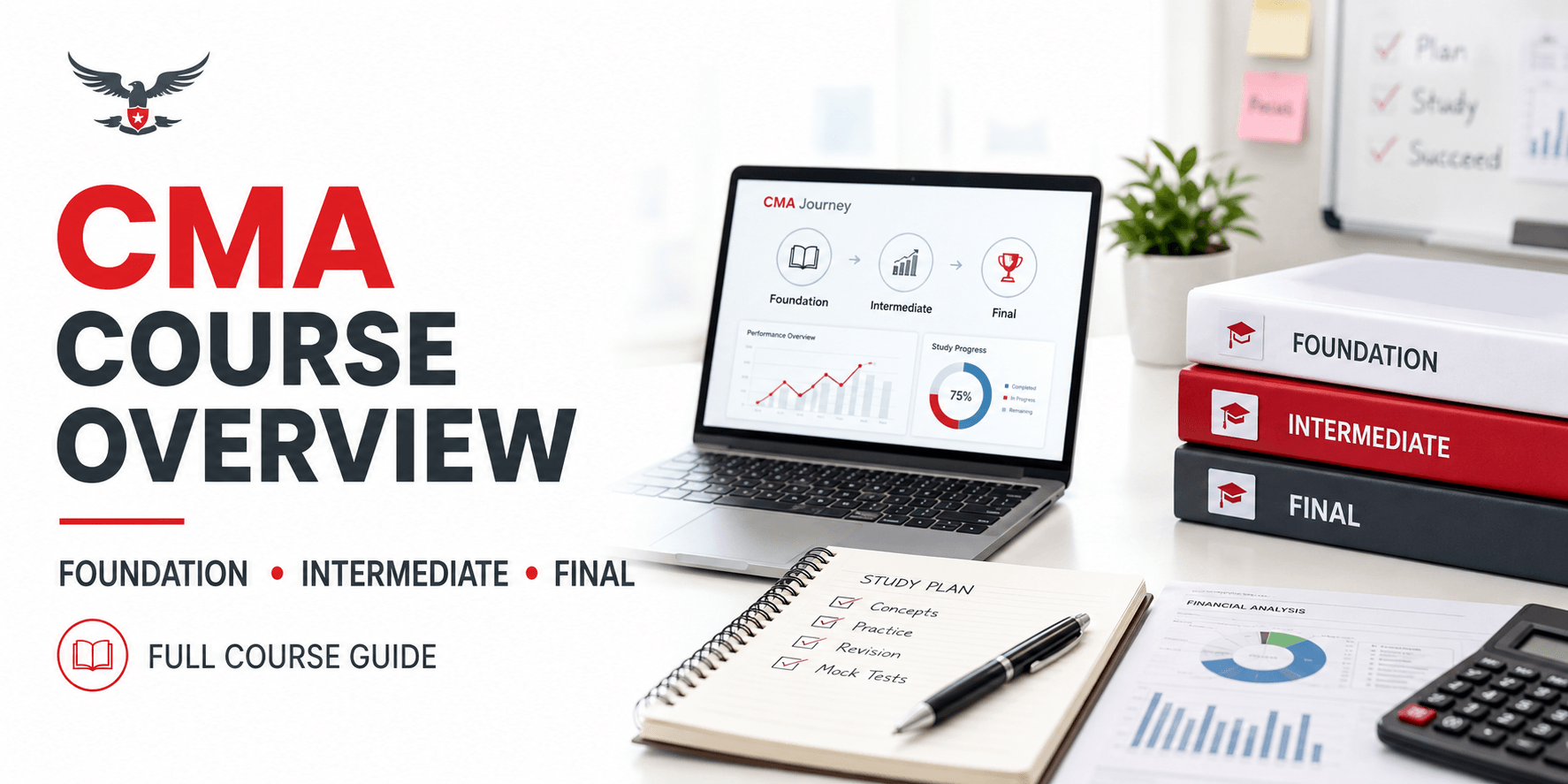
The CMA course is a professional qualification for students seeking careers in cost accounting, financial management, taxation, auditing and business decision-making. Conducted by the Institute of Cost Accountants of India (ICMAI), it has three levels—Foundation, Intermediate and Final—and combines examinations with practical and skills-based training. It explains eligibility, syllabus, fees, duration, preparation and career opportunities after Class 12 or graduation.
CMA Course Overview at a Glance
The CMA India course builds knowledge in accounting, costing, taxation, law, audit, finance and strategic management. Class 12 students usually begin with Foundation, while eligible graduates may enter directly at Intermediate. Each level progresses from basic commercial knowledge to advanced professional application.
CMA Course Levels and Progression
Level | Entry Route | Main Focus | Papers |
| Foundation | After Class 12 or equivalent | Accounting, law, mathematics, economics and management | 4 |
| Intermediate | Foundation pass or eligible direct entry | Costing, taxation, audit, finance and strategy | 8 |
| Final | Completion of Intermediate | Advanced law, tax, reporting, audit and strategic finance | 8 |
Students must also complete the applicable training and membership conditions.
CMA Course Eligibility Criteria
Foundation is mainly for school-level entrants, Intermediate accepts Foundation-qualified students and eligible direct-entry candidates, and Final requires completion of Intermediate. Foundation applicants may register after Class 10, but Class 12 or an accepted equivalent is required for the regular examination route. Intermediate is open to Foundation pass students and eligible graduates or recognised qualification holders, while Final eligibility may also depend on fees and training progress.
CMA Course Syllabus and Subjects
The syllabus combines theory, calculations, law and business application. Foundation introduces commercial fundamentals, Intermediate develops technical expertise, and Final focuses on professional judgement.
CMA Foundation Subjects
Paper | Subject |
| 1 | Fundamentals of Business Laws and Business Communication |
| 2 | Fundamentals of Financial and Cost Accounting |
| 3 | Fundamentals of Business Mathematics and Statistics |
| 4 | Fundamentals of Business Economics and Management |
Intermediate and Final Subjects: Intermediate covers business law, accounting, taxation, costing, operations, strategy, audit, financial management, data analytics and management accounting. Final includes corporate laws, strategic financial management, direct and indirect taxation, strategic cost management, cost and management audit, corporate reporting and one elective.
CMA Exam Pattern and Passing Criteria
CMA examinations may include objective, numerical, descriptive and application-based questions. Foundation emphasises concepts and accuracy, while Intermediate and Final require calculations, legal application and professional presentation. Students generally need at least 40% in each paper and 50% aggregate under the applicable rules.
CMA Course Fees and Total Cost
The total cost includes tuition, examination forms, study resources, coaching, training expenses and repeat attempts. The published figures are ₹6,000 for Foundation, ₹23,100 for Intermediate and ₹25,000 for Final, producing a basic tuition total of ₹54,100 before examination and optional preparation costs.
Estimated CMA Course Cost
Preparation Route | Estimated Total Cost |
| Self-study | ₹65,000–₹90,000 |
| Online coaching | ₹1.20–₹2.20 lakh |
| Classroom coaching | ₹1.80–₹3.50 lakh or more |
Fees Last Verified: The fees were last verified on 19 July 2026. Students should check the latest ICMAI notification because examination fees, concessions and training charges may change.
CMA Course Duration
Duration depends on entry route, attempts, group strategy and training progress. A first-attempt student may need around three to four years after Class 12, while an eligible graduate entering directly at Intermediate may need approximately two-and-a-half to three-and-a-half years. Work, college or repeat attempts may extend it.
Level-Wise Duration
Stage | Planning Period |
| Foundation | 4–8 months |
| Intermediate | 10–18 months |
| Practical and skills training | Runs alongside Intermediate and Final |
| Final | 12–24 months |
| Membership | Depends on qualifying experience |
Practical Training and Skills Requirements
Practical training helps students apply costing, accounting, taxation, finance, audit and compliance knowledge in real organisations. The current structure includes a 15-month practical-training requirement, 120 hours of Intermediate skills training, 80 hours of Final skills training and a 10-day Industry Oriented Training Programme for students covered by the applicable scheme.
How to Become a CMA in India
The Class 12 route is Foundation, Intermediate, practical and skills training, Final and membership. Eligible graduates may begin directly at Intermediate, but they must still complete the remaining examinations, training and experience requirements.
CMA Qualification Roadmap
Complete Class 12 or an eligible graduation.
Register for Foundation or enter Intermediate directly.
Pass Foundation when applicable.
Pass both Intermediate groups.
Complete practical and skills training.
Pass both Final groups.
Meet experience requirements and apply for membership.
How Difficult Is the CMA Course?
CMA is challenging because it combines numerical subjects, law, taxation, audit, strategy and professional writing. Foundation is manageable with strong basics, Intermediate introduces significant technical depth, and Final requires advanced application and judgement. Non-commerce students can succeed with additional accounting preparation.
CMA Preparation Strategy
Foundation students should build concepts and practise accounting, mathematics and objective questions. Intermediate students should balance numerical and theory papers, follow official materials and practise complete answers. Final students should focus on case-based application and professional presentation. Mock tests, previous-year questions and repeated revision improve speed, accuracy and time management.
Recommended Study Resources: Use official ICMAI materials first, then add model papers, previous-year papers, mock tests and reliable question banks that match the current syllabus and examination term.
CMA Career Scope and Salary in India
CMA professionals may work as Cost Accountants, Management Accountants, Financial Analysts, Internal Auditors, Budget Analysts, Tax Professionals, Finance Managers and Controllers. Opportunities exist in manufacturing, banking, insurance, consulting, technology, healthcare, retail, energy and public-sector organisations. A broad fresher planning range is around ₹4–₹7 lakh annually, with higher earnings depending on role, location, industry and skills.
CMA vs CA, CS and MBA Finance
Course | Primary Focus | Best Suited For |
| CMA | Costing, management accounting and corporate finance | Cost control and business finance |
| CA | Audit, taxation, accounting and assurance | Audit, tax and reporting |
| CS | Corporate law, governance and compliance | Law and company administration |
| MBA Finance | Broad management with finance specialisation | Managerial and leadership roles |
Advantages and Challenges of the CMA Course
CMA offers specialised knowledge, varied career paths and a moderate official fee, but it also requires long-term study, practical training and disciplined revision. It is most valuable for students whose interests match costing, accounting, finance, taxation and business decision-making.
Conclusion
The CMA course provides a structured route from Foundation to Intermediate and Final for students seeking careers in accounting, costing, finance, taxation, audit and strategy. Class 12 students begin with Foundation, while eligible graduates may enter Intermediate directly. Before registering, students should verify the latest syllabus, fees, examination dates and training rules and choose CMA only when its subjects and career outcomes match their goals.