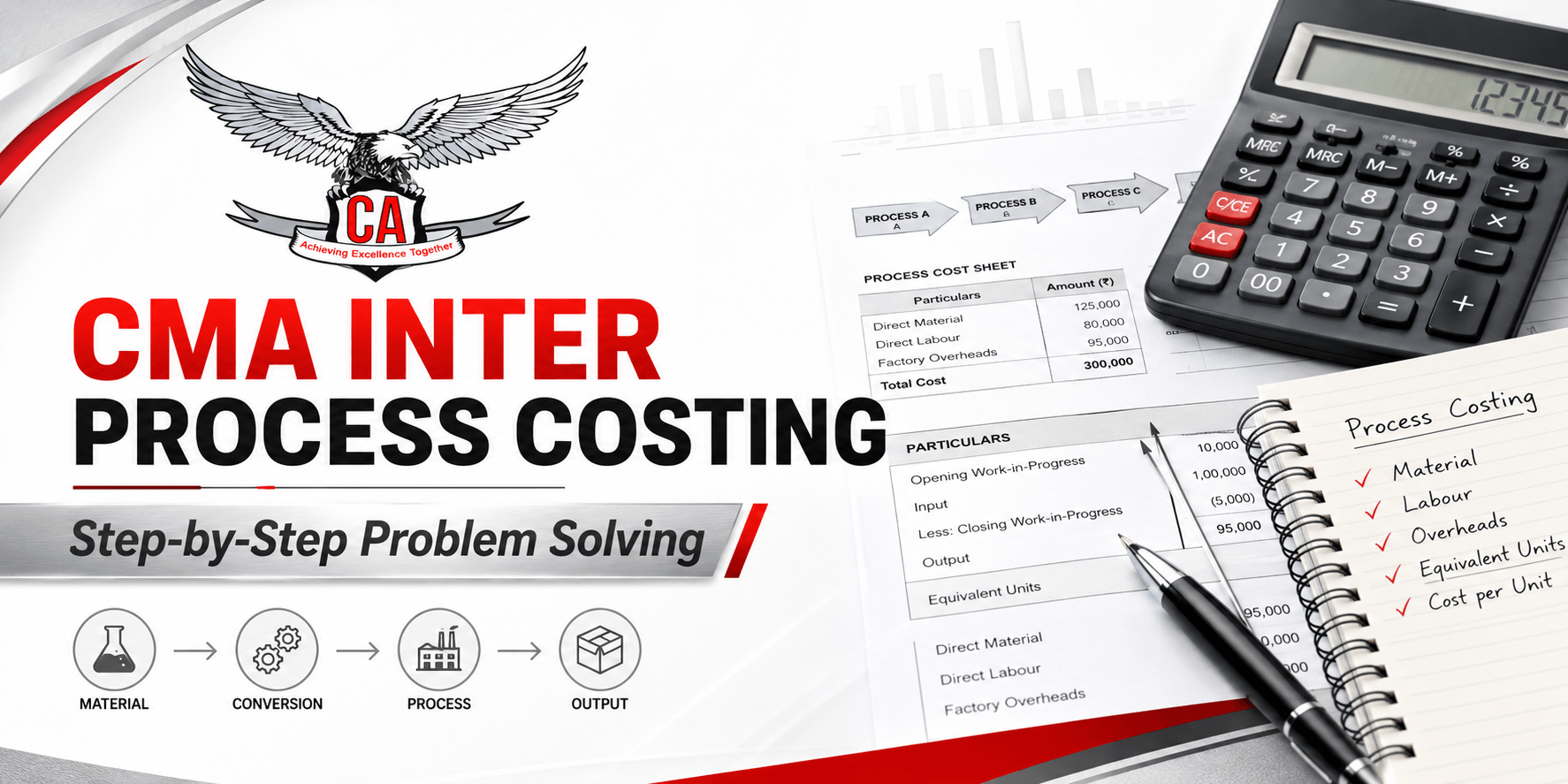
Process Costing is an important topic in CMA Inter Cost Accounting because it combines conceptual understanding with practical calculations. Students often find this chapter difficult because one question may involve normal loss, abnormal loss, abnormal gain, scrap value, work-in-progress, and equivalent production together. However, Process Costing becomes much easier when you follow a fixed sequence instead of trying to prepare the Process Account immediately. This guide explains the main concepts, formulas, solving steps, common mistakes, and preparation strategies you need to handle Process Costing problems confidently in the CMA Inter examination.
What Is Process Costing in CMA Inter Cost Accounting?
Process Costing is a method used to determine the cost of production when identical or similar products are manufactured continuously through one or more stages. Costs relating to materials, labour, and overheads are collected process-wise, and an average cost per unit is calculated. This method is commonly used in continuous production industries where tracing the cost of every individual unit separately is not practical.
Key Features of Process Costing
The main features of Process Costing include continuous production, standardized output, process-wise cost accumulation, average cost calculation, and proper treatment of production losses. The output of one process may also become the input of the next process until the final product is completed.
Process Costing vs Job Costing
Basis | Process Costing | Job Costing |
| Production type | Continuous and repetitive | Customized or order-based |
| Cost collection | Process-wise | Job-wise |
| Output | Homogeneous products | Different products or jobs |
| Cost per unit | Average process cost | Specific cost of each job |
| Suitable for | Mass production | Custom production |
Important Process Costing Terms You Must Know
Before solving Process Costing problems, students should understand terms such as input units, output units, normal loss, abnormal loss, abnormal gain, scrap value, work-in-progress, and equivalent units. Input units represent the quantity introduced into production, while output units represent completed production. Normal loss is expected and unavoidable, abnormal loss exceeds the expected loss, and abnormal gain arises when actual loss is lower than expected.
Basic Process Costing Formulas
The following formulas form the foundation of most basic CMA Inter Process Costing problems and should be understood rather than memorised in isolation.
| Calculation | Formula |
| Normal Loss | Input Units × Normal Loss % |
| Expected Output | Input Units − Normal Loss |
| Abnormal Loss | Expected Output − Actual Output |
| Abnormal Gain | Actual Output − Expected Output |
| Net Process Cost | Total Process Cost − Scrap Value of Normal Loss |
| Cost per Good Unit | Net Process Cost ÷ Expected Good Output |
| Equivalent Units | Incomplete Units × Percentage of Completion |
How to Solve Process Costing Problems Step by Step
A reliable Process Costing approach is to identify all units and costs first, calculate expected production, determine whether abnormal loss or gain exists, calculate the cost per unit, and only then prepare the required accounts. Following this sequence reduces calculation errors and keeps the answer properly organised.
Step 1: Identify the Given Information: Start by identifying input units, material cost, labour cost, overheads, normal loss percentage, scrap value, actual output, and work-in-progress information. Separating these details before calculating anything prevents confusion later in the question.
Step 2: Calculate Normal Loss and Expected Output: Calculate normal loss using the percentage or quantity given in the question and deduct it from the total input units. The remaining units represent expected good output and provide the benchmark for determining abnormal loss or abnormal gain.
Step 3: Identify Abnormal Loss or Abnormal Gain: Compare actual output with expected output. If actual output is lower, the difference is abnormal loss; if actual output is higher, the difference is abnormal gain. These items are treated separately because they do not represent normal production performance.
Step 4: Calculate Net Process Cost and Cost Per Unit: Deduct the scrap value of normal loss from the total process cost to calculate net process cost. Divide this amount by expected good output to determine the cost per unit, which is generally used to value good output and abnormal loss or gain.
Step 5: Prepare the Process Account: Record input units and production costs on the debit side of the Process Account and show normal loss, abnormal loss, completed output, or transferred output on the credit side. Abnormal gain is generally shown on the debit side, and the account should balance in both units and value.
Treatment of Normal Loss, Abnormal Loss, and Abnormal Gain
Item | Meaning | General Treatment |
| Normal Loss | Expected production loss | Credited at scrap value |
| Abnormal Loss | Actual loss exceeds normal loss | Valued at process cost and transferred separately |
| Abnormal Gain | Actual loss is lower than normal loss | Recorded separately as a favourable difference |
How to Solve Equivalent Production Problems
Equivalent production is required when some production remains incomplete at the end of the accounting period. Partially completed units are converted into equivalent fully completed units based on their percentage of completion. Separate calculations may be required for materials, labour, and overheads because each cost element can have a different stage of completion.
FIFO Method in Equivalent Production
Under the FIFO method, opening work-in-progress is treated separately and only the work completed during the current period is included in current equivalent production. This method separates previous-period costs from current-period performance and therefore requires more detailed calculations.
Weighted Average Method
Under the weighted average method, opening work-in-progress costs are combined with current-period costs to calculate an average cost per equivalent unit. This method is simpler because it does not separately distinguish the work completed in different accounting periods.
Common Mistakes Students Make in CMA Inter Process Costing
Students frequently lose marks by treating normal loss as abnormal loss, ignoring scrap value, using actual output instead of expected output for cost calculations, applying the wrong percentage of completion, or placing entries on the wrong side of the Process Account. Another common mistake is skipping working notes, which makes the answer difficult to check and increases the risk of carrying one error through the entire problem.
Process Costing Working Notes You Should Prepare
Clear working notes should normally include a Statement of Units, normal loss calculation, expected output calculation, abnormal loss or gain calculation, cost per unit working, equivalent production statement, and cost allocation statement where applicable. These workings make complicated questions easier to solve and allow students to identify mistakes before preparing the final account.
How to Present Process Costing Answers in the CMA Inter Exam
Students should present Process Costing answers in a logical order by showing formulas, calculations, and working notes before the final account. Use proper debit-and-credit formats, label each working clearly, maintain unit reconciliation, and highlight the final answer. Good presentation is especially important in numerical papers because even when the final figure is incorrect, a correct method and clear workings may still demonstrate proper understanding.
Process Costing Preparation Strategy for CMA Inter Cost Accounting
Start with basic Process Accounts and become comfortable with normal loss before moving to abnormal loss and abnormal gain. Once these concepts are clear, begin equivalent production, work-in-progress valuation, FIFO, and weighted average problems. Students should then solve chapter-wise questions, practise previous examination problems, and attempt timed mock tests to improve both speed and accuracy.
Process Costing Practice Plan
Practice Level | Topics to Cover | Main Objective |
| Beginner | Basic Process Accounts, normal loss, scrap value | Build conceptual clarity |
| Intermediate | Abnormal loss, abnormal gain, multiple processes | Improve calculation accuracy |
| Advanced | Equivalent production, WIP, FIFO, weighted average | Handle complex problems |
| Exam Level | Mixed problems under time limits | Improve speed and presentation |
Process Costing Revision Checklist
Before completing your revision, make sure you can independently prepare a Process Account, calculate normal loss, abnormal loss and abnormal gain, treat scrap value correctly, determine cost per unit, calculate equivalent production, apply FIFO and weighted average methods, value work-in-progress, and prepare clear working notes. Any topic that still requires constant reference to notes should be practised again before attempting full mock tests.
How CA Test Series Can Help You Improve Process Costing
CA Test Series can help students strengthen CMA Inter Cost Accounting through chapter-wise practice, exam-style mock tests, answer evaluation, and detailed performance feedback. Students can use CMA Inter Test Series, CMA Inter Mock Test Papers, CMA Inter Question Papers, CMA Inter Study Material, and Chapter-Wise Cost Accounting Tests to identify weak areas, improve numerical accuracy, and develop better answer presentation under examination conditions.
Chapter-Wise Practice and Mock Tests
Chapter-wise tests allow students to focus separately on normal loss, abnormal loss, abnormal gain, equivalent production, and work-in-progress before attempting combined questions. Full mock tests then help students practise these concepts under realistic exam conditions and improve time management.
Expert Answer Evaluation and Performance Feedback
Answer evaluation helps identify calculation mistakes, missing working notes, incorrect account treatment, and presentation issues that students may not notice during self-study. Performance feedback can then be used to focus revision on weak topics rather than repeatedly practising concepts that are already strong.
Conclusion
Process Costing becomes manageable when students understand the logic behind each calculation and follow a consistent problem-solving sequence. Begin with unit reconciliation, calculate normal loss and expected output, identify abnormal differences, determine the correct cost per unit, and prepare the required accounts with clear working notes. Regular chapter-wise practice, previous examination questions, and evaluated mock tests can help turn Process Costing into a strong scoring area in CMA Inter Cost Accounting.