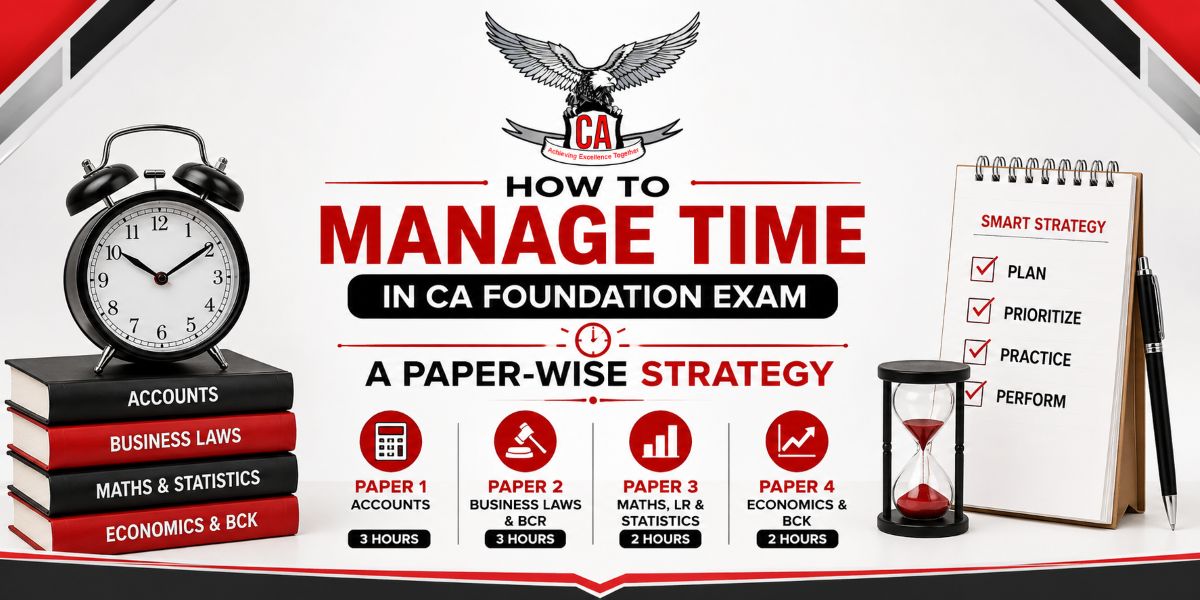
How to Manage Time in CA Foundation Exam: A Paper-Wise Strategy
How to Manage Time in CA Foundation Exam: A Paper-Wise Strategy
You have studied for months. You know your concepts. But inside the exam hall, when the clock starts running, many students realize they have no plan for how to use those three hours. Questions pile up, easy marks get left behind, and panic sets in during the last 30 minutes.
Time management in the CA Foundation exam is a separate skill from subject knowledge. You can know your material well and still underperform if you do not know how to move through the paper strategically. This guide breaks it down paper by paper, with specific timing benchmarks and practical techniques you can rehearse before exam day.
Why Time Management Differs Across CA Foundation Papers
The CA Foundation has four papers, and each one demands a completely different approach to time. Paper 1 (Principles and Practice of Accounting) is numerical and requires working, not just answers. Paper 2 (Business Laws and Business Correspondence) mixes law theory with writing skills. Paper 3 (Business Mathematics, Logical Reasoning, and Statistics) is MCQ-based and benefits from speed. Paper 4 (Business Economics and Business and Commercial Knowledge) is also objective but tests conceptual understanding more than calculation.
Treating all four papers with the same timing approach is one of the most common mistakes students make. A strategy that works for Paper 3 will fail you in Paper 1.
Exam Format at a Glance
Paper | Subject | Format | Marks | Duration |
|---|---|---|---|---|
| Paper 1 | Principles & Practice of Accounting | Descriptive + Practical | 100 | 3 Hours |
| Paper 2A | Business Laws | Descriptive | 60 | 3 Hours (combined) |
| Paper 2B | Business Correspondence & Reporting | Descriptive | 40 | 3 Hours (combined) |
| Paper 3A | Business Mathematics & Logical Reasoning | MCQ | 60 | 2 Hours (combined) |
| Paper 3B | Statistics | MCQ | 40 | 2 Hours (combined) |
| Paper 4A | Business Economics | MCQ | 60 | 2 Hours (combined) |
| Paper 4B | Business and Commercial Knowledge | MCQ | 40 | 2 Hours (combined) |
Paper 1: Accounts – Where Every Minute Counts
Paper 1 is the most time-intensive paper in the CA Foundation. It is entirely practical, and every question requires you to show your workings. Students who do not plan their time here either rush through complex problems or spend too long on one question and run out of time for the rest.
Recommended Time Allocation
Use the first 5–7 minutes to read through the entire paper before writing anything. This gives you a sense of where the easy marks are and lets you decide your attempt order. The paper carries 100 marks in 180 minutes, which gives you roughly 1.8 minutes per mark as your baseline.
- Questions worth 12–16 marks: allocate 20–25 minutes each
- Questions worth 8–10 marks: allocate 12–16 minutes each
- Questions worth 4–6 marks: allocate 6–9 minutes each
- Reserve 10–12 minutes at the end for review and checking carried figures
Strategy for Numerical Questions
Always attempt the question you are most confident about first. Do not attempt questions in serial order unless your confidence level is uniform. If you get stuck mid-calculation on a complex ledger or balance sheet problem, mark it, move on, and return to it after completing other questions. Partial marks are available in accounts—write what you know even if you cannot complete the full working.
Common Time Traps in Paper 1
- Spending more than 25 minutes on a single 12-mark question
- Rewriting a ledger from scratch after a minor error instead of striking through and continuing
- Not allocating time to presentation—neat columnar formats are faster to complete and easier for examiners to mark
Paper 2: Business Laws and Business Correspondence
Paper 2 is a combined paper with 60 marks for Business Laws and 40 marks for Business Correspondence and Reporting (BCR). The total duration is 3 hours. Most students make the mistake of spending too long on Law and running short of time for BCR, which is comparatively easier to score in.
Time Split: Law vs BCR
A practical split is 100 minutes for Business Laws and 70 minutes for BCR, with 10 minutes reserved at the start for reading and at the end for a quick review. BCR offers structured formats (letters, emails, reports, precis) where format knowledge translates directly to marks—you can score well here without deep analysis if you know the structure.
Answering Law Questions Efficiently
Law answers follow a predictable pattern: Issue, Applicable Provision, Application to Facts, Conclusion. Students who write in this format consistently write faster and score better than those who write in unstructured paragraphs. Decide on a format during your preparation phase, not during the exam. If a question asks for provisions under the Indian Contract Act or the Sale of Goods Act, lead with the relevant section number if you remember it—this signals precision to the examiner without requiring long explanations.
BCR: Do Not Leave This for the Last 30 Minutes
BCR writing requires calm thinking. A formal business letter, a report format, or a precis written in a panic will cost you marks on presentation and accuracy. Attempt at least one BCR question before the Law section if you find BCR easier—this warms up your writing and ensures you approach it with a clear mind.
Paper 3: Business Mathematics, Logical Reasoning, and Statistics
Paper 3 is fully MCQ-based and runs for 2 hours. It covers Business Mathematics and Logical Reasoning (60 marks) and Statistics (40 marks). Unlike the descriptive papers, there is no partial marking—every question is right or wrong.
The 80-Question Challenge
With 80 questions in 120 minutes, you have exactly 90 seconds per question on average. In practice, mathematics questions take longer than logical reasoning or statistics. A realistic split is: attempt all straightforward questions in the first 70 minutes, flag uncertain questions, and use the remaining 50 minutes to work through the flagged ones and check answers.
Mathematics: Calculation Accuracy vs Speed
Business mathematics questions—time and work, permutations, compound interest, matrices—require careful calculation. Rushing through these and making arithmetic errors is worse than taking an extra minute to verify. For questions involving long calculations, use the elimination method when two answer options are clearly off, then calculate between the remaining two. This saves time and reduces errors.
Statistics: Priorities Formulaic Questions
Statistics questions with clear formula applications (mean, standard deviation, correlation, regression) should be attempted first. These have definite answers and are quick to solve if you know the formula. Probability and index number questions can be more time-consuming—save these for the second round.
Paper 3 Quick Timing Guide
- Logical reasoning questions: target 60–70 seconds each
- Direct formula-based statistics: target 90 seconds each
- Complex mathematics (matrices, calculus): target 2–3 minutes each
- Flag and return strategy: flag anything taking beyond 2.5 minutes
Paper 4: Business Economics and Business and Commercial Knowledge
Paper 4 is also MCQ-based (2 hours, 100 questions) and tests conceptual understanding of economics and general business awareness. Unlike Paper 3, there are very few calculations. The challenge here is not speed but conceptual clarity and the ability to eliminate wrong options.
Economics: Eliminate First, Select Second
Economics MCQs often have two convincing options. Read the question carefully to identify whether it is asking for a definition, an effect, a cause, or a policy implication—these require different types of recall. Always eliminate the clearly wrong options first. If two options seem equally valid, re-read the question stem; the qualifier (always, never, most likely, typically) usually distinguishes the correct answer.
BCK: Speed Through Current Affairs and Commerce Basics
Business and Commercial Knowledge tests awareness of commerce fundamentals, banking, financial institutions, and business environment. These questions tend to be straightforward if your preparation is solid. Do not spend more than 45 seconds on any BCK question—if you do not know it immediately, mark and move on. These are not calculation problems where extra time yields a different answer.
Exam-Day Time Management: Practical Rules to Follow
The First 5 Minutes
Before writing a single word, read through the question paper. In descriptive papers, identify which questions you will attempt first. In MCQ papers, skim to get a sense of difficulty distribution. This brief scan significantly reduces mid-paper anxiety.
Set Internal Time Checkpoints
For a 3-hour paper, mentally set checkpoints: at 60 minutes, 120 minutes, and 150 minutes. At each checkpoint, assess how many marks you have secured and how many remain. This prevents the common experience of reaching the last 20 minutes with half the paper still unattempted.
Never Get Stuck in One Place
The single most damaging time management behaviour in any exam is refusing to move on from a difficult question. Every minute you spend on a question you cannot solve is a minute taken from a question you can. In descriptive papers, write partial answers and return. In MCQ papers, flag and skip. There are no bonus marks for persistence on a single question.
Practicing Under Timed Conditions
Reading these strategies is useful, but the only way to internalize them is through timed mock tests before exam day. Solve full-length mock papers under exam conditions at least 4–6 times before the actual exam. After each mock test, review your time log: which sections ran long, where you got stuck, and how far off your benchmarks you were. This analysis is more valuable than the score itself.
Platforms like CATestSeries.org provide paper-specific mock tests with detailed performance analytics, allowing you to track your timing patterns by section and question type across multiple attempts—exactly the kind of feedback that makes the difference between knowing a strategy and being able to execute it under pressure.
Frequently Asked Questions
How should I divide time in the CA Foundation Paper 1 exam?
Spend the first 5 minutes reading the paper. Then allocate time by marks: roughly 1.8 minutes per mark. For 12–16 mark questions, budget 20–25 minutes. Keep 10–12 minutes at the end to review calculations and check carried figures.
What is the best strategy for MCQ-based papers (Paper 3 and Paper 4)?
Attempt all questions you are confident about first. Flag uncertain ones and return in the second round. Set a maximum of 90 seconds per question in Paper 3 (due to calculations) and 60 seconds in Paper 4 (concept-based). Do not spend more than 3 minutes on any single question.
How do I manage time in Paper 2 between Law and BCR?
A practical split is 100 minutes for Business Laws and 70 minutes for BCR, with 10 minutes for initial reading. Do not leave BCR entirely for the end—attempt at least one BCR question early so you approach it without time pressure.
Should I attempt questions in serial order in CA Foundation exams?
Not necessarily. In descriptive papers, attempt the questions you are most confident about first to secure those marks early. In MCQ papers, skip difficult questions on the first pass and return to them in the second round.
How many mock tests should I take to improve exam time management?
Aim for at least 4–6 full-length timed mock tests per paper before your actual exam. The goal is not just to test knowledge but to build the muscle memory of pacing. After each test, review your time log by section to identify where you consistently over- or under-spend.
What should I do if I am running out of time in the exam?
In a descriptive paper, write the most important points of your remaining answers—partial marks are available and a structured outline with key points scores better than a blank page. In MCQ papers, mark an answer for every remaining question in the last 2 minutes—there is no negative marking in CA Foundation, so blank answers cost you more than guesses.