How CA Foundation Mock Test Papers (MTPs) Are Different from RTPs
How CA Foundation Mock Test Papers (MTPs) Are Different from RTPs
Most CA Foundation students know that ICAI releases both MTPs and RTPs before each exam attempt. Most also know, vaguely, that both are useful for preparation. But when it comes to how they are actually different—in purpose, structure, and how you should use each one—a surprising number of students are unclear.
That confusion leads to a predictable outcome: students either treat MTPs and RTPs as interchangeable and use only one of them, or they use both without understanding what each is designed to do. Either way, they leave preparation value on the table. This article clarifies exactly what separates these two resources and how to get the most out of both.
The Core Difference: Purpose
The fundamental distinction between a Mock Test Paper and a Revision Test Paper is the purpose each one was designed to serve.
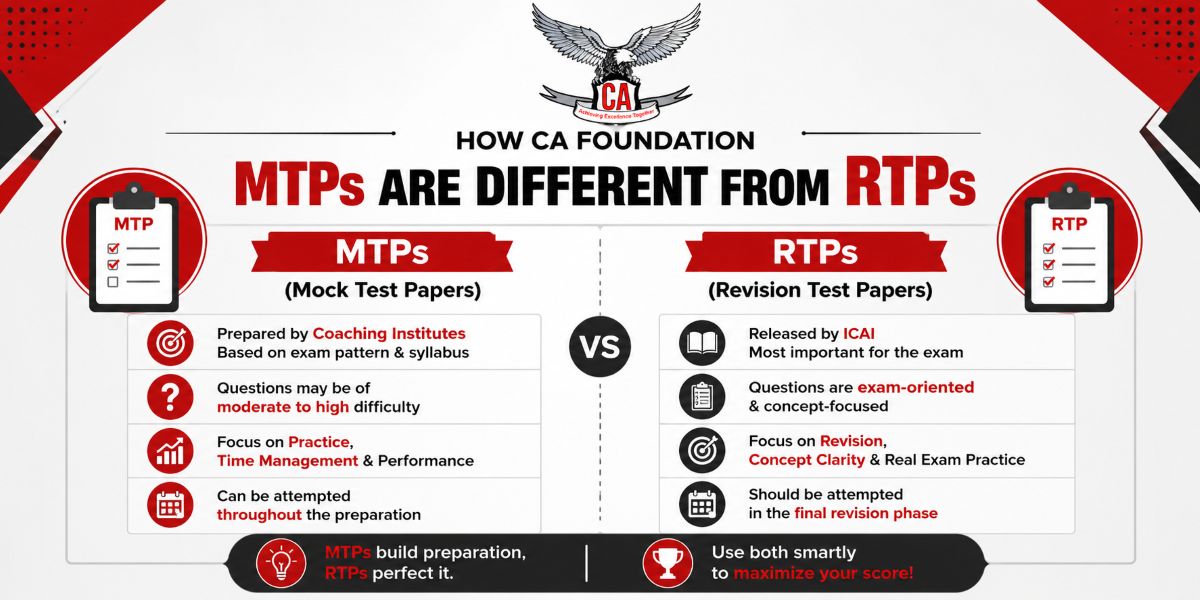
An MTP is a simulated exam. ICAI designs it to replicate the actual CA Foundation exam experience as closely as possible—the format, the marks distribution, the time pressure, and the question types. When you sit an MTP, you are rehearsing the exam itself. The MTP’s primary job is to put you under exam conditions so you can measure your performance, identify weaknesses under pressure, and build the mental stamina required for a three-hour paper.
An RTP is a revision guide. ICAI designs it to help you align your subject knowledge with the current exam attempt’s syllabus and expectations. It contains questions and—crucially—suggested answers prepared by the Board of Studies. The RTP’s primary job is to show you what ICAI considers a complete and correct response to a question of a given type. It teaches you what to write and how to write it, not just whether you know the answer.
Both resources come from the same source. Both are authoritative. But they ask different things of you and should be used at different stages and in different ways.
Structure: What Each Resource Actually Contains
What an MTP Contains
ICAI typically releases two MTPs per exam attempt—MTP 1 and MTP 2. Each MTP contains a complete question paper for each of the four CA Foundation papers, formatted exactly as it would appear in the actual exam.
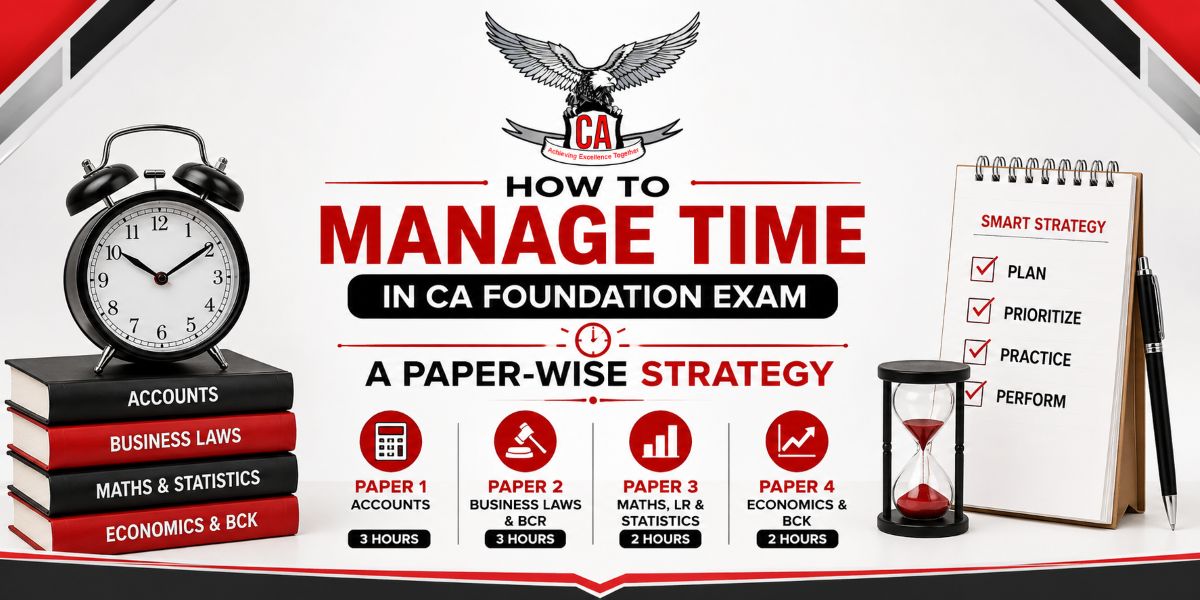
- Paper 1 (Accounts): full descriptive and practical paper, 100 marks, 3 hours
- Paper 2 (Business Laws and BCR): combined descriptive paper, 100 marks, 3 hours
- Paper 3 (Business Mathematics, LR and Statistics): full MCQ paper, 100 marks, 2 hours
- Paper 4 (Business Economics and BCK): full MCQ paper, 100 marks, 2 hours
MTPs include answer keys and suggested solutions, but these are meant to be consulted after you have attempted the paper in full, under timed conditions. The solution is the debrief, not the starting point.
What an RTP Contains
The RTP also covers all four papers, but it is not structured as an exam paper. It is structured as a topic-wise question-and-answer set. Questions are grouped by subject area and are accompanied by detailed suggested answers written by ICAI’s Board of Studies.
- Topic-wise questions rather than a randomised exam paper
- Suggested answers with full working, format, and explanation
- Reflects any syllabus amendments relevant to the upcoming attempt
- Covers the expected question types and difficulty levels for that specific attempt
The RTP does not ask you to sit under exam conditions. It asks you to study the questions and answers together, understand what a correct response looks like, and use that understanding to calibrate your own preparation.
MTP vs RTP: Side-by-Side Comparison
Feature | MTP (Mock Test Paper) | RTP (Revision Test Paper) |
|---|---|---|
| Primary Purpose | Simulate the actual exam | Revise and calibrate preparation |
| Format | Full exam paper (marks + time) | Topic-wise questions with answers |
| Suggested Answers | Consulted after full attempt | Integral to the resource; study alongside questions |
| Number Released | 2 per attempt (MTP 1 & MTP 2) | 1 per attempt |
| Best Used | 6–8 weeks before exam | 4–6 weeks before exam |
| Key Benefit | Identifies performance gaps under pressure | Shows ICAI’s expected answer quality and format |
| Covers Amendments? | Yes | Yes |
| Available From | ICAI website (free) | ICAI website (free) |
When to Use Each Resource
Start with MTPs: Six to Eight Weeks Before the Exam
MTPs work best when your preparation has enough substance behind it to make the simulation meaningful. If you attempt an MTP in the very early stages of studying, before you have covered the syllabus adequately, the low score tells you only that you have not studied enough—which you already know. That is not useful diagnostic information.
The ideal window is six to eight weeks before your exam. By this point, you should have covered the full syllabus at least once and done enough practice to form a baseline. When you sit MTP 1 in this window, the result tells you something specific: which topics you understand well enough to perform under timed conditions and which ones break down when the clock is running.
Use MTP 2 a few weeks later, after you have addressed the gaps that MTP 1 revealed. Comparing your performance across the two MTPs gives you a clear measure of how much your preparation has actually improved.
Move to the RTP: Four to Six Weeks Before the Exam
After completing at least one MTP and addressing the gaps it exposed, shift to the RTP. At this stage, you have a clearer picture of your weak areas, and the RTP helps you close them with ICAI-quality answers as your benchmark.
Work through the RTP topic by topic. Attempt the questions first, then compare your answers against the suggested solutions. For descriptive papers, pay attention not just to whether your answer is correct but to how ICAI structures the response—the level of detail, the format, the language. For MCQ papers, read the explanation for every question you got wrong and every question you answered by elimination rather than knowledge.
The Final Week: Revisit Both
In the last week before the exam, do a rapid re-read of the RTP—questions and answers together—without attempting to solve from scratch. This reinforces key concepts and formats. Also review your MTP performance notes to remind yourself of the specific patterns you identified earlier. Do not attempt a full MTP in this window; the goal is consolidation, not fresh diagnosis.
Common Mistakes Students Make with MTPs and RTPs
Using the RTP as a Mock Test
Some students attempt RTP questions under timed conditions as if it were an exam paper. This misses the point. The RTP’s value is in the suggested answers—if you are not studying those answers carefully and comparing them against your own, you are ignoring the most useful part of the resource.
Reading MTP Solutions Without Attempting the Paper
The inverse problem: treating the MTP as a study resource by reading questions and solutions together without sitting the paper under timed conditions. This removes the diagnostic value entirely. An MTP only tells you something useful about your exam readiness if you have experienced the time pressure first.
Skipping One and Relying on the Other
MTPs and RTPs address different preparation needs. Skipping the MTP means you arrive at the exam without having rehearsed the experience of working through a full paper under time pressure. Skipping the RTP means you have not benchmarked your answers against ICAI’s expected standard. Both gaps show up in results.
Leaving Both for the Final Two Weeks
Students who attempt MTPs and go through the RTP only in the last two weeks before the exam do not have enough time to act on what they find. The value of both resources is in the preparation adjustments they enable—and those adjustments require time to implement.
How to Combine MTPs, RTPs, and Full-Length Mock Tests
ICAI’s MTPs and RTPs are official resources and should be the backbone of your exam-phase preparation. But they have a natural limitation: there are only two MTPs and one RTP per attempt. Once you have used them, you need additional timed practice to keep building your exam readiness.
This is where full-length mock tests from platforms like CATestSeries.org add value. They provide additional simulated exam papers modelled on ICAI’s current pattern, allowing you to continue building timed practice beyond the two official MTPs. Using a combination of ICAI’s MTPs (for official benchmarking), the RTP (for format and quality calibration), and platform-based mock tests (for volume and variety) gives you a more complete preparation system than any single resource alone.
Frequently Asked Questions
How many MTPs does ICAI release per CA Foundation attempt?
ICAI releases two MTPs per exam attempt—MTP 1 and MTP 2. Each covers all four papers in the CA Foundation syllabus and follows the same format as the actual exam.
Is the MTP harder or easier than the actual CA Foundation exam?
MTPs are designed to match the actual exam’s difficulty and format as closely as possible. Some students find one or the other slightly more challenging, but the intent is parity. Treat MTP performance as a reasonably accurate indicator of where you stand relative to the actual exam.
Should I attempt both MTPs and the RTP for every paper?
Yes, for all four papers. Each resource reveals something different about your preparation. MTPs show you how you perform under pressure. The RTP shows you how your answers compare to ICAI’s expected standard. Both pieces of information are useful for every paper.
Can I use past MTPs and RTPs for preparation, or only the current attempt’s?
Both are useful. The current attempt’s MTP and RTP reflect any recent syllabus changes and the most current exam pattern, so they are your primary resources. Past MTPs and RTPs are valuable for additional practice and for identifying which topics recur consistently across attempts—a strong signal of examiner priority.
What should I do after I finish an MTP and score poorly?
A low MTP score is diagnostic information, not a final result. Identify specifically which topics and question types pulled your score down. Go back to those areas in your Study Material or Practice Manual, revise them, and test yourself again with MTP 2 or a platform-based mock test a couple of weeks later. The comparison between your two attempts will show you whether the revision actually worked.
Is there negative marking in CA Foundation MTPs?
No. There is no negative marking in CA Foundation, and this applies to MTPs as well. In MCQ-based papers (Paper 3 and Paper 4), you should attempt every question. In your MTP practice, make a habit of answering every MCQ question even when uncertain—this builds the instinct you need for the actual exam.