CA Foundation RTP: What It Is, How to Use It, and When to Start
CA Foundation RTP: What It Is, How to Use It, and When to Start
Every CA Foundation student has heard the word “RTP” at some point. Some treat it as just another study resource to download and skim through once before the exam. Others swear by it as one of the most reliable predictors of what will actually appear in the paper. The difference between these two groups usually shows up in their results.
This article explains what the CA Foundation RTP actually is, why ICAI publishes it, how to integrate it into your preparation, and—critically—when to start using it so you extract maximum value from it.
What Is the CA Foundation RTP?
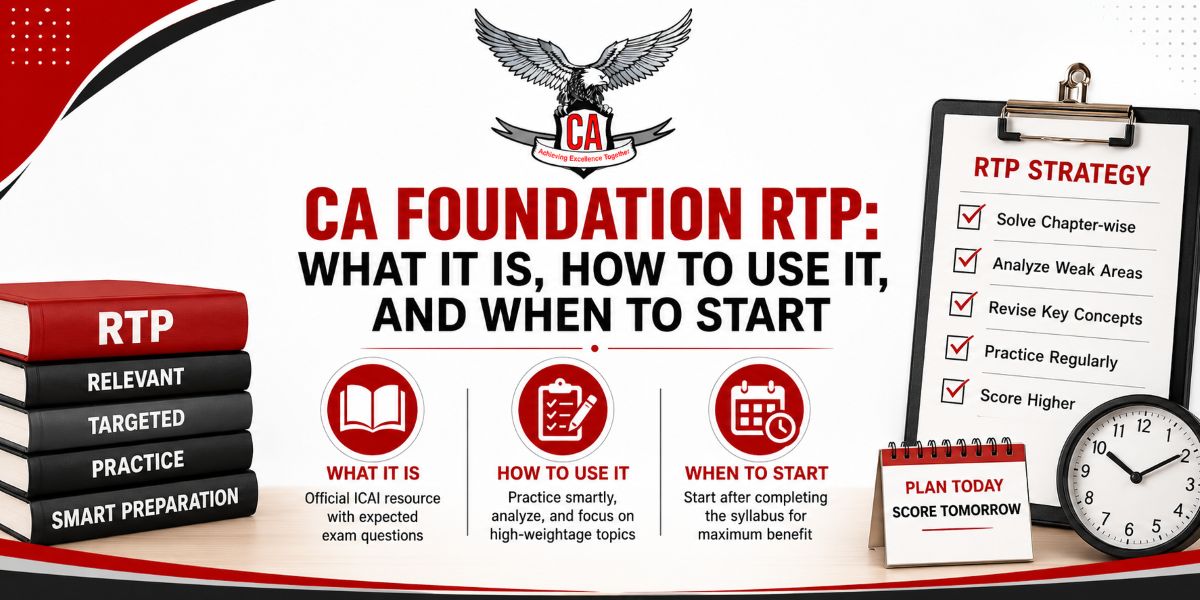
RTP stands for Revision Test Paper. It is an official study document released by the Institute of Chartered Accountants of India (ICAI) before every CA Foundation examination attempt. ICAI publishes a separate RTP for the May attempt and the November attempt, and it is available for free download from the ICAI website.
The RTP is not a mock test in the traditional sense. It is a structured revision tool that contains two distinct components: a set of questions compiled by ICAI specifically for that exam attempt, and suggested answers to those questions prepared by the Board of Studies. Both parts are equally important.
What Does the RTP Contain?
- A full set of practice questions for each paper in the CA Foundation syllabus
- Suggested answers and model solutions prepared by ICAI
- Questions that reflect the current syllabus and the pattern expected in the upcoming exam
- For Paper 1 and Paper 2: descriptive questions and practical problems
- For Paper 3 and Paper 4: MCQ-style questions with explanations
The RTP is paper-specific and syllabus-specific. If there has been any amendment to the syllabus or study material before a particular attempt, the RTP will reflect those changes. This makes it one of the most current and authoritative resources available to students preparing for a specific exam window.
Why the RTP Matters More Than Most Students Realise
Students often underweight the RTP because it is free and does not come packaged as a premium product. That perception is a mistake. The RTP is authored by the same body that sets the actual exam. It is not a third-party estimate of what might appear—it is ICAI’s own indication of the question types, difficulty levels, and topic emphasis relevant to that attempt.
The RTP as an Examiner’s Signal
When ICAI includes a particular topic or question format in the RTP, it is signalling that this area is active in the current syllabus and relevant to the upcoming exam. Historically, a significant proportion of CA Foundation exam questions either directly resemble RTP questions or test the same concepts with minor variation in numbers or context.
This does not mean the RTP is a leaked paper. It means that students who understand the RTP deeply—not just the answers, but the reasoning and concepts behind them—are better calibrated to the examiner’s expectations than those who rely only on textbooks and coaching notes.
RTP vs Study Material vs Practice Manual
ICAI publishes three major resources: the Study Material (SM), the Practice Manual (PM), and the RTP. They serve different purposes and should not be treated as substitutes for each other.
- Study Material: the foundational reference text. Use it for learning concepts and building theory.
- Practice Manual: an extended question bank for each paper. Use it during active preparation to build topic-wise depth.
- RTP: a revision and calibration tool. Use it in the final weeks to align your preparation with the current exam pattern and fill remaining gaps.
Students who skip the Study Material and only do RTPs from previous attempts will have gaps in fundamental understanding. Students who cover the Study Material and Practice Manual but ignore the RTP miss the final alignment step. All three resources have a specific role.
When to Start Using the CA Foundation RTP
Timing matters significantly with the RTP. Using it too early, before you have built adequate subject knowledge, is largely a waste because you will not have the framework to understand the suggested answers properly. Using it too late, in the final two or three days, does not give you enough time to internalise what you find.
The Optimal Window: Four to Six Weeks Before the Exam
The most effective time to begin working through the RTP is four to six weeks before your exam date. At this stage, you should have completed at least one full revision of all four papers. Your conceptual base is in place, and you are transitioning from learning to applying.
Starting at this point gives you enough time to work through the RTP questions seriously, compare your answers against the suggested solutions, identify the gaps those comparisons reveal, and revisit those areas in your notes or Study Material before the exam.
A Practical Week-by-Week Integration
Week 1 of RTP Use (5–6 Weeks Before Exam)
Attempt Paper 1 and Paper 2 RTP questions under timed conditions without referring to the suggested answers. Treat this as a diagnostic exercise. The goal is not to score well—it is to identify which topics, question types, and formats you are struggling with.
Week 2 of RTP Use
Review your Paper 1 and Paper 2 answers against ICAI’s suggested solutions. Pay close attention to the format and structure of the model answers, not just the content. For accounts problems, look at how ICAI presents workings, formats ledgers, and structures balance sheets. For law answers, study the language and sequencing of the model responses.
Week 3–4 of RTP Use
Complete Paper 3 and Paper 4 RTP questions. For the MCQ papers, do not just verify correct answers—read the explanations for every question you got wrong and, importantly, for questions you answered correctly by elimination or guesswork. Understanding why an answer is correct is as valuable as knowing what the correct answer is.
Final Week Before Exam
Do a rapid re-read of the full RTP—questions and suggested answers together—for all four papers. Do not attempt to solve again; read to recall and reinforce. Flag any areas that still feel uncertain and give those one final revision pass from your notes.
How to Use the RTP Effectively
Attempt Before Reading the Answers
The most common misuse of the RTP is reading the questions and then immediately reading the suggested answers. This gives the illusion of preparation without any real learning. Always attempt the question first—even if your answer is incomplete—before looking at the solution. The gap between what you wrote and what ICAI wrote is exactly where your preparation needs work.
Treat the Suggested Answers as a Format Guide
For descriptive papers, ICAI’s suggested answers are not just about content—they demonstrate expected answer length, structure, and the level of detail the examiner considers adequate. A two-mark law question does not require three paragraphs. A 12-mark accounts problem has a specific presentation format. The RTP teaches you these expectations directly.
Use Previous RTPs for Pattern Analysis
The current RTP is the primary resource, but previous RTPs are also valuable for identifying recurring topics and question patterns across attempts. If a particular concept—say, provisions related to the Indian Contract Act, or a specific type of ratio analysis—appears in multiple RTPs, it is a topic ICAI considers central to the syllabus. Weight your revision accordingly.
CATestSeries.org provides RTP-aligned practice tests that mirror the question style and difficulty of ICAI’s official RTPs, allowing you to test yourself on current-attempt patterns alongside your RTP revision rather than treating mock tests and RTP work as separate activities.
Do Not Use the RTP in Isolation
The RTP is a revision tool, not a shortcut. Students who attempt to prepare for CA Foundation by doing only RTP questions—without building the underlying subject knowledge through Study Material and Practice Manual—will find that the RTP exposes gaps they do not have the foundation to fill. Its value is as a final alignment step, not a substitute for complete preparation.
Frequently Asked Questions
Where can I download the CA Foundation RTP?
The RTP is available for free on the official ICAI website (icai.org) under the Board of Studies section. It is uploaded a few weeks before each exam attempt. You can download it paper-wise or as a combined document.
Is the CA Foundation RTP the same as a mock test paper?
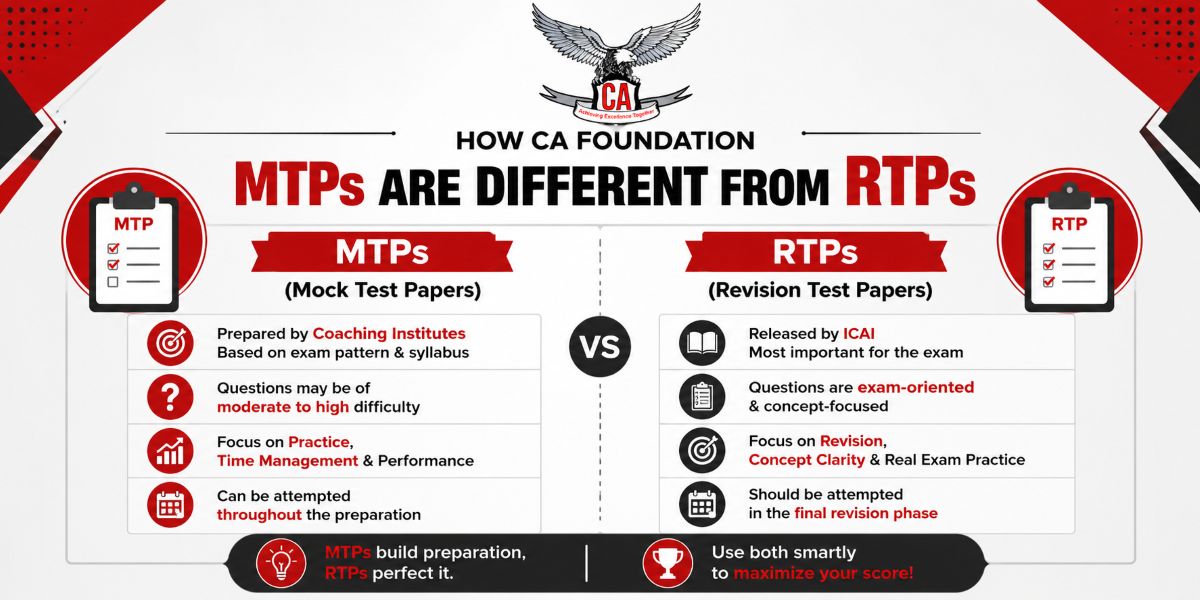
No. A mock test paper replicates the exact format of the exam for timed practice. The RTP is a revision resource with questions and suggested answers, designed to help you align your preparation with ICAI’s expectations for that specific attempt. Both are useful but serve different purposes.
How many months before the exam should I download and start the RTP?
Download the RTP as soon as it is released, but begin active use four to six weeks before your exam, once you have completed at least one full revision of all subjects. Using it earlier is not harmful, but most students get more from it once their foundational preparation is solid.
Do questions from the RTP actually appear in the CA Foundation exam?
Not verbatim, but ICAI does use the RTP to signal topic emphasis and question patterns. Historically, exam questions have closely resembled RTP questions in concept and format, even when the specific numbers or scenarios differ. This makes the RTP one of the most reliable indicators of what to expect.
Should I solve past RTPs or only the current one?
Both. The current RTP reflects the most recent syllabus and exam pattern and should be your primary resource. Past RTPs are useful for identifying recurring topics and understanding how ICAI’s question style has evolved. Doing two to three past RTPs alongside the current one gives you a more complete picture of the paper’s likely scope.
Can I rely on the RTP alone for CA Foundation revision?
No. The RTP works best as the final layer of preparation, not the only layer. It should come after you have worked through the Study Material for conceptual understanding and the Practice Manual for question practice. Students who rely solely on the RTP tend to have patchy knowledge that does not hold up against questions with slight variations in the exam.