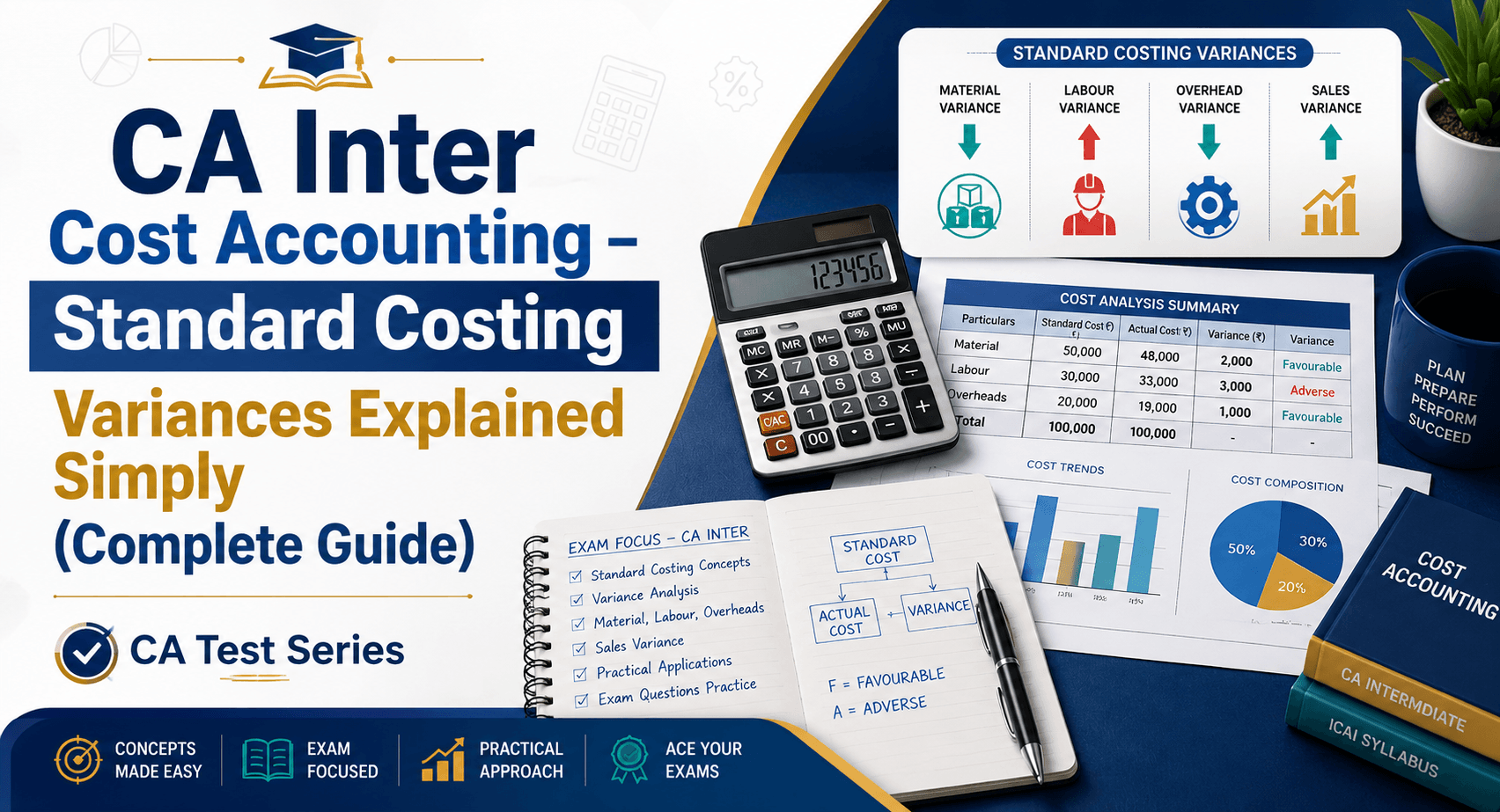
CA Inter Cost Accounting – Standard Costing Variances Explained Simply (Complete Guide)
Standard Costing Variances is one of the most important topics in CA Inter Cost Accounting, as it helps students understand the difference between standard cost and actual cost, which is essential for cost control, performance evaluation, and managerial decision-making. In the ICAI examination, this topic is highly scoring because it combines strong conceptual understanding with numerical problem-solving skills, making it a must-master area for every CA Inter student aiming for high marks.
What is Standard Costing in CA Inter Cost Accounting?
Standard costing is a cost control technique in which costs are predetermined based on efficient operating conditions and later compared with actual costs to identify deviations. In CA Inter Cost Accounting, this system is used to measure efficiency, control wastage, and support business decisions by analyzing cost performance.
Key Objectives of Standard Costing
Objective | Explanation |
| Cost Control | Identifies inefficiencies and helps reduce unnecessary expenses |
| Performance Evaluation | Measures efficiency of departments and employees |
| Decision Making | Supports pricing and production decisions |
| Efficiency Measurement | Compares actual performance with expected standards |
Standard costing is widely used because it provides a structured way to monitor business performance and improve cost efficiency systematically.
What is Variance Analysis? (Core Concept)
Variance analysis is the process of comparing standard costs with actual costs to identify differences known as variances. These variances help determine whether performance is favorable or unfavorable and provide insight into operational efficiency. In CA Inter Cost Accounting, variance analysis is extremely important because it tests both conceptual clarity and numerical accuracy in ICAI exams, making it one of the most frequently asked topics.
Types of Variances Overview
Type | Focus Area |
| Material Variance | Raw material cost and usage |
| Labour Variance | Workforce efficiency and wage cost |
| Overhead Variance | Indirect production costs |
| Sales Variance | Revenue performance analysis |
Variance analysis helps management identify where actual performance deviates from planned standards and why those deviations occur.
Types of Variances in CA Inter Cost Accounting (Complete Breakdown)
Material Variances: Material variances analyze differences in raw material cost due to price changes, usage efficiency, and material handling. These variances help in controlling procurement and production efficiency.
Labour Variances: Labour variances measure the difference between standard labour cost and actual labour cost, focusing on wage rates, productivity, and idle time, which helps evaluate workforce efficiency.
Overhead Variances: Overhead variances deal with indirect production costs and analyze spending efficiency, capacity utilization, and production efficiency for both fixed and variable overheads.
Sales Variances (Advanced but Important): Sales variances measure differences between expected and actual sales performance, including price, volume, and sales mix, helping businesses understand profitability and revenue efficiency.
Standard Costing Variances – Detailed Breakdown Table
Variance Type | Sub-Variance | Purpose |
| Material Variance | Price, Usage, Mix, Yield | Measures material efficiency and cost control |
| Labour Variance | Rate, Efficiency, Idle Time | Measures workforce productivity |
| Overhead Variance | Spending, Efficiency, Capacity | Controls indirect production costs |
| Sales Variance | Price, Volume, Mix | Evaluates sales performance |
This structured breakdown helps CA Inter students quickly revise all variance categories in a single view.
Formula Sheet for Standard Costing Variances (Quick Revision Section)
The following formulas are essential for solving numerical questions in CA Inter Cost Accounting efficiently:
- Material Price Variance (MPV) = (Standard Price – Actual Price) × Actual Quantity
- Material Usage Variance (MUV) = (Standard Quantity – Actual Quantity) × Standard Price
- Labour Rate Variance (LRV) = (Standard Rate – Actual Rate) × Actual Hours
- Labour Efficiency Variance (LEV) = (Standard Hours – Actual Hours) × Standard Rate
- Overhead Variance = Standard Overhead – Actual Overhead
These formulas are frequently tested in ICAI exams and must be revised regularly for accuracy and speed.
Step-by-Step Method to Solve Variance Questions
Solving variance questions requires a structured approach to avoid errors and improve presentation in exams. First, students should carefully identify the given data such as standard cost, actual cost, and output levels. Next, they must determine the correct type of variance, apply the relevant formula, and perform step-by-step calculations without skipping workings. Finally, answers should be presented in a clean ICAI-approved format with proper headings and clear working notes, as presentation plays a key role in scoring marks.
ICAI Exam Weightage & Importance of Variance Analysis
Variance analysis holds significant importance in CA Inter Cost Accounting, typically contributing around 10–15 marks in the examination. It is commonly asked in case-based numerical formats that combine multiple variances in a single question, testing both conceptual clarity and calculation skills. Examiners prefer this topic because it allows them to evaluate a student’s analytical ability, understanding of cost behavior, and accuracy in applying formulas under exam pressure.
Common Mistakes Students Make in Variance Analysis
Many students lose marks in variance analysis due to avoidable mistakes such as selecting incorrect formulas, confusing usage variance with efficiency variance, making calculation errors in standard quantities, presenting answers without proper structure, and ignoring working notes, which are essential for step-wise marking in ICAI exams. Avoiding these mistakes can significantly improve scoring potential in this topic.
Smart Preparation Strategy for CA Inter Cost Accounting Variances
Concept First Approach: Students should always begin by understanding the logic behind each variance instead of memorizing formulas, as conceptual clarity helps in solving unfamiliar exam questions with confidence and accuracy.
Practice Strategy: Preparation should start with basic questions to build foundation, followed by ICAI study material questions for application, and finally advanced exam-level problems to improve speed, accuracy, and exam readiness.
Revision Strategy: Effective revision should include daily formula practice, weekly mixed question solving, and final revision using concise notes and formula sheets to ensure quick recall during exams.
Mock Test Strategy (CA Test Series Advantage)
Mock tests based on the ICAI pattern are essential for improving exam performance as they simulate real exam conditions, improve time management, and enhance accuracy. Students should follow a structured plan including chapter-wise tests, full syllabus mock exams, and timed simulations. After each test, performance should be analyzed carefully by identifying weak areas, tracking repeated mistakes, and focusing on continuous improvement to build exam confidence.
Practice Questions Approach (How to Master Variances)
To master variance analysis in CA Inter Cost Accounting, students should solve at least 50–100 practice questions covering easy, moderate, and difficult levels. Focusing on repeated ICAI question patterns helps students understand exam trends, improve problem-solving speed, and strengthen conceptual clarity across all variance topics.
Quick Revision Chart (Last Day Strategy)
On the final day before the exam, students should revise a one-page summary containing all important formulas, key adjustments, and common shortcuts. This helps improve quick recall, reduces confusion during the exam, and boosts confidence by reinforcing essential concepts in a short time.
Conclusion
Variance analysis is one of the most scoring and concept-driven topics in CA Inter Cost Accounting, and mastering it requires a combination of conceptual understanding, consistent practice, and structured revision. By avoiding common mistakes, following a disciplined preparation strategy, and practicing mock tests through platforms like CA Test Series, students can significantly improve their accuracy, speed, and presentation skills, ultimately achieving better results in ICAI examinations.