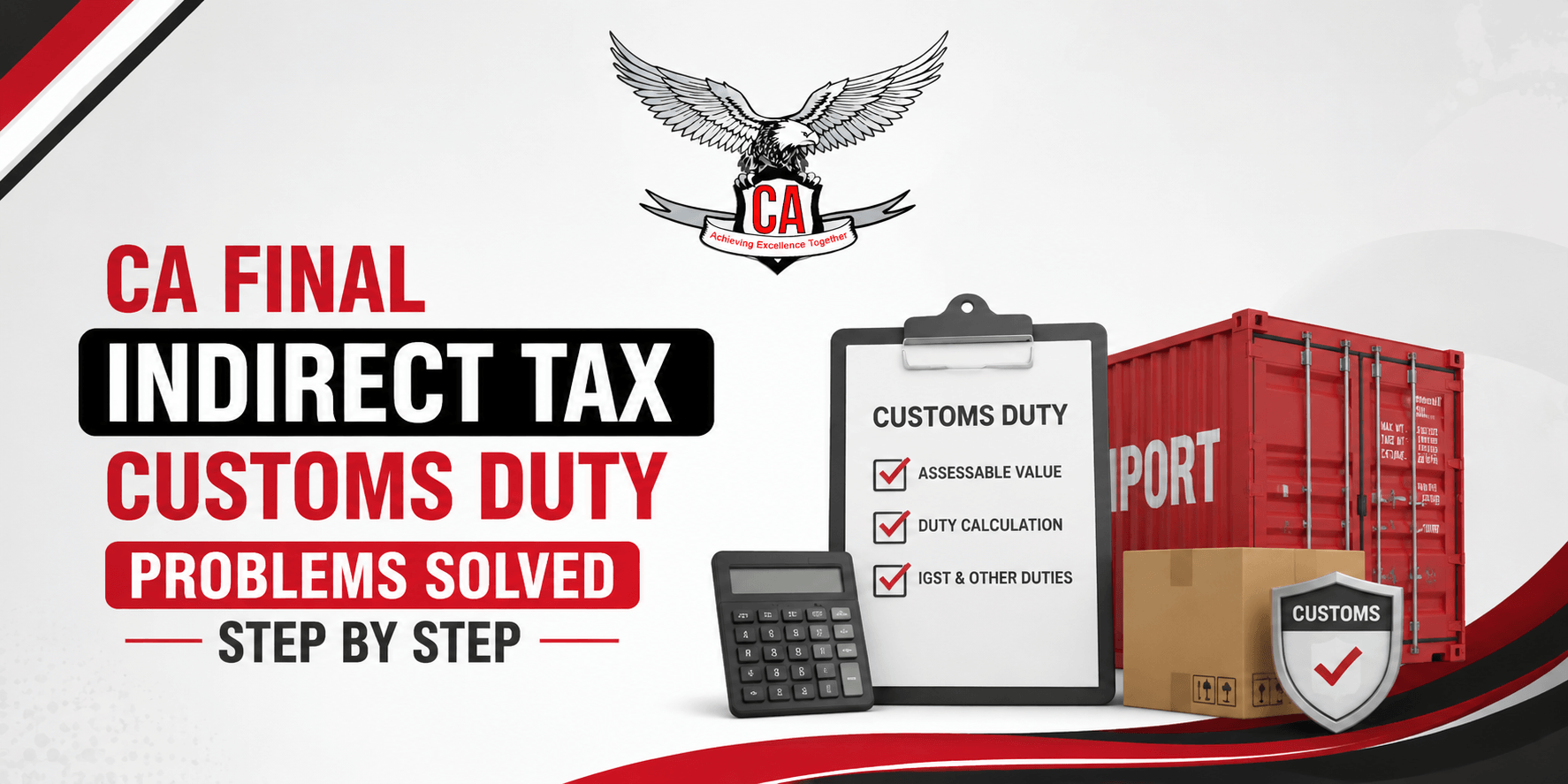
CA Final Indirect Taxs: Customs Duty Problems Solved Step by Step
CA Final Indirect Tax is a crucial subject for CA Final students, and Customs Duty plays a key role within it due to its high scoring nature and practical application. This guide focuses on simplifying Customs Duty problems through a step-by-step approach so students can clearly understand valuation, duty calculation, and exam-oriented techniques. It also helps in building conceptual clarity while improving speed and accuracy in solving ICAI-style questions.
Overview of CA Final Indirect Tax (GST + Customs Framework)
H3: What is covered under CA Final Indirect Tax?: CA Final Indirect Tax mainly covers GST law along with Customs law under the Customs Act, 1962 and Customs Tariff Act, focusing on both conceptual understanding and practical problem-solving required for exams.
H3: Importance of Customs Duty in CA Final exams: Customs Duty is an important scoring area in CA Final exams as it combines theory with numerical problem-solving and is frequently tested in ICAI question papers.
H3: Weightage and exam trends (high scoring areas): Customs Duty questions often appear in case study or valuation-based formats, making it a high-weightage and scoring topic if concepts are clearly understood.
H3: Conceptual link between GST and Customs: Customs Duty forms the base for IGST on imports, creating a direct conceptual connection between Customs law and GST provisions in the indirect tax framework.
Basics of Customs Duty You Must Know for CA Final Indirect Tax
H3: Meaning and scope of Customs Duty: Customs Duty is a tax levied on goods imported into or exported from India, primarily to regulate trade and generate government revenue.
H3: Taxable event in Customs law: The taxable event in Customs occurs when goods cross the customs frontier, meaning import into India or export from India triggers duty liability.
H3: Classification of goods (HSN system overview): Goods are classified under the HSN system in Customs law, which determines applicable duty rates and ensures uniform taxation.
H3: Types of Customs Duties in India: Customs duties include Basic Customs Duty, IGST on imports, Social Welfare Surcharge, and other protective duties like anti-dumping duties.
H2: Core Concepts for Solving Customs Duty Problems
H3: Determination of Assessable Value: Assessable value is calculated mainly based on CIF value, which includes cost, insurance, and freight along with certain statutory additions.
H3: Exchange rate application rules: Exchange rates notified by customs authorities are used for conversion of foreign currency into Indian rupees on the relevant valuation date.
H3: Duty rates and applicable notifications: Duty rates are applied based on Customs Tariff Act provisions and exemption notifications, which may vary depending on product classification.
H3: Sequence of duty calculation (very important for exams): The sequence of duty calculation is critical in exams as each duty is applied on a specific base value, and incorrect order leads to wrong answers.
Step-by-Step Approach to Solve Customs Duty Problems (Exam Method)
Step 1 – Identify type of transaction (Import / Export): The first step is to determine whether the transaction is import or export, as duty applicability depends on the nature of the transaction.
Step 2 – Determine assessable value correctly: The assessable value is computed by adjusting CIF value with relevant inclusions and exclusions as per Customs valuation rules.
Step 3 – Apply Basic Customs Duty (BCD): Basic Customs Duty is applied on the assessable value at the prescribed rate to determine the first level of tax liability.
Step 4 – Compute additional duties (CVD / SWS / IGST): Additional duties such as Social Welfare Surcharge and IGST are calculated in sequence based on the value after BCD.
Step 5 – Final payable customs duty calculation: The final customs duty payable is the sum of all applicable duties calculated in proper sequence.
Step 6 – Common exam mistakes to avoid: Students often lose marks due to incorrect sequencing, missing inclusions in value, and misapplication of duty rates.
Advanced Problem Areas in CA Final Indirect Tax – Customs
Valuation issues in complex imports: Complex imports involve additional valuation rules where multiple goods or services are bundled, requiring careful calculation.
Related party transactions: Transactions between related parties require arm’s length valuation principles to ensure correct duty assessment.
Freight, insurance, landing charges adjustments: Proper inclusion of freight, insurance, and landing charges is essential for accurate CIF-based valuation.
Special valuation rules cases: Special valuation rules apply in exceptional cases where standard valuation methods cannot be used directly.
High-scoring tricky questions from past exams: Past ICAI exams often include tricky valuation-based questions designed to test conceptual clarity and application skills.
Practical Problem Solving Examples (Exam-Oriented Practice Section)
Simple Customs Duty problem (basic level): Basic problems focus on straightforward CIF valuation and BCD calculation to build foundational understanding.
Moderate level integrated GST + Customs problem: Moderate questions combine Customs duty with IGST application to test integrated indirect tax knowledge.
Advanced CA Final case study problem: Advanced case studies involve multi-layer calculations and complex valuation scenarios similar to ICAI exam questions.
Stepwise explanation format (how answers should be written): Answers should follow a structured ICAI format with clear steps, proper labeling, and logical calculation flow.
Important Amendments & ICAI Updates (Latest Exam Relevance)
Recent changes in Customs valuation rules: Recent updates in valuation rules directly impact how assessable value is calculated in exam scenarios.
Budget updates affecting Customs Duty: Budget changes may alter duty rates, exemptions, or classification rules, making them important for exams.
ICAI suggested amendments and exam applicability: ICAI RTPs and MTPs often include amendments that are directly relevant for CA Final exam preparation.
CA Final Indirect Tax Preparation Strategy for Customs Chapter
How to revise Customs Duty effectively:Effective revision involves repeated practice of valuation problems and understanding the duty sequence clearly.
How to practice problem-solving daily: Daily practice of ICAI-style questions improves accuracy, speed, and conceptual clarity.
Time management in exam for Customs questions: Proper time management ensures students can complete valuation and calculation-based questions efficiently.
Suggested study sequence (concept → practice → revision): A structured study flow from concept learning to practice and revision ensures better retention and exam performance.
FAQs on CA Final Indirect Tax – Customs Duty
Customs Duty in CA Final Indirect Tax refers to tax on imports and exports under Customs law, and it is important for scoring in exams due to its numerical nature and frequent appearance in ICAI papers. Assessable value is calculated mainly using the CIF method with required adjustments, and duty calculation follows a strict sequence of BCD, SWS, and IGST. Customs is considered one of the most important chapters in CA Final Indirect Tax, and regular practice of ICAI questions helps in scoring better marks.
Common Mistakes Students Make in Customs Duty Problems
Students often lose marks in Customs Duty problems due to avoidable conceptual and calculation mistakes such as incorrect valuation assumptions, wrong sequencing of duty components, and missing small inclusions in CIF value. Many also make errors in IGST computation and confuse Basic Customs Duty (BCD) with Countervailing Duty (CVD), which leads to incorrect final answers even when most steps are correct.
Wrong valuation assumptions: Wrong valuation assumptions usually occur when students incorrectly interpret CIF components or fail to include required adjustments, leading to an inaccurate assessable value for duty calculation.
Incorrect sequencing of duties: Incorrect sequencing of duties happens when students apply IGST or surcharge before BCD, which distorts the entire calculation and results in wrong final tax amounts.
Ignoring small inclusions in CIF value: Ignoring small inclusions such as insurance, freight adjustments, or landing charges leads to undervaluation and ultimately incorrect customs duty computation.
Calculation errors in IGST: IGST calculation errors arise when students apply the tax on the wrong base value or fail to include all preceding duty components in the calculation chain.
Concept confusion between CVD and BCD: Confusion between CVD and BCD is common, where students mix their applicability and calculation base, leading to conceptual and numerical mistakes in exam answers.
Conclusion
Customs Duty is one of the most important and scoring areas in CA Final Indirect Tax, and success depends on mastering valuation rules and the correct sequence of duty calculation. With consistent practice, conceptual clarity, and structured revision, students can significantly improve their accuracy and performance in exam scenarios.