CA Final Advance Audit: How to Write Case-Based Audit Answers
Case-based questions in CA Final Advanced Audit require students to apply auditing concepts, Standards on Auditing (SA), and professional judgment to practical scenarios instead of writing theoretical answers. Success in these questions depends on understanding the situation, identifying audit issues, and presenting answers in a structured, examiner-friendly format with proper application of standards and clear reasoning.
Understanding CA Final Advanced Audit Case-Based Questions
What ICAI expects in case study answers: ICAI expects students to demonstrate application skills, not memorization, meaning answers should clearly connect auditing standards with real-life case facts, showing logical reasoning, professional scepticism, and practical audit decision-making.
Nature and structure of audit case scenarios: Audit case scenarios are usually descriptive situations involving company operations, financial reporting issues, internal control weaknesses, or ethical dilemmas where students must identify risks, apply relevant SA, and suggest audit procedures or conclusions.
Common areas covered in case-based questions (SA, Company Audit, Risk, Ethics): Most case-based questions focus on key areas such as audit risk assessment, company law compliance, ethical issues, internal controls, audit evidence, and reporting requirements based on various Standards on Auditing.
Why case-based answers are scoring if written correctly: These questions are highly scoring because they allow structured presentation of points, direct application of standards, and easy marking for examiners when answers are logically organized with clear headings and relevant keywords.
Common Mistakes Students Make in Case-Based Audit Answers
Writing theory instead of application-based answers: Many students lose marks by reproducing textbook theory without linking it to the case facts, which makes the answer generic and irrelevant to the examiner’s expectations.
Missing audit keywords and standards references: Failure to mention relevant SA numbers, audit terminology, and professional keywords weakens the answer and reduces its credibility in the examiner’s evaluation.
Poor structuring and lack of headings: Unstructured answers without clear headings or segmentation make it difficult for examiners to follow logic, leading to reduced presentation marks even if content is correct.
Ignoring facts given in the case: Overlooking key facts from the scenario results in incomplete analysis, as ICAI expects direct reference to case details while forming audit judgments.
Overwriting irrelevant points: Adding unnecessary or unrelated theory wastes time and creates confusion, reducing the clarity and precision required for high-scoring answers.
Step-by-Step Approach to Write Perfect Case-Based Answers
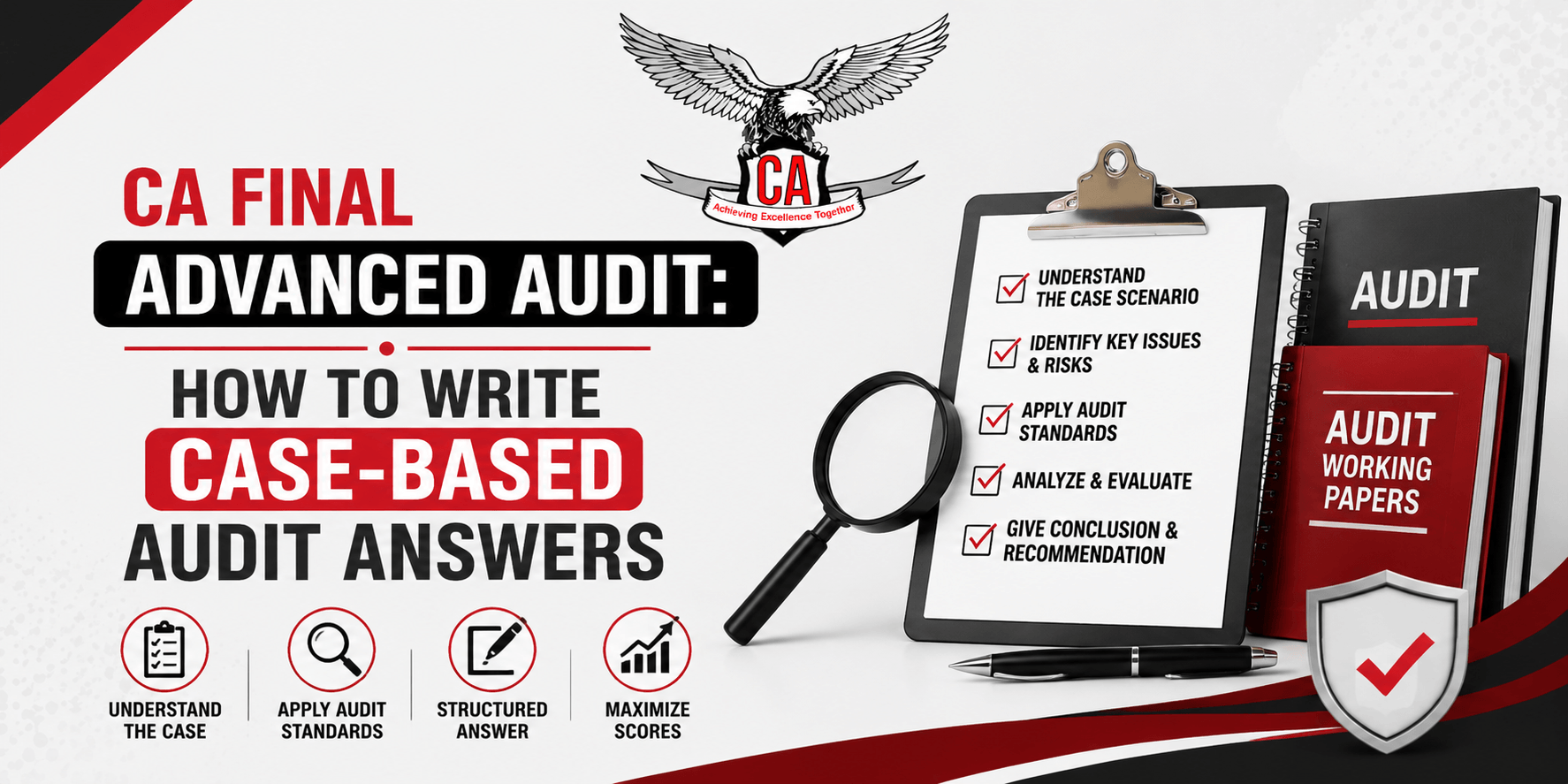
Step 1 – Read and understand the case scenario carefully: Begin by carefully reading the case to understand the business context, identify issues, and note important facts that will guide audit analysis.
Step 2 – Identify audit issues and risk areas: Highlight key problem areas such as misstatements, control weaknesses, or compliance risks that directly impact financial reporting or audit opinion.
Step 3 – Link with relevant Standards on Auditing (SA): Match each identified issue with appropriate SA provisions to strengthen the answer with professional and technical backing.
Step 4 – Structure answer using headings and sub-headings: Organize the answer clearly using headings like issue identification, relevant SA, application, and conclusion to improve readability and scoring.
Step 5 – Write conclusion with professional judgment: End with a clear audit conclusion or recommendation based on professional judgment, showing how the auditor should respond to the issue.
Step 6 – Time management during exam writing: Allocate time efficiently to ensure all case issues are addressed without rushing the conclusion, maintaining both quality and completeness.
Ideal Format for Writing Case-Based Audit Answers (ICAI Style)
Introduction to the issue: Start with a brief introduction explaining the audit context and the nature of the issue identified in the scenario.
Identification of audit issue/problem: Clearly state the audit issue or risk based on facts given in the case, keeping it precise and relevant.
Relevant SA / legal provision: Mention the applicable Standards on Auditing or legal requirements that govern the identified issue.
Application to case facts: Apply the selected SA directly to the case scenario, explaining how the standard relates to the specific facts provided.
Auditor’s recommendation or conclusion: Provide a clear professional conclusion or audit action, such as additional procedures, reporting implications, or control recommendations.
Important Standards on Auditing for Case-Based Questions
SA 200 series – General principles; The SA 200 series forms the foundation of auditing, covering basic principles like audit objective, responsibilities, and professional scepticism.
SA 315 & SA 330 – Risk assessment and response: These standards are crucial for identifying and responding to risks of material misstatement through planning and audit procedures.
SA 500 series – Audit evidence: The SA 500 series focuses on obtaining sufficient and appropriate audit evidence, which is frequently tested in case scenarios.
SA 700 series – Audit reporting: This series deals with forming audit opinions and reporting, including modifications and key audit matters in financial statements.
Ethics and professional scepticism relevance: Ethical standards and professional scepticism guide auditor behaviour, ensuring independence, objectivity, and critical evaluation of evidence.
Answer Writing Techniques to Score High Marks
Use of keywords from ICAI study material: Incorporating ICAI-specific keywords and phrases improves answer alignment with marking schemes and increases scoring potential.
Structuring answers with clear headings: Well-structured answers with headings and subheadings make it easier for examiners to evaluate and award marks systematically.
Writing to-the-point, examiner-friendly content: Answers should be concise, relevant, and directly focused on the case requirement without unnecessary elaboration.
Highlighting audit risks and controls: Clearly identifying risks and corresponding controls demonstrates strong analytical ability and practical audit understanding.
Presentation tips for better readability: Neat formatting, logical flow, and consistent structure improve readability and create a positive impression on examiners.
Time Management Strategy for Case-Based Questions
Reading time strategy (first 15 minutes): During the initial reading time, focus on quickly scanning the entire paper to understand case scenarios, underline key facts, and mentally map which Standards on Auditing (SA) are likely applicable. This helps in forming a clear direction before writing starts and prevents confusion during the exam.
Answer allocation based on marks: Divide your time strictly according to marks, typically allocating about 1.5 minutes per mark. Higher-mark case studies should be broken into smaller sub-parts and planned separately to ensure balanced coverage across all requirements.
Avoiding time wastage on theory writing: Avoid writing lengthy theoretical explanations that are not directly linked to the case facts. Focus only on relevant application points and SA references to maximize marks within limited time.
Balancing accuracy and speed: Maintain a balance between writing quickly and ensuring conceptual correctness. Prioritize identifying key audit issues and presenting structured answers rather than overthinking minor details.
Practice Strategy for CA Final Advanced Audit Preparation
ICAI RTPs and MTPs practice plan: Regular practice of Revision Test Papers (RTPs) and Mock Test Papers (MTPs) helps in understanding ICAI question patterns, frequently tested areas, and expected answer formats.
Mock test importance (link with CA Test Series platform): Mock tests simulate real exam conditions and help improve time management, answer presentation, and confidence. Platforms like CA Test Series or ICAI mock tests are useful for structured practice and performance tracking.
How to self-evaluate answers: After writing practice answers, compare them with suggested solutions to identify gaps in application, missing SA references, and weak presentation areas.
Improving weak areas through revision cycles: Focus on repeated revision cycles where weak topics are revisited multiple times, ensuring better retention and improved application in case-based scenarios.
Examiner Expectations in Advanced Audit Answers
Logical flow and professional presentation: Examiners expect answers to follow a clear sequence with proper headings, logical progression, and clean presentation that makes evaluation easy.
Application of auditing standards: Marks are awarded based on how effectively students apply relevant Standards on Auditing to case facts rather than simply stating definitions.
Clarity in reasoning and conclusions: Answers should clearly explain why a particular audit issue exists and how it impacts the audit, followed by a justified conclusion.
Use of structured answer format: A consistent structure such as issue identification, relevant SA, application, and conclusion significantly improves readability and scoring potential.
Conclusion
Case-based questions in CA Final Advanced Audit are highly scoring when approached with proper structure, strong conceptual clarity, and effective time management. Success depends on consistent practice, correct application of Standards on Auditing, and clear, examiner-friendly presentation. A disciplined preparation strategy combining RTPs, mock tests, and revision cycles can significantly improve performance and exam confidence.