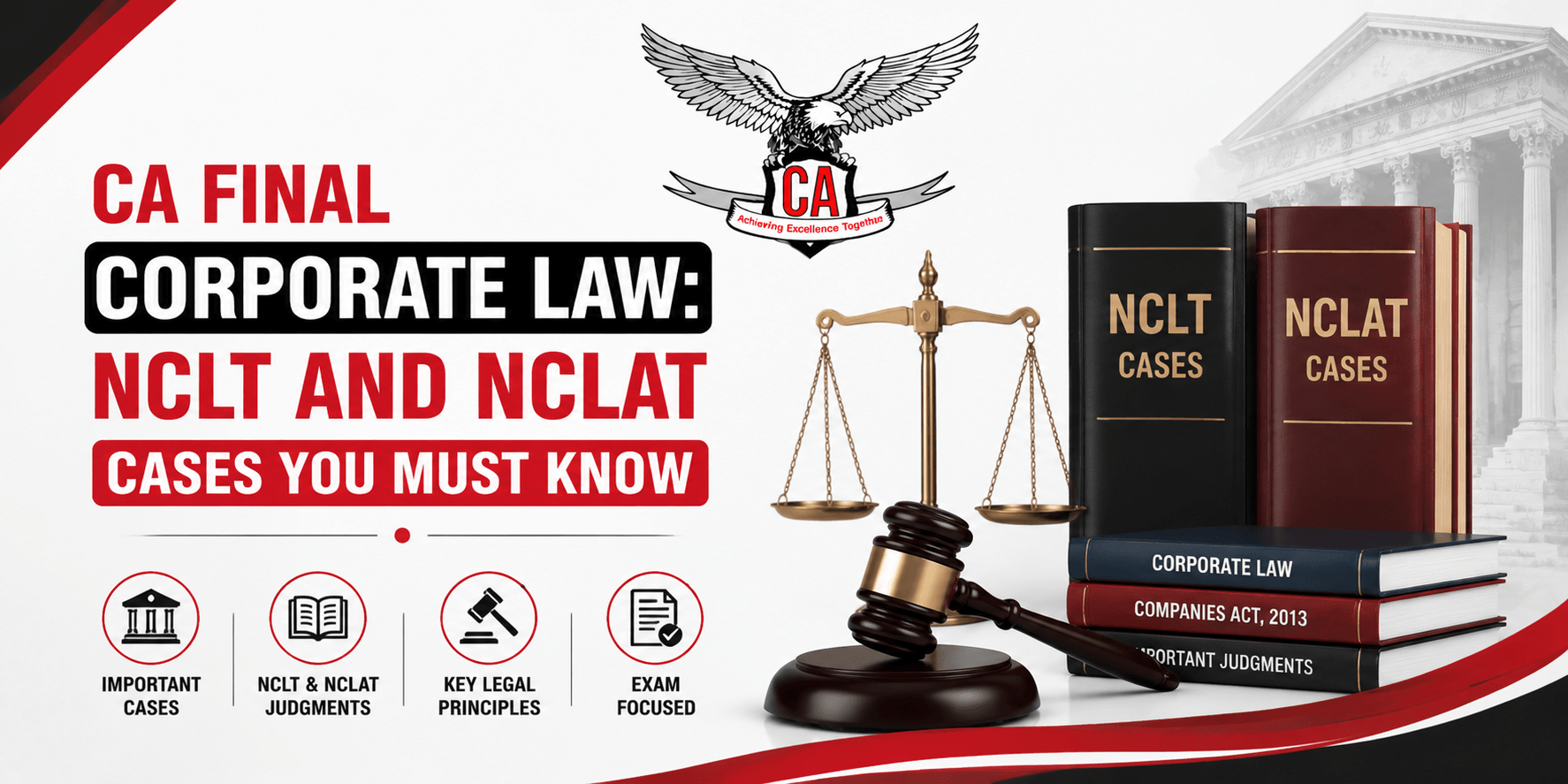
CA Final Corporate Law: NCLT and NCLAT Cases You Must Know
CA Final Corporate Law includes important tribunal-based concepts from NCLT and NCLAT, which are frequently tested in ICAI exams through case-based and application-oriented questions. Understanding these cases helps students apply legal provisions effectively instead of memorizing theory, and this guide is designed to simplify the most important tribunal judgments for quick revision and better exam performance.
Understanding NCLT and NCLAT in CA Final Corporate Law
H3: Meaning and Role of NCLT (National Company Law Tribunal): NCLT is a quasi-judicial body under the Companies Act, 2013 that handles corporate disputes such as oppression, mismanagement, mergers, and insolvency matters, making it a key authority for company law adjudication.
H3: Meaning and Role of NCLAT (National Company Law Appellate Tribunal): NCLAT is the appellate authority that hears appeals against the orders of NCLT and also plays a major role in reviewing insolvency and corporate law decisions to ensure legal correctness.
H3: Difference Between NCLT and NCLAT (Exam-Focused Comparison): NCLT functions as the primary tribunal for corporate disputes while NCLAT acts as the appellate body, and the key difference lies in their jurisdiction, authority level, and role in the legal hierarchy.
H3: Why Tribunals Are Important in Corporate Law Syllabus: Tribunals like NCLT and NCLAT are important because they connect theoretical company law provisions with real-life corporate disputes and are frequently tested in ICAI case-based exam questions.
Why NCLT and NCLAT Case Laws Are Important for CA Final Exams
H3: ICAI Exam Pattern and Case-Based Questions: ICAI focuses heavily on case-based questions where students must apply legal provisions to practical scenarios involving tribunal decisions and corporate disputes.
H3: Weightage of Tribunal-Related Questions: Questions from NCLT and NCLAT case laws regularly appear in exams and carry significant marks, making them highly important for scoring well.
H3: How Case Laws Improve Answer Presentation and Marks: Using case laws in answers shows strong conceptual understanding and improves answer quality by adding legal reasoning and structured application.
H3: Common Examiner Expectations from Students: Examiners expect students to correctly apply sections of the Companies Act along with logical reasoning based on tribunal judgments rather than writing only theoretical explanations.
Important CA Final Corporate Law NCLT Cases
H3: Landmark NCLT Judgments You Must Remember: Certain landmark NCLT judgments are frequently referenced in exams and help students understand how tribunals interpret corporate law provisions in real disputes.
H3: Company Law Disputes and Insolvency-Related Cases: These cases involve disputes between companies, shareholders, and creditors, especially under insolvency proceedings and corporate restructuring matters.
H3: Shareholder Rights and Oppression & Mismanagement Cases: These cases mainly focus on protection of minority shareholders under Sections 241 and 242 where tribunals intervene in unfair corporate practices.
H3: Merger, Amalgamation, and Restructuring Cases: These cases deal with approval and validation of schemes of merger and amalgamation under Section 230–232 of the Companies Act.
H3: Insolvency and Liquidation-Related NCLT Decisions: These include important decisions under the Insolvency and Bankruptcy Code where tribunals decide on initiation, resolution, or liquidation of companies.
Important CA Final Corporate Law NCLAT Cases
H3: Key Appellate Decisions Under NCLAT: NCLAT decisions are important because they clarify legal interpretations and resolve disputes arising from NCLT judgments in corporate matters.
H3: Corporate Insolvency Resolution Cases (CIRP-Related Rulings): These cases focus on approval, rejection, and modification of resolution plans under the Corporate Insolvency Resolution Process.
H3: Appeals Related to Company Law Disputes: These include disputes between shareholders, directors, and companies where parties challenge NCLT orders before NCLAT.
H3: Case Laws Affecting Interpretation of IBC and Companies Act: These judgments help in understanding how tribunals interpret provisions of the Insolvency and Bankruptcy Code and Companies Act in practical situations.
Topic-Wise Case Law Classification (High Scoring Area)
H3: Oppression and Mismanagement (Section 241–242)
These cases deal with unfair treatment of minority shareholders and misuse of power by majority shareholders within a company.
H3: Mergers and Amalgamations (Section 230–232): These involve tribunal approval of corporate restructuring schemes ensuring fairness to shareholders and creditors.
H3: Insolvency and Bankruptcy Code (IBC) Cases: These cases focus on corporate insolvency resolution, creditor rights, and liquidation procedures under the IBC framework.
H3: Shareholder Disputes and Corporate Governance Cases: These cases address conflicts between shareholders and management relating to control, decision-making, and governance issues.
H3: Winding Up and Liquidation Cases: These cases involve closure of companies when they are unable to continue business operations or meet financial obligations.
How to Write Case Law Answers in CA Final Corporate Law Exams
H3: Step-by-step answer writing format: Case law answers in CA Final Corporate Law should follow a clear structure starting with identifying the issue, applying the relevant legal provision, linking it with the applicable case law, and finally concluding with a precise and logical legal outcome to maximize marks.
H3: How to quote case laws effectively: Case laws should be quoted briefly by mentioning the key principle or judgment relevance rather than writing long details, and they should be directly linked to the facts of the question to show proper application of law.
H3: Common mistakes students make in case-based answers: Students often lose marks by writing only theory without applying facts, misquoting case laws, or failing to structure answers properly, which reduces clarity and examiner impact in Corporate Law answers.
H3: Presentation tips for scoring better marks: Good presentation includes using headings, underlining key legal terms, writing in points where needed, and maintaining a logical flow so that the examiner can easily follow the application of law.
Revision Strategy for NCLT and NCLAT Case Laws
H3: One-page summary method: The one-page summary method helps in quick revision by condensing all important NCLT and NCLAT case laws into a structured sheet that can be revised repeatedly before exams.
H3: Mind maps and flowcharts technique: Mind maps and flowcharts help in visually connecting case laws with relevant sections of the Companies Act, making it easier to recall during exam pressure.
H3: Revision timetable for last 30 days: A structured 30-day revision plan should divide case laws into daily targets with regular revision cycles to ensure better retention and faster recall.
H3: Mock test practice strategy using CA Test Series: Regular mock tests using CA Test Series help students evaluate their preparation, identify weak areas in case law application, and improve exam writing speed and accuracy.
Most Frequently Asked Questions in CA Final Corporate Law (Exam Trend Analysis)
H3: Repeated case law themes in ICAI exams; ICAI frequently repeats themes such as oppression and mismanagement, insolvency resolution, and merger approvals, making them highly important for preparation.
H3: High probability questions from NCLT/NCLAT: High probability questions usually come from landmark tribunal judgments involving shareholder disputes, insolvency cases, and corporate restructuring scenarios.
H3: Scenario-based questions and how to prepare: Scenario-based questions require understanding legal provisions and applying them to practical facts, which can be mastered through consistent practice of past papers and mock tests.
Practice Zone (CA Test Series Exclusive Section)
H3: Chapter-wise practice tests on Corporate Law; Chapter-wise tests help students strengthen individual topics and ensure conceptual clarity before moving to full syllabus revision.
H3: NCLT and NCLAT case-based mock exams: These mock exams simulate real ICAI exam patterns and improve case law application skills under time pressure.
H3: ICAI pattern full syllabus tests: Full syllabus tests help students assess overall preparation and identify gaps in Corporate Law case law understanding.
H3: Performance analysis and feedback system: Performance analysis provides detailed feedback on strengths and weaknesses, helping students improve accuracy, presentation, and time management.
Conclusion
CA Final Corporate Law becomes highly scoring when NCLT and NCLAT case laws are properly understood and practiced in an application-based manner, and consistent revision along with mock test practice helps students improve both accuracy and presentation in the final exam.
FAQs on CA Final Corporate Law: NCLT and NCLAT Cases
What are the most important NCLT cases for CA Final Corporate Law?
Important NCLT cases are those involving oppression and mismanagement, insolvency proceedings, and merger approvals that are frequently tested in ICAI exams.
How many NCLAT cases should I remember for exams?
Instead of memorizing numbers, focus on understanding key principles from major NCLAT judgments that are commonly applied in exam scenarios.
Are case laws compulsory in CA Final Corporate Law answers?
Case laws are not compulsory but using them appropriately strengthens answers and significantly improves scoring potential.
How do I revise NCLT and NCLAT judgments quickly?
Quick revision can be done through summary notes, flowcharts, and repeated mock test practice to improve recall speed.
Which chapters have maximum case law questions?
Chapters like oppression and mismanagement, mergers and amalgamation, and insolvency law contain the highest number of case-based questions.
How does ICAI frame tribunal-based questions?
ICAI frames questions in a scenario format where students must apply legal provisions and tribunal principles to solve practical corporate disputes.