CA Final Financial Reporting: Ind AS vs AS — When to Apply Which
CA Final Financial Reporting is one of the most important papers in the CA Final examination because it tests a student’s ability to apply accounting standards in practical business situations. One common area of confusion among students is the difference between Ind AS and AS, especially when deciding which treatment to apply in the exam. Since CA Final FR is mainly focused on Indian Accounting Standards, students must understand Ind AS concepts clearly while also knowing how AS differs from them. This guide explains Ind AS vs AS in a simple, exam-oriented way so that students can answer CA Final Financial Reporting questions with better clarity, accuracy, and confidence.
Why Ind AS Matters in CA Final Financial Reporting
CA Final Financial Reporting is not limited to basic accounting entries or simple formats. It focuses on advanced reporting areas such as consolidation, financial instruments, business combinations, revenue recognition, leases, impairment, provisions, and disclosures. These topics require a strong understanding of Ind AS because most questions test application, judgment, presentation, and adjustment-based treatment. Students should therefore treat Ind AS as the core foundation of CA Final FR rather than a separate theory portion.
Why CA Final FR Is Application-Based
CA Final FR questions usually require students to identify the correct accounting treatment, prepare workings, make adjustments, explain the principle, and present the final reporting impact. The paper is application-based because students are expected to handle real-world reporting situations instead of simply writing definitions. This is why topics such as consolidation, financial instruments, leases, revenue, and business combinations need both conceptual clarity and regular practice.
Why Students Still Need to Understand AS
Although CA Final Financial Reporting mainly focuses on Ind AS, understanding AS is still useful. AS helps students compare older accounting treatments with Ind AS-based reporting and understand why certain changes were introduced. For example, comparing AS 9 with Ind AS 115 helps students understand the shift from risk-and-reward-based revenue recognition to performance-obligation-based recognition. However, in the exam, students must apply the standard specifically required by the question.
Ind AS vs AS: Basic Difference
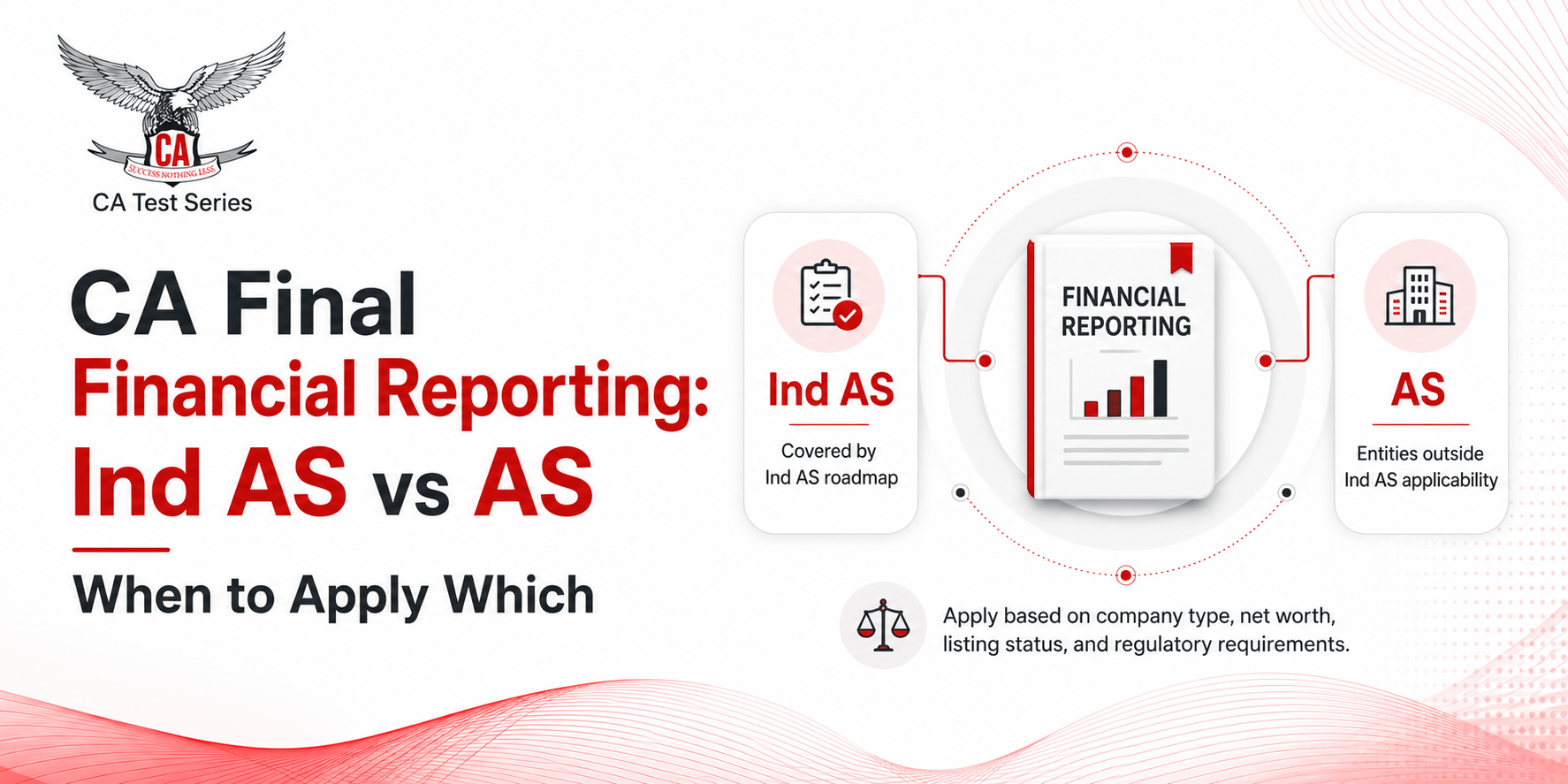
Ind AS and AS both provide accounting guidance, but they differ in depth, approach, presentation, and disclosure requirements. Ind AS is more principle-based and fair-value-oriented, while AS is comparatively simpler and more traditional in many areas. For CA Final Financial Reporting, this difference is important because using AS treatment in an Ind AS question may lead to wrong recognition, measurement, presentation, or disclosure.
Basis of Difference | Ind AS Treatment | AS Treatment | CA Final FR Relevance |
| Framework | More principle-based and aligned with modern reporting | Comparatively traditional | Helps in advanced FR questions |
| Fair Value | Used widely in many standards | Historical cost is more common | Important for financial instruments and business combinations |
| Substance Over Form | Strong focus on economic substance | Less detailed application | Useful in case-based questions |
| Disclosures | Detailed disclosure requirements | Fewer disclosures | Important for descriptive answers |
| Revenue | Five-step model under Ind AS 115 | Risk and reward approach under AS 9 | Frequently tested |
| Leases | Right-of-use asset and lease liability | Finance lease and operating lease classification | Important for practical questions |
| Consolidation | Based on control and group reporting principles | Comparatively simpler approach | High-practice area |
| Financial Instruments | Detailed classification and measurement rules | Less comprehensive guidance | One of the toughest FR areas |
When to Apply Ind AS vs AS in CA Final FR
Students should apply Ind AS when the question specifically mentions an Ind AS or when the topic belongs to the core CA Final Financial Reporting syllabus. Areas such as financial instruments, business combinations, consolidated financial statements, leases, revenue from contracts, share-based payments, impairment, and fair value measurement are generally Ind AS-driven. The best exam approach is to first identify the standard being tested and then write the answer according to that standard.
When to Apply Ind AS
Apply Ind AS when the question mentions standards such as Ind AS 115, Ind AS 116, Ind AS 109, Ind AS 103, or Ind AS 110. For example, if a question refers to revenue from customer contracts, students should apply the five-step model of Ind AS 115. If the question involves lease accounting under Ind AS 116, the answer should include right-of-use asset, lease liability, finance cost, and depreciation treatment.
When AS Knowledge Is Useful
AS knowledge is useful mainly for comparison, conceptual background, and understanding the transition from older accounting rules to Ind AS. Students may use AS knowledge to understand how accounting treatment has changed, but they should not use AS-based treatment in an Ind AS question unless the question specifically asks for a comparison. This distinction is important for avoiding conceptual errors.
When Not to Mix AS and Ind AS
Students should not mix AS and Ind AS terminology in the same answer unless the question asks for a comparative discussion. Using old AS logic in Ind AS-based topics such as revenue, leases, consolidation, or financial instruments can make the answer incorrect. In CA Final Financial Reporting, answers should be standard-specific, properly reasoned, and supported by clear workings.
Topic-Wise Ind AS vs AS Mapping for CA Final Financial Reporting
A topic-wise mapping helps students revise faster and identify the main areas where Ind AS differs from AS. Instead of studying standards separately, students should compare recognition, measurement, presentation, and disclosure requirements topic by topic.
Topic | Ind AS | AS | Key Exam Focus |
| Presentation of Financial Statements | Ind AS 1 | AS 1 | OCI, structure, materiality, disclosures |
| Cash Flow Statement | Ind AS 7 | AS 3 | Classification and presentation |
| Accounting Policies and Errors | Ind AS 8 | AS 5 | Retrospective application and prior period errors |
| Property, Plant and Equipment | Ind AS 16 | AS 10 | Component accounting, revaluation, depreciation |
| Borrowing Costs | Ind AS 23 | AS 16 | Qualifying asset and capitalisation period |
| Intangible Assets | Ind AS 38 | AS 26 | Research, development, useful life, amortisation |
| Impairment of Assets | Ind AS 36 | AS 28 | CGU, recoverable amount, reversal |
| Provisions and Contingencies | Ind AS 37 | AS 29 | Present obligation and measurement |
| Revenue Recognition | Ind AS 115 | AS 9 | Five-step model and performance obligations |
| Leases | Ind AS 116 | AS 19 | ROU asset and lease liability |
| Financial Instruments | Ind AS 32, 109, 107 | Limited AS guidance | Classification, ECL, fair value, disclosures |
| Business Combinations | Ind AS 103 | AS-based amalgamation guidance | Goodwill, NCI, fair value adjustments |
| Consolidation | Ind AS 110, 111, 112, 27, 28 | AS 21, 23, 27 | Control, associates, joint arrangements, eliminations |
High-Scoring Areas in CA Final Financial Reporting
High-scoring preparation does not mean studying every topic with the same intensity. Some areas need deep conceptual clarity, while others require repeated numerical practice. Financial instruments, consolidation, business combinations, revenue recognition, leases, and fair value measurement are important because they involve judgment, calculations, and presentation. Students should give extra attention to these areas while also revising smaller standards for short questions and adjustments.
Areas That Need Regular Practice
Consolidated financial statements, amalgamation and business combination adjustments, expected credit loss, amortised cost, lease calculations, and revenue recognition case studies should be practised repeatedly. These areas can be scoring if students know the process, but they can become confusing without written practice. Mock tests and chapter-wise tests are useful for building speed and accuracy.
Common Mistakes Students Should Avoid
Mistake | Why It Hurts Marks |
| Mixing AS and Ind AS terminology | Makes the answer conceptually incorrect |
| Ignoring disclosures | Leads to incomplete descriptive answers |
| Not reading the requirement | Results in unnecessary or wrong answers |
| Wrong classification of financial assets | Affects measurement and presentation |
| Missing OCI impact | Changes final reporting treatment |
| Confusing control with ownership | Creates errors in consolidation questions |
| Poor working notes | Makes long answers difficult to evaluate |
How to Answer Ind AS Questions in CA Final FR
A good Ind AS answer should be structured, clear, and exam-focused. Students should first identify the relevant Ind AS, then read the requirement carefully, explain the principle, prepare workings, and conclude with the final accounting treatment. This method improves presentation and helps the examiner understand the logic behind the answer.
Step | What to Do |
| Step 1 | Identify the relevant Ind AS and topic |
| Step 2 | Check whether the question asks for treatment, journal entries, computation, disclosure, or explanation |
| Step 3 | Write the principle before calculation |
| Step 4 | Use working notes, assumptions, and clear headings |
| Step 5 | Conclude with final amount, treatment, and presentation impact |
CA Final Financial Reporting Preparation Strategy
A strong CA Final Financial Reporting preparation strategy should combine concept study, ICAI material practice, summary revision, and mock tests. Students should start with conceptual standards, then move to core scoring areas, and finally practise advanced topics such as financial instruments, business combinations, and consolidation. Revision should include short notes on recognition, measurement, presentation, disclosure, journal entries, and common adjustments.
Best Study Order for CA Final FR
Phase | Topics to Cover | Purpose |
| Phase 1 | Framework, presentation standards, assets, liabilities | Build conceptual foundation |
| Phase 2 | Revenue, leases, PPE, intangibles, provisions, borrowing costs | Cover scoring standards |
| Phase 3 | Financial instruments, business combinations, consolidation, fair value | Master advanced areas |
| Phase 4 | RTPs, MTPs, mock tests, time-bound practice | Improve exam readiness |
How CA Test Series Helps in FR Preparation
CA Test Series helps CA Final students prepare for Financial Reporting through ICAI-pattern mock tests, chapter-wise practice, full syllabus exams, expert answer evaluation, study materials, and performance feedback. Since FR requires both concept clarity and answer-writing skills, regular testing helps students identify weak areas such as consolidation, financial instruments, leases, revenue recognition, and business combinations. It also improves speed, accuracy, presentation, and confidence before the final exam.
Conclusion
CA Final Financial Reporting requires strong understanding of Ind AS, clear comparison with AS, and regular exam-oriented practice. Students should know when to apply Ind AS, when AS knowledge is useful, and how to avoid mixing both treatments. With a standard-wise study plan, ICAI-based practice, summary notes, mock tests, and proper mistake analysis, students can prepare more confidently and improve their performance in CA Final FR.