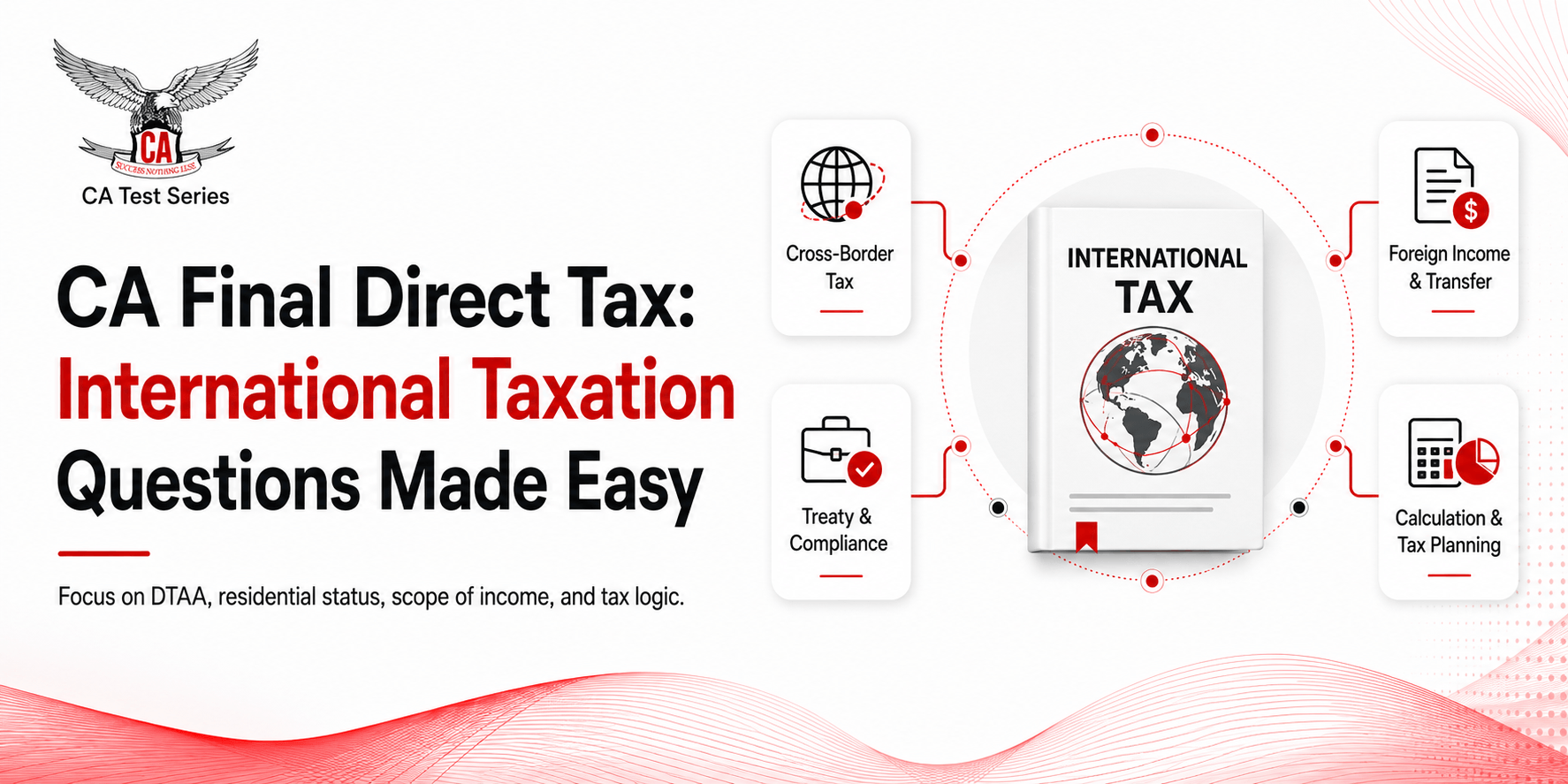
CA Final Direct Tax: International Taxation Questions Made Easy
CA Final Direct Tax is one of the most important papers for students preparing for the CA Final examination. The subject includes both Direct Tax Laws and International Taxation, which makes it practical, concept-based and application-oriented. Many students find this paper challenging because it requires a strong understanding of domestic tax provisions, amendments, case laws, transfer pricing, DTAA, non-resident taxation and treaty-based interpretation. However, with the right study plan, ICAI-based practice and regular mock test writing, CA Final Direct Tax can become much easier to manage and score.
CA Final Direct Tax: Paper Overview
CA Final Direct Tax Laws and International Taxation is designed to test whether students can understand and apply income tax provisions in practical situations. The paper is not only about memorising sections; it checks how well a student can analyse facts, apply provisions and present the correct tax treatment. Since the paper includes both theory and practical questions, students should prepare with concept clarity, regular revision, amendment updates and exam-style writing practice.
Particulars | Details |
| Paper Name | Direct Tax Laws and International Taxation |
| Level | CA Final |
| Paper Type | Practical + Theory |
| Main Areas | Direct Tax Laws and International Taxation |
| Best Sources for Preparation | ICAI Study Material, RTP, MTP, Past Papers and Test Series |
| Key Skill Required | Concept application and answer presentation |
What Is Covered in CA Final Direct Tax?
CA Final Direct Tax mainly covers two major areas: Direct Tax Laws and International Taxation. The Direct Tax portion includes residential status, heads of income, deductions, exemptions, assessment of various entities, TDS, TCS, advance tax, assessment procedure, appeals, penalties and prosecution. The International Taxation portion includes transfer pricing, non-resident taxation, double taxation avoidance agreement, advance ruling, equalisation levy, tax treaties and BEPS basics. Students should prepare both areas together because exam questions can sometimes combine domestic tax and international tax concepts.
Why CA Final Direct Tax Is Important for Scoring and Career Growth
CA Final Direct Tax is important not only for passing the exam but also for building a strong career in taxation, audit, finance, consultancy and corporate advisory. A student who understands Direct Tax and International Taxation properly can handle tax computation, compliance, advisory work, cross-border taxation and assessment-related issues more confidently. Since taxation is a major professional area for Chartered Accountants, this subject can directly support future career opportunities in CA firms, corporate tax departments and consulting companies.
CA Final Direct Tax Syllabus: Direct Tax and International Taxation
The CA Final Direct Tax syllabus is broad, so students should divide it into smaller parts for better preparation. Direct Tax Laws should be prepared with computation practice and amendment revision, while International Taxation should be studied with a concept-based and case-study approach. A structured chapter-wise plan helps students cover important topics without last-minute pressure and ensures better retention before the exam.
Part A: Direct Tax Laws
Part A focuses on Indian income tax provisions and their practical application. Important areas include basic concepts, residential status, income from different heads, deductions, exemptions, set-off and carry forward of losses, assessment of companies, firms and trusts, TDS, TCS, advance tax, appeals, penalties and prosecution. This part requires regular written practice because many questions involve computation, adjustment and interpretation.
Part B: International Taxation
Part B focuses on the taxation of cross-border transactions, foreign income and non-resident taxation. Important areas include transfer pricing, arm’s length price, associated enterprises, permanent establishment, royalty, fees for technical services, DTAA relief, advance ruling and equalisation levy. This section becomes easier when students follow a step-by-step method instead of trying to memorise every concept separately.
CA Final Direct Tax Weightage for Better Preparation
Understanding the preparation priority of different topics helps students manage time effectively. High-weightage and concept-heavy areas should be revised multiple times, but smaller topics should not be ignored because CA Final papers often test integrated understanding. Students should use weightage only as a planning tool, not as a reason to skip chapters.
Area | Importance Level | Preparation Priority |
| PGBP | High | Must Practice |
| Capital Gains | High | Must Practice |
| TDS, TCS and Advance Tax | High | Revise with examples |
| Assessment of Various Entities | Medium to High | Prepare with charts |
| Assessment Procedure | Medium | Focus on flow and time limits |
| Transfer Pricing | High | Practice numerical and case-based questions |
| DTAA and Non-Resident Taxation | High | Build conceptual clarity |
High-Scoring Topics in CA Final Direct Tax
Some topics in CA Final Direct Tax are highly scoring because they follow structured rules and clear application patterns. These include PGBP, capital gains, deductions, TDS, TCS, advance tax, assessment of various entities, transfer pricing and DTAA-based questions. Students should practise these areas repeatedly from ICAI study material, RTPs, MTPs and past papers to improve accuracy and speed.
CA Final International Taxation Questions Made Easy
International Taxation questions become easier when students understand the transaction before applying the provision. The key is to identify the parties, residential status, source of income, nature of payment, country involved and treaty applicability. Once these basic facts are clear, students can compare domestic tax provisions with DTAA and apply the provision that is more beneficial to the assessee.
Common Types of International Taxation Questions
CA Final International Taxation questions may be based on DTAA, transfer pricing, non-resident taxation, equalisation levy or case-study scenarios. DTAA questions usually test treaty benefit and double taxation relief, while transfer pricing questions focus on associated enterprises and arm’s length price. Non-resident taxation questions require students to decide whether income is taxable in India, and equalisation levy questions usually relate to specified digital transactions.
Step-by-Step Method to Solve International Taxation Questions
Students should follow a fixed method while solving International Taxation questions. First, identify the residential status of the assessee. Second, identify the source and nature of income. Third, check whether DTAA applies. Fourth, compare the Income Tax Act with treaty provisions. Fifth, apply the provision that is more beneficial. Finally, calculate the tax impact and conclude the answer clearly. This approach reduces confusion and improves answer presentation.
Step | What to Do |
| Step 1 | Identify residential status |
| Step 2 | Identify source and nature of income |
| Step 3 | Check DTAA applicability |
| Step 4 | Compare domestic law and treaty provisions |
| Step 5 | Apply beneficial provision |
| Step 6 | Calculate tax impact |
| Step 7 | Write a clear conclusion |
How to Solve CA Final Direct Tax Questions in Exam
To solve CA Final Direct Tax questions effectively, students should first read the requirement before reading the full question. Then they should mark important data such as dates, amounts, residential status, country involved and nature of income. After that, they should identify the relevant provision, show working notes clearly, write assumptions where required and conclude the answer properly. This method helps students avoid unnecessary writing and improves the quality of answers.
Common Mistakes in CA Final Direct Tax and International Taxation
Many students lose marks because of avoidable mistakes rather than lack of preparation. Common mistakes include ignoring latest amendments, writing long theory without applying it to the facts, applying the wrong residential status, forgetting DTAA benefit comparison, missing working notes and presenting case-based answers poorly. Students should also avoid relying only on notes without practising ICAI questions properly.
Best Preparation Strategy for CA Final Direct Tax
A strong preparation strategy for CA Final Direct Tax should include ICAI study material, amendment notes, short revision notes, RTPs, MTPs, past papers, chapter-wise tests and full syllabus mock exams. Students should not study the subject randomly because the syllabus is large and amendment-driven. A planned approach helps in completing the syllabus, revising important areas and improving answer writing before the exam.
CA Final Direct Tax 60-Day Study Plan
A 60-day plan is useful for students who have already studied the subject once and want structured revision before the exam. The first phase should focus on core Direct Tax concepts, the second phase on International Taxation, the third phase on ICAI questions, and the final phase on amendments and mock tests. This plan can be adjusted depending on the student’s preparation level.
Time Period | Focus Area | Target |
| Days 1–15 | Core Direct Tax Concepts | Complete major chapters |
| Days 16–30 | International Taxation | Cover DTAA, transfer pricing and non-resident taxation |
| Days 31–40 | ICAI Questions and RTPs | Practice application-based questions |
| Days 41–50 | Revision and Amendments | Strengthen weak areas |
| Days 51–60 | Mock Tests | Improve speed and presentation |
Role of CA Test Series in CA Final Direct Tax Preparation
CA Test Series can help students prepare for CA Final Direct Tax through ICAI-pattern chapter-wise tests, full syllabus mock exams, expert answer evaluation and performance feedback. Many students understand concepts but struggle to write answers within exam time. Regular test series practice helps students improve time management, presentation, working notes and confidence in both Direct Tax and International Taxation questions.
CA Final Direct Tax Notes and Practice Material
Good CA Final Direct Tax notes should include important provisions, amendments, charts, case laws, examples, practice questions and summary points. Amendment notes should be revised separately because Direct Tax changes frequently. Students should also practise RTP, MTP and past exam questions because these materials help them understand ICAI’s question style and expected answer format.
CA Final Direct Tax Answer Writing Tips
Answer writing is very important in CA Final Direct Tax because the examiner checks not only the final answer but also the method, reasoning and presentation. Practical answers should include clear computation and working notes, while theory answers should be concise and relevant. International Taxation answers should follow a structure of facts, issue, applicable provision, treaty comparison, application and conclusion.
Conclusion
CA Final Direct Tax can be made easier with the right preparation strategy, regular amendment revision and consistent exam-style practice. International Taxation may seem complex at first, but a step-by-step approach can help students handle DTAA, transfer pricing and non-resident taxation questions more confidently. With ICAI material, structured notes, mock tests and expert evaluation from CA Test Series, students can improve their preparation and perform better in the CA Final Direct Tax paper.