CA Final Elective Papers: Which One Should You Choose and Why?
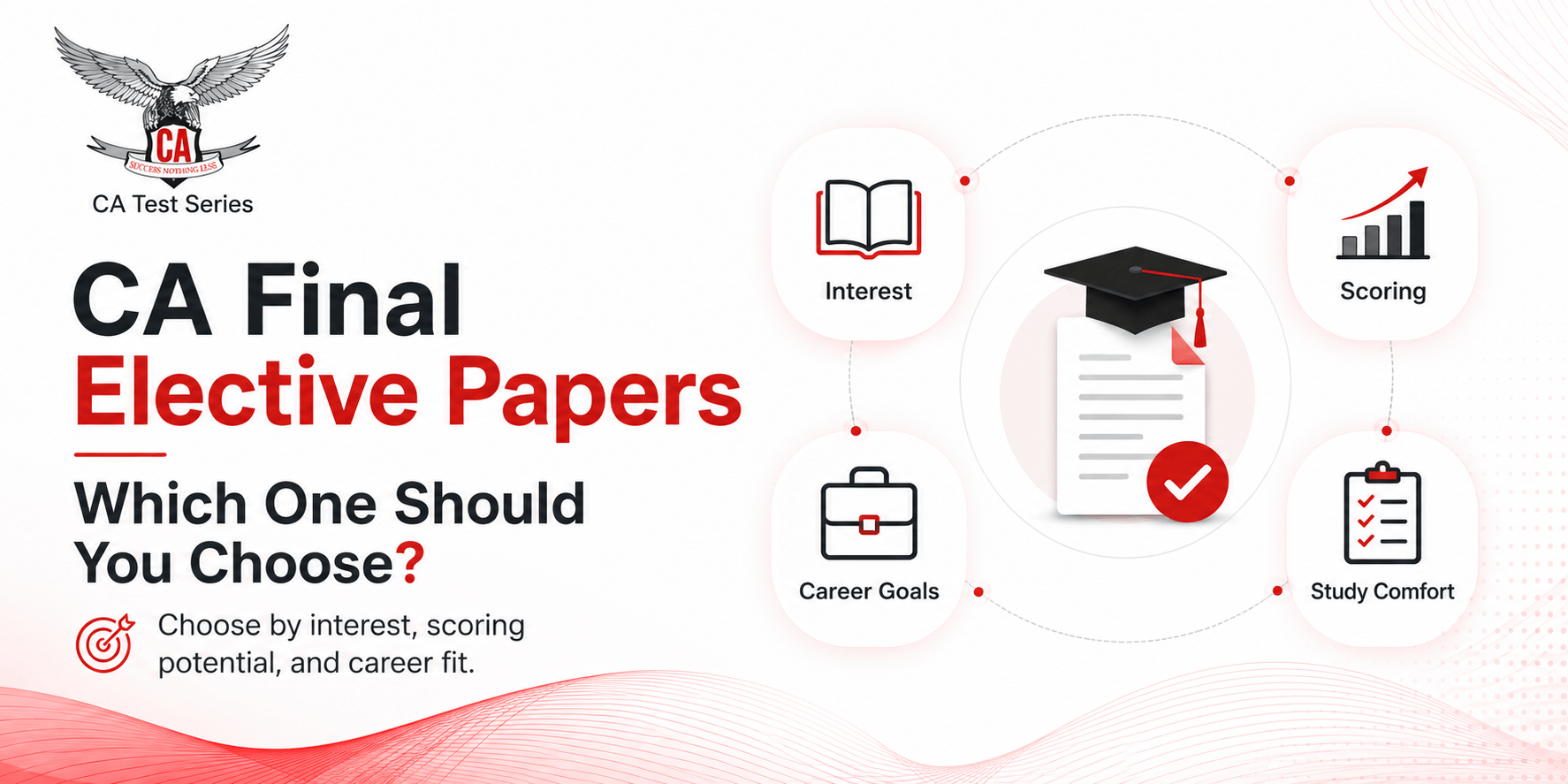
Choosing the right CA Final Elective Paper was once an important decision for students preparing under the old ICAI scheme. Many students searched for the best elective based on scoring potential, articleship experience, career goals, and subject comfort. However, under the current ICAI scheme, the old elective paper system has been replaced by Paper 6: Integrated Business Solutions, a compulsory open-book and case-study-based paper. Still, understanding CA Final Elective Papers is useful because it helps students connect their strengths with future career paths and prepare better for case-study-style questions.
CA Final Elective Papers: Old Scheme vs New Scheme
Under the old scheme, CA Final students could choose one elective paper from six options. These papers allowed students to specialize in areas such as taxation, finance, law, risk, reporting, or multidisciplinary case studies. Under the current scheme, students no longer choose from these electives. Instead, all students appear for Integrated Business Solutions, which tests practical application across multiple subjects.
Area | Old CA Final Elective Papers | Current CA Final Paper 6 |
| Paper type | Choice-based elective | Compulsory paper |
| Focus | Subject specialization | Integrated case studies |
| Nature | Open-book elective paper | Open-book case-study-based paper |
| Skill tested | Depth in one area | Application across multiple areas |
| Best preparation method | Subject-wise study and practice | Case analysis, concept linking, and mock tests |
List of Old CA Final Elective Papers
The old CA Final Elective Papers included six options, and each paper suited a different type of student. The right choice depended on articleship exposure, career direction, reading comfort, and subject strength.
Elective Paper | Syllabus Nature | Best Suited For |
| Risk Management | Practical, analytical, business-risk focused | Students interested in consulting, internal audit, and risk advisory |
| Financial Services and Capital Markets | Finance, banking, and market-oriented | Students interested in investment, banking, capital markets, or financial institutions |
| International Taxation | Technical, tax-focused, and provision-based | Students interested in direct tax, transfer pricing, and global tax advisory |
| Economic Laws | Law-heavy and compliance-focused | Students interested in legal, FEMA, insolvency, and corporate compliance roles |
| Global Financial Reporting Standards | Accounting standards and reporting-focused | Students interested in audit, IFRS, Ind AS, and MNC reporting |
| Multidisciplinary Case Study | Integrated and application-based | Students strong in multiple CA Final subjects |
How to Choose the Right CA Final Elective Paper
The best CA Final Elective Paper was not the same for every student. A paper that felt easy for one student could be difficult for another because every student has a different background, articleship experience, and career goal. Instead of choosing based on popularity or rumours, students should evaluate the paper based on practical fit.
1. Choose Based on Your Articleship Experience
Articleship experience can make preparation easier because you may already understand the practical side of the subject. For example, a student with direct tax exposure may find International Taxation more relatable, while a student working in audit may feel more comfortable with Global Financial Reporting Standards or Multidisciplinary Case Study.
2. Choose Based on Your Career Goal
Your future career plan should play a major role in paper selection. If you want to work in tax consulting, International Taxation may be the best fit. If you are interested in audit or reporting, GFRS can be more useful. For finance roles, Financial Services and Capital Markets may be more relevant.
3. Choose Based on Subject Strength
Students should select a paper that matches their natural strength. If you are strong in law, Economic Laws may feel manageable. If you enjoy practical business situations, Risk Management or Multidisciplinary Case Study may be suitable. A paper aligned with your strength can reduce pressure and improve performance.
4. Choose Based on Study Resources and Mock Practice
Before finalizing any paper, students should check the availability of ICAI study material, past papers, revision notes, and mock tests. A good test series can help students understand the question pattern, improve answer structure, and identify weak areas before the final exam.
Which CA Final Elective Paper Was Best for Each Career Goal?
The old elective papers were useful because they allowed students to match their exam preparation with professional ambitions. The table below gives a simple career-based selection guide.
Career Goal | Best Elective Paper | Why It Fits |
| Tax consulting | International Taxation | Covers transfer pricing, non-resident taxation, and cross-border tax concepts |
| Audit and assurance | Global Financial Reporting Standards | Builds knowledge of IFRS, Ind AS, and financial reporting |
| Investment banking or finance | Financial Services and Capital Markets | Connects with banking, capital markets, mutual funds, and financial products |
| Risk advisory | Risk Management | Focuses on business risks, controls, governance, and advisory work |
| Corporate law and compliance | Economic Laws | Covers regulatory, legal, FEMA, insolvency, and compliance areas |
| General business advisory | Multidisciplinary Case Study | Tests integrated thinking across multiple CA Final subjects |
Difficulty Level of CA Final Elective Papers
The difficulty level of CA Final Elective Papers depended mainly on the student’s background. International Taxation could feel difficult for students weak in tax, but manageable for those with direct tax exposure. Economic Laws could feel heavy for students who dislike legal provisions, while GFRS could be technical for students weak in accounting standards. Risk Management and Multidisciplinary Case Study required practical thinking, case analysis, and the ability to apply concepts instead of only memorizing theory.
CA Final Paper 6 Under the New Scheme
Under the current ICAI scheme, Paper 6 is Integrated Business Solutions. This paper is case-study-based and open book. It requires students to apply knowledge from multiple CA Final subjects in practical business situations. The focus is no longer on choosing one elective but on solving integrated problems using accounting, audit, tax, finance, law, and strategic management concepts.
Skills Needed for Integrated Business Solutions
Students preparing for Paper 6 should build strong conceptual clarity across all core subjects. They should also practice reading case studies, identifying issues, linking different subjects, using study material efficiently, and writing structured answers within the exam time.
Skill | Why It Matters |
| Concept clarity | Helps students apply the correct provision, standard, or rule |
| Case analysis | Helps identify the real issue in a business scenario |
| Cross-subject linking | Helps connect tax, audit, accounts, finance, and law in one answer |
| Professional judgment | Helps students write practical and logical conclusions |
| Time management | Helps complete case studies within the exam duration |
Common Mistakes Students Should Avoid
Many students make the mistake of choosing a paper only because their friends selected it or because they heard it was scoring. Another common mistake is ignoring articleship experience and future career goals. Students also underestimate open-book and case-study-based papers, assuming that they are easy because books are allowed. In reality, open-book exams require quick thinking, strong concepts, and regular practice.
How CA Test Series Can Help CA Final Students
CA Test Series helps CA Final students prepare through ICAI-pattern mock tests, chapter-wise practice papers, full-syllabus tests, expert answer evaluation, and detailed performance feedback. For Paper 6 and case-study-based questions, regular mock test practice is important because students need to improve speed, answer structure, issue identification, and practical application. A test-based preparation approach helps students understand where they stand before the actual exam.
Preparation Strategy for CA Final Paper 6
Students should begin with concept revision and then move to case-study practice. Instead of reading passively, they should solve practical questions, review mistakes, and prepare short notes for quick reference. ICAI study material, past papers, and mock tests should be part of the preparation plan. A good approach is to spend the first phase on concept clarity, the second phase on case practice, and the final phase on timed mock tests and revision.
Final Decision Framework
Although CA Final Elective Papers are part of the old scheme, the decision-making logic is still useful. Students should identify their strongest subject area, match it with their career goal, review the syllabus, check ICAI study material, attempt a sample paper or mock test, and then finalize their preparation strategy. For current students, the focus should be on Integrated Business Solutions and case-study-based preparation.
Conclusion
CA Final Elective Papers helped students specialize in areas such as taxation, finance, law, reporting, risk, and multidisciplinary case studies. Under the current ICAI scheme, students must now focus on CA Final Paper 6: Integrated Business Solutions. Whether you are comparing old electives or preparing for the new Paper 6, the key to success is the same: understand concepts clearly, practice case studies regularly, attempt mock tests, and use performance feedback to improve before the final exam.