Master Journal Entries in CA Foundation Without Mistakes
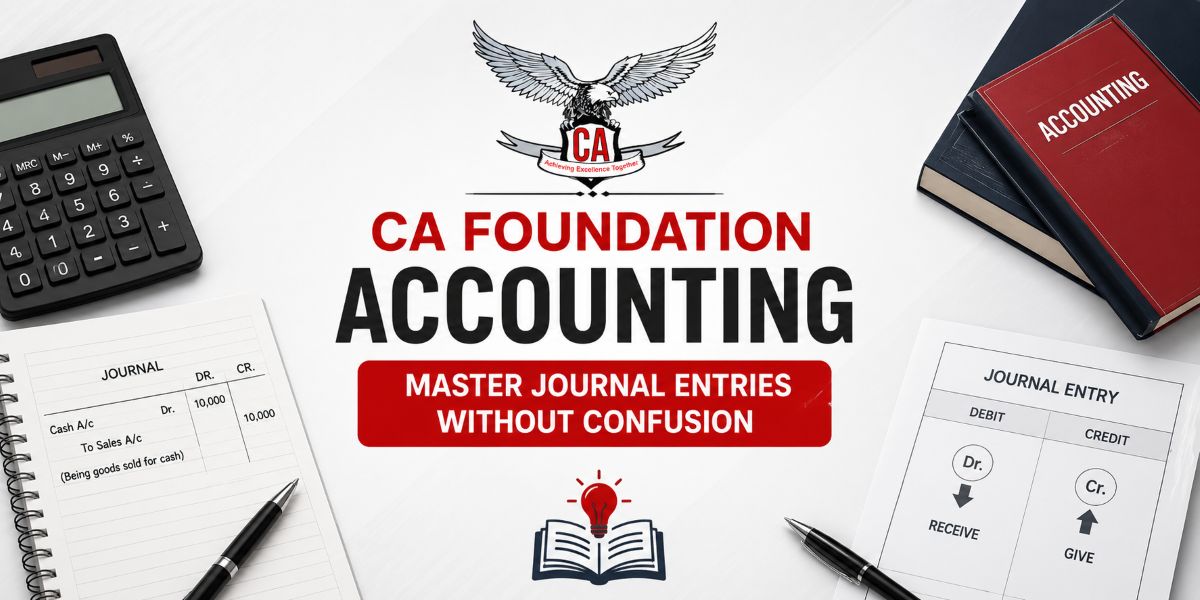
CA Foundation Accounting: How to Master Journal Entries Without Confusion
For most CA Foundation students, Accounting is either the most scoring subject or the most frustrating one. The difference usually comes down to one topic: Journal Entries.
Many students start their CA Foundation preparation feeling confident, only to become confused when they encounter debit and credit rules, multiple transactions, and adjustment entries. They memorize formats, practice random questions, and still make mistakes in exams.
The good news is that journal entries are not difficult. In fact, once you understand the logic behind them, they become one of the easiest and most scoring areas in the entire CA Foundation syllabus.
This guide will help you understand journal entries from the ground up, avoid common mistakes, and develop a practical approach that makes Accounting easier and more enjoyable.
Why Journal Entries Are So Important in CA Foundation Accounting
Journal entries are the foundation of the accounting process.
Every financial transaction recorded by a business begins with a journal entry. Before preparing:
- Ledger Accounts
- Trial Balance
- Final Accounts
- Financial Statements
an accountant must first record transactions correctly in the journal.
This is why ICAI places significant emphasis on journal entries throughout the CA Foundation Accounting syllabus.
If your journal entry concepts are weak, almost every chapter that follows becomes difficult.
What Is a Journal Entry?
A journal entry is the first formal record of a financial transaction in accounting books.
Whenever a business:
- Receives cash
- Pays expenses
- Purchases goods
- Sells products
- Receives income
the transaction is first recorded through a journal entry.
Every journal entry follows the Double Entry System, meaning:
Every transaction affects at least two accounts.
One account is debited.
Another account is credited.
This principle ensures that accounting records remain balanced.
The Biggest Reason Students Get Confused
Most students try to memorize journal entries without understanding why accounts are debited or credited.
For example:
Cash A/c Dr.
To Sales A/c
Many students remember the format but have no idea why Cash is debited and Sales is credited.
As soon as a new transaction appears, they become confused.
Instead of memorization, focus on understanding the logic behind every transaction.
Once the logic becomes clear, journal entries become predictable.
Understanding the Golden Rules of Accounting
The simplest way to master journal entries is by learning the three traditional accounting rules.
Personal Account
Debit the Receiver
Credit the Giver
Example:
Ravi gives ₹10,000 to the business.
Journal Entry:
Cash A/c Dr.
To Ravi A/c
Ravi is the giver, so his account is credited.
Real Account
Debit What Comes In
Credit What Goes Out
Example:
Furniture purchased for cash.
Furniture A/c Dr.
To Cash A/c
Furniture comes into the business, so it is debited.
Cash goes out, so it is credited.
Nominal Account
Debit All Expenses and Losses
Credit All Incomes and Gains
Example:
Salary paid.
Salary A/c Dr.
To Cash A/c
Salary is an expense, so it is debited.
Cash goes out, so it is credited.
A Better Modern Approach: Understand Account Types
While the golden rules are useful, many toppers prefer understanding account classifications.
Every account belongs to one of these categories:
Assets
Examples:
- Cash
- Bank
- Furniture
- Building
- Machinery
Assets increase on the debit side and decrease on the credit side.
Liabilities
Examples:
- Creditors
- Loans
- Outstanding Expenses
Liabilities increase on the credit side and decrease on the debit side.
Capital
Examples:
- Owner's Capital
- Retained Earnings
Capital increases on the credit side.
Income
Examples:
- Sales
- Commission Received
- Interest Received
Income increases on the credit side.
Expenses
Examples:
- Salary
- Rent
- Electricity
Expenses increase on the debit side.
A Simple 4-Step Method to Solve Any Journal Entry
Many students panic when facing lengthy transactions.
Instead, follow this method.
Step 1: Read the Transaction Carefully
Never rush.
Understand exactly what happened.
Step 2: Identify the Accounts Involved
Ask:
Which accounts are affected?
Example:
"Purchased furniture for cash."
Accounts involved:
- Furniture
- Cash
Step 3: Identify the Effect
Ask:
Which account is increasing?
Which account is decreasing?
Furniture increases.
Cash decreases.
Step 4: Apply Debit and Credit Rules
Furniture (Asset Increase) → Debit
Cash (Asset Decrease) → Credit
Final Entry:
Furniture A/c Dr.
To Cash A/c
Common Journal Entries Every CA Foundation Student Must Know
Capital Introduced
Cash A/c Dr.
To Capital A/c
Goods Purchased for Cash
Purchases A/c Dr.
To Cash A/c
Goods Sold for Cash
Cash A/c Dr.
To Sales A/c
Rent Paid
Rent A/c Dr.
To Cash A/c
Salary Paid
Salary A/c Dr.
To Cash A/c
Machinery Purchased on Credit
Machinery A/c Dr.
To Creditor A/c
These basic entries appear repeatedly throughout the syllabus.
Strong familiarity saves valuable exam time.
Common Mistakes Students Make
Memorizing Instead of Understanding
This is the biggest mistake.
Students memorize hundreds of entries without understanding account behavior.
The result?
Confusion when questions are modified.
Ignoring Account Classification
If you cannot identify whether an account is an asset, liability, income, or expense, journal entries become difficult.
Spend time understanding classifications.
Lack of Practice
Accounting is not a theory subject.
Reading solutions repeatedly will not improve accuracy.
Writing journal entries yourself is essential.
Rushing Through Questions
Students often miss words like:
- Credit
- Cash
- Discount
- Outstanding
- Prepaid
These small details completely change the journal entry.
How to Practice Journal Entries Effectively
Start With Basic Transactions
Focus first on:
- Cash transactions
- Purchases
- Sales
- Expenses
Build confidence before moving to complex adjustments.
Maintain a Journal Entry Notebook
Create a dedicated notebook.
Write every new transaction you learn.
Over time, you'll build a personalized revision guide.
Solve Questions Daily
Even 20–30 minutes of daily practice creates significant improvement.
Consistency matters more than long study sessions.
Analyze Mistakes
When you make an error, don't just correct it.
Ask:
Why did I make this mistake?
This habit dramatically improves retention.
How Mock Tests Help Master Journal Entries
One reason students struggle in Accounting exams is lack of exam-oriented practice.
Journal entries may seem easy during study sessions but become challenging under time pressure.
This is where structured mock tests become valuable.
Platforms like CATestSeries.org help CA Foundation students practice Accounting in a real exam environment.
Regular testing helps students:
- Improve speed
- Strengthen concepts
- Reduce careless mistakes
- Build confidence
- Understand ICAI-style questions
More importantly, detailed evaluations help identify weaknesses before the actual exam.
Exam Tips for Scoring High in Journal Entry Questions
Write Narrations Properly
Narrations are often ignored by students.
A proper narration demonstrates understanding of the transaction.
Keep Working Notes Clean
Presentation matters in Accounting.
Organized solutions reduce examiner confusion.
Revise Frequently
Journal entries are highly interconnected.
Regular revision improves accuracy and recall speed.
Practice ICAI-Level Questions
Focus on conceptual questions instead of relying only on basic examples.
CA Foundation increasingly tests understanding rather than memorization.
Final Thoughts
Journal entries are not a chapter you memorize and forget. They are the language of accounting.
Once you understand how accounts behave and why transactions are debited or credited, Accounting becomes significantly easier.
The students who score highest in CA Foundation Accounting are rarely those with extraordinary talent. They are usually the students who master the basics, practice consistently, and avoid unnecessary shortcuts.
Start by understanding the logic behind every transaction, practice journal entries daily, and regularly test your knowledge through structured assessments. With the right approach, journal entries can become one of the strongest and most scoring areas of your CA Foundation preparation.