CA Final New Course Structure: All 6 Papers Explained with Marks
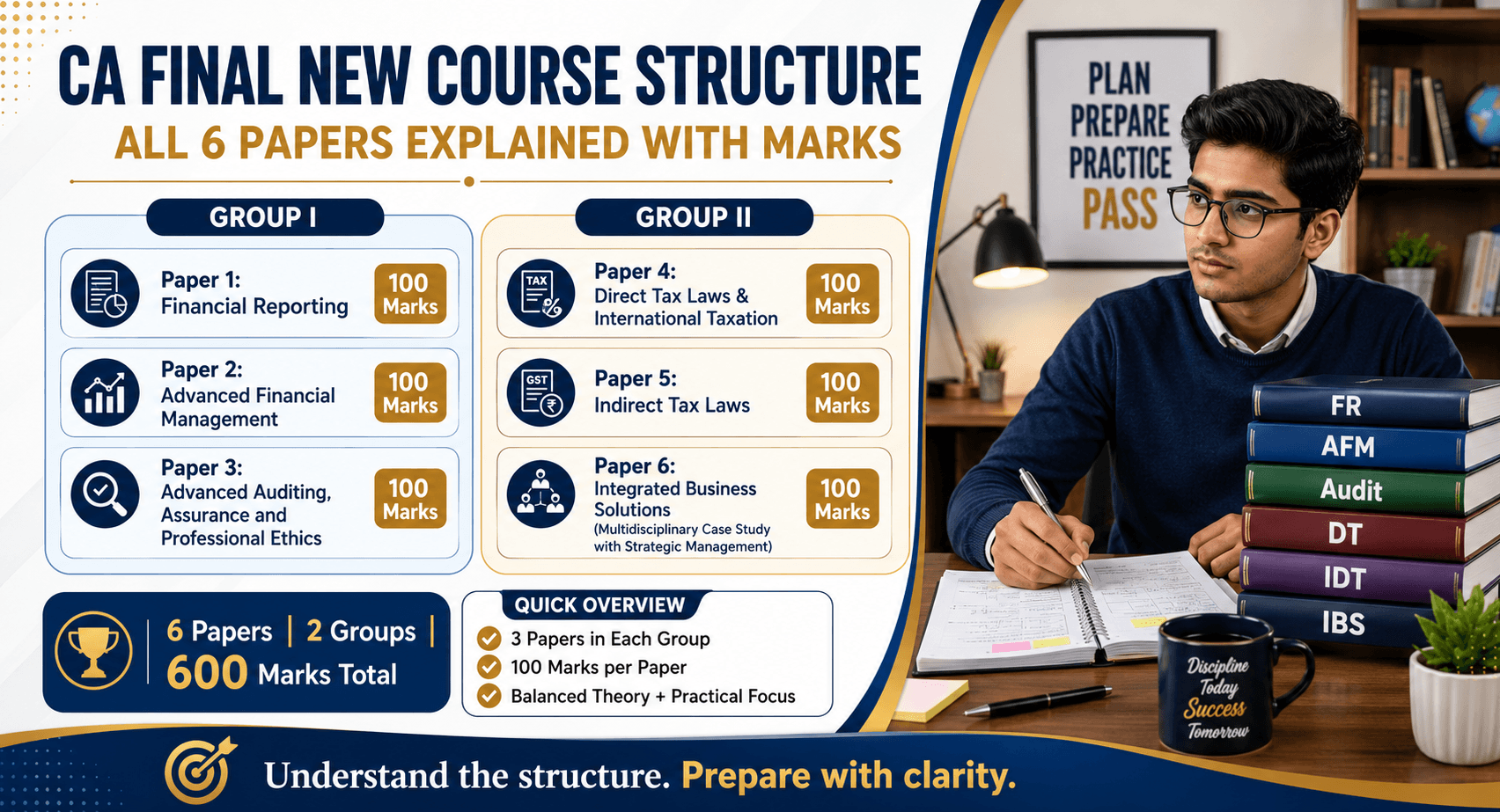
The CA Final New Course Structure is important for every student preparing for the final stage of the Chartered Accountancy course. Under the ICAI new scheme, CA Final includes 6 papers divided into 2 groups, and each paper carries 100 marks. This guide explains the CA Final subjects, group-wise papers, marks distribution, exam pattern, passing criteria, exemption rules, preparation strategy, and how mock tests can help students prepare more effectively.
What Is the CA Final New Course Structure?
The CA Final New Course Structure is the updated exam format introduced by ICAI to make CA Final preparation more practical, analytical, and application-based. The course includes subjects related to financial reporting, financial management, auditing, direct tax, indirect tax, and integrated business case studies. Students should understand the complete structure before preparing because each paper has a different nature, difficulty level, and scoring approach.
CA Final New Course Structure at a Glance
The CA Final New Course has 2 groups, with 3 papers in each group. Group 1 mainly focuses on accounting, finance, auditing, assurance, and professional ethics, while Group 2 focuses on direct taxation, indirect taxation, and integrated business solutions. Since all papers carry equal marks, students should prepare every subject seriously instead of depending only on selected papers.
CA Final New Course Overview | Details |
| Total Groups | 2 Groups |
| Total Papers | 6 Papers |
| Papers in Each Group | 3 Papers |
| Marks Per Paper | 100 Marks |
| Total Marks | 600 Marks |
| Paper 6 Format | Open Book and Case Study-Based |
CA Final New Course Structure: Group 1 Papers
CA Final Group 1 includes three important subjects: Financial Reporting, Advanced Financial Management, and Advanced Auditing, Assurance and Professional Ethics. This group needs strong concepts, regular practice, and proper answer presentation because students have to handle both practical and theory-based questions.
Paper No. | CA Final Group 1 Subject | Marks |
| Paper 1 | Financial Reporting | 100 |
| Paper 2 | Advanced Financial Management | 100 |
| Paper 3 | Advanced Auditing, Assurance and Professional Ethics | 100 |
| Total | Group 1 | 300 |
Paper 1: Financial Reporting: Financial Reporting is Paper 1 of CA Final Group 1 and carries 100 marks. This subject focuses on advanced accounting concepts, Indian Accounting Standards, consolidation, financial statements, business combinations, and reporting requirements. Students should focus on concept clarity, ICAI study material, working notes, and regular numerical practice to score well.
Paper 2: Advanced Financial Management: Advanced Financial Management is Paper 2 of CA Final Group 1 and carries 100 marks. This subject includes topics such as portfolio management, security analysis, derivatives, forex, risk management, mergers, acquisitions, and financial decision-making. Since this paper is practical and calculation-based, students should revise formulas and solve exam-style questions regularly.
Paper 3: Advanced Auditing, Assurance and Professional Ethics: Advanced Auditing, Assurance and Professional Ethics is Paper 3 of CA Final Group 1 and carries 100 marks. This paper tests students on auditing standards, professional ethics, audit reports, company audit, special audits, and assurance services. Students should focus on technical keywords, structured answers, and repeated revision because presentation plays an important role in this subject.
CA Final New Course Structure: Group 2 Papers
CA Final Group 2 includes Direct Tax Laws and International Taxation, Indirect Tax Laws, and Integrated Business Solutions. This group needs regular revision because tax subjects include many provisions and amendments, while Paper 6 requires case study analysis and practical application of concepts.
Paper No. | CA Final Group 2 Subject | Marks |
| Paper 4 | Direct Tax Laws and International Taxation | 100 |
| Paper 5 | Indirect Tax Laws | 100 |
| Paper 6 | Integrated Business Solutions | 100 |
| Total | Group 2 | 300 |
Paper 4: Direct Tax Laws and International Taxation: Direct Tax Laws and International Taxation is Paper 4 of CA Final Group 2 and carries 100 marks. This subject covers income tax provisions, assessment procedures, capital gains, business income, tax planning, international taxation, and transfer pricing. Students should focus on updated amendments, practical questions, and repeated revision of important provisions.
Paper 5: Indirect Tax Laws: Indirect Tax Laws is Paper 5 of CA Final Group 2 and carries 100 marks. This paper mainly covers GST, customs law, input tax credit, supply, valuation, registration, returns, refunds, and related compliance provisions. Students should connect concepts with practical situations and revise amendments carefully before the exam.
Paper 6: Integrated Business Solutions: Integrated Business Solutions is Paper 6 of CA Final Group 2 and carries 100 marks. This paper is open book and case study-based, but students should not treat it as easy. It requires analytical thinking, quick understanding of case facts, practical application of concepts, and proper time management during the exam.
CA Final New Course Exam Pattern
The CA Final New Course exam pattern includes case scenario or case study-based MCQs and descriptive questions. Students need to practice both formats because MCQs test accuracy and quick decision-making, while descriptive questions test explanation, calculation, legal interpretation, and presentation skills.
Exam Pattern Area | Details |
| Question Type | Case Scenario-Based MCQs and Descriptive Questions |
| MCQ Weightage | 30% |
| Descriptive Weightage | 70% |
| Negative Marking | No Negative Marking in MCQs |
| Paper 6 | Open Book and Fully Case Study-Based |
CA Final New Course Passing Criteria
To pass CA Final, students need to score the minimum required marks in each paper and the required aggregate marks in the group. A student generally needs 40% marks in each paper and 50% aggregate marks in the group. Therefore, students should focus on balanced preparation instead of depending only on one strong subject.
Passing Criteria | Requirement |
| Minimum Marks Per Paper | 40% |
| Minimum Aggregate Per Group | 50% |
| Marks for Exemption | 60% or More in a Paper |
| Exemption Validity | Next Three Following Examinations |
CA Final New Course vs Old Course Structure
The CA Final New Course is different from the old course because the paper structure has been revised and the focus has shifted more toward application-based learning. Some papers have been removed, merged, or redesigned under the new scheme. Students converting from the old course should carefully study the updated syllabus and avoid preparing from outdated material.
CA Final New Course Preparation Strategy
A strong CA Final preparation strategy should include ICAI study material, chapter-wise practice, regular revision, mock tests, and performance analysis. Practical subjects like Financial Reporting and Advanced Financial Management need daily problem-solving, while auditing and taxation subjects need repeated reading, legal clarity, and answer writing practice.
CA Final New Course Study Plan
A proper study plan helps students cover the vast CA Final syllabus in a systematic way. Students with 6 months should focus first on concept building, then revision, and finally mock tests. Students with 3 months should focus on revision, high-weightage topics, amendments, and exam-style practice.
Study Timeline | Main Focus |
| 6 Months Before Exam | Concept Building and Full Syllabus Coverage |
| 3 Months Before Exam | Revision and Important Question Practice |
| 45 Days Before Exam | Mock Tests and Weak Area Improvement |
| Final 15 Days | Amendments, Summary Notes, and Mistake Revision |
Common Mistakes Students Make in CA Final New Course
Many students struggle in CA Final because they study hard but do not follow a proper strategy. Common mistakes include ignoring ICAI study material, studying without understanding paper-wise weightage, not practicing case study-based questions, skipping mock tests, and managing revision poorly. Avoiding these mistakes can improve confidence and exam performance.
How CA Test Series Helps with CA Final New Course Preparation
CA Test Series helps CA Final students prepare according to the CA Final New Course Structure through ICAI-pattern test papers, chapter-wise practice tests, full syllabus mock exams, expert answer evaluation, and performance feedback. This helps students identify weak areas, improve answer presentation, manage time better, and prepare more confidently for the actual exam.
CA Test Series Feature | Benefit for Students |
| ICAI-Pattern Test Papers | Helps students practice exam-style questions |
| Chapter-Wise Tests | Improves topic-wise clarity and confidence |
| Full Syllabus Mock Exams | Builds real exam readiness |
| Expert Answer Evaluation | Improves presentation and answer quality |
| Performance Feedback | Helps identify weak areas |
| Paper-Wise Strategy | Supports focused improvement in each subject |
Who Should Follow This CA Final New Course Guide?
This guide is useful for students appearing for Group 1, Group 2, or both groups of CA Final. It is also helpful for students converting from the old course to the new course and students planning their first CA Final attempt. Anyone who wants a clear understanding of CA Final papers, marks, exam pattern, and preparation strategy can use this guide.
CA Final New Course Quick Reference Section
A quick reference section helps students revise the full CA Final New Course Structure in less time. Students can use this summary to check papers, groups, marks, passing criteria, and preparation priorities before making their study timetable or starting revision.
Quick Reference | Details |
| Total Papers | 6 |
| Total Groups | 2 |
| Total Marks | 600 |
| Marks Per Paper | 100 |
| Group 1 Marks | 300 |
| Group 2 Marks | 300 |
| Passing Marks | 40% in each paper and 50% aggregate |
| Paper 6 | Integrated Business Solutions |
Conclusion
The CA Final New Course Structure includes 6 papers, 2 groups, and 600 total marks. To prepare well, students must understand the paper-wise structure, exam pattern, passing criteria, and subject-wise preparation needs. With ICAI study material, regular revision, case study practice, mock tests, and expert feedback from CA Test Series, students can prepare more effectively and improve their chances of success in CA Final.