How to Attempt 100% of CA Final Paper in 3 Hours: Time Strategy
Attempting 100% of the CA Final paper in 3 hours is not only about preparation; it is also about execution, speed, and smart decision-making inside the exam hall. Many students know the answers but still leave questions incomplete because they spend too much time on one answer, ignore reading time, or fail to divide time according to marks. A practical CA Final Paper Time Strategy helps you plan the paper, choose the right attempt order, write concise answers, and complete the exam with better confidence.
Why Time Management Matters in CA Final Exams
CA Final is a professional-level exam where knowledge alone is not enough because students must apply concepts, write structured answers, and manage pressure within a fixed time. Poor time management can reduce marks even after strong preparation because unanswered questions mean lost scoring opportunities. The aim should be to write enough for marks, maintain clarity, and complete the paper without wasting time on unnecessary details.
Understand the CA Final Paper Before Planning Time
Before writing, students should understand the paper pattern, question choices, marks distribution, and answer requirements. ICAI officially provides 15 minutes of reading time before the examination so candidates can read the question paper and plan their answering strategy. ICAI also lists CA Final papers such as Financial Reporting, Advanced Financial Management, Advanced Auditing, Direct Tax Laws, Indirect Tax Laws, and Integrated Business Solutions under the current Final Course structure.
CA Final Paper Time Strategy: The Golden Rule
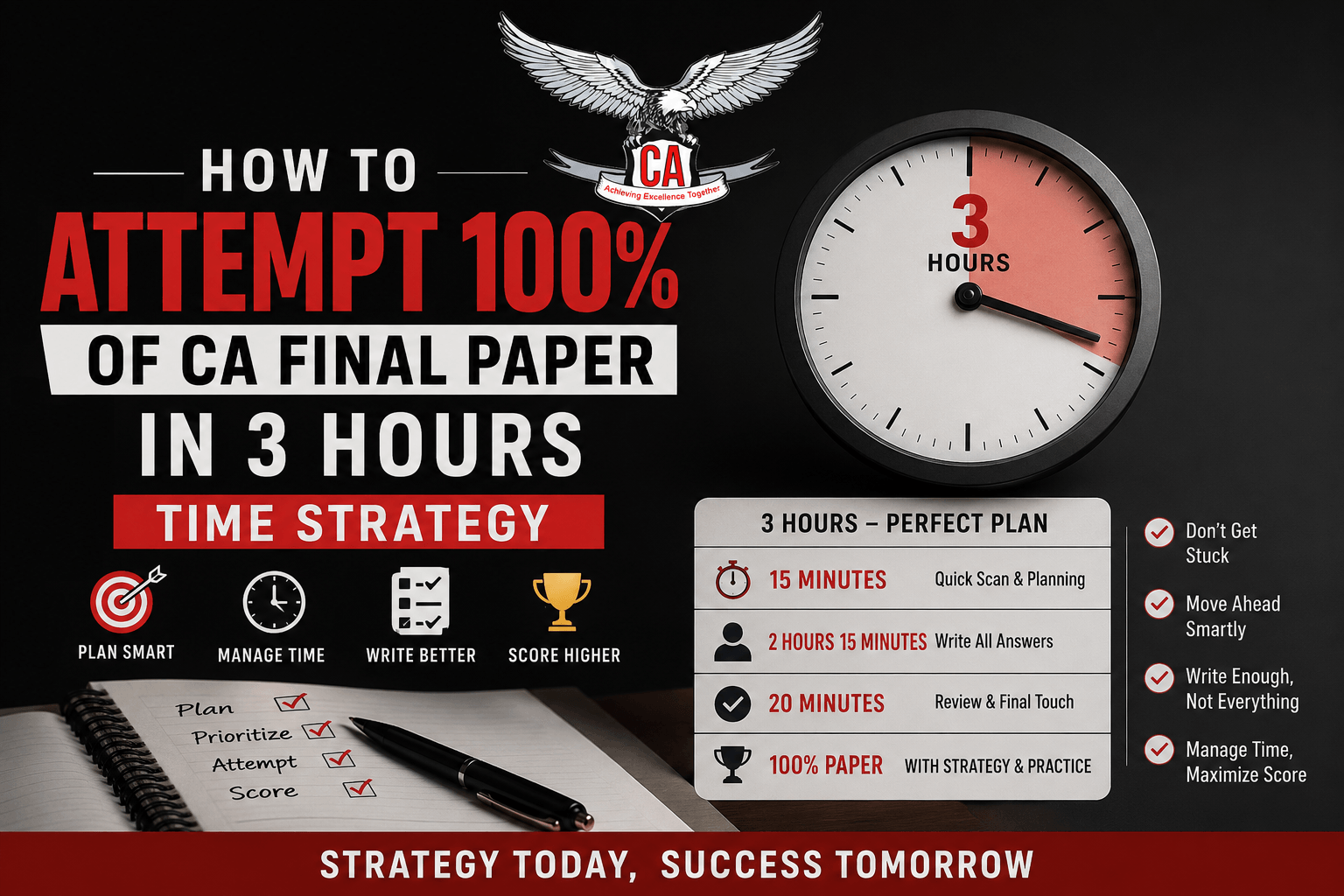
The golden rule is to attempt the paper according to marks, confidence, and time, not according to emotion. Do not give equal time to every question because a 5-mark answer and a 15-mark answer do not need the same depth. Allocate time based on marks, keep a small buffer for review, and move ahead when a question takes longer than planned. Perfectionism in the first two hours often creates pressure in the final hour, so write relevant answers and continue moving.
How to Use the 15-Minute Reading Time Effectively
The 15-minute reading time should be used as a planning tool, not as passive reading time. In the first few minutes, scan the whole paper and understand the structure. Then identify easy, moderate, and difficult questions. Finally, decide your attempt order before writing begins. Do not panic, solve full answers mentally, or spend too much time on one difficult question during reading time. A clear plan can save valuable minutes during the writing period.
Reading Time Block | What to Do | Purpose |
| First 5 minutes | Scan the complete paper | Understand structure and choices |
| Next 5 minutes | Mark easy, moderate, and difficult questions | Decide confidence level |
| Last 5 minutes | Plan attempt order | Start writing without confusion |
3-Hour CA Final Paper Time Division
A good 3-hour CA Final exam strategy divides the 180 minutes into smaller blocks so students can track progress instead of writing randomly. Start with a strong question to build confidence, use the middle phase for moderate and lengthy answers, and keep the final minutes for review. This approach helps you stay in control and reduces the chance of leaving easy marks unattempted.
Time Block | Suggested Action | Goal |
| First 10 minutes | Start with your strongest question | Build confidence |
| Next 60 minutes | Attempt easy and scoring questions | Secure marks early |
| Next 75 minutes | Complete moderate-length answers | Maintain steady progress |
| Next 35 minutes | Handle difficult or lengthy questions | Maximize remaining marks |
| Last 10 minutes | Review numbering, workings, and presentation | Avoid avoidable mistakes |
Marks-Wise Time Allocation for CA Final Answers
Marks-wise time allocation helps you control answer length and prevent overwriting. A small question should be answered directly, while a high-mark question needs more explanation, working notes, or analysis. However, no question should consume more time than its marks justify. This habit helps students attempt more questions and maintain balanced performance across the paper.
Marks | Suggested Time | Answer Style |
| 4 marks | 6–7 minutes | Short, direct, point-wise |
| 5 marks | 8–9 minutes | Focused answer with key points |
| 8 marks | 12–14 minutes | Structured answer with explanation |
| 10 marks | 15–17 minutes | Detailed but controlled answer |
| 15–20 marks | 25–32 minutes | Planned answer with clear workings |
Best Question Attempt Order in CA Final Exam
The best attempt order depends on your confidence, paper structure, and question type. In most cases, it is better to begin with a question you know well because it builds momentum and reduces nervousness. Easy questions should usually be attempted first, but “easy” means familiar and scoring, not just short. For optional questions, compare confidence, time requirement, length, and scoring potential before choosing.
Subject-Wise Time Strategy for CA Final Papers
Each CA Final subject needs a slightly different time strategy because the answer style changes from paper to paper. Financial Reporting and Advanced Financial Management require accurate calculations, formats, and working notes. Advanced Auditing needs concise professional language and point-wise presentation. Direct Tax and Indirect Tax require correct provisions, computations, and conclusions. Integrated Business Solutions is case-based, so students should read the case carefully, identify issues, and write relevant analysis without copying large parts of the question.
Answer Writing Strategy to Save Time
Answer writing should be clear, direct, and scoring. Use point-wise answers instead of long paragraphs, especially in theory papers. In practical papers, use headings, formats, and working notes so the examiner can follow your answer easily. Avoid rewriting the question because it wastes time. Underline important keywords only where useful, but do not spend time decorating the answer sheet. Write what the question asks, not everything you know about the topic.
How to Attempt 100% Paper Without Losing Quality
Attempting the full paper does not mean writing rushed or poor-quality answers. It means maintaining a balance between speed and presentation. Start fast but stay accurate, leave space if you are stuck, and move ahead instead of wasting time on one difficult part. Rough work should be used smartly to organize calculations, not to create extra confusion. Your goal should be readable, relevant, and complete answers across the paper.
Common Time-Wasting Mistakes in CA Final Exams
The most common time-wasting mistakes include spending too much time on the first question, trying to write perfect answers, ignoring reading time, managing calculations poorly, changing attempt order repeatedly, and not checking time after every question. These mistakes can damage the full paper even when preparation is good. To avoid them, follow a fixed time plan and review your progress after every major answer.
What to Do If You Are Running Out of Time
If you are running out of time, do not panic or give up. In the last 45 minutes, focus on questions that can be answered quickly and carry reasonable marks. Write short but scoring answers using points, keywords, formulas, provisions, and conclusions. Prioritize known questions and avoid lengthy explanations. Even partial answers can help you score if they are relevant and clearly presented.
Practice Plan to Improve CA Final Paper Speed
Paper speed improves through timed practice, not just reading. Solve ICAI past papers under time limits, attempt full-syllabus mock tests, practice chapter-wise timed tests, and review evaluated answers carefully. Track your average time per question so you know where you are slow. Regular practice under exam-like conditions helps you improve speed, accuracy, confidence, and answer presentation before the actual exam.
How CA Test Series Helps Improve Exam Time Management
CA Test Series helps CA Final students improve exam time management through ICAI-pattern mock tests, full syllabus test papers, chapter-wise practice, expert answer evaluation, and performance feedback. Students can identify slow areas, improve writing speed, and understand how to complete the paper within time. A time-based practice environment also helps students build the discipline needed to attempt 100% of the paper in the actual exam.
Sample 7-Day Practice Plan Before CA Final Exam
A focused 7-day plan before the CA Final exam should be used for revision, mock test practice, answer evaluation, and strategy correction rather than learning too many new topics. The aim is to improve execution and enter the exam hall with a clear paper attempt plan.
Day | Practice Task | Goal |
| Day 1–2 | Analyze papers and set time targets | Understand paper demand |
| Day 3–4 | Practice timed questions | Improve speed |
| Day 5 | Take a full mock test | Test exam strategy |
| Day 6 | Review evaluated answers | Fix weak areas |
| Day 7 | Revise final exam hall strategy | Build confidence |
Conclusion
Attempting 100% of the CA Final paper in 3 hours is possible when preparation is supported by a practical time strategy. Students should use reading time wisely, attempt questions in the right order, divide time according to marks, write concise answers, and practice regularly through mock tests. With a clear CA Final Paper Time Strategy and consistent practice with CA Test Series, students can improve speed, reduce exam pressure, and write better answers in the final exam.