CMA Practical Training Requirements: What Companies Accept
Understanding the CMA Practical Training Requirements is essential before accepting a training offer because not every employer or job role automatically qualifies. Under ICMAI’s current New Practical Training Scheme, students registered for the Intermediate course on or after 11 February 2020 are covered by a 15-month practical training requirement, subject to the Institute’s applicable rules. Training may be completed under a Practicing Cost Accountant, a firm of Cost Accountants, or an eligible organization while working in recognized professional areas. Before joining any company, students should verify both the organization and their actual job responsibilities through official ICMAI sources.
CMA Practical Training Requirements at a Glance
The current ICMAI scheme provides a broad range of training options, allowing students to gain experience in industry, professional practice, banking, government organizations, startups and several other sectors. The following table gives a quick overview of the main requirements students should understand before selecting a training organization.
Requirement | Current Position |
| Training duration | 15 months for students registered for Intermediate on or after 11 February 2020 |
| Training stage | Students can begin practical training from the Intermediate level |
| Main training routes | PCMA, firm of Cost Accountants or recognized organization |
| Recognized areas | Costing, accounting, finance, audit, tax, compliance, ERP, banking, insurance, project management and other approved areas |
| Organization training form | Form T-4 |
| PCMA or Cost Accountant firm | Form T-1 |
| Previous experience | May qualify for exemption subject to ICMAI approval |
| Official source | The Institute of Cost Accountants of India |
What Companies Are Accepted for CMA Practical Training?
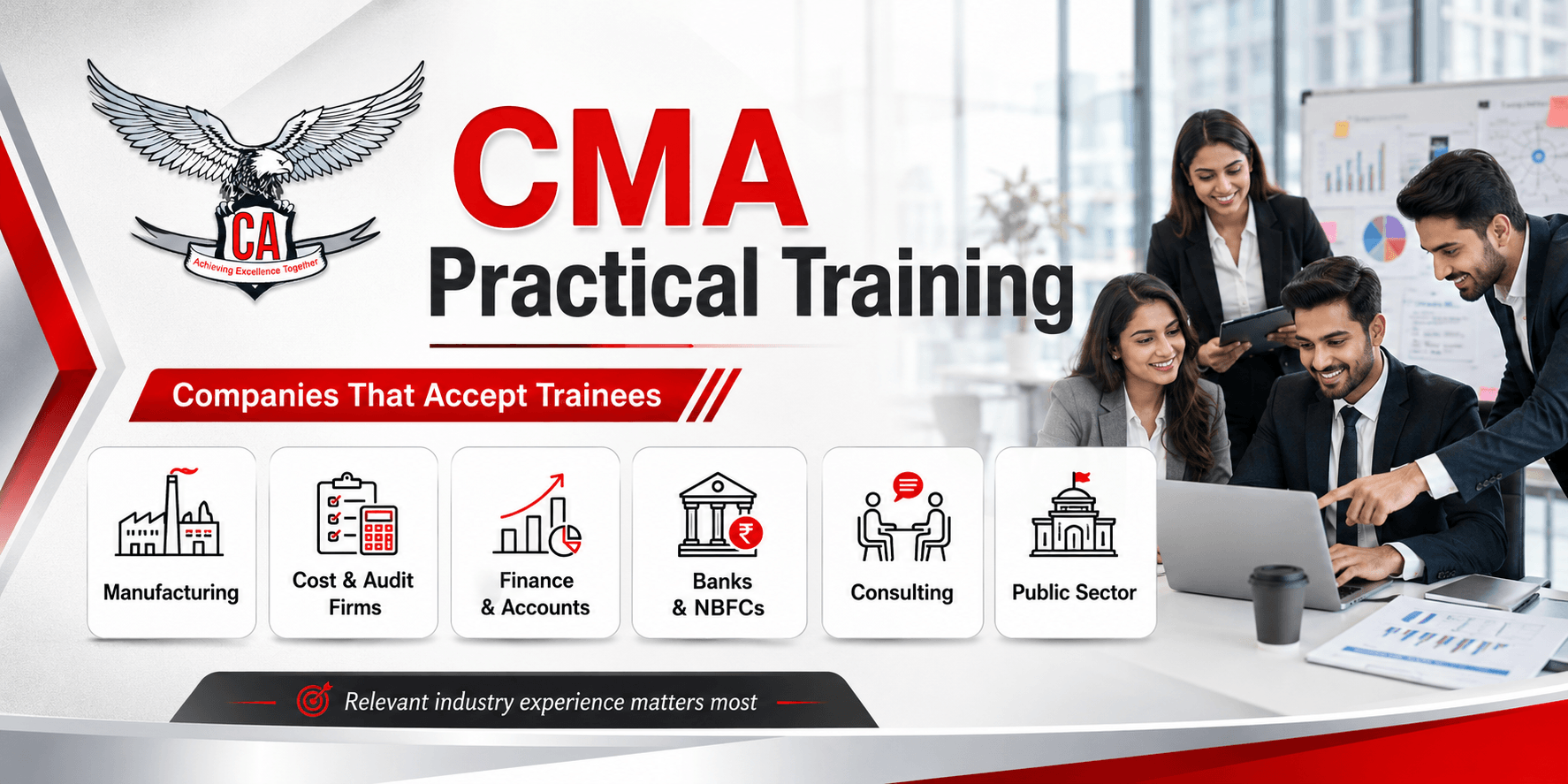
ICMAI recognizes several categories of organizations for practical training, including Central and State Government bodies, semi-government organizations, public utilities, banks, insurance companies, financial institutions, PSUs, certain educational institutions, co-operative societies, NGOs, qualifying private businesses, MSMEs and startups. Students may also train under a Practicing Cost Accountant or a firm of Cost Accountants. However, the employer category is only part of the requirement because the actual work performed must also fall within a recognized training area.
Manufacturing Companies: Manufacturing companies can be particularly valuable for CMA students because they may provide direct exposure to product costing, budgeting, inventory management, financial control, MIS, variance analysis and supply chain activities. Under the current scheme, organizations outside the service sector may qualify under the applicable recognition criteria, including the relevant turnover requirement, while eligible MSMEs and startups are separately recognized categories.
Service Sector Companies: Service companies may also provide valid CMA practical training where the organization meets the applicable ICMAI criteria and the student performs recognized professional work. Opportunities may exist in IT, consulting, logistics, financial services and other industries, particularly in finance, accounts, taxation, internal audit, ERP, MIS and project management functions.
Banks, Financial Institutions, Government Organizations and PSUs: Banks, insurance companies, other financial institutions, government and semi-government organizations, public utilities and Public Sector Undertakings are specifically included among recognized organization categories. These employers may provide useful practical experience in banking operations, finance, accounting, audit, compliance, project management and related areas.
Practicing Cost Accountants and Cost Accountant Firms: Students may complete practical training under a Practicing Cost Accountant or a firm of Cost Accountants. This route can provide exposure to cost accounting, cost audit, taxation, regulatory compliance, financial accounting and management consultancy services. Students following this route use the prescribed Form T-1 process, while training in a recognized organization is notified through Form T-4.
Which Job Roles Count Toward CMA Practical Training?
A student does not necessarily need the job title “CMA Trainee” for the work to be relevant. ICMAI recognizes a wide range of professional areas, including management accounting, cost accounting, financial accounting, financial management, auditing, regulatory compliance, direct and indirect taxation, corporate and commercial laws, ERP systems, project management, banking, insurance, financial services, management consultancy and supply chain management. The actual duties performed are therefore more important than the title printed on an offer letter.
Career Area | Relevant Training Roles |
| Cost Accounting | Product costing, cost control, cost records, variance analysis |
| Corporate Finance | Financial reporting, budgeting, working capital, financial analysis |
| Audit | Internal audit, cost audit, controls and compliance |
| Taxation | Direct tax, indirect tax and tax compliance |
| Technology and MIS | ERP, financial systems, management reporting |
| Banking | Banking operations, finance, risk and compliance |
| Supply Chain | Inventory, procurement finance and supply chain management |
How to Know Whether a Company Qualifies
Before joining, students should check the employer’s legal entity, organization category, applicable eligibility conditions, proposed department and actual job responsibilities. ICMAI maintains official information about organizations registered or empanelled for practical training, but the New Practical Training Scheme also recognizes broader organization categories. Therefore, a company not immediately visible in one online list should not automatically be considered ineligible, and students should seek official clarification when the position is uncertain.
Company Eligibility Checklist
What to Check | Why It Matters |
| Organization category | Confirms whether the employer fits an ICMAI-recognized category |
| Company eligibility conditions | Some organizations may need to satisfy specific criteria |
| Department | Helps determine whether the role offers relevant professional exposure |
| Job responsibilities | Actual duties should connect with recognized training areas |
| Training registration | The correct ICMAI process should be completed |
| Supporting documents | Records may be required for future verification |
Does Practical Training at Any Company Count?
No. Employment with a company does not automatically become recognized CMA practical training simply because the employer is large or well known. The organization should qualify under the applicable ICMAI scheme, the student's work should fall within a recognized professional area, and the prescribed training process should be followed. This means students should evaluate both the company and the role before accepting an offer.
Can You Train in an MNC, Startup, Bank or Private Company?
An MNC or private company may potentially qualify if the specific employing entity satisfies the relevant ICMAI conditions and the role involves recognized work. Startups and MSMEs are specifically included among recognized organization categories, while banks and other financial institutions are also expressly listed. The safest approach is to verify the exact organization and position rather than assuming eligibility based only on the type or reputation of the employer.
Can You Complete CMA Practical Training in a CA Firm?
Ordinary CA or CS articleship is not recognized as CMA practical training under the current scheme. However, work performed exclusively in a separate Management Consultancy Division of a CA or CS firm may receive recognition on a percentage basis depending on factors such as the nature of the duties, the work performed and its connection with areas such as costing, management accounting, finance, taxation or MIS.
CMA Practical Training Registration Process
Students should complete the appropriate practical training process instead of waiting until the end of their training to address registration. Under the current scheme, Form T-1 applies to training under a PCMA or firm of Cost Accountants, while Form T-4 applies to training with a recognized organization. Form T-5 is also part of the practical training process in relation to Final examination requirements. Students should use the latest online forms and instructions published by ICMAI because procedures may be revised.
Can Previous Work Experience Count Toward CMA Practical Training?
Relevant current or previous employment may support an application for practical training exemption when the experience is gained in a recognized organization and approved area of work. Approval is not automatic, and students must follow ICMAI’s prescribed exemption process and provide supporting evidence. The Institute assesses whether the applicant’s actual responsibilities and employment circumstances satisfy the applicable requirements.
How to Choose the Best Company for CMA Practical Training
The best training company is not always the employer with the biggest brand name or highest stipend. Students should prioritize meaningful responsibilities, relevant professional exposure, good supervision, opportunities to work with real financial information and systems, reasonable exam support and potential long-term career value. A smaller organization offering hands-on costing, audit or finance experience may sometimes provide stronger learning than a famous company offering only repetitive administrative work.
Best Company Type Based on Your Career Goal
Career Goal | Training Environment to Consider |
| Cost Accounting | Manufacturing company or Cost Accountant firm |
| Corporate Finance | MNC, large corporate or financial institution |
| Audit and Compliance | Cost Accountant firm, consulting or internal audit department |
| Taxation | Professional firm or corporate tax department |
| Banking | Bank or financial institution |
| Manufacturing Career | Industrial or manufacturing organization |
| Independent Practice | Practicing Cost Accountant or Cost Accountant firm |
Common Mistakes to Avoid
Common mistakes include joining before verifying employer eligibility, accepting an unrelated role, assuming every famous company automatically qualifies, delaying the required training process, depending on outdated online information and failing to keep employment and training records. Students should also avoid choosing a company only for its stipend because the quality of practical exposure can have a much greater influence on future interviews, professional confidence and career opportunities.
CMA Practical Training Company Checklist Before You Join
Before accepting an offer, confirm that the organization appears to meet the applicable CMA Practical Training Requirements, your job responsibilities fall within a recognized area, the employer can support the necessary documentation and you understand the registration process that applies to your training route. ICMAI maintains official databases and practical training resources, so students should use those sources for final verification rather than relying only on coaching groups, social media posts or informal advice.
Final Check | Confirm |
| Is the organization eligible? | ☐ |
| Is my job role relevant? | ☐ |
| Have I checked the applicable ICMAI criteria? | ☐ |
| Do I understand the registration process? | ☐ |
| Can the employer provide required documents? | ☐ |
| Will the role provide useful professional experience? | ☐ |
Conclusion
Choosing the right organization is one of the most important parts of meeting the CMA Practical Training Requirements. Students should look beyond the company name and carefully check employer eligibility, job responsibilities, training registration and long-term learning opportunities before joining. Manufacturing companies, service businesses, banks, PSUs, government organizations, startups, financial institutions and professional Cost Accountant firms can all provide potential training opportunities when the applicable ICMAI conditions are satisfied. Because practical training rules and procedures can change, students should always verify their specific situation through the latest information published by ICMAI before making a final decision.