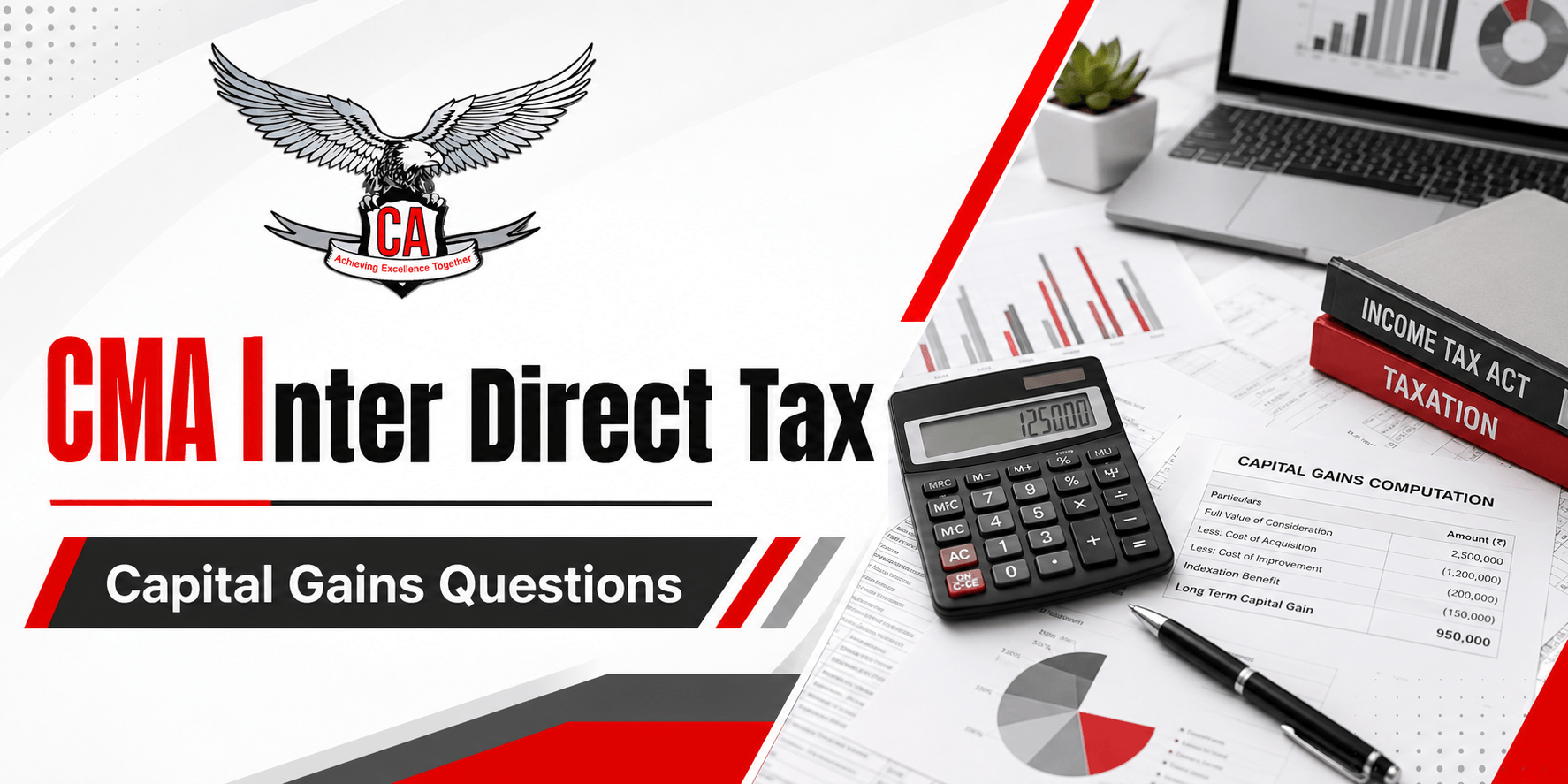
CMA Inter Direct Tax: How to Handle Capital Gains Questions
Capital Gains is an important application-based area of CMA Inter Direct Tax. Many students know the formulas but still lose marks because they classify the asset incorrectly, use the wrong cost, miss an exemption, or apply an outdated provision. The safest approach is to follow a fixed method: identify the asset, determine the holding period, check the transfer, calculate the correct cost, review exemptions, and compute the taxable gain.
Understanding Capital Gains Under CMA Inter Direct Tax
Capital Gains generally arise when a capital asset is transferred and the transaction results in a taxable gain under the applicable provisions. Before starting a computation, confirm whether the item is a capital asset, whether a valid transfer has taken place, and whether any special rule or exemption applies. A transfer may include sale, exchange, relinquishment, extinguishment of rights, compulsory acquisition, and other specified transactions.
Types of Capital Assets You Must Know
Capital assets are broadly classified as short-term or long-term according to the applicable holding period. This classification can affect computation, tax treatment, exemptions, and set-off of losses.
Asset Type | What to Check |
| Listed shares and securities | Listing status and holding period |
| Land and building | Purchase and transfer dates |
| Gifted or inherited assets | Previous owner details |
| Depreciable assets | Block of assets and WDV |
Short-Term vs Long-Term Capital Gains
STCG arises from a short-term capital asset, while LTCG arises from a long-term capital asset. Students should not apply one common holding period to every asset and should always use the rule relevant to the asset and examination term.
Capital Gains Computation Formula for CMA Inter
The general computation starts with the full value of consideration and deducts eligible transfer expenses, cost of acquisition, and cost of improvement. Where permitted, indexed cost may be used. After computing the gain, students should check whether an exemption is available.
Particulars | Treatment |
| Full value of consideration | Relevant sale or deemed value |
| Less: Transfer expenses | Eligible transfer-related expenses |
| Less: Cost of acquisition | Correct cost under applicable rules |
| Less: Cost of improvement | Eligible improvement cost |
| Less: Eligible exemption | Apply after checking conditions |
| Taxable Capital Gain | Final taxable amount |
Cost of Acquisition and Indexation
The purchase price may be the cost in a normal case, but special rules can apply to inherited property, gifted assets, bonus shares, rights shares, and self-generated assets. Indexation should be used only where permitted under the law applicable to the relevant CMA Inter examination term.
Step-by-Step Method to Solve CMA Inter Capital Gains Questions
Follow a fixed sequence: identify the capital asset, note the acquisition and transfer dates, classify it as short-term or long-term, determine the correct sale consideration, calculate the allowable cost, apply indexation where permitted, check exemptions, and calculate the taxable Capital Gain. Support important adjustments with working notes.
How to Handle Different Types of Capital Gains Questions
Different assets may require different approaches, so identify the category of question before applying the normal formula.
Sale of Land and Building: Questions involving land and buildings may include stamp duty value, cost of improvement, indexation, and exemptions. Check the actual sale value, any deemed value, purchase and transfer dates, and reinvestment details.
Sale of Shares and Securities: For shares and securities, listing status, holding period, and special tax provisions are important. Classify the asset correctly and then check whether a special rate or computation rule applies.
Depreciable, Gifted, and Inherited Assets: Depreciable assets may require block-of-assets calculations, while gifted or inherited assets can involve special cost and holding-period rules. Identify the nature and ownership history of the asset before calculating the gain.
Capital Gains Exemptions Important for CMA Inter
Exemptions can reduce taxable Capital Gains when prescribed conditions are satisfied. Focus on the original asset, eligible new investment, time limit, assessee eligibility, and amount of exemption.
Section | Broad Area | Key Exam Focus |
| 54 | Residential house property | Investment and time limit |
| 54B | Agricultural land | Usage conditions and reinvestment |
| 54EC | Specified bonds | Limit and investment period |
| 54F | Other eligible long-term asset | Net consideration and conditions |
A comparison chart is an effective revision tool because it helps students compare exemption conditions instead of memorising section numbers separately.
Set-Off and Carry Forward of Capital Losses
Short-Term and Long-Term Capital Losses should be classified separately before set-off. Students must check which gains each loss can be adjusted against and whether any unabsorbed amount can be carried forward under the applicable rules.
How to Read a Capital Gains Case-Based Question
Mark the asset type, acquisition date, transfer date, sale value, cost, improvement expenses, transfer expenses, and reinvestment details. A simple timeline is especially useful when multiple dates or exemption conditions are involved.
Recommended Answer-Writing Format
A good answer should show the relevant provision, computation, and working notes. Start with sale consideration, deduct eligible expenses and cost, calculate the gain before exemption, deduct the eligible exemption, and show the final taxable Capital Gain. Use separate working notes for holding period, indexed cost, exemptions, and loss adjustments.
Common Mistakes in CMA Inter Capital Gains Questions
Common mistakes include misclassifying STCG and LTCG, using the wrong cost, applying indexation incorrectly, missing exemptions, ignoring special provisions, and using outdated tax rules. Skipping working notes and rounding figures too early can also reduce accuracy.
Smart Preparation Strategy for CMA Inter Direct Tax Capital Gains
Build concept clarity before memorising sections. Prepare a one-page formula sheet and an exemption comparison chart. Practise basic computations first, then move to indexation, exemptions, multiple assets, case-based questions, and full total income problems. Solve previous questions, attempt timed mock tests, and maintain an error log.
Capital Gains Revision Checklist Before the CMA Inter Exam
Revise capital asset and transfer concepts, STCG and LTCG classification, cost rules, indexation, exemptions, special transactions, set-off provisions, and working note formats. Also check amendments applicable to your examination term, especially those affecting holding periods, rates, and indexation.
How CA Test Series Can Help You Prepare for CMA Inter Direct Tax
CA Test Series can support Capital Gains preparation through chapter-wise practice, CMA Inter Direct Tax mock tests, exam-pattern questions, and expert answer evaluation. Regular testing helps identify weak concepts, improve answer presentation, and build speed for practical questions.
Conclusion
Capital Gains become easier when students follow a clear problem-solving process. Identify the asset, determine the holding period, apply the correct cost and special provisions, check exemptions, and present the answer with proper working notes. With consistent practice, updated revision, and timed testing, students can handle CMA Inter Direct Tax Capital Gains questions with greater accuracy and confidence.