CA Inter Passing Rate Analysis: Which Paper Has the Lowest Pass %?
CA Inter Passing Rate Analysis helps students understand how competitive the CA Intermediate exam is and how they should plan their next attempt. Many students look only at the final pass percentage, but the real value of this analysis is in understanding group-wise difficulty, paper-wise risk, preparation gaps, and the role of mock test practice. CA Inter is not just about completing the syllabus. Students must revise regularly, solve ICAI-pattern questions, write answers properly, and manage exam time effectively. This guide explains the latest CA Inter pass percentage, the most challenging papers, common reasons for low scores, and how CA Test Series can help students improve their chances of passing.
Latest CA Inter Pass Percentage: Attempt-Wise Summary
As per the latest officially available ICAI result analysis for the January 2026 CA Intermediate examination, Group I recorded a pass percentage of 13.96%, Group II recorded 15.54%, and students appearing in both groups recorded 9.39%. These numbers show that CA Inter remains a difficult exam where students need more than basic preparation. Group I had a lower pass percentage than Group II, while both groups together had the lowest overall pass rate. This clearly shows that students attempting both groups need stronger planning, better revision discipline, and regular full syllabus mock exams before the final attempt.
CA Inter January 2026 Result Category | Candidates Appeared | Candidates Passed | Pass Percentage |
| Group I | 1,05,526 | 14,733 | 13.96% |
| Group II | 69,477 | 10,798 | 15.54% |
| Both Groups | 41,798 | 3,924 | 9.39% |
CA Inter Passing Rate Analysis: Previous Attempt Trends
CA Inter pass percentage changes from attempt to attempt depending on paper difficulty, student preparation, evaluation standards, and overall exam performance. Instead of seeing a low pass percentage as a reason to panic, students should use it as a planning tool. If a group has a lower pass percentage, it may need more revision time, more mock tests, and better answer-writing practice. Students should compare recent attempts to understand whether Group I or Group II has been more challenging and then prepare accordingly. A trend table in the article can help readers quickly compare performance across attempts.
Attempt | Group I Pass % | Group II Pass % | Both Groups Pass % | Key Observation |
| January 2026 | 13.96% | 15.54% | 9.39% | Group I lower than Group II |
| September 2025 | Add official data | Add official data | Add official data | Update from ICAI source |
| May 2025 | Add official data | Add official data | Add official data | Update from ICAI source |
Which CA Inter Paper Has the Lowest Pass Percentage?
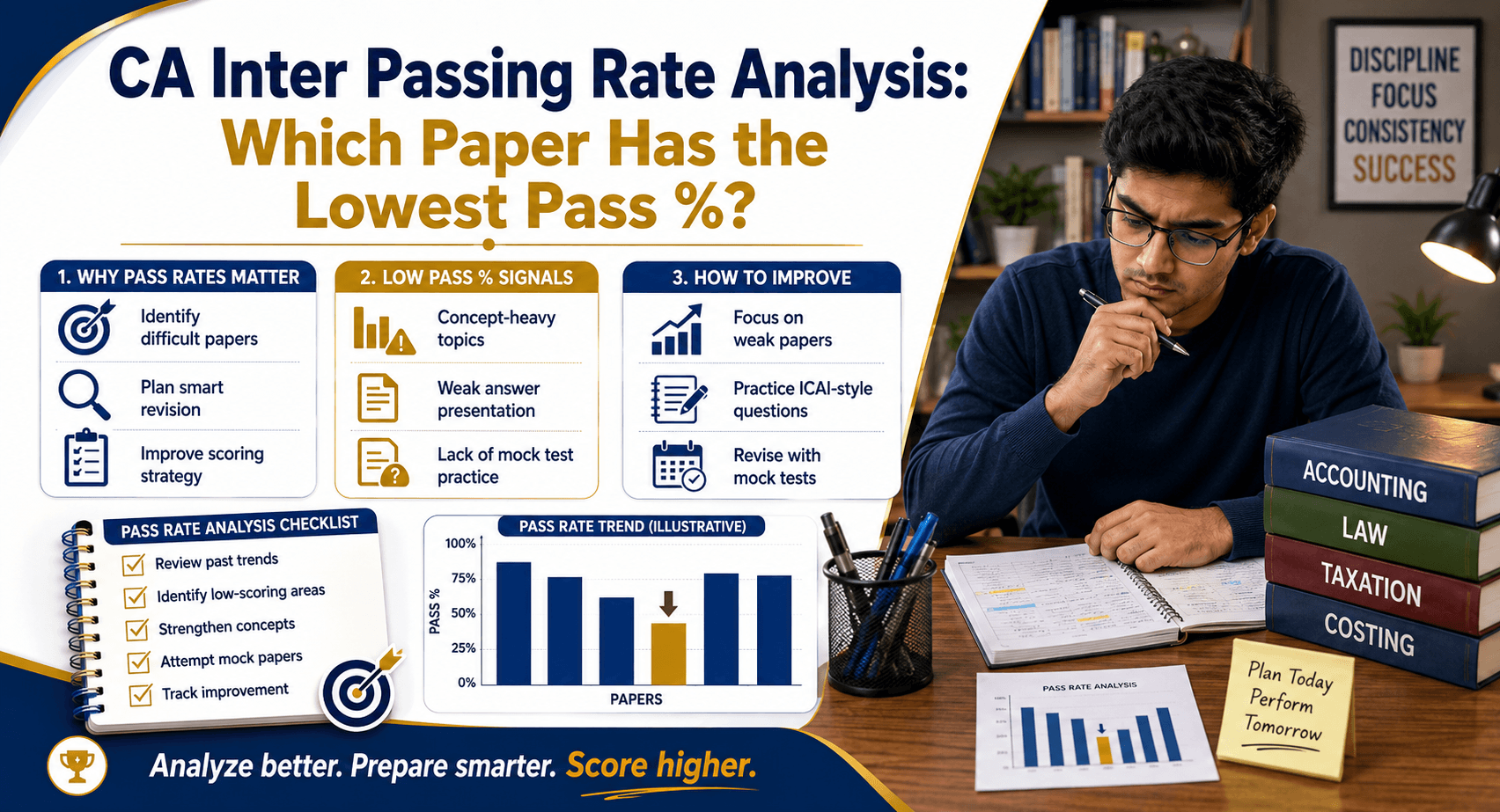
ICAI generally publishes group-wise pass percentages, not official paper-wise CA Inter pass percentages. Therefore, it is not accurate to claim that one specific CA Inter paper has the lowest official pass percentage unless ICAI releases paper-wise data. However, students can still understand paper-wise difficulty by looking at common performance patterns, mock test scores, answer evaluation feedback, and the type of mistakes students usually make. Based on preparation difficulty, Auditing and Ethics, Taxation, and Advanced Accounting are often treated as high-risk papers because they need consistent revision, strong conceptual clarity, accuracy, and proper ICAI-style presentation.
CA Inter Paper | Paper Type | Common Difficulty | Preparation Focus |
| Advanced Accounting | Practical | Concepts, formats, working notes | Daily problem practice |
| Corporate and Other Laws | Theory | Legal language and provisions | Answer writing with keywords |
| Taxation | Practical + Theory | Amendments, calculations, provisions | Repeated revision and ICAI questions |
| Cost and Management Accounting | Practical | Speed and accuracy | Formula-based practice |
| Auditing and Ethics | Theory | Keywords and presentation | ICAI-style written answers |
| FM and SM | Mixed | Formula practice and theory retention | Balanced revision |
CA Inter Group 1 vs Group 2: Which Is More Difficult?
The difficulty of CA Inter Group 1 and Group 2 depends on a student’s strengths. Group 1 may feel harder for students who struggle with Advanced Accounting and Taxation, while Group 2 may feel harder for students who are weak in Auditing, Financial Management, or theory retention. Based on January 2026 data, Group I had a lower pass percentage than Group II, but students should not assume Group II is easy. Both groups require a different preparation method. Group 1 needs strong practical command and regular Law revision, while Group 2 needs a balance of numerical practice, Audit presentation, and Strategic Management revision.
Why Do Students Score Low in Certain CA Inter Papers?
Students often score low in CA Inter because they do not prepare according to the nature of each paper. Practical subjects need repeated question-solving, while theory subjects need writing practice and proper use of keywords. Many students study the syllabus but do not attempt enough mock tests, which creates problems in time management and answer presentation. Some students also depend only on coaching notes and ignore ICAI study material, RTPs, MTPs, and previous exam questions. These mistakes can reduce marks even when the student has studied the topics. The best approach is to combine concept clarity, ICAI-based practice, mock tests, and mistake analysis.
CA Inter Passing Criteria Explained
To pass CA Inter, students must score at least 40% marks in each paper and 50% aggregate in the group. This means a student cannot pass a group only by scoring well in one or two papers if another paper falls below the minimum requirement. Students should also understand the exemption rule. If a student scores 60% or more in a paper after appearing in all papers of a group but does not clear the group, that paper may be eligible for exemption as per ICAI rules. This is why students should set paper-wise target marks instead of aiming only for the minimum score.
Requirement | Minimum Marks Needed |
| Each paper | 40% |
| Group aggregate | 50% |
| Exemption eligibility | 60% or more in a paper, subject to ICAI rules |
How to Prepare for the Lowest-Scoring CA Inter Paper
Since official paper-wise pass percentage is not usually released, students should identify their own lowest-scoring paper through mock tests. A student may be weak in Audit because of poor keywords, weak in Taxation because of amendments, or weak in Advanced Accounting because of calculation and presentation errors. The right strategy is to find weak chapters early, solve ICAI-pattern questions, attempt chapter-wise tests, and then move to full syllabus mock exams. After every test, students should review mistakes carefully and maintain a mistake book. This makes revision more focused and helps avoid repeated errors in the final exam.
How CA Test Series Helps Improve CA Inter Pass Chances
CA Test Series helps CA Inter students improve their pass chances by giving them ICAI-pattern test papers, chapter-wise practice tests, full syllabus mock exams, expert answer evaluation, and performance feedback. Instead of preparing blindly, students can understand which chapters are weak, where marks are being lost, and how their answers can be improved. Expert evaluation is especially useful because many students do not notice their own mistakes in presentation, working notes, keywords, or answer structure. With regular testing and feedback, students can improve both confidence and exam readiness before the actual CA Inter attempt.
CA Test Series Feature | How It Helps Students |
| ICAI-pattern test papers | Builds familiarity with exam-style questions |
| Chapter-wise tests | Improves weak topics one by one |
| Full syllabus mock exams | Tests complete exam readiness |
| Expert evaluation | Identifies presentation and concept mistakes |
| Performance feedback | Shows subject-wise and chapter-wise gaps |
| Improvement plan | Helps students revise more strategically |
CA Inter Passing Rate Analysis: Smart Study Plan for Students
A smart CA Inter study plan should be based on the student’s group, weak subjects, revision stage, and mock test performance. Students attempting Group 1 should focus on Advanced Accounting and Taxation practice while revising Law regularly. Students attempting Group 2 should balance Costing, Audit, FM, and SM without ignoring theory subjects. Students attempting both groups need a disciplined timetable that includes first revision, second revision, full syllabus tests, and final mistake-book revision. Low-scoring papers should be revised more frequently, but scoring papers should not be ignored because they help improve aggregate marks.
Common Mistakes Students Make in Low Pass Percentage Papers
The most common CA Inter preparation mistakes include studying theory without writing practice, not revising difficult chapters multiple times, avoiding mock tests, spending too much time on one paper, and not following ICAI presentation style. Many students also fail to analyze their test performance after completing a mock paper. This reduces the benefit of practice. Students should treat every mock test as a learning tool. They should check why marks were lost, whether the mistake was conceptual or presentational, and how to correct it before the next test. This habit can make a major difference in final exam performance.
Key Lessons from CA Inter Passing Rate Analysis
The biggest lesson from CA Inter Passing Rate Analysis is that students should prepare strategically, not emotionally. A low pass percentage does not mean the exam is impossible, but it does show that casual preparation is risky. Students should use pass trends to choose revision priorities, identify high-risk papers, and balance difficult subjects with scoring papers. The focus should be on what students can control: syllabus coverage, revision quality, ICAI question practice, mock test performance, answer presentation, and mistake correction. With the right plan, students can improve their chances of clearing CA Inter.
Conclusion
CA Inter Passing Rate Analysis helps students understand exam difficulty, group-wise performance, and paper-wise preparation risks. Since ICAI does not generally publish paper-wise pass percentages, students should use mock test performance and expert feedback to identify their own weak papers. The best way to improve CA Inter pass chances is to revise consistently, solve ICAI-pattern questions, attempt chapter-wise and full syllabus tests, and analyze mistakes after every test. With a structured plan and proper feedback, students can prepare more confidently for the next CA Inter attempt.