CA Foundation Passing Criteria Explained
CA Foundation Passing Criteria Explained: Aggregate vs Subject-Wise Requirements
Every CA Foundation student eventually asks the same question: "How many marks do I actually need to pass?"
Some students believe scoring a high overall percentage is enough, while others focus only on clearing individual subjects. The reality is that the CA Foundation examination follows a dual passing system. To qualify, students must satisfy both the subject-wise requirement and the aggregate requirement simultaneously.
This is where many students get confused and, unfortunately, lose an attempt despite scoring what appears to be a decent overall score.
In this guide, we'll break down the CA Foundation passing criteria in simple terms, explain how aggregate marks work, discuss common mistakes students make, and show you how to plan your preparation to maximize your chances of clearing the exam in the first attempt.
Understanding the CA Foundation Passing Criteria
The Institute of Chartered Accountants of India (ICAI) has established specific passing requirements to ensure students maintain a balanced performance across all subjects.
The CA Foundation examination is not designed to reward excellence in only one or two subjects. Instead, it evaluates whether a student has a reasonable understanding of every core area covered in the syllabus.
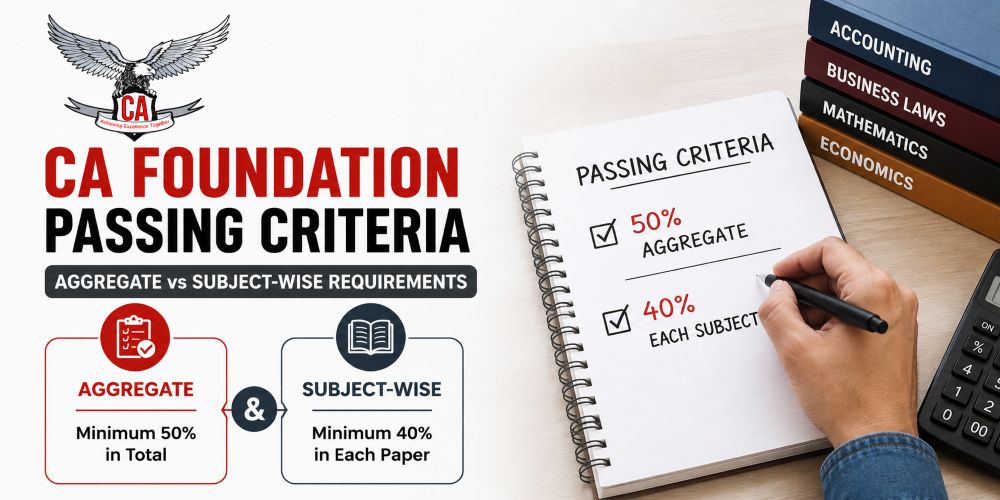
To pass the examination, students must satisfy two conditions:
Subject-Wise Passing Requirement
A student must score at least 40% marks in each paper.
Aggregate Passing Requirement
A student must secure at least 50% marks in total across all papers combined.
Both conditions are mandatory.
Even if a student satisfies one requirement but fails the other, the result will be declared as failed.
What Does Subject-Wise Passing Mean?
The 40% Rule Explained
CA Foundation consists of four papers, each carrying 100 marks.
To satisfy the subject-wise requirement, students must score a minimum of 40 marks in every paper.
For example:
| Paper | Marks Obtained |
|---|---|
| Accounting | 55 |
| Business Laws | 48 |
| Mathematics | 42 |
| Economics | 50 |
Since the student has scored above 40 in every subject, the subject-wise requirement is fulfilled.
However, this alone does not guarantee passing the examination.
The aggregate requirement must also be met.
What Does Aggregate Passing Mean?
The 50% Rule Explained
The aggregate requirement refers to the total marks obtained across all papers.
Since the CA Foundation examination consists of four papers of 100 marks each, the total marks are:
400 Marks
To achieve a 50% aggregate, students must score at least:
200 Marks out of 400
This overall score is calculated after adding marks from all subjects.
Let's look at an example.
| Paper | Marks |
|---|---|
| Accounting | 55 |
| Business Laws | 48 |
| Mathematics | 42 |
| Economics | 55 |
Total = 200 Marks
Since the student has:
- Scored more than 40 in each subject
- Achieved 200 marks overall
The student passes the examination.
Why Many Students Fail Despite Good Overall Marks
One of the biggest misconceptions among CA Foundation students is believing that a strong aggregate score automatically guarantees success.
Unfortunately, that is not how the system works.
Consider this example:
| Paper | Marks |
|---|---|
| Accounting | 80 |
| Business Laws | 75 |
| Mathematics | 25 |
| Economics | 60 |
Total = 240 Marks
At first glance, 240 out of 400 appears excellent.
However, the student scored only 25 marks in Mathematics.
Since the minimum requirement of 40 marks in every paper is not satisfied, the student fails despite having a 60% aggregate.
This example highlights why balanced preparation is critical.
Why Students Fail Despite Clearing Every Subject
The opposite situation can also occur.
A student may score more than 40 in all papers but still fail because the aggregate requirement is not met.
Example:
| Paper | Marks |
|---|---|
| Accounting | 40 |
| Business Laws | 40 |
| Mathematics | 40 |
| Economics | 40 |
Total = 160 Marks
The student has cleared every individual subject.
However, the aggregate is only 40%, which is below the required 50%.
As a result, the student fails.
Which Requirement Is More Important?
The Correct Answer: Both
Many students ask whether they should focus on aggregate marks or individual subjects.
The answer is simple:
Neither can be ignored.
A smart CA Foundation preparation strategy focuses on:
- Securing at least 50–55 marks in strong subjects
- Ensuring weaker subjects remain above 40 marks
- Building a safe aggregate above 200
The goal is not perfection.
The goal is balance.
How ICAI's Passing System Benefits Students
At first, the passing criteria may appear strict.
However, there is a practical reason behind it.
Chartered Accountancy is a professional qualification that requires competence across multiple disciplines.
A future Chartered Accountant must understand:
- Accounting
- Law
- Economics
- Quantitative concepts
ICAI's passing structure ensures students develop a balanced foundation before advancing to CA Intermediate.
Smart Strategy to Meet Both Requirements
Don't Ignore Weak Subjects
Many students spend excessive time on Accounting while completely avoiding Mathematics or Law.
This approach is risky because even one paper below 40 can lead to failure.
Aim Higher Than the Minimum
Instead of targeting exactly 40 marks, try targeting:
- 55–60 in strong subjects
- 45–50 in moderate subjects
- At least 45 in weaker subjects
This creates a safety margin.
Practice Mock Tests Regularly
Mock tests help students:
- Identify weak areas
- Improve speed
- Understand exam pressure
- Track aggregate performance
Platforms like CATestSeries.org are particularly useful because they help students evaluate both subject-wise performance and overall aggregate readiness before the actual examination.
Focus on Revision
Many students lose marks because they continuously learn new concepts but fail to revise old topics.
Regular revision improves retention and increases scoring consistency across all papers.
Common Mistakes Students Make
Focusing Only on Aggregate Marks
Students often assume high scores in Accounting can compensate for poor performance in Mathematics or Law.
This is incorrect because every subject requires a minimum score.
Ignoring One Difficult Subject
Some students completely avoid a challenging paper and hope to make up the difference elsewhere.
This strategy frequently results in failure.
Not Tracking Mock Exam Performance
Students should calculate both:
- Individual subject scores
- Total aggregate score
during every mock test.
Final Thoughts
The CA Foundation passing criteria are actually straightforward once you understand the system.
To pass, you must satisfy two conditions at the same time:
- Score at least 40% in every paper
- Score at least 50% aggregate overall
Neither condition can replace the other.
The most successful students are not necessarily the ones who score the highest in a single subject. They are the students who maintain consistency across all papers while building a comfortable aggregate score.
If your goal is to clear CA Foundation in the first attempt, focus on balanced preparation, regular mock testing, and strong revision. Doing so will help you satisfy both the aggregate and subject-wise requirements with confidence.
Frequently Asked Questions
What is the minimum percentage required to pass CA Foundation?
Students must secure at least 50% aggregate and a minimum of 40% in each paper.
Can I pass CA Foundation with 200 marks?
Yes, provided you also score at least 40 marks in every subject.
What happens if I score 250 marks but fail one paper?
You will fail because ICAI requires a minimum of 40% in every paper.
Can high marks in one subject compensate for low marks in another?
No. Every paper must independently meet the 40% minimum requirement.
Is aggregate calculated out of 400 marks?
Yes. The aggregate is calculated using the total marks obtained across all four papers.
What is a safe score to target in CA Foundation?
Most experts recommend aiming for 220–240+ marks overall while ensuring every paper remains above 45 marks.