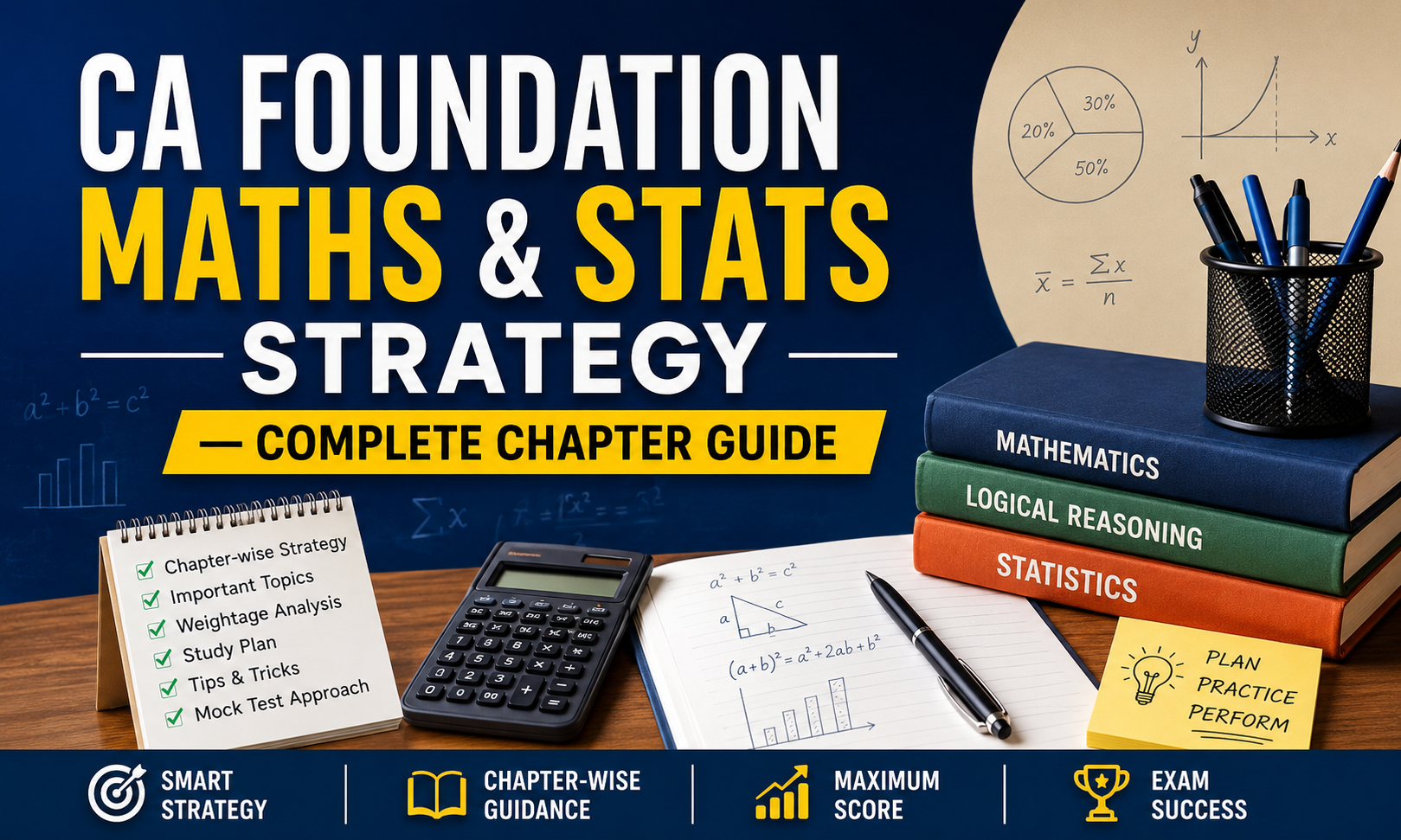
CA Foundation Maths & Stats Strategy — Complete Chapter Guide
CA Foundation Maths & Stats Strategy — Complete Chapter Guide
Preparing for the CA Foundation Mathematics, Logical Reasoning & Statistics paper can feel overwhelming at first. Many students struggle because the subject combines three different areas in one paper — quantitative aptitude, reasoning, and statistics. However, with the right strategy, this paper can become one of the highest-scoring subjects in the entire CA Foundation exam.
Unlike theory subjects, Maths & Stats rewards practice, speed, and smart chapter selection. Students who follow a proper chapter-wise plan often score 60–80 marks even if they were weak in mathematics during school.
In this complete guide by CATestSeries.org, you’ll learn the best chapter-wise preparation strategy, important topics, weightage trends, time management methods, and practical study techniques to improve your score in CA Foundation Maths & Stats.
Understanding the CA Foundation Maths & Stats Paper
The CA Foundation Maths paper consists of three major sections:
Business Mathematics
This section focuses on numerical problem-solving and conceptual mathematics. It includes topics such as ratios, equations, calculus basics, matrices, and statistics-related mathematics.
Logical Reasoning
Logical reasoning is generally considered the scoring section because questions are concept-based and repetitive in pattern.
Statistics
Statistics requires conceptual clarity along with formula application. Students often lose marks here because they memorize formulas without understanding practical usage.
The paper is objective-type with negative marking, which means accuracy matters more than random attempts.
Why Most Students Struggle in Maths & Stats
Many students enter CA Foundation with fear of mathematics. The problem usually comes from poor strategy rather than lack of ability.
Common mistakes include:
Studying difficult chapters first
Ignoring calculator practice
Memorizing formulas without application
Not practicing MCQs daily
Leaving statistics for the last month
Attempting all questions without accuracy
The biggest truth about CA Foundation Maths is simple: consistency beats intelligence.
Students who solve questions daily improve faster than students who only watch lectures.
Chapter-Wise Strategy for Business Mathematics
Business Mathematics carries significant weight in the exam. Some chapters are easy and scoring, while others require deeper practice.
Ratio, Proportion & Indices
This chapter is one of the easiest scoring areas.
Focus on:
Simplification techniques
Fraction conversions
Ratio applications
Percentage relationships
Practice mental calculations regularly because speed matters here.
Equations
Linear equations and simultaneous equations are frequently tested.
Key preparation tips:
Practice shortcut methods
Learn elimination and substitution properly
Solve MCQs under time pressure
Students who practice equations daily usually gain strong calculation confidence.
Mathematics of Finance
This is among the most important chapters for CA students because it connects with future subjects.
Important concepts include:
Simple interest
Compound interest
Annuities
EMI calculations
Present and future value
Use practical examples while studying finance mathematics. Real-world understanding improves retention.
Time Value of Money
This chapter is highly scoring if formulas are revised properly.
Create a separate formula notebook containing:
Present value formulas
Future value formulas
Discounting formulas
Annuity formulas
Revise these formulas every morning for better memory retention.
Permutations and Combinations
Students often fear this chapter unnecessarily.
The key is understanding:
Selection vs arrangement
Factorial application
Formula conditions
Avoid direct memorization. Instead, solve practical examples repeatedly.
Sequence and Series
Arithmetic progression and geometric progression questions are usually straightforward.
Focus on:
nth term
Sum formulas
Pattern identification
This chapter becomes easy after solving 40–50 MCQs.
Differential Calculus
This chapter requires conceptual understanding.
Start with:
Functions
Limits
Differentiation basics
Do not jump directly into difficult questions. Build basics first.
Matrices
Matrices are comparatively scoring because question patterns repeat frequently.
Practice:
Addition and subtraction
Multiplication
Determinants
Inverse matrices
Accuracy is extremely important in matrix calculations.
Chapter-Wise Strategy for Logical Reasoning
Logical reasoning is often the deciding factor between average and excellent scores.
Students who master reasoning can compensate for weaker mathematics sections.
Number Series
Practice pattern identification daily.
Common patterns include:
Square numbers
Cube numbers
Difference patterns
Multiplication patterns
Spend at least 15 minutes daily on number series.
Coding-Decoding
This chapter becomes easy with practice.
Focus on:
Alphabet positions
Letter shifting
Symbol replacement
Pattern observation
Most questions follow repetitive logic structures.
Direction Test & Seating Arrangement
Visualization is important here.
Use rough diagrams while practicing:
Circular arrangement
Linear seating
Direction movement
Avoid solving mentally in the beginning.
Syllogism
Syllogism questions are highly scoring.
Use:
Venn diagrams
Elimination techniques
Statement-conclusion logic
Daily practice improves speed dramatically.
Blood Relations
Students make mistakes due to confusion in relationships.
The best strategy:
Draw family trees
Use symbols
Solve slowly initially
Once accuracy improves, increase speed.
Chapter-Wise Strategy for Statistics
Statistics is scoring but formula-intensive. Most students either ignore it or study it too late.
The smartest approach is steady daily practice.
Statistical Representation of Data
This chapter is relatively simple.
Learn:
Frequency distribution
Histograms
Ogives
Graph interpretation
Visual learning works best here.
Measures of Central Tendency
This is one of the most important chapters.
Key topics:
Mean
Median
Mode
Weighted averages
Practice calculator usage extensively because lengthy calculations are common.
Measures of Dispersion
Students often lose marks due to formula confusion.
Prepare a one-page formula sheet covering:
Range
Quartile deviation
Mean deviation
Standard deviation
Daily revision is essential.
Probability
Probability is conceptual and highly scoring.
Focus on:
Basic probability rules
Conditional probability
Independent events
Solve application-based MCQs regularly.
Correlation and Regression
Understand practical interpretation instead of blindly applying formulas.
Learn:
Positive correlation
Negative correlation
Scatter diagrams
Regression equations
These concepts become easier with graphical understanding.
Index Numbers & Time Series
This chapter is practical and repetitive.
Focus on:
Laspeyres index
Paasche index
Trend analysis
Solve previous year questions carefully because patterns often repeat.
Best Study Plan for CA Foundation Maths & Stats
A structured study plan improves consistency and reduces stress.
Daily Study Strategy
An ideal daily schedule:
2 hours Mathematics
1 hour Logical Reasoning
1 hour Statistics
30 minutes formula revision
1 mock test every weekend
Avoid studying only one section for the entire day.
Weekly Revision Plan
Your weekly revision should include:
Formula revision
MCQ practice
Calculator speed practice
Error analysis
Revision matters more than passive reading.
Mock Test Strategy
Mock tests are essential for Maths & Stats preparation.
While attempting mocks:
Maintain exam timing
Avoid unnecessary guessing
Analyze wrong answers carefully
Track weak chapters
Students who solve at least 15–20 mocks perform significantly better in actual exams.
How to Improve Speed and Accuracy
Speed without accuracy is dangerous because of negative marking.
Improve Calculator Efficiency
Learn:
Memory functions
Percentage calculations
Square roots
Shortcut operations
A fast calculator user saves valuable exam time.
Solve MCQs Daily
Daily MCQ practice builds:
Confidence
Speed
Accuracy
Pattern recognition
Even 40–50 MCQs daily can create major improvement within two months.
Maintain an Error Notebook
Write down:
Incorrect formulas
Repeated mistakes
Confusing concepts
Revision of mistakes prevents repetition in exams.
Common Mistakes to Avoid in CA Foundation Maths
Many students lose marks due to avoidable errors.
Ignoring Statistics
Statistics carries good weightage and should never be skipped.
Over-Attempting Questions
Because of negative marking, accuracy matters more than total attempts.
Watching Lectures Without Practice
Concepts become strong only through solving questions.
Leaving Difficult Chapters Completely
Even difficult chapters can provide partial marks if basic concepts are understood.
Not Revising Formulas
Formula revision should happen daily, not weekly.
Best Resources for CA Foundation Maths & Stats Preparation
Choosing the right study resources matters greatly.
Useful preparation sources include:
ICAI study material
RTPs and MTPs
Previous year papers
Mock test platforms
Chapter-wise MCQ books
Students preparing through structured test series often perform better because they develop exam temperament early.
For chapter-wise mock tests, performance analysis, and practice papers, students can explore resources available on CATestSeries.org.
Final 30-Day Preparation Strategy
The last month before exams should focus on revision and testing.
First 10 Days
Revise formulas
Solve easy chapters
Build confidence
Next 10 Days
Attempt full-length mocks
Improve weak areas
Analyze mistakes
Last 10 Days
Focus only on revision
Avoid new concepts
Practice high-weightage chapters
Maintain calm and consistency
Do not panic during the final days. Calm revision works better than aggressive studying.
FAQs About CA Foundation Maths & Stats
Is CA Foundation Maths difficult for non-maths students?
No. Many non-maths students score well with consistent practice and proper chapter selection. Logical reasoning and statistics can balance weaker mathematics areas.
Which section is most scoring in CA Foundation Maths paper?
Logical Reasoning is generally considered the highest-scoring section because question patterns are repetitive and concept-based.
How many hours should I study Maths daily for CA Foundation?
Ideally, 3–4 hours daily with regular MCQ practice and revision is sufficient for strong preparation.
Can I pass CA Foundation Maths by studying only important chapters?
Yes, but relying only on selective chapters is risky. Covering at least 70–80% of the syllabus gives better safety.
How important are mock tests for Maths & Stats?
Mock tests are extremely important because they improve speed, accuracy, time management, and confidence.
What is the best way to memorize formulas?
Create a dedicated formula notebook and revise it daily. Repetition and application help formulas stay in memory longer.
Is negative marking dangerous in CA Foundation Maths?
Yes. Random guessing can reduce scores significantly. Focus on accurate attempts instead of maximum attempts.
Which is harder: Mathematics or Statistics?
This depends on individual strengths. Students comfortable with formulas may prefer statistics, while concept-oriented students often find mathematics easier.
How many mock tests should I solve before exams?
At least 15 full-length mock tests are recommended for proper exam preparation.
Can I score above 70 in CA Foundation Maths?
Yes. Students who practice consistently, revise formulas daily, and solve regular mocks can comfortably score above 70 marks.