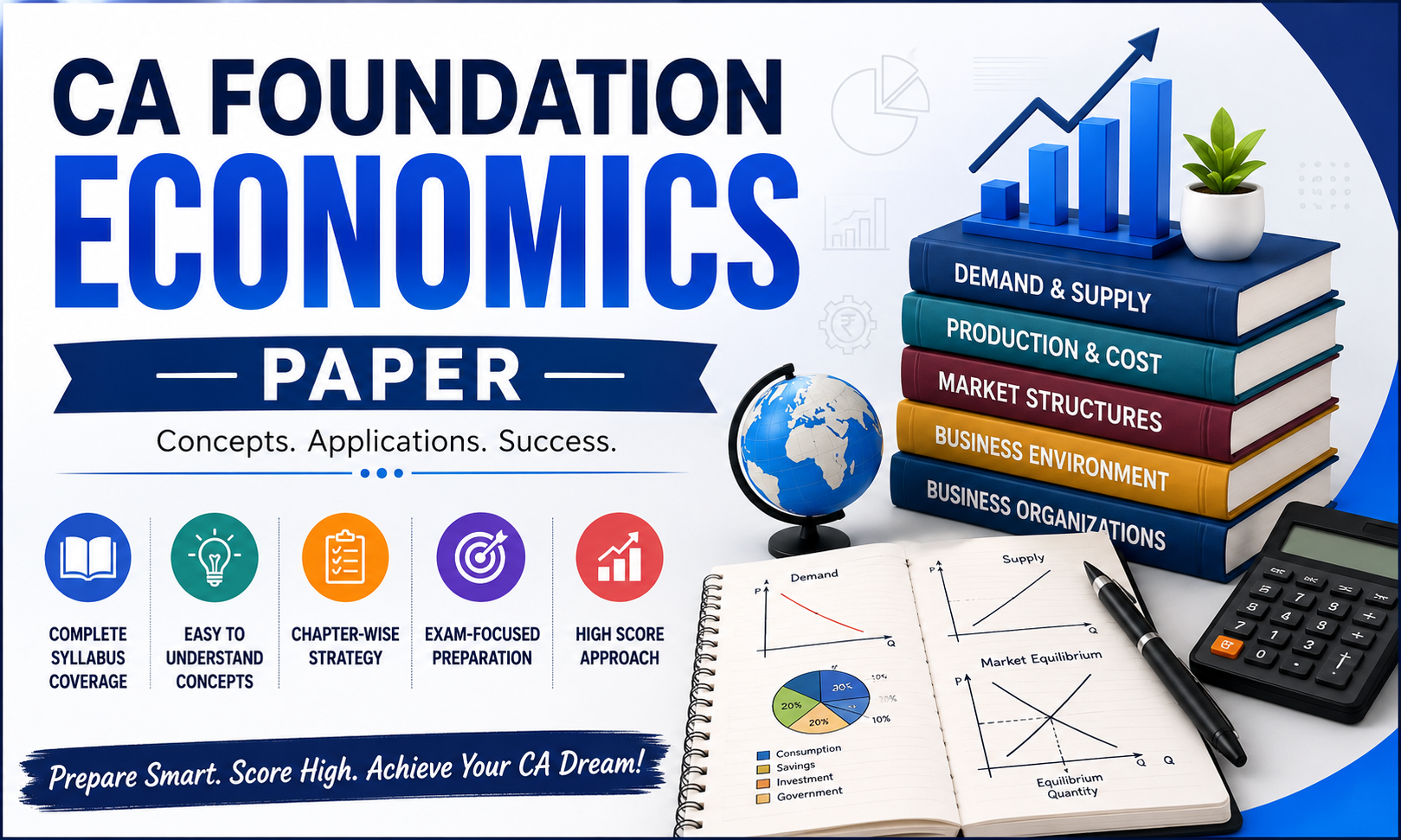
CA Foundation Economics Paper — Complete Chapter-Wise Strategy
Preparing for the CA Foundation Economics paper requires more than simply memorizing concepts. The subject tests your understanding of economic principles, analytical thinking, and the ability to apply concepts in practical situations. Many students underestimate Economics because the syllabus appears theoretical, but with the right chapter-wise strategy, scoring high marks becomes much easier.
This complete guide will help you understand how to prepare every chapter efficiently, which topics deserve maximum attention, and how to revise smartly before the exam. Whether you are a first-time aspirant or repeating the exam, this strategy is designed to help you study in a practical and result-oriented way.
Understanding the CA Foundation Economics Paper
Before starting chapter-wise preparation, it is important to understand the paper structure.
The Economics subject in CA Foundation is divided into two parts:
- Business Economics
- Business and Commercial Knowledge (BCK)
Business Economics carries conceptual and numerical-based questions, while BCK mainly focuses on theory, business environment, and practical awareness.
The paper is objective-type with negative marking, which means accuracy is extremely important. Random guessing can reduce your overall score.
To perform well:
- Focus on concept clarity
- Practice MCQs regularly
- Revise definitions and keywords
- Avoid rote memorization without understanding
A student with strong conceptual preparation can easily score 60+ in this paper.
Best Study Approach for Economics Preparation
A smart study strategy always works better than long study hours.
Focus on ICAI Study Material First
The ICAI module should be your primary source. Most MCQs and conceptual questions are directly or indirectly based on ICAI language and examples.
Do not depend only on coaching notes.
Maintain a Chapter-Wise Notebook
Create short notes for:
- Definitions
- Formulas
- Curves and graphs
- Important concepts
- Frequently confused terms
These notes become extremely useful during revision.
Practice MCQs Daily
Economics is an MCQ-based paper. Reading theory alone is not enough.
Practice:
- Chapter-wise MCQs
- Mock tests
- Previous year questions
- Time-based practice sessions
Revise Frequently
Economics concepts are easy to forget if not revised regularly.
Use:
- Weekly revision
- Formula revision
- Concept recaps
- Quick tests
Consistency matters more than studying randomly.
Chapter-Wise Strategy for Business Economics
Chapter 1: Introduction to Business Economics
This chapter forms the base of the entire subject.
Important Topics
- Meaning of economics
- Micro and macro economics
- Nature and scope of business economics
- Basic economic problems
Preparation Strategy
This chapter is theoretical and easy scoring.
Focus on:
- Definitions
- Distinctions between concepts
- Real-life business examples
Questions are generally direct and conceptual. One proper reading with revision is usually enough.
Chapter 2: Theory of Demand and Supply
This is one of the most important chapters in the syllabus.
Important Topics
- Law of demand
- Elasticity of demand
- Demand forecasting
- Law of supply
- Market equilibrium
Preparation Strategy
This chapter requires conceptual clarity.
Students often get confused in elasticity-related questions. Practice numerical and graphical questions regularly.
Special Focus Areas
- Movement vs shift in demand curve
- Types of elasticity
- Consumer behavior situations
- Practical examples from markets
Use diagrams while studying because visual learning improves retention.
Chapter 3: Theory of Production and Cost
This chapter includes both theory and practical application.
Important Topics
- Production function
- Laws of production
- Economies and diseconomies of scale
- Cost concepts
Preparation Strategy
Understand the logic behind production behavior instead of memorizing definitions.
Focus heavily on:
- Law of variable proportions
- Returns to scale
- Fixed and variable costs
- Average and marginal cost relationships
Questions from this chapter are often analytical.
Try solving MCQs after every topic instead of waiting until chapter completion.
Chapter 4: Price Determination in Different Markets
This chapter is highly scoring if concepts are clear.
Important Topics
- Perfect competition
- Monopoly
- Monopolistic competition
- Oligopoly
Preparation Strategy
Students should compare all market structures side by side.
Prepare a comparison chart for:
- Number of firms
- Nature of products
- Price control
- Entry barriers
- Competition level
This chapter becomes easy once differences between market types are understood properly.
MCQs are usually concept-based and application-oriented.
Chapter 5: Business Cycles
This is a small but important chapter.
Important Topics
- Meaning of business cycle
- Features
- Phases of business cycle
- Causes and effects
Preparation Strategy
This chapter can be completed quickly.
Focus mainly on:
- Expansion
- Boom
- Recession
- Depression
- Recovery
Questions are straightforward and theory-based.
A single-page summary note is enough for revision.
Chapter-Wise Strategy for Business and Commercial Knowledge (BCK)
Chapter 6: Introduction to Business and Business Environment
This chapter introduces fundamental business concepts.
Important Topics
- Types of business activities
- Objectives of business
- Business environment
- Environmental analysis
Preparation Strategy
BCK requires smart memorization.
Use:
- Mind maps
- Flowcharts
- Keyword-based learning
Avoid reading lengthy paragraphs repeatedly.
Instead, break topics into short points for easier recall.
Chapter 7: Business Organizations
This chapter is extremely important for examinations.
Important Topics
- Sole proprietorship
- Partnership
- LLP
- Company form of business
- Cooperative societies
Preparation Strategy
Comparative learning works best here.
Prepare tables in your notes comparing:
- Ownership
- Liability
- Formation
- Advantages
- Disadvantages
Most MCQs test conceptual differences between business structures.
Frequent revision is essential.
Chapter 8: Government Policies for Business Growth
This chapter connects economics with practical business situations.
Important Topics
- Liberalization
- Privatization
- Globalization
- Industrial policy
- Fiscal policy
Preparation Strategy
Understand the practical impact of government policies on businesses and industries.
Relate concepts with:
- Indian economy
- Current business trends
- Government reforms
Real-world examples improve memory retention significantly.
Chapter 9: Organizations Facilitating Business
This chapter contains factual information.
Important Topics
- SEBI
- RBI
- SIDBI
- NABARD
- Stock exchanges
Preparation Strategy
Students often forget institutional functions.
Use short tricks and mnemonic methods to remember:
- Roles
- Objectives
- Functions
Revise this chapter multiple times before exams because factual questions are common.
Smart Revision Plan for Economics
Preparation alone is not enough. Revision determines final marks.
30-Day Revision Strategy
First 10 Days
- Complete full syllabus revision
- Solve chapter-wise MCQs
- Mark weak areas
Next 10 Days
- Practice mock tests
- Revise mistakes
- Improve speed and accuracy
Final 10 Days
- Revise notes only
- Solve previous year papers
- Focus on formulas, concepts, and tricky MCQs
Do not start new books during the last phase.
Common Mistakes Students Should Avoid
Many students lose marks because of avoidable mistakes.
Ignoring MCQ Practice
Reading theory without solving MCQs is a major mistake.
Economics is an application-based paper.
Memorizing Without Understanding
Concepts like elasticity, production, and market structures require understanding.
Blind memorization creates confusion in exams.
Avoiding Revision
Students often study chapters once and never revise again.
Economics needs repeated revision for retention.
Guessing Excessively
Negative marking can seriously affect scores.
Attempt only questions where you have reasonable confidence.
Best Tips to Score High in CA Foundation Economics
Study Regularly Instead of Studying in Bulk
Daily study sessions are more effective than weekend marathon sessions.
Use Practical Examples
Economics becomes easier when linked with real business situations.
Practice Time Management
Mock tests help improve:
- Speed
- Accuracy
- Decision-making
Analyze Your Weak Areas
Track chapters where mistakes happen repeatedly and revise them more frequently.
Keep Revision Notes Short
Short notes save massive time during final preparation.
FAQs About CA Foundation Economics Preparation
Is Economics difficult in CA Foundation?
No. Economics becomes easy when concepts are understood clearly and revised regularly. Most students struggle because they focus only on memorization instead of conceptual learning.
Which chapters are most important in Economics?
Theory of Demand and Supply, Production and Cost, Market Structures, and Business Organizations are among the highest-weightage chapters.
How many hours should I study Economics daily?
One to two focused hours daily are usually enough if you study consistently and practice MCQs regularly.
Is ICAI material enough for preparation?
Yes. ICAI study material is the most important resource for CA Foundation Economics. Additional MCQ practice can improve performance further.
How can I improve MCQ accuracy?
Practice mock tests regularly, analyze mistakes, and avoid random guessing during exams.
Can I score 70+ in Economics?
Yes. With strong conceptual clarity, regular revision, and MCQ practice, scoring 70+ is completely achievable.
Final Thoughts
CA Foundation Economics is a scoring subject for students who prepare strategically. Instead of treating it like a theory paper, focus on understanding concepts, practicing MCQs, and revising consistently.
A chapter-wise approach helps you cover the syllabus systematically without confusion or stress. Concentrate on high-weightage chapters first, strengthen weak areas through practice, and maintain regular revision until the exam.
The students who succeed in Economics are not necessarily those who study the longest — they are the ones who study smartly, revise properly, and practice consistently.
If followed sincerely, this complete chapter-wise strategy can help you build confidence and score exceptionally well in the CA Foundation Economics paper.