CA Foundation Exam Structure: How Many Papers, Marks, and Duration
The CA Foundation exam is the first step for students who want to become Chartered Accountants in India. Conducted by the Institute of Chartered Accountants of India, the CA Foundation course introduces students to accounting, business laws, mathematics, economics, and commercial knowledge. Before starting preparation, every student should clearly understand the CA Foundation exam structure, including the number of papers, total marks, passing criteria, and exam duration.
Understanding the complete exam pattern helps students plan their study schedule effectively and avoid confusion during preparation. In this article, we will explain the entire CA Foundation exam structure in detail.
What is the CA Foundation Exam?
The CA Foundation exam is an entry-level examination for students who want to pursue the Chartered Accountancy profession. After completing Class 12, students can register for the CA Foundation course and appear in the exam conducted by ICAI.
The exam tests students in accounting, law, mathematics, economics, and business concepts. It serves as the foundation for advanced CA studies.
CA Foundation Exam Overview
Before discussing each paper in detail, let us look at the basic overview of the CA Foundation examination.
| Particulars | Details |
|---|---|
| Conducting Body | ICAI |
| Level | Entry-Level |
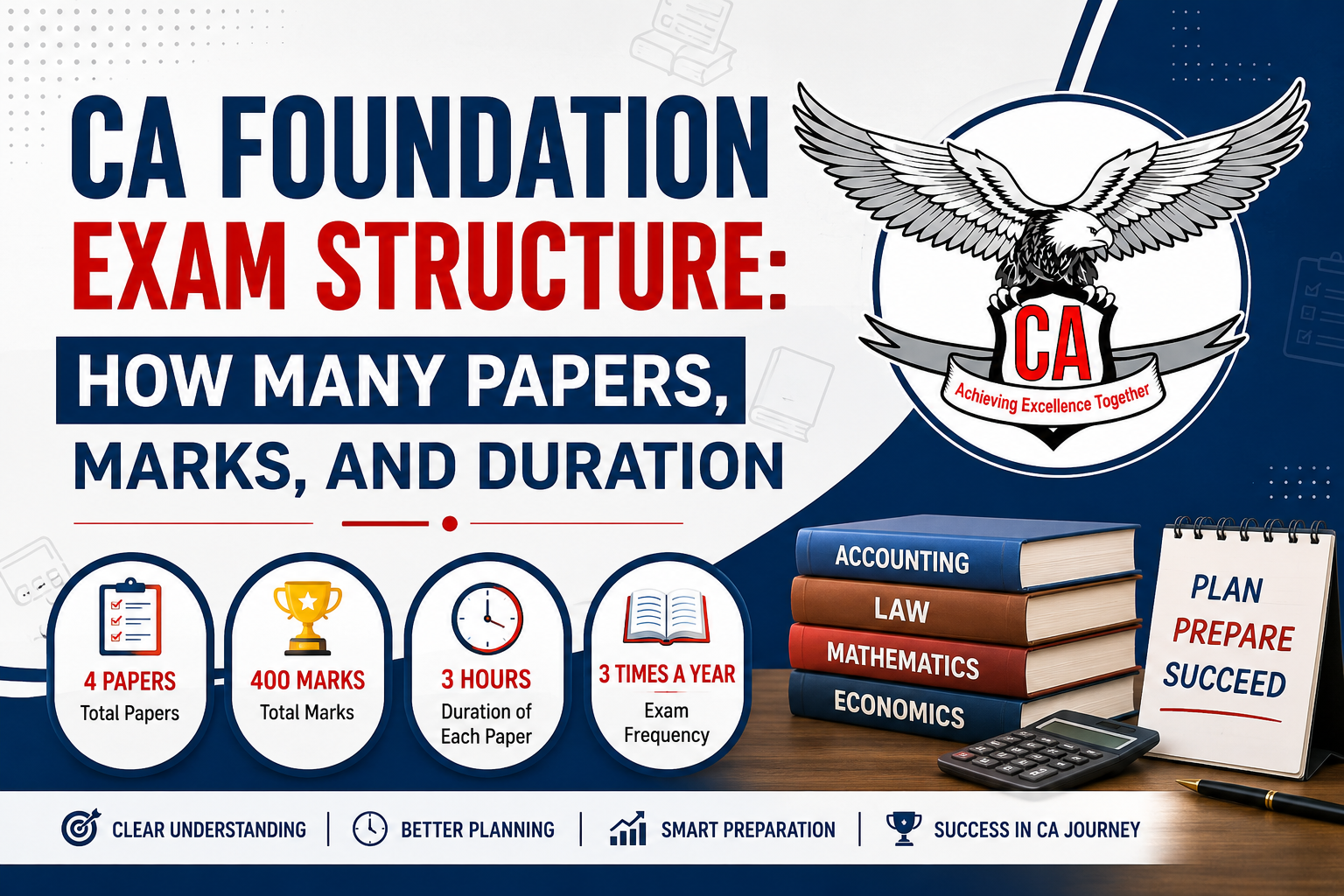
| Number of Papers | 4 Papers |
| Total Marks | 400 Marks |
| Mode of Exam | Offline/Online OMR Based (depending on paper type) |
| Exam Frequency | 3 Times a Year |
| Duration of Each Paper | 3 Hours |
| Medium | English & Hindi |
| Negative Marking | Applicable in Objective Papers |
How Many Papers Are There in CA Foundation?
The CA Foundation exam consists of four papers. These papers are divided into subjective and objective formats.
List of CA Foundation Papers
Paper 1: Principles and Practice of Accounting
This paper focuses on the fundamentals of accounting and financial principles. Students learn journal entries, ledgers, trial balance, final accounts, depreciation, bills of exchange, and other accounting concepts.
| Details | Information |
|---|---|
| Subject | Principles and Practice of Accounting |
| Marks | 100 |
| Type | Subjective |
| Duration | 3 Hours |
This is considered one of the most important papers because accounting knowledge continues throughout the CA journey.
Paper 2: Business Laws and Business Correspondence & Reporting
This paper is divided into two sections:
Section A: Business Laws
This section covers legal concepts and business regulations, including:
Indian Contract Act
Sale of Goods Act
Business Laws basics
Section B: Business Correspondence and Reporting
This section tests communication and business writing skills.
| Details | Information |
|---|---|
| Subject | Business Laws & Business Correspondence |
| Marks | 100 |
| Type | Subjective |
| Duration | 3 Hours |
Students often find this paper theory-heavy, so regular revision is important.
Paper 3: Business Mathematics, Logical Reasoning & Statistics
This paper evaluates analytical and numerical skills.
Topics Covered
Business Mathematics
Ratio and proportion
Equations
Time value of money
Permutations and combinations
Logical Reasoning
Number series
Coding-decoding
Direction tests
Statistics
Measures of central tendency
Probability
Correlation and regression
| Details | Information |
|---|---|
| Subject | Mathematics, Logical Reasoning & Statistics |
| Marks | 100 |
| Type | Objective |
| Duration | 3 Hours |
This paper contains multiple-choice questions and includes negative marking.
Paper 4: Business Economics and Business & Commercial Knowledge
This paper focuses on economics and commercial awareness.
Section A: Business Economics
Students study:
Demand and supply
Market structures
National income
Economic theories
Section B: Business & Commercial Knowledge
This section tests awareness of:
Business environment
Organizations
Government policies
Current commercial knowledge
| Details | Information |
|---|---|
| Subject | Economics & Commercial Knowledge |
| Marks | 100 |
| Type | Objective |
| Duration | 3 Hours |
This paper requires both conceptual understanding and current business awareness.
CA Foundation Total Marks
The total marks in the CA Foundation exam are 400.
Marks Distribution
| Paper | Marks |
|---|---|
| Paper 1 | 100 |
| Paper 2 | 100 |
| Paper 3 | 100 |
| Paper 4 | 100 |
| Total | 400 |
Every paper carries equal weightage, so students should focus equally on all subjects.
CA Foundation Exam Duration
Each paper in the CA Foundation exam has a duration of 3 hours.
Total Exam Hours
Since there are four papers, the total writing time becomes:
4 \times 3 = 12 \text{ hours}
Students spend a total of 12 examination hours across all papers.
CA Foundation Passing Criteria
To pass the CA Foundation exam, students must satisfy two conditions.
Minimum Marks in Each Paper
Students must score at least:
40%
in every paper.
Since each paper is of 100 marks, students need a minimum of:
40 \text{ marks out of } 100
in each subject.
Overall Aggregate Requirement
Apart from individual passing marks, students must also secure:
50%
aggregate marks overall.
That means students need at least:
200 \text{ marks out of } 400
to clear the exam.
Is There Negative Marking in CA Foundation?
Yes, negative marking applies only to objective papers.
Papers with Negative Marking
Negative marking is applicable in:
Paper 3
Paper 4
For every wrong answer:
0.25
marks are deducted.
Therefore, students should avoid random guessing in objective papers.
Subjective vs Objective Papers
Understanding the paper format helps students prepare better.
Subjective Papers
These papers require written answers:
Paper 1
Paper 2
Students must explain concepts, solve practical questions, and write descriptive answers.
Objective Papers
These papers contain MCQs:
Paper 3
Paper 4
Students mark answers on OMR sheets or computer-based systems depending on ICAI guidelines.
CA Foundation Exam Medium
Students can choose the exam language according to their preference.
Available Mediums
English
Hindi
However, certain technical sections may still appear in English even if students choose Hindi medium.
Important Features of CA Foundation Exam Structure
Balanced Subject Combination
The exam includes:
Theory subjects
Practical subjects
Analytical subjects
Communication skills
This balanced structure develops a strong base for future CA levels.
Equal Weightage to All Subjects
Every paper carries 100 marks. No single subject has extra importance in terms of marks distribution.
Focus on Conceptual Learning
The exam pattern is designed to test conceptual clarity rather than rote memorization.
Students who understand concepts usually perform better than those who only memorize answers.
Tips to Prepare According to Exam Structure
Understand the Weightage
Study high-weightage chapters first while ensuring complete syllabus coverage.
Practice Writing Answers
For subjective papers:
Improve presentation
Practice descriptive answers
Work on time management
Solve MCQs Regularly
For objective papers:
Attempt mock tests
Practice speed and accuracy
Learn elimination techniques
Focus on Revision
Revision is essential because the CA syllabus is vast.
Students should revise:
Formulae
Accounting formats
Legal provisions
Economic concepts
regularly before exams.
Common Mistakes Students Make
Ignoring Theory Subjects
Many students focus only on accounting and mathematics while neglecting law and economics.
This imbalance often leads to failure despite good marks in practical subjects.
Poor Time Management
Students sometimes spend too much time on one paper or chapter.
A balanced study schedule is necessary.
Avoiding Mock Tests
Mock tests help students understand:
Exam pressure
Time management
Weak areas
Skipping mock exams can reduce confidence in the actual examination.
Why Understanding the Exam Structure Is Important
Knowing the CA Foundation exam pattern helps students:
Build a proper study plan
Allocate time effectively
Understand scoring opportunities
Avoid unnecessary stress
Prepare strategically
Students who understand the exam structure usually prepare more confidently and efficiently.
Final Thoughts
The CA Foundation exam consists of four papers carrying a total of 400 marks, with each paper having a duration of 3 hours. Students must secure at least 40% marks in each subject and 50% overall aggregate to pass the examination.
The exam structure is carefully designed to test accounting knowledge, business laws, mathematics, economics, analytical ability, and communication skills. Since the CA journey is challenging, understanding the exam pattern from the beginning can give students a major advantage.
With proper planning, regular revision, mock tests, and conceptual clarity, students can successfully clear the CA Foundation exam and move toward the next stage of becoming a Chartered Accountant.