CA Foundation Business Mathematics: Chapter-Wise Difficulty Rating
CA Foundation Business Mathematics: Chapter-Wise Difficulty Rating
Business Mathematics is often the most feared subject in CA Foundation. Many students enter the course believing that Mathematics will be their biggest obstacle, especially those from non-Mathematics or Commerce backgrounds. However, the reality is that not all chapters in CA Foundation Business Mathematics are equally difficult.
Some chapters are highly scoring and conceptually straightforward, while others require stronger analytical thinking and extensive practice. Understanding the relative difficulty of each chapter can help students allocate their study time more effectively and build a smarter preparation strategy.
In this article, we'll analyze the major Business Mathematics chapters, assign practical difficulty ratings, and discuss how students can approach each topic to maximize their scores.
Why Chapter-Wise Difficulty Analysis Matters
Many students make the mistake of treating every chapter equally.
This often leads to:
- Spending excessive time on easy chapters
- Ignoring difficult but important topics
- Poor revision planning
- Inefficient preparation
A chapter-wise difficulty assessment helps students:
- Prioritize preparation
- Allocate study hours wisely
- Identify potential weak areas
- Improve confidence through strategic learning
Difficulty ratings in this guide are based on common student experiences, conceptual complexity, and the level of practice typically required.
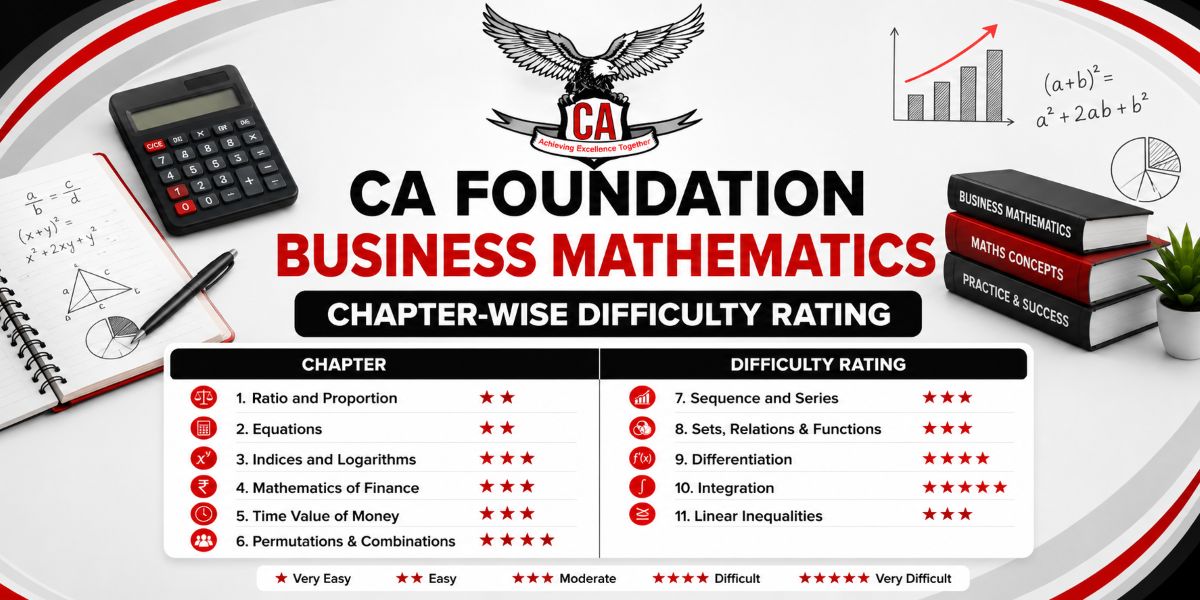
Difficulty Rating Scale
For simplicity, we'll use the following scale:
| Rating | Difficulty Level |
|---|---|
| ⭐ | Very Easy |
| ⭐⭐ | Easy |
| ⭐⭐⭐ | Moderate |
| ⭐⭐⭐⭐ | Difficult |
| ⭐⭐⭐⭐⭐ | Very Difficult |
Remember that difficulty is subjective. A student strong in Mathematics may find a chapter easier than someone with limited quantitative exposure.
Ratio and Proportion – ⭐⭐ Easy
Ratio and Proportion is usually one of the most approachable chapters in the syllabus.
Students are often familiar with these concepts from school mathematics.
Why Students Find It Easy
- Simple formulas
- Logical concepts
- Direct applications
- Limited complexity
Common Challenges
- Unit conversion mistakes
- Incorrect ratio order
- Simplification errors
Preparation Tip
Focus on understanding relationships rather than memorizing methods. Regular practice can make this one of your highest-scoring chapters.
Equations – ⭐⭐ Easy
Linear and simultaneous equations are generally straightforward for most students.
Why Students Score Well
- Predictable question patterns
- Formula-based solving techniques
- Strong overlap with school-level mathematics
Common Challenges
- Sign errors
- Calculation mistakes
- Incorrect substitution
Preparation Tip
Practice multiple question variations to improve speed and accuracy.
Indices and Logarithms – ⭐⭐⭐ Moderate
This chapter begins introducing concepts that feel unfamiliar to many students.
Why It Feels Challenging
- Several logarithmic properties
- Rule-based problem solving
- Multiple simplification steps
Common Challenges
- Forgetting logarithmic identities
- Misapplying exponent rules
Preparation Tip
Create a formula sheet and revise it regularly. Most difficulties disappear with repetition.
Mathematics of Finance – ⭐⭐⭐ Moderate
This chapter includes practical concepts such as interest, annuities, and present value calculations.
Why Students Like This Chapter
- Real-world relevance
- Formula-driven questions
- Predictable structure
Common Challenges
- Formula selection
- Long calculations
- Confusing future and present value concepts
Preparation Tip
Understand the logic behind financial calculations rather than relying solely on memorization.
Time Value of Money – ⭐⭐⭐ Moderate
This is one of the most important chapters in Business Mathematics.
Why It Matters
Time Value of Money concepts frequently appear in professional accounting and finance environments.
Common Challenges
- Compound interest calculations
- Discounting techniques
- Formula interpretation
Preparation Tip
Solve a variety of practical examples involving investments, loans, and savings.
Permutations and Combinations – ⭐⭐⭐⭐ Difficult
Many students begin encountering real difficulty here.
Why Students Struggle
- Multiple formulas
- Complex question interpretation
- Confusion between arrangement and selection
Common Challenges
- Choosing the correct formula
- Understanding restrictions and conditions
Preparation Tip
Spend more time understanding the question than applying the formula. Most mistakes occur during interpretation.
Sequence and Series – ⭐⭐⭐ Moderate
Sequence and Series is manageable once the patterns are understood.
Why Students Initially Struggle
- Formula-heavy content
- Pattern recognition requirements
Common Challenges
- Confusing arithmetic and geometric progressions
- Incorrect formula application
Preparation Tip
Practice identifying progression types quickly before solving.
Sets, Relations, and Functions – ⭐⭐⭐ Moderate
This chapter introduces more abstract mathematical thinking.
Why Students Find It Different
Unlike arithmetic chapters, it focuses more on logical relationships.
Common Challenges
- Function notation
- Domain and range concepts
- Set operations
Preparation Tip
Use diagrams and visual representations to strengthen understanding.
Differentiation – ⭐⭐⭐⭐ Difficult
Differentiation is often considered one of the tougher areas for students without a strong mathematics background.
Why It Is Challenging
- Conceptual understanding required
- Multiple differentiation rules
- Step-by-step calculations
Common Challenges
- Chain rule applications
- Product and quotient rules
- Calculation accuracy
Preparation Tip
Consistency is essential. Small daily practice sessions work better than occasional long study sessions.
Integration – ⭐⭐⭐⭐⭐ Very Difficult
Integration is commonly regarded as one of the most difficult chapters in CA Foundation Mathematics.
Why Students Struggle
- Reverse-thinking process compared to differentiation
- Multiple integration techniques
- Higher conceptual complexity
Common Challenges
- Formula recall
- Method selection
- Algebraic simplification
Preparation Tip
Master differentiation first. A strong foundation significantly improves integration performance.
Linear Inequalities – ⭐⭐⭐ Moderate
Linear inequalities are conceptually simple but require careful execution.
Common Challenges
- Sign changes
- Graph interpretation
- Solution representation
Preparation Tip
Practice graphical representation alongside algebraic solutions.
Which Chapters Should Beginners Prioritize?
Students who are weak in Mathematics should initially focus on:
- Ratio and Proportion
- Equations
- Mathematics of Finance
- Time Value of Money
- Sequence and Series
These chapters provide a strong scoring foundation while building confidence.
Which Chapters Require Extra Practice?
The following chapters generally require more attention:
- Permutations and Combinations
- Differentiation
- Integration
These areas often consume more preparation time and should not be left until the final revision phase.
A Smart Study Strategy Based on Difficulty
A practical approach is:
Phase 1: Easy Chapters
Build confidence through:
- Ratio and Proportion
- Equations
- Finance-related topics
Phase 2: Moderate Chapters
Move to:
- Logarithms
- Sequences
- Sets and Functions
Phase 3: Difficult Chapters
Allocate additional practice time for:
- Permutations and Combinations
- Differentiation
- Integration
This progression reduces overwhelm and improves retention.
The Role of Mock Tests in Mathematics Preparation
Many students understand concepts but struggle under exam conditions.
Mock tests help improve:
- Speed
- Accuracy
- Time management
- Confidence
Platforms such as CATestSeries.org provide chapter-wise tests, sectional assessments, and full-length mock examinations that help students identify difficult areas and refine their preparation strategy.
Final Thoughts
No chapter in CA Foundation Business Mathematics is impossible. What appears difficult today often becomes manageable after sufficient practice.
The key is understanding where to invest your study time. Easy chapters should be mastered quickly, moderate chapters should be revised regularly, and difficult chapters should receive focused attention throughout your preparation journey.
A strategic chapter-wise approach helps students improve efficiency, reduce stress, and maximize scoring opportunities in the examination.
Frequently Asked Questions
Which is the easiest chapter in CA Foundation Business Mathematics?
Ratio and Proportion and Equations are generally considered among the easiest chapters.
Which chapter is the most difficult?
Integration is often regarded as the most challenging chapter for many students.
Should weak Mathematics students skip difficult chapters?
No. Difficult chapters should be studied strategically, not avoided.
How much time should I spend on difficult chapters?
Allocate additional practice sessions while maintaining regular revision of easier topics.
Are chapter-wise mock tests useful?
Yes. They help identify weaknesses early and improve exam readiness.
Can I score well in Business Mathematics without a strong Maths background?
Absolutely. Consistent practice, conceptual understanding, and regular mock testing can help students from any background perform well.