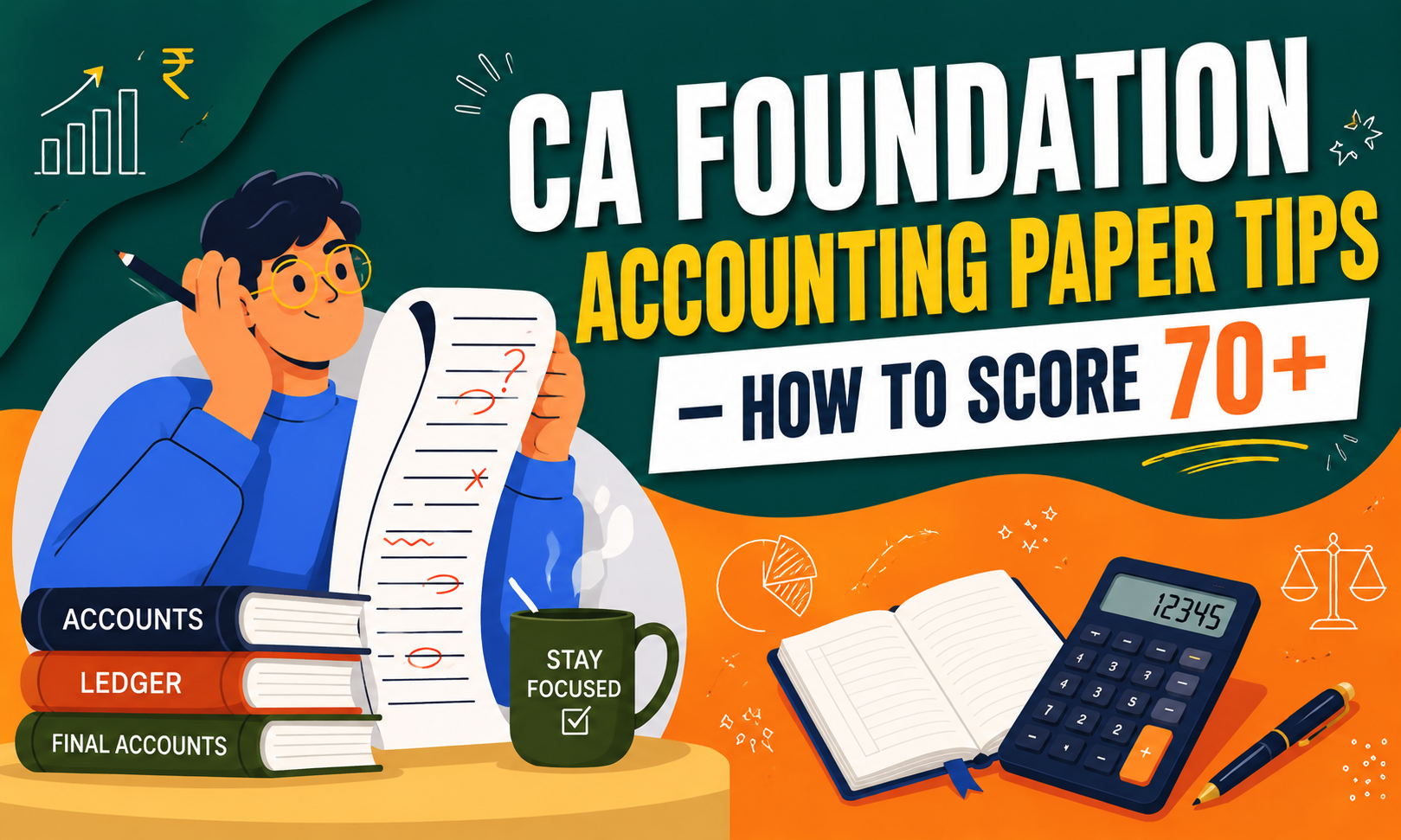
CA Foundation Accounting Paper Tips — How to Score 70+
Scoring 70+ in the CA Foundation Accounting paper is not about studying for long hours without direction. It is about understanding concepts clearly, practicing smartly, and avoiding the common mistakes that cost marks in the exam hall. Many students focus only on completing chapters, but toppers focus on presentation, accuracy, and consistent revision.
The CA Foundation Accounts paper is one of the most scoring subjects in the exam. If prepared correctly, it can significantly improve your overall aggregate and increase your chances of clearing the exam in the first attempt.
At CATestSeries.org, students preparing for CA Foundation regularly practice through mock tests, chapter-wise tests, and exam-level papers to strengthen accuracy and speed. This article will help you understand exactly how to approach the Accounting paper strategically and score above 70 marks confidently.
Why the Accounting Paper Is a Game-Changer in CA Foundation
The Accounting paper carries 100 marks and requires both conceptual understanding and practical application. Unlike theory subjects where answers can vary slightly, Accounts rewards precision and systematic preparation.
Students who score well in Accounts usually do three things consistently:
- Practice daily
- Revise formats regularly
- Solve papers in exam conditions
A strong score in Accounts can balance weaker subjects and improve your overall rank potential.
Understand the CA Foundation Accounting Exam Pattern Properly
Before preparing, you must understand how the paper is structured.
Types of Questions Asked
The paper usually includes:
- Journal entries
- Ledger accounts
- Rectification of errors
- Bank reconciliation statement
- Final accounts
- Depreciation
- Partnership accounts
- Bills of exchange
- Inventory valuation
- Accounting standards basics
Questions test both calculation skills and accounting treatment knowledge.
Weightage Matters More Than Random Study
Not all chapters carry equal importance. High-weightage chapters should receive more practice time.
Generally important chapters include:
- Partnership Accounts
- Final Accounts
- Depreciation
- Bills of Exchange
- Bank Reconciliation
- Rectification of Errors
Students who prepare based on chapter importance perform better than students who study every chapter with the same intensity.
Build Strong Conceptual Clarity Before Memorization
One of the biggest mistakes CA Foundation students make is memorizing adjustments without understanding the logic behind them.
Accounting is rule-based. Once the logic becomes clear, solving questions becomes much easier.
Focus on the “Why” Behind Every Adjustment
Instead of memorizing journal entries directly, ask:
- Why is this adjustment passed?
- What effect does it create?
- Which account is impacted?
This improves retention and reduces confusion during tricky questions.
Learn Formats Thoroughly
Formatting errors can reduce marks even when calculations are correct.
Practice formats for:
- Trading Account
- Profit & Loss Account
- Balance Sheet
- Cash Book
- Consignment Accounts
- Partnership Adjustments
Repeated format writing improves presentation speed during exams.
Create a Smart Daily Practice Routine
Consistency matters more than occasional long study sessions.
Ideal Daily Practice Structure
A productive Accounts study routine can look like this:
1 Hour — Concept Revision
Read theory, formulas, and formats.
2 Hours — Practical Problem Solving
Solve mixed-level questions from different chapters.
30 Minutes — Error Analysis
Review mistakes carefully instead of ignoring them.
30 Minutes — Formula & Adjustment Revision
Revise entries, adjustments, and treatment rules.
This structure helps improve accuracy gradually.
Solve Questions Without Looking at Solutions
Passive learning creates false confidence.
Always attempt:
- Full calculations
- Narrations
- Formats
- Adjustments
before checking answers.
Master Calculator Speed and Accuracy
In CA Foundation Accounts, calculation mistakes are one of the biggest reasons students lose marks.
Improve Speed With Repetition
Practice:
- Addition speed
- Percentage calculations
- Depreciation calculations
- Ratio-based adjustments
The more questions you solve, the faster your calculations become naturally.
Avoid These Common Calculation Mistakes
Students frequently:
- Miss negative signs
- Ignore adjustments
- Carry forward wrong balances
- Make totaling mistakes
Always verify totals before moving to the next step.
Use Mock Tests to Build Exam Temperament
Many students know concepts but panic during the real exam because they never practiced under time pressure.
Why Mock Tests Matter
Mock tests help you:
- Improve speed
- Learn question selection
- Build writing stamina
- Identify weak chapters
- Reduce exam fear
At CATestSeries.org, students regularly practice CA Foundation-level test series designed according to ICAI standards, helping them simulate the real exam environment.
Attempt Papers in Strict Exam Conditions
While solving mock tests:
- Sit for 3 hours continuously
- Avoid interruptions
- Use only permitted materials
- Maintain proper answer-sheet presentation
This develops real exam discipline.
Learn the Art of Presentation in Accounts
Presentation directly impacts scoring in practical papers.
Even when answers are partially wrong, proper working notes and format presentation can still fetch marks.
Always Show Working Notes
Never skip calculations.
Clearly mention:
- Formula used
- Adjustment treatment
- Supporting calculations
ICAI awards step marks when the approach is correct.
Keep Your Answer Sheet Clean
Maintain:
- Proper headings
- Correct formats
- Neat calculations
- Adequate spacing
Messy presentation increases the chance of unnoticed mistakes.
Chapter-Wise Strategy to Score Higher
Different chapters require different preparation approaches.
Partnership Accounts
This chapter is highly scoring if practiced regularly.
Focus on:
- Admission
- Retirement
- Goodwill treatment
- Profit-sharing ratio
- Capital adjustments
Practice comprehensive problems repeatedly.
Final Accounts
This chapter tests adjustment understanding.
Pay attention to:
- Outstanding expenses
- Prepaid expenses
- Closing stock
- Depreciation
- Bad debts
Small adjustment mistakes can affect the entire answer.
Bank Reconciliation Statement
This chapter is easy to score.
Students lose marks mainly due to:
- Direction mistakes
- Wrong additions/subtractions
- Ignoring timing differences
Practice multiple formats for confidence.
Depreciation
Understand:
- Straight Line Method
- Written Down Value Method
- Asset disposal treatment
Questions are often formula-based and highly scoring.
Avoid These Major Mistakes in the Exam Hall
Many students prepare well but still lose marks because of avoidable errors.
Starting With Difficult Questions
Attempt easier questions first to build confidence and secure marks early.
Ignoring Working Notes
Even if the final answer is wrong, working notes can still fetch marks.
Poor Time Management
Do not spend excessive time on one difficult question.
Move ahead and return later if needed.
Leaving Questions Blank
Attempt every question logically. Partial marks matter in Accounts.
Revision Strategy for the Last 30 Days
The final month before the exam should focus more on revision than learning new concepts.
First 10 Days — Chapter Revision
Revise:
- Concepts
- Adjustments
- Formats
- Journal entries
Focus on weak chapters first.
Next 10 Days — Intensive Practice
Solve:
- Mock tests
- RTPs
- MTPs
- Previous year questions
Time yourself seriously.
Final 10 Days — Mistake Correction & Fast Revision
Revise:
- Error notebook
- Common adjustments
- Important formats
- Frequently repeated concepts
Avoid overloading yourself with new material.
How Toppers Approach the Accounting Paper
Students scoring 70+ usually follow a disciplined strategy.
They Practice Daily
Even 2–3 hours of consistent practice works better than random marathon sessions.
They Analyze Mistakes
Toppers maintain error notebooks where they track:
- Conceptual mistakes
- Calculation errors
- Presentation problems
They Prioritize ICAI Material
ICAI study material remains the most important resource for preparation.
They Simulate Real Exams
Regular full-length mock tests improve confidence dramatically.
Best Resources for CA Foundation Accounting Preparation
Choosing the right resources saves time and improves efficiency.
ICAI Study Material
This should always be your primary source.
Mock Test Papers
Solve:
- ICAI MTPs
- RTPs
- Previous year papers
Test Series Platforms
Platforms like CATestSeries.org help students evaluate preparation through:
- Chapter-wise tests
- Full syllabus tests
- Performance analysis
- Exam-style practice
Structured testing improves consistency and discipline.
Time Management Strategy During the Actual Exam
A good attempt strategy can improve your score significantly.
First 15 Minutes
Use reading time wisely:
- Identify easy questions
- Mark lengthy problems
- Decide attempt order
Next 2 Hours
Attempt:
- High-confidence questions first
- Medium-level questions next
Maintain speed without sacrificing accuracy.
Final 30–40 Minutes
Use this time for:
- Rechecking totals
- Verifying adjustments
- Reviewing unanswered parts
This final review often saves crucial marks.
Motivation Matters More Than Perfection
Many students feel Accounts are difficult because they compare themselves with others.
In reality, Accounts become easier with repetition.
A student who practices consistently for 90 days usually performs far better than someone studying irregularly for 6 months.
Do not aim for perfection initially. Aim for improvement every day.
Conclusion
Scoring 70+ in the CA Foundation Accounting paper is completely achievable with the right preparation strategy. Conceptual clarity, daily practice, mock test discipline, and strong presentation skills are the real difference-makers.
Instead of studying randomly, focus on:
- Smart revision
- Repeated practice
- Error correction
- Exam-oriented preparation
The Accounting paper rewards consistency more than intelligence. Students who solve enough practical questions and revise properly almost always see significant improvement in scores.
Use quality mock tests, practice in exam conditions, and keep refining your weak areas regularly. With disciplined preparation and the right guidance, crossing 70 marks in CA Foundation Accounts becomes a realistic target rather than just a dream.
FAQs About CA Foundation Accounting Paper Preparation
How many hours should I study Accounts daily for CA Foundation?
Ideally, 2–4 focused hours daily are enough if practiced consistently with proper revision and mock tests.
Is ICAI study material enough for scoring 70+ in Accounts?
Yes. ICAI material, RTPs, MTPs, and previous year papers are more than enough when practiced thoroughly.
Which chapter is most important in CA Foundation Accounts?
Partnership Accounts, Final Accounts, Depreciation, and Bank Reconciliation are among the highest-scoring chapters.
How can I improve calculation speed in Accounts?
Daily practical solving, calculator practice, and timed mock tests help improve speed naturally.
Are mock tests necessary for CA Foundation Accounts?
Yes. Mock tests improve:
- Time management
- Accuracy
- Presentation
- Exam confidence
How many mock tests should I solve before the exam?
At least:
- 5–7 full syllabus tests
- Multiple chapter-wise tests
- Previous year papers
should be solved before the exam.
Can I score 70+ if I am weak in Accounts now?
Yes. With consistent practice and concept clarity, even average students can score above 70 marks in Accounts.
What is the biggest mistake students make in Accounts?
Ignoring revision and not practicing enough full-length questions are the most common mistakes.