
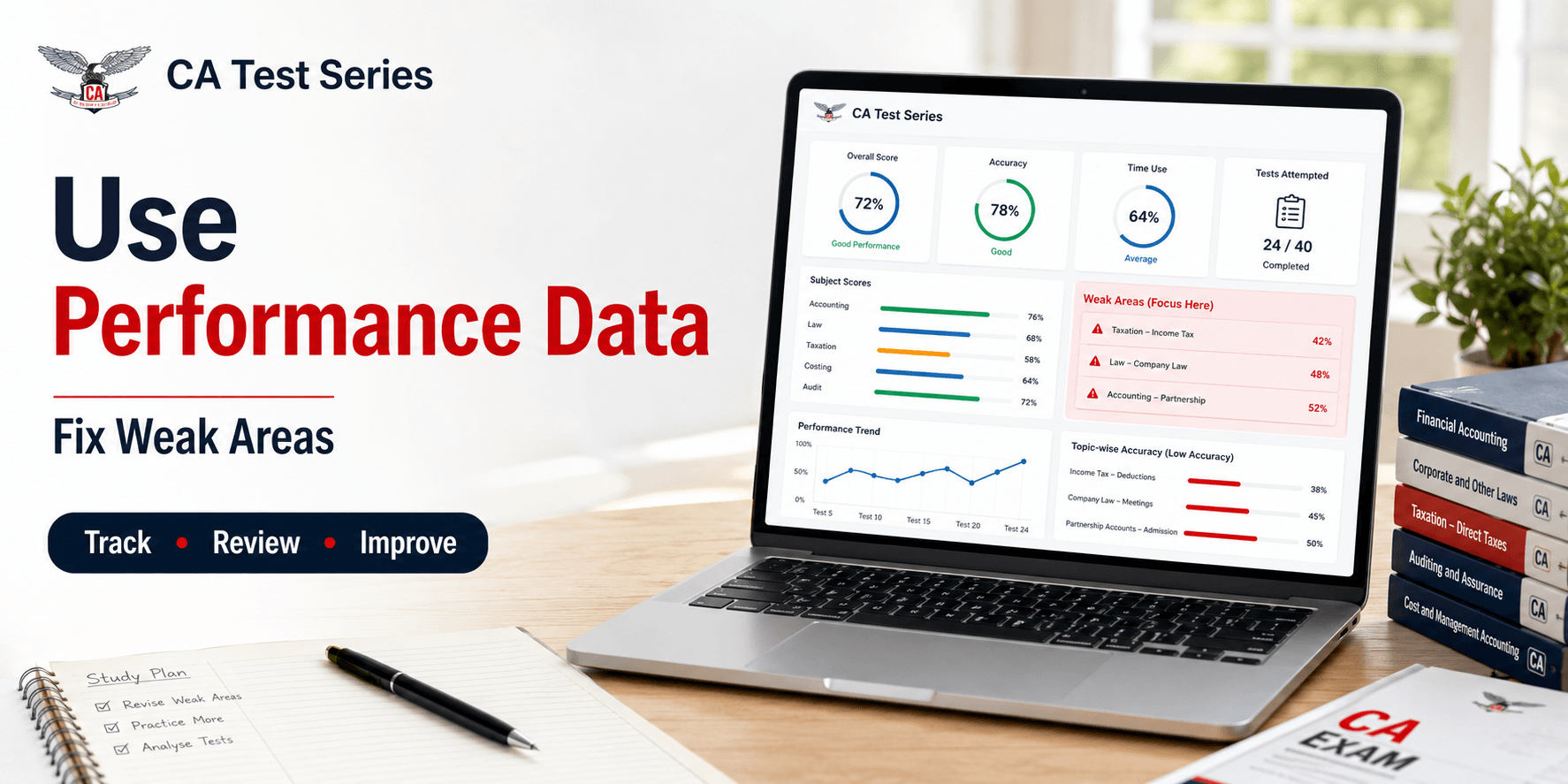
How to Use CA Test Series Performance Data to Fix Weak Areas
Many CA students take mock tests regularly, but only a few use their results properly to improve their preparation. A scorecard is not just about marks; it shows where you are strong, where you are losing marks, and what needs to be corrected before the exam. By understanding CA Test Series Performance data, students can identify weak chapters, improve time management, reduce repeated mistakes, and create a smarter revision plan for CA Foundation, CA Inter, and CA Final exams.
What Is CA Test Series Performance Data?
CA Test Series Performance data refers to the detailed information students receive after attempting a mock test, chapter-wise test, or full syllabus test. It includes marks, accuracy, time taken, skipped questions, wrong answers, topic-wise performance, concept clarity, and answer presentation feedback. This data helps students understand their actual preparation level instead of depending only on total marks.
Why Marks Alone Are Not Enough
Marks are important, but they do not explain the full reason behind weak performance. Two students may score the same marks but face different problems. One may have weak concepts, while another may know the topic but lose marks due to poor presentation, calculation mistakes, or lack of time. That is why students should review the complete performance report, not just the final score.
How Performance Data Helps CA Students Improve
Performance data gives students a clear direction for revision and practice. Instead of revising the whole syllabus randomly, students can focus on the exact chapters, question types, and skills where they are losing marks. This makes CA preparation more targeted, practical, and result-oriented.
Key Performance Data Every CA Student Should Track
Every CA student should track important performance metrics after each mock test because each metric reveals a different preparation problem. Total marks show the overall result, but subject-wise marks, chapter-wise accuracy, time per question, skipped questions, wrong answers, and evaluator feedback show where improvement is actually needed.
Performance Metric | What It Shows | Action to Take |
| Subject-Wise Marks | Strong and weak subjects | Give more time to low-scoring subjects |
| Chapter-Wise Accuracy | Weak topics or chapters | Revise concepts and solve chapter-wise questions |
| Time Taken Per Question | Speed and time management | Practice under timed conditions |
| Wrong Answers | Mistake areas | Review the reason behind each mistake |
| Skipped Questions | Lack of confidence or lack of time | Practice similar questions and improve attempt strategy |
| Answer Presentation Feedback | Writing quality and structure | Improve format, working notes, and clarity |
| Overall Trend | Progress across tests | Continue methods that show improvement |
How to Use CA Test Series Performance Data to Fix Weak Areas
Using CA Test Series Performance data becomes easier when students follow a proper process. The goal is not only to check marks but also to understand the reason behind mistakes, revise weak areas, practice again, and measure improvement through another test. This method turns every mock test into a useful improvement tool.
Step 1: Review the Full Test Report: The first step is to review the complete test report carefully instead of checking only the total score. Students should look at subject-wise marks, chapter-wise mistakes, skipped questions, time taken, and answer evaluation feedback. This gives a clear starting point for improvement.
Step 2: Separate Weak Chapters from Weak Skills: Students should separate weak chapters from weak exam skills because both need different solutions. A weak chapter needs concept revision and more practice, while a weak skill may require better time management, improved presentation, or more writing practice.
Step 3: Find Repeated Mistake Patterns: One wrong answer may be a small mistake, but repeated mistakes across different tests show a serious weak area. Students should compare old and new reports to identify errors that happen again and again, such as calculation mistakes, skipped questions, incomplete answers, or poor answer structure.
Step 4: Revise the Concept Behind Each Mistake: Students should revise the concept behind every major mistake instead of only reading the correct answer. Understanding why the answer was wrong is more useful than memorizing the solution. This builds stronger concept clarity and reduces the chance of repeating the same mistake.
Step 5: Practice and Retest: After revising a weak topic, students should solve chapter-wise questions or short practice tests to check improvement. If accuracy, speed, and confidence improve, the correction method is working. If the same mistakes continue, the student should revise the topic again with a different approach.
Common Weak Areas Found in CA Test Series Performance Analysis
CA Test Series Performance analysis usually highlights weak areas such as poor concept clarity, lack of practice, poor time management, weak answer presentation, low MCQ accuracy, and difficulty in practical questions. These problems are common during CA preparation, but they should be corrected early before they affect final exam performance.
Conceptual Weakness: Conceptual weakness means the student does not fully understand a topic or cannot apply it correctly in exam-style questions. This cannot be fixed by only memorizing answers. Students should revise the concept from the basics and then solve different types of questions from that chapter.
Poor Time Management: Poor time management is one of the main reasons students lose marks in mock tests. Some students spend too much time on difficult questions and leave easier questions incomplete. Timed practice helps students learn how to divide exam time properly and complete the paper with better control.
Weak Answer Presentation: Weak answer presentation can reduce marks even when the student knows the correct points. Poor formatting, missing working notes, unclear explanations, and unstructured theory answers make it harder for the evaluator to award marks. Students should practice writing clean, step-wise, and examiner-friendly answers.
Low Accuracy in MCQs: Low accuracy in MCQs usually happens due to weak concepts, confusion between options, careless reading, or lack of practice. Students should review every wrong MCQ and understand why the correct option is right. This improves both accuracy and confidence in objective questions.
Weak Area Improvement Plan
A weak area improvement plan helps students convert performance data into clear action. The plan should include the weak topic, reason for the mistake, revision action, practice method, and retest date. This keeps preparation organized and helps students track whether their weak areas are actually improving.
Weak Area | Reason for Mistake | Revision Action | Practice Plan | Retest Date |
| Taxation Adjustments | Concept confusion | Revise notes and examples | Solve chapter-wise questions | After 3 days |
| Audit Theory | Poor presentation | Study model answer format | Write 5 answers daily | After 4 days |
| Accounts Problem | Calculation mistakes | Review step-wise method | Practice timed sums | After 2 days |
| Law MCQs | Confusion between options | Revise provisions carefully | Attempt MCQ practice set | After 3 days |
| Costing | Time management issue | Practice faster solving methods | Attempt timed questions | After 5 days |
How CA Foundation, CA Inter, and CA Final Students Can Use Performance Data
CA Foundation, CA Inter, and CA Final students can use performance data differently based on their exam level. Foundation students should focus on basic concepts and MCQ accuracy, Inter students should balance theory and practical subjects, and Final students should focus on advanced concept application, case-based answers, and full syllabus performance.
For CA Foundation Students: CA Foundation students should use performance data to track MCQ accuracy, improve speed, and strengthen basic concepts. Since Foundation is the first stage of the CA journey, students should build the habit of reviewing mistakes, practicing regularly, and tracking improvement from the beginning.
For CA Inter Students: CA Inter students should use performance data to manage the larger syllabus and balance different subjects. They should check group-wise weakness, theory and practical subject performance, writing speed, and chapter-wise accuracy. This helps them create a more focused revision plan.
For CA Final Students: CA Final students should use performance data to improve advanced concept clarity, case-based answer writing, time management, and full syllabus readiness. At this level, test reports are useful for refining strategy, improving presentation, and correcting repeated mistakes before the exam.
Mistakes Students Make While Reading Performance Reports
Many students receive performance reports but do not use them properly. They check only the final marks, ignore skipped questions, avoid reviewing wrong answers, repeat the same revision method, and fail to track progress over time. These mistakes reduce the value of mock tests and slow down improvement.
Looking Only at Total Marks
Looking only at total marks is a common mistake because marks show the result but not the reason behind it. Students should also check chapter-wise performance, skipped questions, time taken, wrong answers, and evaluator feedback to understand where they need improvement.
Not Reviewing Wrong and Skipped Questions
Wrong and skipped questions show the areas where students are losing marks. A skipped question may indicate lack of confidence, poor preparation, or lack of time. Reviewing both wrong and skipped questions helps students correct mistakes and improve their attempt strategy.
Benefits of Using CA Test Series Performance Data Regularly
Using CA Test Series Performance data regularly helps students prepare in a smarter and more organized way. It improves revision planning, increases accuracy, strengthens time management, improves answer presentation, and builds confidence before the exam. Regular analysis also helps students fix weak areas before they become serious problems.
Better Revision Planning: Performance data helps students revise according to actual weakness instead of guesswork. Students can give more time to low-scoring subjects and weak chapters while maintaining revision of stronger areas. This makes study time more effective.
Higher Accuracy and Better Time Management: When students review their wrong answers and timing issues, they understand where they are making mistakes and where they are spending too much time. Regular timed practice and mistake analysis help improve both accuracy and speed.
Stronger Exam Confidence: Students feel more confident when they can see real improvement in their test reports. Improvement in marks, accuracy, speed, and answer presentation gives students proof that their preparation is becoming stronger.
Conclusion
CA Test Series Performance data is one of the most useful tools for fixing weak areas before the exam. It helps students understand their marks, mistakes, skipped questions, timing issues, chapter-wise weakness, and answer presentation problems. When CA Foundation, CA Inter, and CA Final students analyze their test reports regularly, revise weak topics, practice again, and track improvement, they can prepare with more clarity, confidence, and control.