How to Solve CA Inter EIS (Enterprise Information Systems) in 2 Days
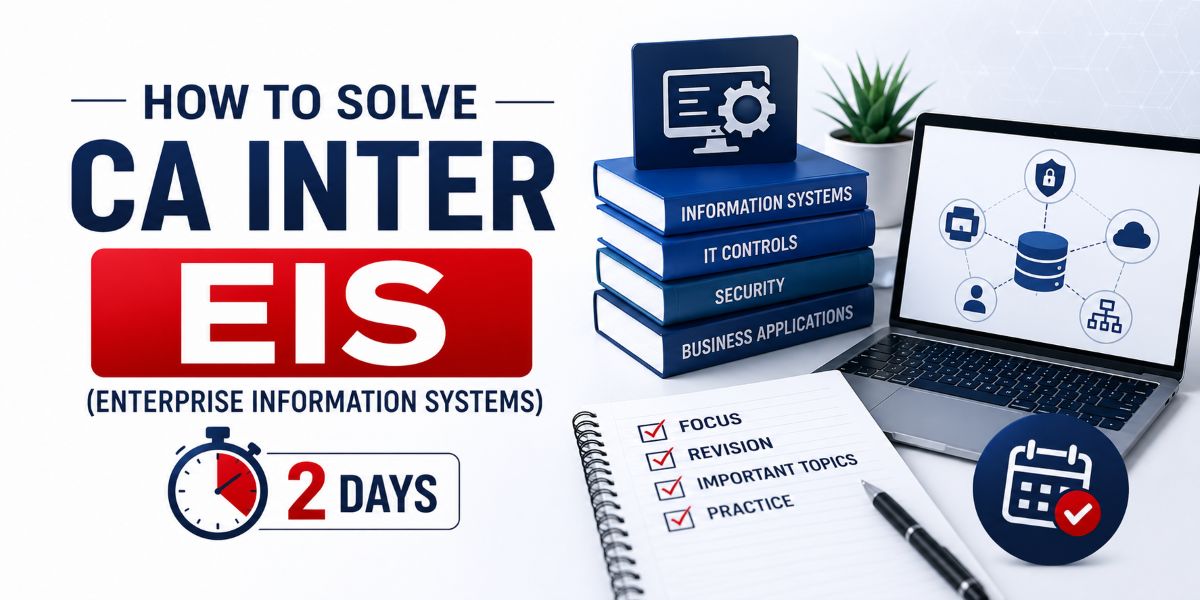
How to Solve CA Inter EIS (Enterprise Information Systems) in 2 Days
For many CA Intermediate students, Enterprise Information Systems (EIS) feels overwhelming until the final week before exams. The subject contains numerous chapters, technical terminology, and theoretical concepts that often make students believe it requires months of preparation.
The reality is different.
If your exam is approaching and you have only two days left, you can still prepare EIS effectively and score respectable marks with a focused strategy. EIS is not a subject where you need to understand every concept in depth. Success largely depends on smart revision, keyword retention, presentation skills, and selecting high-return topics.
This guide explains exactly how to prepare and solve CA Inter EIS in just 2 days without wasting time on ineffective study methods.
Is It Really Possible to Prepare EIS in 2 Days?
Yes, provided your objective is to maximize marks from the available time rather than master the entire syllabus.
Many students clear EIS by concentrating on:
- Frequently tested chapters
- Important keywords
- ICAI language and presentation
- Repeated examination patterns
- Selective preparation of high-weightage topics
The key is not studying everything. The key is studying what matters most.
Understanding the Nature of EIS Questions
Before starting preparation, it is important to understand how EIS questions are framed.
Most EIS Questions Are Theory-Based
Unlike practical subjects, EIS mainly tests:
- Concepts
- Definitions
- Frameworks
- Security measures
- Controls
- Information systems applications
Most answers require descriptive writing rather than calculations.
Keywords Carry Significant Weight
Examiners often look for specific ICAI terminology.
For example, if a question asks about information security controls, writing relevant keywords such as:
- Preventive controls
- Detective controls
- Corrective controls
can significantly improve marks even if the answer is not word-for-word from the study material.
What to Study on Day 1
Day 1 should focus on covering the highest-scoring areas of the syllabus.
Step 1: Analyze Previous Year Questions
Spend the first hour reviewing:
- Last 5 to 10 exam papers
- RTPs (Revision Test Papers)
- MTPs (Mock Test Papers)
Identify:
- Frequently repeated questions
- Common theory areas
- Chapters with consistent weightage
You will quickly notice that certain concepts appear repeatedly.
Step 2: Focus on High-Weightage Chapters
While weightage may vary slightly across attempts, students should generally prioritize chapters involving:
- Enterprise Information Systems concepts
- Business Process Management
- Information Technology Controls
- Information Security
- Business Applications of Information Systems
These areas frequently contribute a significant portion of marks.
Step 3: Prepare Short Notes
Instead of reading lengthy chapters repeatedly, create concise revision notes.
Include:
- Definitions
- Keywords
- Lists
- Flowcharts
- Mnemonics
- Important headings
The goal is to create a quick revision document for Day 2.
Step 4: Learn Through Question Patterns
Many EIS answers follow predictable structures.
For example:
Definition Questions
Answer format:
- Definition
- Explanation
- Features
- Example
Advantages and Disadvantages Questions
Answer format:
- Introduction
- Advantages in points
- Limitations in points
- Conclusion
Following a structured format improves presentation and readability.
What to Study on Day 2
Day 2 should focus entirely on revision and answer-writing practice.
Revise Keywords Multiple Times
Keywords are often the difference between average and good marks.
Examples include:
- Authentication
- Authorization
- Encryption
- Segregation of Duties
- Access Control
- Backup Management
- Disaster Recovery
- Business Continuity Planning
These terms should become instantly recognizable.
Practice Writing Answers
Many students know concepts but struggle during the exam because they have never written answers.
Practice:
- 3-mark questions
- 5-mark questions
- 6-mark questions
Focus on writing concise and structured responses.
Revise RTPs and MTPs
ICAI RTPs and MTPs often provide valuable clues regarding important topics.
Pay special attention to:
- Recently introduced concepts
- New amendments
- Current examination trends
Memorize Important Lists
Lists are frequently tested in EIS.
Examples include:
- Types of controls
- Components of information systems
- Security threats
- Business process categories
- Risk management techniques
These questions offer easy scoring opportunities.
Smart Techniques to Memorize EIS Quickly
Use Mnemonics
Mnemonics simplify retention.
For example, when memorizing multiple control objectives or security principles, create short memory aids from the first letter of each point.
Learn Headings First
Students often try to memorize complete paragraphs.
A better approach is:
- Learn main headings.
- Understand sub-points.
- Expand naturally during the exam.
This method is faster and more effective.
Use Active Recall
Instead of reading repeatedly:
- Close the book.
- Recall concepts mentally.
- Write them down.
- Check what you missed.
Active recall improves retention significantly compared to passive reading.
How to Write EIS Answers for Maximum Marks
Use Proper Headings
Examiners appreciate organized answers.
Always include:
- Main heading
- Sub-headings
- Bullet points
Avoid large blocks of text.
Highlight Keywords
Underline important terms wherever possible.
Examples:
- Information Security
- Internal Controls
- Data Integrity
- Confidentiality
This makes it easier for examiners to identify relevant points.
Use Bullet Points
Bullets improve readability and save time.
Instead of writing lengthy paragraphs, break answers into:
- Point 1
- Point 2
- Point 3
- Point 4
This approach often results in better presentation marks.
Include Diagrams Where Relevant
Simple diagrams, flowcharts, and frameworks can improve answer quality and make concepts easier to explain.
Common Mistakes Students Make During Last-Minute EIS Preparation
Trying to Study Every Chapter
This usually leads to confusion and poor retention.
Instead:
- Focus on important chapters.
- Cover frequently asked topics.
- Prioritize revision over fresh learning.
Memorizing Without Understanding
Pure memorization often fails in descriptive questions.
Understand the concept first and then remember the keywords.
Ignoring RTPs and MTPs
Many students rely solely on notes.
RTPs and MTPs provide insight into the examiner's expectations and should never be skipped.
Avoiding Answer Writing
Reading alone creates false confidence.
Writing answers helps identify weak areas and improves speed.
A Practical 2-Day EIS Study Plan
Day 1
Morning Session
- Previous year questions
- Chapter weightage analysis
- Important topic identification
Afternoon Session
- Study major chapters
- Prepare short notes
- Mark important keywords
Evening Session
- Solve RTP questions
- Revise completed topics
Day 2
Morning Session
- Revise short notes
- Memorize lists and keywords
Afternoon Session
- Practice answer writing
- Solve selected MTP questions
Evening Session
- Quick revision of all chapters
- Focus on high-frequency questions
- Avoid learning new topics
Can You Score Good Marks in EIS with Just 2 Days of Preparation?
Yes, many students have successfully scored well by following a focused revision strategy.
Your score depends on:
- How effectively you revise
- How well you remember keywords
- How clearly you present answers
- How intelligently you prioritize topics
Even with only two days available, disciplined preparation can help you perform much better than expected.
Conclusion
Preparing CA Inter EIS in 2 days is challenging but entirely possible when approached strategically. Instead of attempting to cover every page of the syllabus, focus on high-weightage chapters, repeated examination questions, important keywords, RTPs, and structured answer writing.
The students who score well in EIS are not necessarily the ones who study the longest. They are often the ones who revise smarter, write better answers, and understand what examiners are looking for.
With a focused 2-day plan, proper revision, and effective presentation, you can maximize your EIS score and move one step closer to clearing CA Intermediate.
Frequently Asked Questions (FAQs)
Can I complete the entire EIS syllabus in 2 days?
Completing every topic thoroughly may not be practical, but you can cover the most important and high-scoring areas effectively within two days.
Which study material should I use for last-minute EIS preparation?
Focus on ICAI study material, RTPs, MTPs, previous year questions, and concise revision notes.
Are RTPs and MTPs enough for EIS revision?
They are extremely valuable but should be combined with basic conceptual understanding and keyword revision.
How important are keywords in EIS?
Keywords are crucial because examiners often award marks based on the inclusion of relevant technical terminology.
Should I memorize answers word-for-word?
No. Understand the concept and remember the key points and terminology instead of rote memorization.
Is answer-writing practice necessary for EIS?
Yes. Writing practice improves speed, presentation, and confidence during the examination.
Can selective study help clear EIS?
Strategic selective study focused on high-weightage and frequently asked topics can significantly improve your chances of scoring well.
What is the biggest mistake students make while preparing EIS?
Trying to cover everything at the last minute instead of prioritizing important topics, keywords, and revision.