How to Avoid Working-Note Mistakes in Advanced Accounts
Advanced Accounts is a practical course that needs both conceptual knowledge and correct calculations, as well as proper presentation of answers. The importance of working notes lies in the fact that working notes demonstrate how the numbers provided in the final answer have been calculated. The help of CA Vinayak Sikka can help students to take a systematic approach towards solving Advanced Accounts problems where there would be emphasis on conceptual knowledge, use of the right formula, and right presentation. Such an approach will help students to avoid mistakes such as the use of the wrong formula, wrong base, forgetting some adjustments, and using the wrong opening/closing balance.

How Missing Working Notes Can Affect Your CA Inter Marks
Lack of clarity or working notes can influence your CA Inter grades since it will make your calculations hard to assess. Although you get the right answer, you might end up losing some marks since your working notes for your answer or adjustments are not clear enough. Working notes contribute to better presentation by making sure that you present your answer in an organised manner.
15 Mistakes Students Usually Make by CA Vinayak Sikka
1. Do Not Start Calculating Without Understanding the Question
Mistake: Commencing calculations before analysing what needs to be done.
How to attempt: Analyse the requirement first and then pick only those figures for the calculation that are required.
Example: If the requirement is purchase consideration, then Vinayak should work on only those figures that affect purchase consideration and not on other things.
Rule: Requirement → Figures → Calculation
2. Avoid Combining Adjustments into a Working Note
Mistake: Failure to make any adjustment or making more than one adjustment.
How to attempt: Make individual entries for adjustments and ascertain the effect of each adjustment on the final figure.
Example: In case the question has depreciation, provision, and outstanding expenses, handle each one individually before giving the final solution.
Principle: One Adjustment = One Working Note = Correct Solution
3. Incorrect Selection of the Base Figure
Mistake: Application of the correct formula on the incorrect base amount.
How to attempt: Check first before doing your calculation by asking yourself, “What percent of?”
Examples: In calculating for depreciation using WDV, you have to check first if it is the right percentage of the original cost.
Principle: Right Base = Right Calculation
4. Ignoring Important Dates
Mistake: Not considering the dates and working on an incorrect period.
How to Attempt: Mark all the dates and compute the correct period. Make use of a timeline if necessary.
Example: In case an asset is purchased on 1st October, then the depreciation period could be just 6 months and not 12 months.
Rule: Dates -> Period -> Calculation
5. Incorrectly Identifying Opening and Closing Numbers
Mistake: Misidentifying the opening and closing figures and hence making mistakes in calculations.
How to Attempt: Always make sure that you are working with the right figure, whether opening or closing balance.
Example: Opening Balance: Rs. 10,000 and Closing Balance: Rs. 15,000. Mistakenly taking Rs.15,000 as the opening balance will lead to an incorrect adjustment.
Formula: Opening/Closing Identification→Calculation
6. Not identifying “Already Included” and “Not Yet Included”
Mistake: Including/deducting something twice, as its treatment was not examined properly before.
How to Attempt: Find out if it is already recorded or not recorded yet and then make the change.
Example: In case of depreciation that is already included, it should not be deducted again.
Procedure: Examine Existing Treatment → Then Make the Change
7. Mentioning Double Adjustment
Mistake: Including the same adjustment twice, leading to an inaccurate figure.
How to attempt: Check off adjustments after making the adjustment so that you will not include it twice.
Example: If the goodwill adjustment is already included in the purchase price, you cannot add it again.
Concept: Make One Adjustment → Check Off → No More
8. Not showing all the steps of calculation
Mistake: Mentioning only the final answer without showing the calculation involved.
How to Attempt: All significant steps and formulas used in the working note should be mentioned. Even step marks can be earned if a slight mistake is made by writing the working.
Example:
Only Final Figure | Proper Working |
Goodwill = Rs.50,000 | Average Profit = (Rs.40,000 + Rs.50,000 + Rs.60,000) ÷ 3 = Rs.50,000 |
Goodwill = Rs.50,000 × 1 year = Rs.50,000 |
9. Not giving correct headings to working notes
Mistake: Failing to use headings for calculations, thus making the result hard to understand.
How to attempt: Ensure each working note is given a proper heading.
Example:
Without a Working Note | With Working Note |
Depreciation = Rs.60,000 | Working Note 1: Depreciation Calculation Cost of Asset = Rs.600,000 Rate of Depreciation = 10% Depreciation = Rs.600,000 × 10% = Rs.60,000 |
10. Inconsistent units
Mistake: The use of Rs., Rs.'000, and Rs. Lakhs in calculations.
How to attempt: Employ only one unit of measurement through the process, unless there is a need for conversion.
In case of Rs. lakhs, make sure all your calculations are in Rs. lakhs.
Formula: Same Unit = No Error = No Mistakes
11. Incorrect Positive and Negative Adjustments
Mistake: When an amount that should have been subtracted is added, or vice versa.
How to attempt: In the process of making adjustments, ask yourself, “Does it increase or reduce the amount?”
Example: Expense payable – Increase in expense; Expense prepaid - Reduction in expense.
12. Journal entries and working notes mixed together
Mistake: Putting together calculation and journal entries in the working note.
How to attempt: Keep calculations and journal entries separate in your working notes unless told otherwise.
Example: Do the calculation of depreciation in the working note and journal entry of depreciation in some other place.
Rule: Calculations Separated → Entries Separated
13. Failure to verify the calculation
Mistake: Replying to the problem without checking the important calculation.
How to approach: Check formulas, percentages, ratios, totals and important numbers before finalising.
Example: Recalculate depreciation and goodwill after doing working notes.
Rule: Calculating -> Checking -> Finalising
14. Lack of space for doing calculations
Mistake: Merging workings with the solution.
How to Approach: Keep the rough workings separate from the neat workings so that only the latter are shown.
Example: Carry out the rough workings on a separate page while showing only the required working in the working note.
Principle: Rough Working Separate → Neat Solution
15. Cross-Check as Much as Possible
Mistake: Failing to check whether the results make sense.
How to attempt: Conduct basic logical reconciliations where possible.
Example: Compare Total Assets to Equity and Liabilities.
Principle: Cross-Check = Find Errors = Greater Precision
CA Vinayak Sikka’s Mistake Analysis Method
Keep a “Mistakes Book” that records your recurring mistakes. After each question, write down the mistake, the reason, and ways to prevent it next time.
Mistake | Reason | Prevention |
Wrong base used | Formula not checked | Write the formula first. |
Amount added twice | Already included | Check inclusions. |
Opening/closing figures confused | Figures not labelled | Mark them clearly. |
Period missed | Date ignored | Highlight important dates |
Consistently doing this will help you find out where you go wrong.
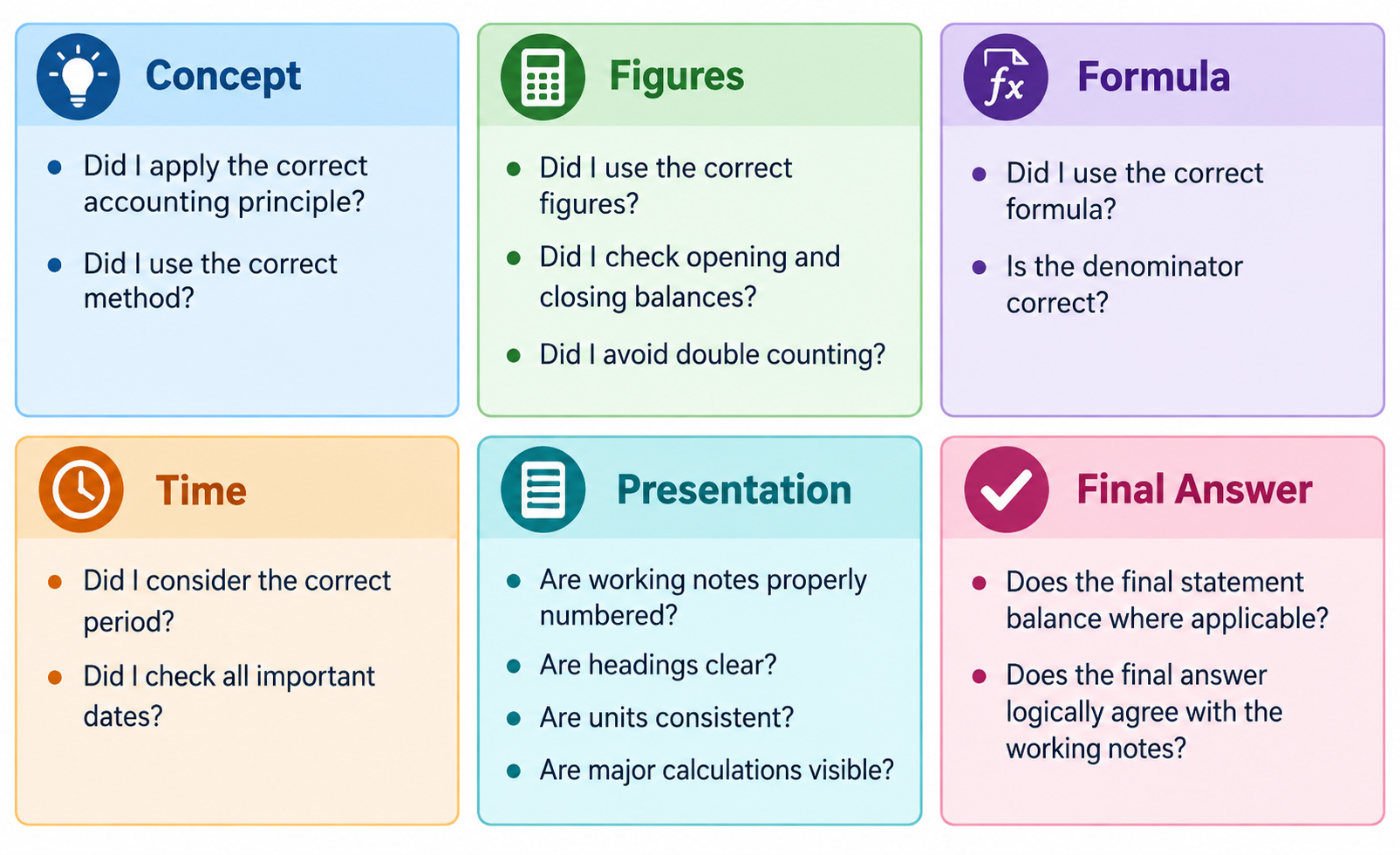
CA Vinayak Sikka’s 5-Minute Working Note Checklist
Before choosing any answer, take 5 minutes to check your working through these six criteria. This self-check will be helpful to find errors and safeguard marks in CA Inter examinations.
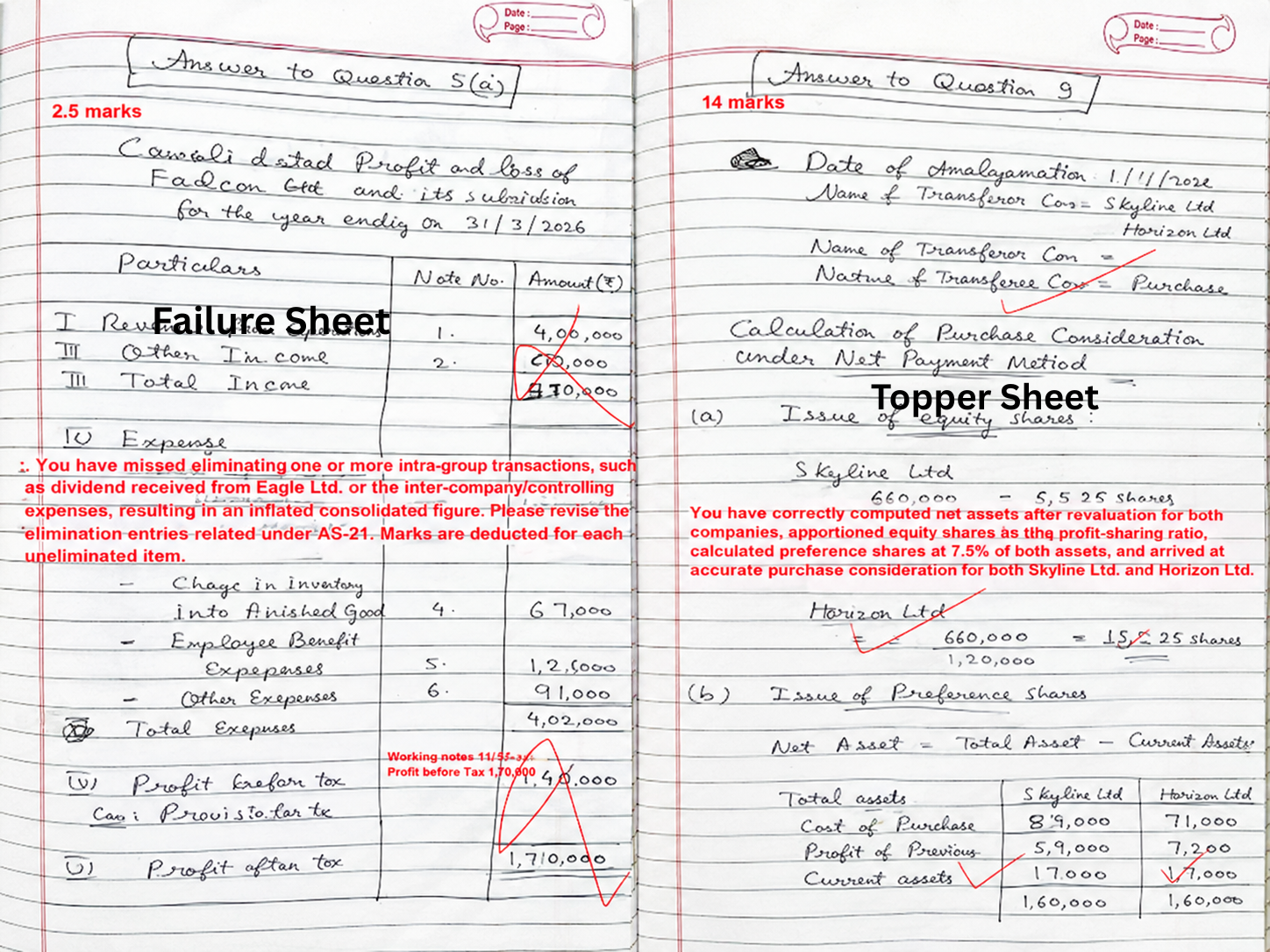
Failure Sheet vs. Topper Sheet: What Separates the Two?
In contrast to a failure sheet, a topper sheet can differ not necessarily in terms of content but rather in terms of presentation and accuracy. For instance, although a failure sheet may have missing workings, missing adjustments, and incorrect calculations, a topper sheet will have all steps presented in full, all adjustments done correctly, and allow for maximum marking of steps regardless of any mistakes.
Conclusion
Well-prepared Advanced Accounts working notes make your solution systematic, correct, and easy for the examiner to verify. Working notes reveal the reasoning, accounting concepts, and mathematics involved in the answer, and strong working note preparation is a core skill for CA Inter and Final exams alike.
Mistakes are common because of the following reasons:
hasty solving,
wrong formula or basis,
lack of adjustments,
double counting,
incorrect dates, and
confusion of opening and closing values.
The best strategy is read → identify → formula → figures → calculation → cross-check → present.
With practice, proper headings for working notes, careful handling of adjustments, and keeping a mistake book, mistakes can be minimised.
In conclusion, working notes must be logical, clear, traceable, and examiner-friendly.