Consolidation of Financial Statements: CA Vinayak Sikka
Consolidation of Accounting Statements is one such topic in the CA Inter Accounts course that students find difficult to understand. This topic could be better understood by linking it to the business relationship between a parent company and its subsidiary. This will help students understand the logic behind each accounting adjustment made.
CA Vinayak Sikka is a Chartered Accountant who teaches CA Inter Accounts. He adopts an interactive way of learning wherein he explains the concepts using examples that will help learners understand the application of those concepts while solving questions. This technique will help learners understand the relationship between the parent company and subsidiary company while answering questions.

What is Consolidation of Financial Statements?
Financial Statement Consolidation refers to the act of combining the financial statements of the parent company and the subsidiary companies into one set of financial statements.
Let us assume that Company A has control over Company B. In this situation, Company A becomes the parent company, or the holding company, and Company B becomes the subsidiary company. Both companies maintain their own set of books of accounts. However, during the preparation of consolidated financial statements, the accounting statements of the parent and subsidiary companies are combined in accordance with the applicable accounting principles. This does not mean simply combining every item from their financial statements; the relationship between the parent and subsidiary and the required consolidation adjustments must also be considered.
The objective of consolidation is to report the financial position and results of operations of the group as a single economic entity. The students, while preparing the consolidated financial statements, usually get confused about the adjustments for goodwill or capital reserve, Non-Controlling Interest, pre-acquisition and post-acquisition profits, and inter-company transactions. Hence, it is essential for students to understand the consolidation process and adjustments.
The accounting treatment of Consolidation of Financial Statements should be understood with reference to the applicable accounting standards, such as Ind AS 110 for consolidated financial statements and, where relevant, Ind AS 103 for business combinations. For entities following the Accounting Standards framework, AS 21 deals with consolidated financial statements. These standards provide the framework for understanding areas such as control, goodwill, Non-Controlling Interest (NCI), and intra-group transactions.
Consolidation under AS 21
AS 21 (Consolidated Financial Statements) concerns itself with the treatment and presentation of financial statements of a parent company with one or more subsidiaries. The primary aim of consolidation is to treat the accounting entity as an economic entity comprising the parent and the subsidiary together.
As per AS 21, the financial statements of the parent and subsidiary are consolidated through the addition of like items of assets, liabilities, income and expenses of both the entities. Some eliminations are done in this process, like the investment of the parent in the subsidiary gets eliminated by the share of the subsidiary's equity held by the parent, and similarly, intercompany transactions are also eliminated.
The following are the important points for CA Inter students:
Parent and subsidiary relationship
Date of acquisition
Pre- and post-acquisition profits
Goodwill or capital reserve
Inter-company transactions and balances
Preparation and presentation of consolidated financial statements
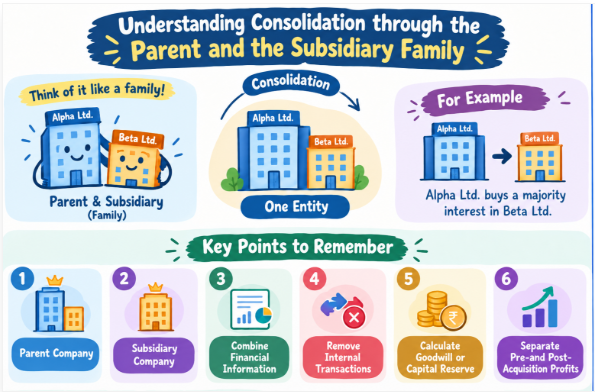
Understanding Consolidation through the Parent and the Subsidiary Family
Think of a parent company and its subsidiary as family members. Even though the two companies have their own accounts, consolidation helps determine their position as one entity. In this manner, it becomes easy to understand why financial statements are combined and why adjustments are made.
For instance, let us say that Alpha Ltd. acquires a majority shareholding in Beta Ltd. In this case, Alpha will be the parent company, while Beta will be the subsidiary company. The consolidation of financial statements facilitates the process of combining both firms.
These terms have been defined by CA Vinayak Sikka with the help of some basic examples from business:
Parent Company: One firm has a controlling interest in another firm.
Subsidiary Company: The firm that is controlled by the parent firm.
Combining of Financial Data: Relevant financial data in terms of assets, liabilities, income, and expenditure are combined together.
Internal Transactions are Removed: These internal transactions made between the parent company and subsidiary are removed because the two are now considered as one entity.
Goodwill or Capital Reserve Calculation: Goodwill or capital reserve is calculated based on the parent company’s investment in its subsidiary.
Net Minority Interest (NCI): It is the share of the subsidiary’s equity and profits or losses that belongs to the minority interest.
Separation of Profits before and after Acquisition: Any profits generated before the date of acquisition are considered pre-acquisition profits, which make up the net assets acquired. Meanwhile, any profits generated after the date of acquisition are post-acquisition profits, which are allocated accordingly.
Worked Example for Goodwill and NCI
Example: Alpha Ltd. acquires 80% of Beta Ltd. for ₹80 lakh. The value of identifiable net assets of Beta Ltd. at the time of acquisition was ₹90 lakh.
Step | Working | Amount |
Parent’s share of net assets | 80% × ₹90 lakh | ₹72 lakh |
Goodwill (AS 21) | ₹80 lakh − ₹72 lakh | ₹8 lakh |
NCI | 20% × ₹90 lakh | ₹18 lakh |
Goodwill check (Ind AS 103, NCI at proportionate share) | ₹80 lakh + ₹18 lakh − ₹90 lakh | ₹8 lakh |
Why is Consolidation Required?
Whenever a parent company acquires a subsidiary, looking at the financial statements of the two companies may not give the true picture of the business organization as a whole. This is why consolidation becomes necessary.
Main reasons for consolidation:
Shows the complete financial position: By combining the relevant assets, liabilities, income, and expenditures of the parent and the subsidiary.
Shows how the entity operates as a whole: Allows users to assess the overall performance of the business group rather than evaluating each company on its own.
Prevents double counting: Adjusts transactions and balances between the parent and the subsidiary so that dealings with each other are not inflated within the group.
Shows what belongs to the parent and what belongs to others: Helps identify the portion of the subsidiary that belongs to the parent and the portion that belongs to other shareholders who hold Non-Controlling Interest (NCI).
Helps in making better economic decisions: Allows investors, lenders, and other users to evaluate the financial position and performance of the consolidated business group.
Reflects the control relationship: As the controlling interest is with the parent, the financial information of the subsidiary is consolidated within the parent’s statements instead of presenting it separately as an investment.
Concepts a student must be clear about
Some basic concepts should be clear to a student before they start solving questions on Consolidation of Financial Statements. There are several adjustments involved in consolidation, and understanding these concepts first makes the practical questions much easier to solve.
Parent-Subsidiary Relationship: The students need to identify the companies controlling each other; the company controlling the other is the parent company, while the one being controlled by the other is the subsidiary company.
Acquisition Date: The Acquisition Date is the day when the parent company gains control of the subsidiary company. It is important in terms of consolidation because the profits and reserves of the subsidiary company are usually categorized into pre-acquisition profits/reserves and post-acquisition profits/reserves based on the acquisition date.
Control of Subsidiary Company: The fact that there is control means that the parent company owns more than half of the voting power or has the ability to control the composition of the board of directors or governing body.
Pre-acquisition Profits and Post-Acquisition Profits: Pre-acquisition profits are those which are earned by the subsidiary company before the parent company acquires control of the subsidiary company. Post-acquisition profits are those which are earned by the subsidiary company after the parent company acquires control of it. This classification is relevant for goodwill/capital reserve and group reserves.
Goodwill or Capital Reserve: According to AS 21, if the cost of the parent's investment is higher than the share of the parent in the subsidiary's equity, the amount is called goodwill; otherwise, the amount becomes capital reserve. As per Ind AS 103, goodwill is the excess of the consideration transferred and NCI over 100% of the identifiable net assets acquired, and a negative number after reassessment will result in a bargain purchase gain treated as capital reserve.
Minority Interest (Non-Controlling Interest, or NCI): It refers to the share of the subsidiary's equity and earnings (losses) that belong to parties other than the parent. It will be presented separately from the equity interest belonging to the parent's shareholders in the consolidated financial statements.
Inter-Company Transactions: There could be intercompany transactions between the parent and the subsidiary. Since the parent and subsidiary are one economic unit, some balances and transactions might be required to be eliminated while preparing consolidated financial statements.
Fair Value Adjustments: Sometimes the assets and liabilities of the subsidiary may have to be adjusted to their fair value as at the acquisition date while preparing consolidated financial statements.
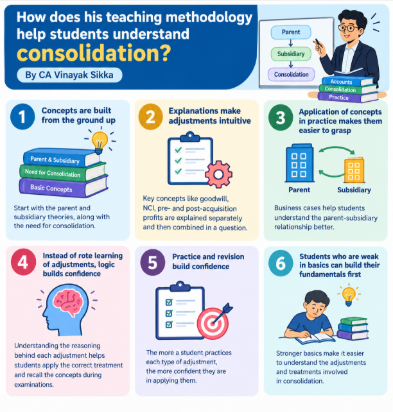
How does his teaching methodology help students understand consolidation?
Consolidation of Financial Statements might appear intimidating to students due to the need to understand the parent-subsidiary relationship and the multiple adjustments required at the same time. Teaching it through a systematic approach makes it interesting for students, as it enables them to grasp the underlying logic for each step and not just rote-learn the treatment. It does so in the following ways:
Concepts are built from the ground up: Firstly, the parent and subsidiary theories are taught, along with the necessity for consolidation. This gives students a solid foundation to understand upcoming adjustments.
Explanations make adjustments intuitive: The concepts of goodwill, NCI, pre- and post-acquisition profits, etc., are each explained separately from the consolidation process. These are then combined in a question for students to practice.
Application of concepts in practice makes them easier to grasp: Business cases could help students understand the relationship between the parent and subsidiary better.
Instead of rote learning of adjustments, logic builds confidence: Understanding the reasoning behind each adjustment helps students apply the correct treatment and recall the concepts more effectively during examinations.
Practice and revision build confidence: The more a student practices each type of adjustment, the more confident they are in applying them.
Students who are weak in basics can build their fundamentals first: A lot of students struggle with basic accounting concepts and therefore find it difficult to understand the complexities of consolidation of financial statements. Strengthening the fundamentals first can make it easier to understand the various adjustments and treatments involved in consolidation.
Practice, revision, and question-solving approach
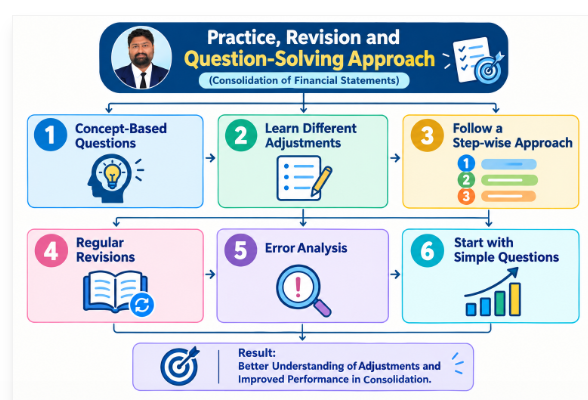
The preparation of Consolidation of Financial Statements involves more than just theoretical understanding. Students often require extensive practice as one question could comprise multiple adjustments. Having a structured approach to practise, revise, and solve questions can assist students in comprehending the treatment and enhance their precision.
Concept-Based Questions: Students must start practising questions from a conceptual angle before moving on to comprehensive, lengthy questions. One must have an understanding of the parent-subsidiary relationship, acquisition date, goodwill, NCI, pre/post-acquisition profits, etc. before one can begin to utilise these concepts and apply adjustments when required.
Different Adjustments: After concept-based questions, students can move on to questions comprising inter-company transactions, unrealised profit, dividends, fair value adjustments, and other adjustments required for consolidation. These multiple adjustments can be different for each question, and therefore, it is important to get comfortable with the changing treatments from one question to another.
Step-wise Approach while Solving Questions: While practising questions, students can utilise a step-wise approach as follows:
Identify Parent & Subsidiary → Determine Acquisition Date → Calculate Net Assets at Acquisition → Make Fair Value Adjustments → Eliminate Unrealised Profit and Intra-Group Items → Calculate Goodwill/Capital Reserve → Determine NCI → Calculate Post-Acquisition Profits and Group Reserves → Prepare Consolidated Statement of Profit and Loss → Prepare Consolidated Balance Sheet.
Regular Revisions: It is also important that revisions of concepts and adjustments take place at regular intervals. One can make short notes or a summary for different adjustments for quick reference and to aid the process of recalling the relevant treatment.
Error Analysis: The analysis of errors in questions attempted can also help students identify the weak areas and focus on improving accuracy. One must understand why and where the error was committed while attempting the question. For example, if there was an error in the calculation of Minority Interest, the student can analyse whether the error was due to incorrect application of the formula, wrong value substituted, etc. Similarly, if the adjustment of pre-acquisition profits has been wrongly applied as post-acquisition profits, this highlights the lack of conceptual understanding, which needs to be improved.
Start with Simple Questions: Finally, students can begin with simple questions and then gradually move on to comprehensive questions. This will allow one to develop speed and accuracy in attempting questions.
Teaching Methodology, Study Material and Practice Approach
CA Vinayak Sikka follows the traditional approach of building the basics before moving on to higher-level concepts and questions. He uses concepts to explain the logic behind various accounting treatments and journal entries, then applies these principles to actual questions. He follows the traditional approach of understanding the basics and then moving on to higher-level concepts and questions. The trainer uses concepts to explain the logic behind various accounting treatments and journal entries and then moves on to applying these principles to actual questions. Moreover, students can also use concept-based material, chapter-wise practice questions, revision notes, and exam-oriented questions for better understanding and practice. By practicing practical numericals, students can enhance their accuracy, working notes, and speed while solving CA Inter Accounts questions. Moreover, revision lectures and practice tests can also be helpful.
What is covered in CA Vinayak Sikka’s online classes
CA Vinayak Sikka teaches CA Inter Accounts through online video lectures.
The online classes of Accounting offered by CA Vinayak Sikka are designed to ensure that a student goes from being confused about Accounting to being exam-ready in this subject. The classes will cover:
Complete syllabus coverage — right from Accounting Standards to Consolidated Financial Statements in sequence and with proper conceptual build-up.
Animation-based video lectures — topics such as amalgamation, internal reconstruction, and consolidation, which are complicated, are made easy to understand by making the students visualise how numbers are transferred between accounting statements.
Case-based teaching method — practical illustrations from the business and banking world instead of bookish illustrations to make accounting treatments more understandable to the students.
Questions on each chapter — selected questions that are in accordance with the ICAI exam pattern.
Doubt support — structured doubt-clearing mechanism for conceptual and numerical doubts.
Exam strategy classes — tips on presentation, working notes, and time management in Accounting.
Course Fees and Batch Language: What to Know Before Enrolling
Detail | Information |
Course Fee | Check the current fee on the official course page |
Batch Language | Hindi + English (Mixed) |
Demo Class | Click here - Watch the free CA Inter Accounts demo class |
Mode | Online classes |
Doubt Support | WhatsApp group, live doubt sessions |
Conclusion
Consolidation of Financial Statements can be made easier for students by learning the logic of parent-subsidiary relations and the reasons for the adjustments rather than learning by rote. CA Vinayak Sikka’s method is based on gradual concept building and application of these concepts through examples, practice, and revision with the help of these examples. This helps students develop an understanding of concepts like goodwill, treatment of Minority Interest, pre- and post-acquisition profits, and inter-company transactions, and enables them to approach the problems of consolidation in a much more organized manner.