Accounting Standards Explained Through a Business Story
Accounting standards are the rules and regulations issued by ICAI that tell businesses how to record, measure, and disclose every financial transaction in their books or the financial statements. They ensure that the financial report made by a company is consistent, transparent, and easy to compare with different businesses. Without accounting standards, every business would keep records in its own way, and conflicts would arise among parties involved in transactions. Thus, AS fixes this for the following parties:
Owners, who are concerned only with their profit and loss.
Creditors, who are concerned about the return of their credit amount.
Investors, who care about the company for investing their money.
Banks, who want to check statements for lending money.
Tax authorities, who want a clear figure for assessing tax.
Employees, who want to check the stability of the business for salary.
The value of Accounting Standards is clearly understood through CA Vinayak Sikka, who is one of the best faculty for CA Inter Advanced Accounting, using the example of a business, i.e., Riya’s bakery. Through this, students can easily understand the value of Accounting standards, their importance, and the needs of the accounting standards.
Why Are Accounting Standards Needed
You need to understand Accounting standards and why these accounting standards are needed for business rules and regulations. To go through it, some essential points are as follows:
Consistency: With the help of accounting standards, two businesses record their transaction or events in the same way. This eliminates the conflicts that have ever been seen in business. Recording on an accrual or cash basis.

Comparability: In the competitive world, if every business records events on its own choices, then how can the financial records be compared among them? Thus, accounting standards are needed to make comparison easy. This comparability not only helps in comparing one business to another, but it also helps in determining the growth between two or more years for the same business.
Legal support: Companies Acts and Audit reports also depend on the Accounting Standards. A business using accounting standards correctly while preparing the financial statements can have legal proof for the future in case of any conflict.
Transparency: Financial statements prepared by following accounting standards truly give reliable numbers for the relevant parties. These may include creditors, bankers, lenders, and investors. They can build trust because the records and books of the business show transparent figures.
Prevent manipulation: Without accounting standards, many owners can hide profits to avoid taxes. Also, sometimes businesses show more profits to attract shareholders. After looking at these serious matters, it becomes necessary for them to keep books according to accounting standards. They are bound by them and hesitate to make any wrong disclosure.
A Brief Story Frame: Riya’s Bakery
For knowing the value of accounting standards in business, let’s follow CA Vinayak Sikka’s examples from the Story of Riya’s bakery from Day 1.
Riya used to bake cakes for many years for family and friends. Her family and friends also appreciated her, so she decided to convert her hobby into a shop. She spent all her savings and took a small loan from the bank to manage all the preliminary expenses. She spent money on buying a microwave oven, a display counter, and a scooter for delivery.
Now she has people around her business.
The supplier from whom she buys flour, sugar, and butter and can buy on credit, to be paid for later.
Bank manager who provides her loans and always has an interest in seeing what the business is doing,
A customer who loves her cakes and buys on credit.
A friend who is interested in investing in her bakery.
The way she keeps records
Riya notes everything in a notebook about money in, money out, and her margins. She notes it randomly anytime during the day. It works for a while.
But after one month, the bank manager asks for her financial statements. Her friends ask about the profitability of her bakery. Riya opens her notebook, but she cannot answer any question. At that moment, she discovered the need for accounting standards in her business.

How Accounting Standards Move Around Every Moment
Now, let's see how a list of accounting standards moves with her with every event. How she can map every event to standards. Some of them are:
Events | Concepts | Accounting standard |
Buying materials like flour, sugar, and butter and selling the stock | Inventories | AS 2 |
Purchasing oven | PPE | AS 10 |
Wear and tear of the oven | Depreciation | AS 6 |
Making sales | Revenue Recognition | AS 9 |
Loan from the bank | Borrowing cost | AS 16 |
Cash movement | Cash flow statement | AS 3 |
A customer sues over a bad cake | Provision and contingent liabilities | AS 29 |
Full List of Accounting Standards
Here are all 29 Indian Accounting Standards issued by ICAI:
Accounting standards | Deals With |
AS 1 | Disclosure of Accounting Policies |
AS 2 | Valuation of Inventories |
AS 3 | Cash Flow Statements |
AS 4 | Contingencies and Events After the Balance Sheet Date |
AS 5 | Net Profit or Loss |
AS 6 | Depreciation Accounting |
AS 7 | Construction Contracts |
AS 8 | Research and Development |
AS 9 | Revenue Recognition |
AS 10 | Property, Plant, and Equipment |
AS 11 | Impact of foreign exchange rate changes |
AS 12 | Government Grants |
AS 13 | Accounting for Investments |
AS 14 | Amalgamations |
AS 15 | Employee Benefits |
AS 16 | Borrowing Costs |
AS 17 | Segment Reporting |
AS 18 | Related Party Disclosures |
AS 19 | Leases |
AS 20 | Earnings Per Share |
AS 21 | Consolidated Financial Statements |
AS 22 | Accounting for Taxes on Income |
AS 23 | Accounting for Investments in Associates |
AS 24 | Discontinuing Operations |
AS 25 | Interim Financial Reporting |
AS 26 | Intangible Assets |
AS 27 | Joint Ventures |
AS 28 | Impairment of Assets |
AS 29 | Provision and contingent liabilities |
Note: AS 8 (Research and Development) was later withdrawn and merged into AS 26, which is why some lists show only 27-28 standards in active use.
What Happened When Riya Did Not Follow Accounting Standards
Before following the accounting standards. Riya entered into the books whatever day suits. In March, the oven is an expense; in April, it becomes an asset. The records show two different sets of numbers, showing losses in two different periods. The reason is not dishonesty on the part of Riya. It was because nothing forced her to follow rules and regulations. Accounting standards fix it; the record will be according to her version of the numbers by her or the numbers that everyone relies on. The main constraints she lacks are:
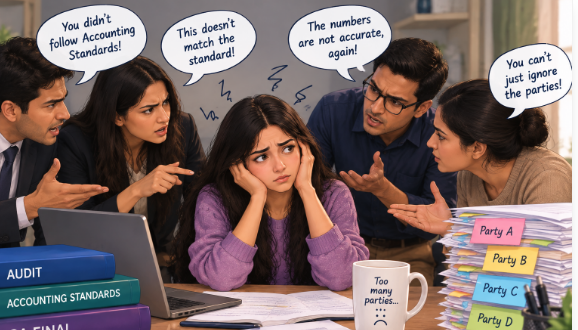
No Standardisation in Recording
The nature of the revenue, as mentioned above, was changing from month to month. Many advance orders and later payment she noted in the current period. This revenue impressed investors in the current period but will be confusing in the next one. There was also a dispute over damage to a customer's cake order. But Riya didn't write anything about it; it is still unsettled. The investors put money in but found out later.
False Financial Positions
The financial position automatically went false due to random recording of transactions. Sometimes it shows a lot of profits, and sometimes it shows losses. No consistency was found in the books. Wrong treatment of assets and liabilities was evident in the books. Sometimes several transactions are missed in records. Riya's records don't follow any structure for recording transactions.
No Trust in Parties
As mentioned, banks lend money expecting easy returns and also get further benefits from the bakery. Lenders trust in Riya’s creditworthiness. But they boost confidence in one month, then lose confidence in the next month due to irregularities in the books. They started questioning the truth. The friend who was thinking of investing in a bakery also cancelled it.
Drops Trust in the Whole Market
No evidence of returns for investors and lenders. It creates a negative market image. Customers are also affected by it. The market comparisons are limited by the records she made. Over time, the whole market starts questioning the honesty of Riya. The tax authorities also found hidden losses and profits from the books.
Changes Seen After Applying Accounting Standards
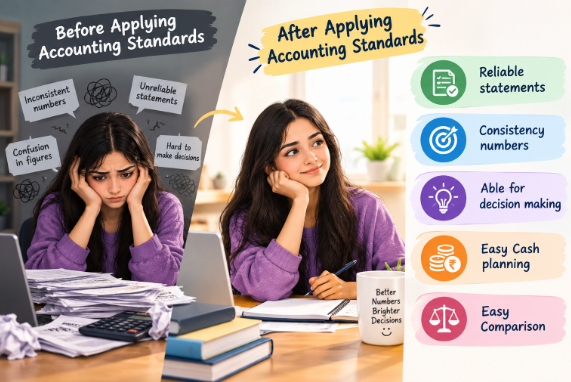
Realising the need for Accounting Standards, Riya decides to follow them. Within a few months, she sees real changes — and notices how accurate her record-keeping has become. Clear benefits of the accounting standards are as follows:
Clear Records
It becomes easier to present the balance sheet and profit and loss account. The statements are well-structured and organised. Interested parties can access any data whenever they need. Searching for a transaction also becomes quite easy. The statements also become more believable.
Reliable Statements
The banks approve loans in one go after finding reliable statements. The documents become more trustworthy as they provide details of every transaction. The changes that occur through every event are also seen easily now. Investors also start believing in the bakery. The returns are also managed by checking daily activities.
Consistency Numbers
The consistency in numbers is seen easily; the flow chart does not increase or decrease suddenly. A step-by-step growth can be easily predicted. The irregular reports and items like ovens, whose nature is changed from expenses to assets, start looking consistent. The assets and liabilities are matched automatically, and no special efforts are needed to analyse them.
Better Decision-Making
From the statement, Riya understands the cakes are making money, but the pastries don't. She changed her menu. Also, she arranged a variety of cakes. She had been thinking for a long time about buying another oven, but due to irregular profits, she dropped the plan. But now, she analysed that she could do it.
Easy Cash Planning
From the cash flow statement, she is able to see where the most cash is used and where the most cash is coming from. Now, she might be able to arrange cash wherever she needs. To reduce expenses, she understands she could arrange cash from the cake revenue. Also, she gets the revenue per item.
Easy Comparison
The comparison becomes easy by applying the accounting standards. Now, Riya can compare the profit of more than one period or with the other bakery. It is necessary for growth and development. It helps in determining the life of the business. Investors are also attracted by it.
Steps Needed While Starting to Follow Accounting Standards
The following accounting standards do not mean only writing the records according to rules; it also means having faith in them. Regularity is also needed in applying accounting standards; the bookkeeper must put in consistent effort.
Regularity
Recording of transactions needs to be done regularly. Not letting it be delayed. Once you forget any little transaction, it will lead to the whole accounts being unbalanced. Regularly means regularity, not once a week or month. You need to give an update every day so that the next day, steps will be easy to take.
Separate accounts
Also, the owner needs to maintain discipline in managing the money. He shouldn’t use the business money for his personal use or bring extra money without it being capital in the business. It is necessary to understand that the identity and the person are separate. No doubt they are interlinked but not identical.
Using the method consistently
Consistency in the method is also needed. As in depreciation, there are a lot of methods, but if you start using a single method, use it the same for every asset and on the same assets in every period. This helps in getting a true and realistic value even after a long period.
Use accounting software
Instead of making regular books, there is software that is available in the market. Many of them are free of cost. Like Tally, Busy, etc. Humans can make mistakes easily in calculations; it affects analysis. The software makes calculations quite easy and gives more accuracy. Also, humans can lead to a stop in operations due to various personal reasons like health. Thus, the operation behind it need not suffer.
Arrange a Qualified Accountant for Review
In the beginning, it looks easy to manage all the operations along with the bookkeeping as the business grows. But after a period, the operation becomes too busy for one person, so he cannot manage all of them. Further, for well-structured books, there is always a need for a professional accountant. The accountant can manage books more accurately than a normal person.
Do Students Need to Learn Accounting Standards
Yes, learning accounting standards is necessary for certain reasons, such as
For Professional Exams
Accounting standards cover a large portion of many professional exams like CA, CMA, bachelor's or master's in commerce, BBA, etc. Students engaging in these courses need to understand accounting standards. Understanding their meaning and concepts is the way that they can get good marks on the exam.
For Financial Reporting
Accounting standards are the language that conveys accounting principles and methodology in various states and countries. Standards like GAAP and IFRS define how transactions are reported internationally. Without knowing the core concepts, students can never survive in the financial environment of the market.

To Be Ready for Jobs
Real accounting jobs, like tax, audit, financial reporting, etc., are operated on the same standard framework. Employers who understand these standards from the basics don't need to consult multiple references while applying the rules.
For Global Ethics and Relevance
Accounting standards provide rules for preventing fraud and manipulation. Learning standards helps in judging business activities. These standards are not only domestically but also accepted internationally.
Conclusion
Accounting standards do not add paperwork; they just provide a system to arrange the books. They protect the business from confusion. Trust, comparability, and better decisions can be achieved through applying accounting standards easily. Most businesses understand their importance and start using them in bookkeeping. Riya’s bakery example by CA Vinayak Sikka clearly explained the need for accounting standards by showing the difference between before and after situations with the standards. For students, accounting standards also mean a lot for cracking the exam. Accounting standards are like a boat that helps you survive in the ocean of reports and records.