
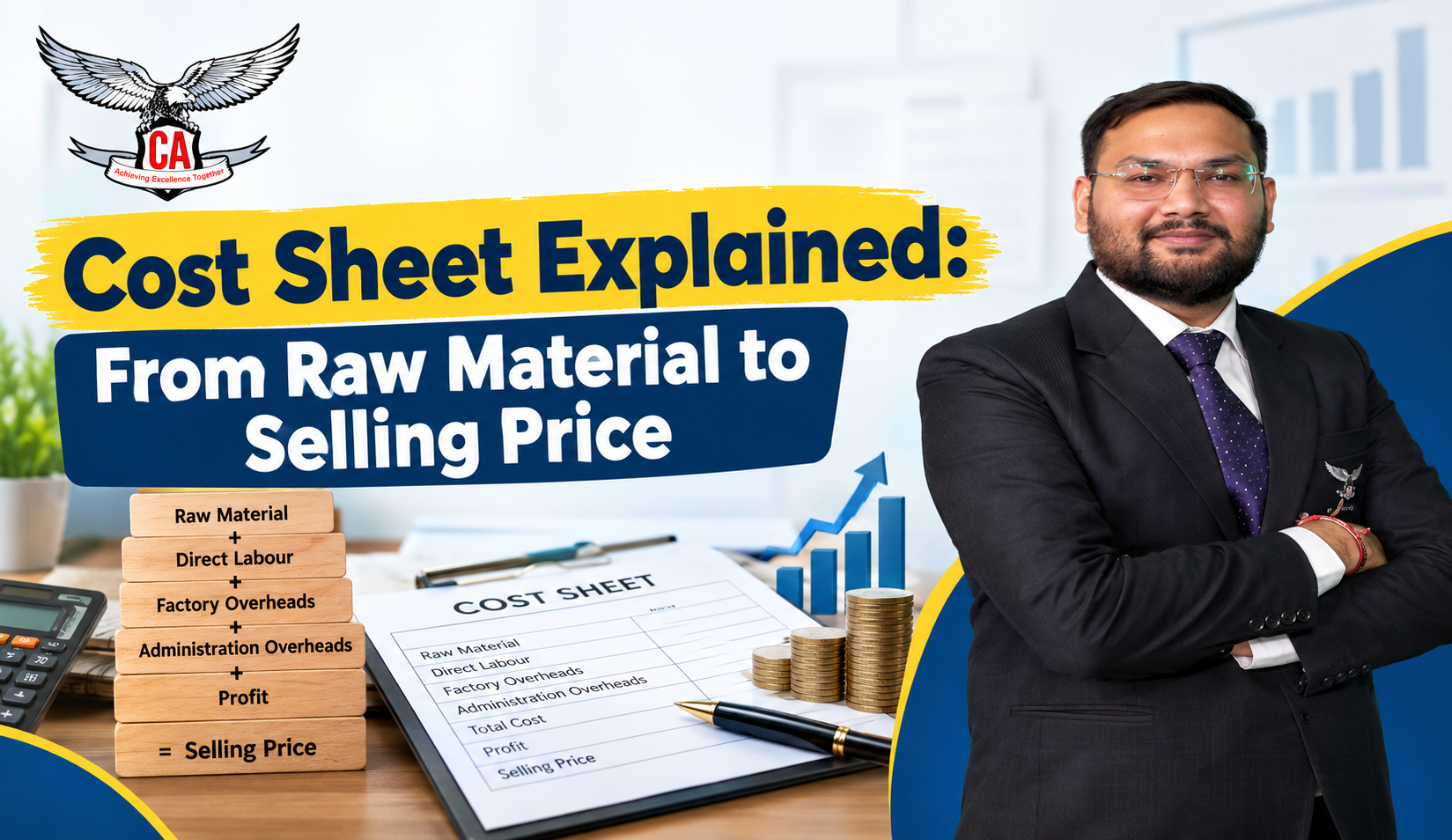
The cost sheet is a tool that includes the total cost structure related to the production of goods and services. The cost sheet starts with the cost of materials and then follows all other costs until the selling price.
This Cost Sheet Explained guide connects theory to real-world business decisions, which is exactly why understanding a cost sheet is crucial for CA Intermediate and commerce students. It covers expenses such as labour, supplies, manufacturing, office, and sales. A cost sheet helps in cost management, profit calculation, expense comparison, and determining the appropriate selling price.
How CA Himanshu Singla explains the cost sheet
CA Himanshu Singla provides a clear and useful explanation of the cost sheet. To make the concepts easier to understand, he connects each cost component to real-world business examples. Prior to learning formulas and computations, his method emphasizes understanding the flow of costs. Students are able to answer cost sheet inquiries more confidently and clearly as a result.

What is a Cost Sheet?
A cost sheet reflects the total cost of producing a particular item. This is helpful in calculating cost per unit, profit, and selling price. The basic flow can be understood as

Cost of Raw Material
Raw materials include things like fabric, steel, and wood that are used directly in the production of a product. The opening stock, purchases, and closing stock all affect the cost of the materials.
Material Consumed = Opening Stock + Purchases + Direct Expenses on Material – Closing Stock
Example: Imagine that a business has:
Opening Stock of Material: 60,000
Purchases: 4,00,000
Closing Stock: 50,000
Material Consumed = 60,000 + 4,00,000 - 50,000 = 4,10,000
The production cost will therefore be Rs. 4,10,000.
Direct Labour
The next important item after material is direct labour. Direct labour means payment of money to the workers who directly manufacture the goods. For example,
Employees who are putting together a machine.
The tailors who are stitching clothes.
The employees who are running production machines.
The carpenters who are making furniture.
Direct Expenses
These types of expenses are those which can be directly associated with a specific product or process of production. Direct expenses are
Special design expenses.
Hiring charges of special machines employed for a particular job.
Payment of royalty based on production.
Special moulding and tooling expenses.
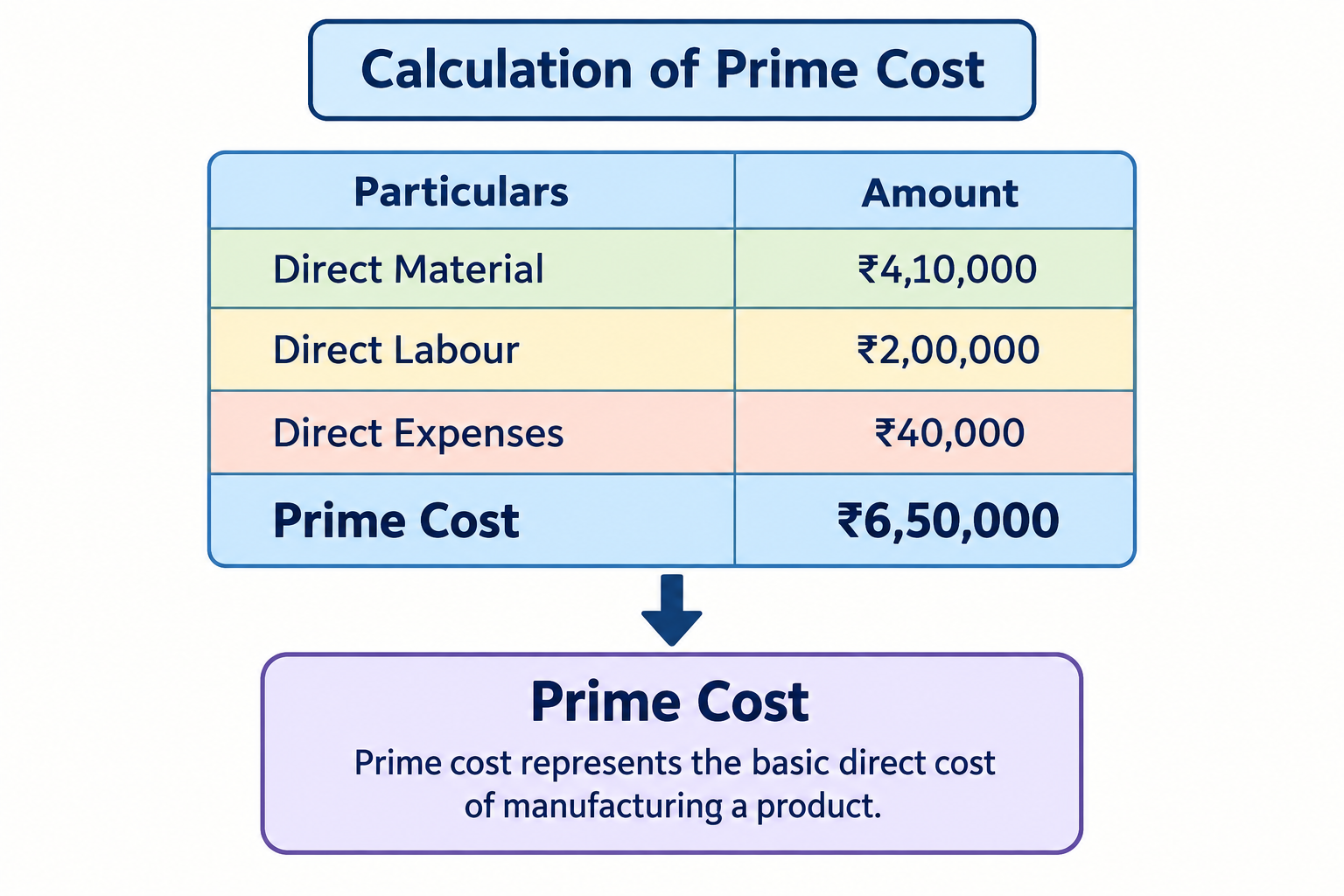
Prime Cost
Our prime cost is the sum of the direct labor, direct material, and direct expense costs.
Formula: Prime Cost = Direct Material + Direct Labour + Direct Expenses
Production or Workplace Overheads
Factory overheads are indirect expenses associated with production that are not traceable to a single product.
Example:
Factory rent
Electricity
machinery depreciation
Salary of Supervisor
Wages for Indirect Workers
Factory Cost = Prime Cost + Factory Overheads + Opening WIP – Closing WIP
Work-in-progress refers to products that are partially finished.
Example: Prime Cost = ₹6,50,000
Factory Overheads = ₹1,50,000
Factory Cost before WIP adjustment = 8,00,000
Work-in-Progress Adjustment
Work-in-Progress (WIP) refers to products that are only partially finished. In an expense sheet, WIP will be added in case of opening, WIP will be deducted in case of closing.
Example: Prime Cost = ₹ 6,50,000
Factory Overheads = ₹1,50,000
Opening WIP = ₹30,000
Closing WIP = ₹20,000
Factory Cost = ₹6,50,000 + ₹1,50,000 + ₹30,000 − ₹20,000 = ₹8,10,000
Cost of Production
The entire cost of producing final items is known as the cost of production.
Formula: Cost of Production = Factory Cost + Administrative Overheads relating to Production
Example: Cost of Production = ₹8,10,000 + 90,000 = 9,00,000
Finished Goods Stock Adjustment
Not all the items manufactured by the business will necessarily be sold during the year. Therefore, opening and closing stocks of finished goods need to be taken into account while computing the cost of goods sold or cost of sales.
Formula: COGS = Opening Finished Goods + Cost of Production − Closing Finished Goods
Example: ₹70,000 + ₹9,00,000 − ₹90,000 = ₹8,80,000
Administrative Overheads Relating to Production
These are administrative costs tied to running the factory or production function — added at the Cost of Production stage.
Example: Works manager's salary, factory office salaries, cost of factory administration.
Administrative Overheads relating to Sales (General Office)
These are general office/administrative costs not tied to production — added at the Cost of Sales stage.
Example: Office salaries, rent, legal costs, electricity.
Note: A cost sheet can carry two separate administrative overhead lines — one relating to production (added at the Cost of Production stage) and one relating to sales/office administration (added at the Cost of Sales stage). Don't add the same admin figure twice; each pool belongs to its own stage.
Distribution and Sales Overheads
These are indirect expenses associated with delivering and selling items to clients.
Examples:
advertising
commissions on sales
delivery
packing
Cost of Sales
Cost of sales refers to the cost of goods sold as well as administrative and selling expenses.
Formula: Cost of Sales = Cost of Sold Goods + Administrative Overheads + Selling and Distribution Overheads
Example: ₹8,80,000 + ₹90,000 + ₹80,000 = ₹10,50,000
Increasing Profit to Set the Selling Price
The last step involves adding the profit to be made to the cost of sales.
Formula: Selling Price = Cost of Sales + Profit
Calculate: ₹10,50,000 + ₹1,50,000 = ₹12,00,000
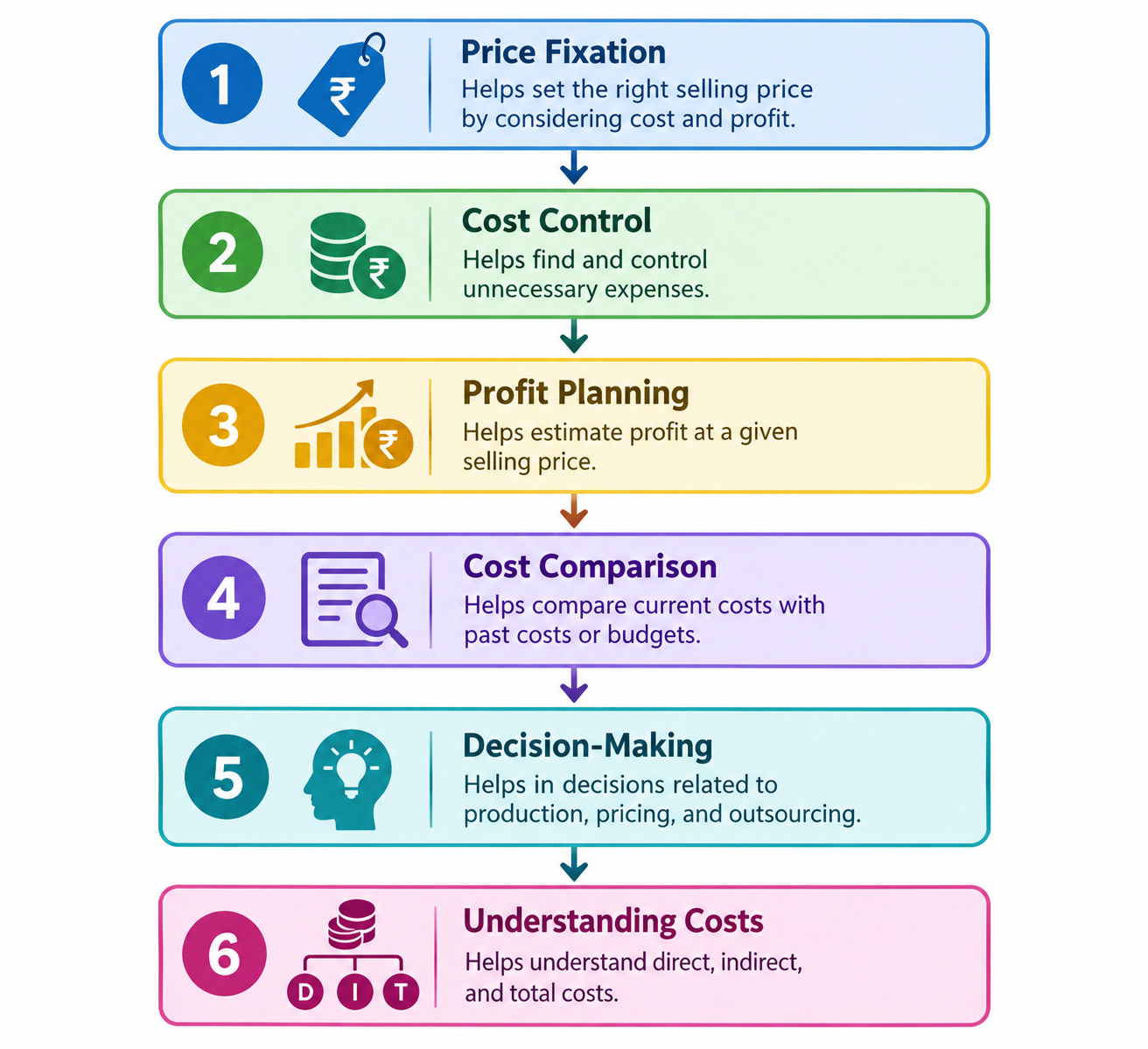
Why Is the Cost Sheet Important?
The cost sheet is helpful for an organization to know its costs and set the selling price and profit margins.
Example of a Simple Cost Sheet
Suppose a company produces 1,000 units with the following costs:
Cost Sheet Component | Amount (₹) |
Direct Material | 4,00,000 |
Direct Labour | 2,00,000 |
Direct Expenses | 50,000 |
Prime Cost | 6,50,000 |
Factory Overheads | 1,00,000 |
Factory Cost | 7,50,000 |
Administrative Overheads – Production | 30,000 |
Cost of Production | 7,80,000 |
Administrative Overheads – Sales | 20,000 |
Selling & Distribution Overheads | 50,000 |
Cost of Sales | 8,50,000 |
Profit | 1,00,000 |
Selling Price | 9,50,000 |
Selling Price per Unit (1,000 units) | ₹950 |
Note: In ICAI exam problems, administrative overheads are often split explicitly into "relating to production" and "relating to sales/general "office"—allocate each figure to its correct stage (cost of production vs. Cost of sales) rather than combining them. Misreading which pool a given figure belongs to is a common scoring error.
Important Points to Remember
Direct Material + Direct Labour + Direct Expenses = Prime Cost.
Add Factory Overheads for Factory Cost.
Opening WIP + Deduct Closing WIP.
Cost of Production is the cost of manufacturing finished goods.
Add Selling & Distribution Overheads to find Cost of Sales.
Add Profit to Cost of Sales to find Selling Price.
Cost per Unit = Total Cost ÷ Number of Units.
Always check stock adjustments carefully as they affect the final cost.
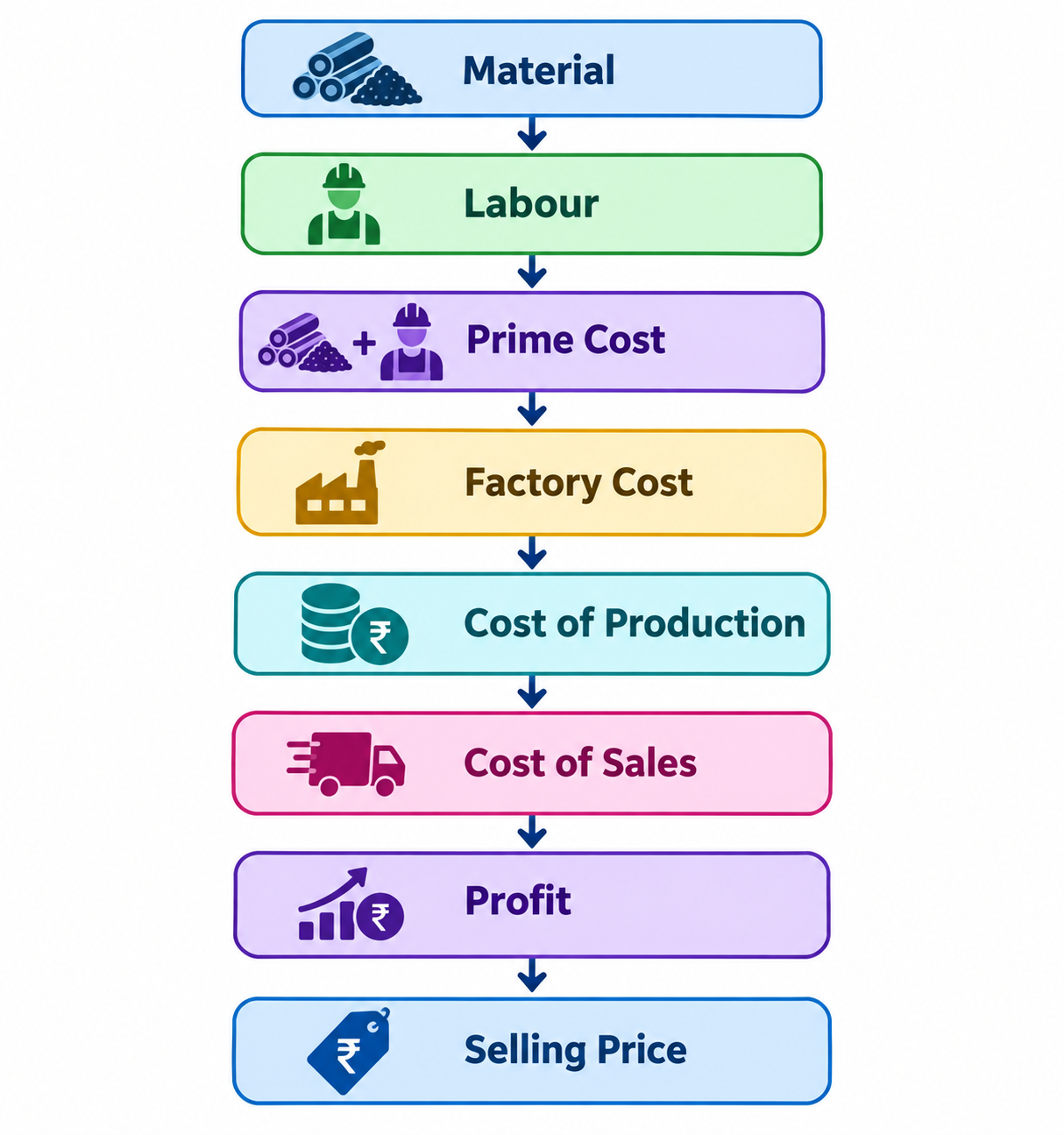
Every Cost Sheet Formula follows the same five-stage sequence, from Prime Cost to Selling Price.
Cost Sheet and CA Intermediate Preparation
It is more crucial for CA Intermediate students to understand the cost flow than to commit formulas to memory. Remember the sequence:
Questions about stock, work-in-progress, finished goods, overheads, cost per unit, profit, and selling price should be practiced by students.
Read each adjustment carefully while answering questions, then accurately enter it into the cost sheet. Whether you're just starting out or looking to sharpen a firm grip on cost sheets, this CA Intermediate Cost Sheet guide gives you the sequence and formulas you need for exam-day accuracy.
Conclusion
Cost Sheet represents the total cost of production of a product from the time raw material is purchased till the final selling price. It is useful for price fixation, profit planning and cost control. It is useful for CA Intermediate students in solving problems.