

Cost of capital refers to the minimum return that a company is expected to earn from its investments to cover the cost of funds used to finance those investments. A business can raise funds through different sources, such as loans, shares, and shareholders. Each source of finance has a cost for the company.
Therefore, the cost of capital helps a company understand how much return it should generate before accepting an investment decision. If a project is expected to earn a return higher than the
Cost of Capital, it may be considered financially attractive. If the expected return is lower, the company may need to reconsider the investment.
Types of Cost of Capital
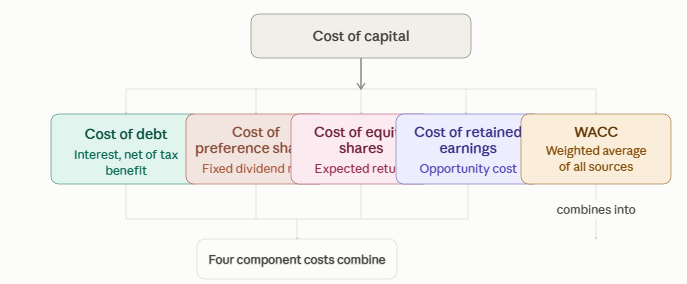
A company raising capital from multiple sources carries a different cost for each source. The key types of cost of capital are as follows:
Cost of Debt Financing: It is the charge payable on borrowed money, such as loans and debt securities. For instance, if a company borrows money at 10%, the interest on it shall be the amount payable for using the loan. The tax benefit available on interest payments is taken into account when calculating the cost of debt financing. For example: If a firm has taken a ₹10 lakh bank loan at 10%, the company has to pay ₹1 lakh to the bank as interest every year. Therefore, before taxes: Cost of Debt = 10%
If the company pays ₹1 lakh as interest to the bank, and it receives a 30% tax benefit, the effective cost of debt is: Kd = 10% * (1 − 30%) = 7%
Therefore, although the bank charges 10% interest on the ₹10 lakh loan, the effective cost of debt is 7% when a 30% tax benefit on the interest payment is considered.
Cost of Preference Share Capital: It is the claim of preference shareholders on the income of a company for financing through issuing preference shares. The claim is in the form of a fixed percentage of dividend. Therefore, it is the amount of dividend that is the cost of using preference share capital. For example: If a firm issues ₹10 lakh preference shares carrying an 8% dividend, the company will have to pay:
₹10 lakh * 8% = ₹80,000 dividend
Therefore: Cost of Preference Share Capital = 8%
Cost of Equity Share Financing: It depicts a claim on the income of a company by equity shareholders for financing through issuing equity shares. As against the case with preference shares, the dividend payable to equity shareholders is not fixed. Therefore, the company’s cost of equity is determined based on a prospective return.
For example: If shareholders buy ₹10 lakh equity shares of a company, and expect to receive a 12% return on their investment, the company will have to give them ₹1.2 lakh every year. Therefore, Cost of Equity = 12%. The company does not have to pay any fixed amount as a dividend to the equity shareholders. However, they expect a certain return on the money that they have invested in the company.
Cost of Retained Earnings: Retained earnings are the amount of profit not distributed as a dividend. Although a company does not pay any interest or dividend on retained earnings, they have a cost because shareholders could have invested that money elsewhere. Therefore, it is the expected return shareholders would have gotten had the company not retained the earnings. For example: A company is earning ₹5 lakh profit. Instead of distributing this profit to the shareholders in the form of a dividend, it retains the whole amount to reinvest in the company to expand its operations. The company does not have to pay any interest on this retained amount, but the shareholders could have used this money to earn a certain amount of return. Let us say the shareholders could have earned 12% on the ₹5 lakh retained profit; the opportunity cost of retained earnings for the company will be 12%. Therefore, Cost of Retained Earnings (Kr) = 12%
Weighted Average Cost of Capital: A company hardly uses only one source of financing. It utilizes a combination of financing sources, and the total cost of financing is known as WACC. It considers the weighted average cost of all the sources of funds. For example: Suppose a company needs ₹10 lakh to expand its business. It arranges ₹6 lakh through a bank loan at 8% and ₹4 lakh through equity shares at 12%.
The loan represents 60% of the total funds, while equity represents 40%.
Loan contribution to WACC = 60% × 8% = 4.8%
Equity contribution to WACC = 40% × 12% = 4.8%
Therefore, WACC = 4.8% + 4.8% = 9.6%.
This means the company's overall cost of the funds used for the business is 9.6%.
Cost of Capital Explained With Business Loan Story by CA Chesta Chawla
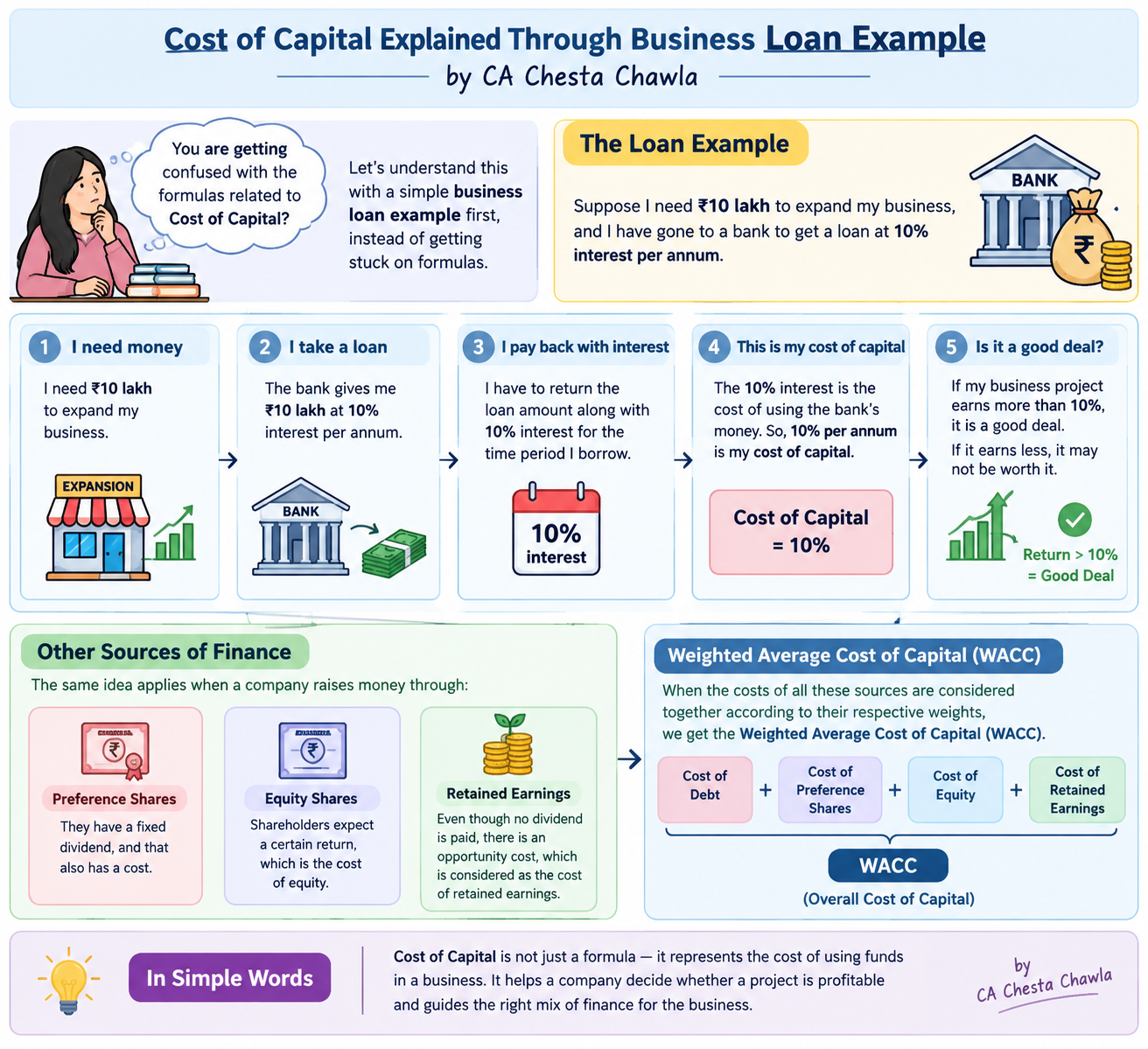
You are getting confused with the formulas related to Cost of Capital, so let's see in this case how this can be easily explained by taking a business loan example first, rather than getting stuck on formulas.
Suppose I need ₹10 lakh to expand my business, and I go to a bank for a loan at 10% interest per annum. The bank will give me money, and I will have to pay back that money with 10% interest for the time period that I have borrowed. This means that the bank's money will cost me 10% per annum. That is my cost of capital. This simply means that whatever profit my business project is making, 10% of that profit has to go to the bank as a cost for the loan.
So if my business is earning more than the cost of my business loan, it is a good deal. Similarly, whenever a company issues preference shares, equity shares, or retained earnings, they have to consider the amount of profit that has to be given to these shareholders. When a company makes use of various sources of finance, the total cost of these funds weighted according to their relative weights is called the Weighted Average Cost of Capital (WACC)
How CA Chesta Chawla Teaches Cost of Capital
The teaching of Cost of Capital by CA Chesta Chawla aims to provide concept clarity, practice with easy examples, and numerical problems to make it easier to understand. The learner can understand the logic of any calculation to apply the relevant formulas of Cost of Capital.
1. Concept Clarity: The topic can be started by understanding the basic concept and importance of Cost of Capital. Different sources of finance have different costs of capital.
2. Learning with business examples: The examples of Debt→Preference, Equity→Retained Earnings can be related to businesses to understand the topic better.
3. Formula with logic: Being able to understand the logic behind the application of all formulas makes it easier to solve problems related to Cost of Capital. There is no doubt about which formula to apply to a given set of problems.
4. Step-by-step Numericals: It becomes easier to solve any numerical by identifying the relevant information given in the question, applying the correct formula, substituting the values, and obtaining the final solution.
5. Focus on all important areas: The teaching can focus on all important areas, including the calculation of Cost of Debt, Cost of Preference Share Capital, Cost of Equity, Cost of Retained Earnings, and Weighted Average Cost of Capital (WACC).
6. Exam-Oriented Practice: Practice of different types of questions can be done to become thorough with the calculations, adjustments, and interpretations required for solving questions of Cost of Capital.
7. Relate to application: The topic becomes interesting when one understands the application of Cost of Capital, such as the evaluation of projects, choice of financing options, and establishing optimal capital structure.

Importance of Cost of Capital
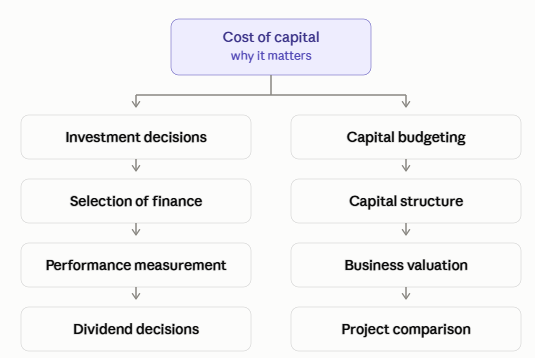
Cost of Capital is important because it tells a company the minimum return it should earn on the money invested in a project or business activity. It helps management make better financial and investment decisions. The importance of the cost of capital is explained in detail below:
1. Investment Decisions: It helps the company take decisions regarding whether an investment is financially viable by considering the return that the company expects out of the investment.
2. Capital Budgeting: It helps in evaluating capital projects as well as in taking decisions on their acceptance and rejection.
3. Selection of Finance: It helps in comparing the cost of various types of finance like debt, preference shares, and equity.
4. Capital Structure: It helps in determining the optimal capital structure of debt and equity for the company.
5. Performance Measurement: The returns provided by the company can be compared with the cost of capital, which in turn helps measure the performance of the company.
6. Business Valuation: It helps in determining the value of a business. WACC is a commonly used discount rate while valuing a firm by the discounted cash flow method.
7. Dividend Decisions: It helps the management take decisions regarding dividends, i.e., whether to distribute profits as dividends or retain them for the future growth of the firm.
8. Project Comparison: It helps the firm compare different investment proposals.
Common Mistakes Students Make in Cost of Capital
Students generally go wrong while learning and understanding the formulas and applying them to the calculation problems. Here are some common mistakes in relation to cost of capital:
1. Using the wrong formula: Students tend to use the same formula in all questions, instead of identifying redeemable and irredeemable debt or shares.
2. Tax advantage on debt: While calculating the cost of debt, students forget that deducting the interest on debt is a tax advantage.
3. Cost of equity vs retained earnings: In the case of retained earnings, the cost of equity shares is not known or is forgotten and is substituted with the idea of opportunity cost.
4. Wrong weights in WACC: When dealing with WACC, wrong weights are substituted, and wrong proportions are calculated.
5. Calculation errors: Errors might creep in due to wrongly substituted values, like percentages, or simple calculation errors like multiplication or division, which might lead to wrong answers.
6. Not considering the requirements of the question: Students directly substitute the values in the formulas but do not consider whether the question specifies the market value or book value, tax rate, dividend, growth rate, or redemption value.
7. Mugging up formulas: Students learn formulas mechanically without understanding the concepts involved. It becomes hard to apply them to a particular question.

How to Prepare Cost of Capital for CA Inter
CA Inter students can prepare for Cost of Capital by first understanding the concept and practicing the formulas with various numerical questions. CA Chesta Chawla teaches the students to associate the formulas with business examples and understand the logic behind them.
To understand the concept: Firstly, we need to understand what we mean by Cost of Capital and why a business incurs a cost to raise funds.
Cost of various sources of finance: Learn about Cost of Debt, Preference Share capital, Equity, and Retained Earnings.
Understand the formulas: Instead of learning the formulas, we should understand the applications of the formulas to have a clear grasp of the topic.
Basic numerical: Practice the basic questions and gradually go towards those questions which also incorporate application of taxes, redemption, market value, book value, etc.
Learn about WACC: It shows how the individual cost of each source is incorporated in the total capital cost by considering their weights.
Exam-Based Questions: Practice as many questions as possible from ICAI and other various types of questions to understand the possible applications of the concepts in the exams.
Analysis of Common Mistakes: Keep a track of your common mistakes and revise the important formulas, adjustments, and calculations related to cost of capital to avoid them in the future.
Conclusion
Cost of capital helps a firm understand the amount that it has to pay for the funds it needs to raise, and the returns it has to earn on the funds that it has invested. With the help of an example, students can get a better idea of the concept of cost of capital and learn to apply the formula correctly. They can get to learn how to calculate WACC and cost of capital and score well in such questions. Cost of capital is crucial to understand and compare the different financing options available to a firm. Students of CA Inter can improve their calculation skills and avoid errors by practicing such numerical problems. With an understanding of concepts, they can also be able to relate it to real-life situations and can perform better in exams.