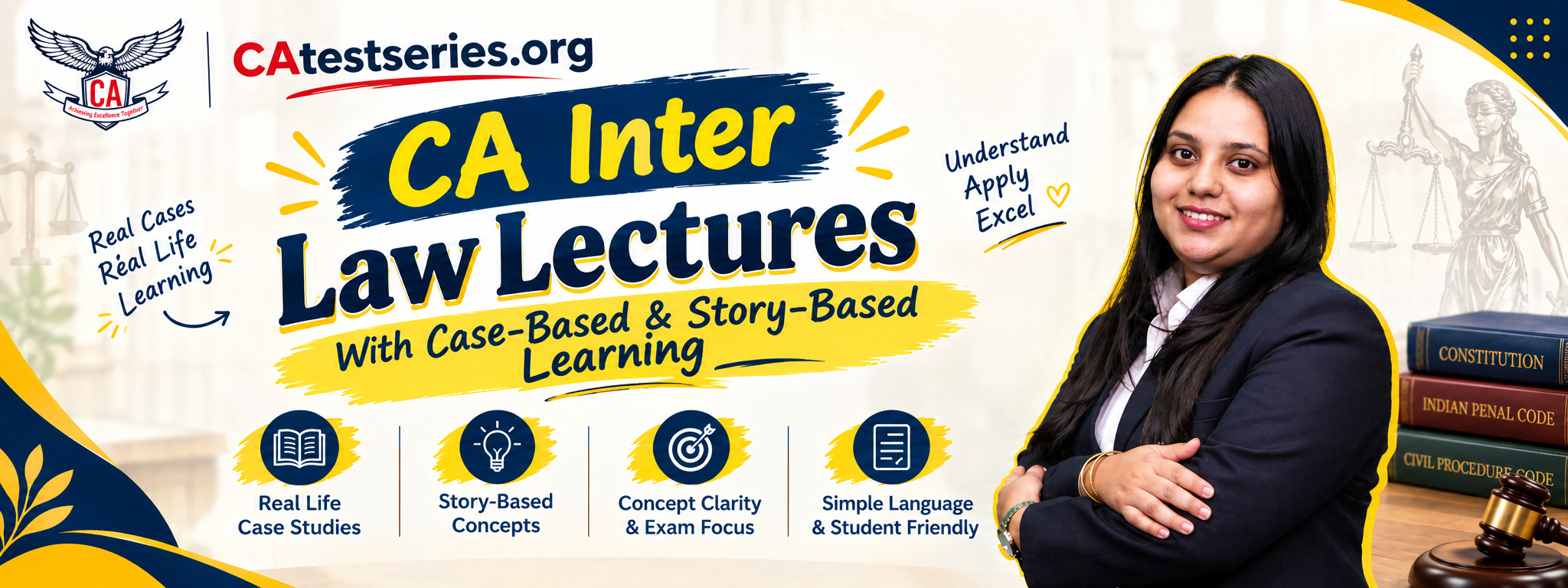
CA Inter Law Lectures With Case-Based & Story-Based Learning
CA Inter Law Lectures With Case-Based & Story-Based Learning
Preparing for CA Inter Law solely by memorising sections and provisions can be quite challenging for students. Due to complex legal language, case laws, and similar provisions, students often struggle to grasp how a provision actually applies in practice. Therefore, understanding the subject in an engaging and simple manner can make preparation much easier.
Case- and story-based learning makes this much simpler. When a provision is explained using practical situations, case studies, or stories, it makes it easier for students to comprehend what the provision means and how it is applied. This allows students to retain knowledge by associating it with real-life situations and not just memorising facts.

CA Inter Law Syllabus Pattern
Particulars | Details |
Subject Name | |
Paper Number | Paper 2 |
Group | Group 1 |
Maximum Marks | 100 |
Exam Duration | 3 hours |
Syllabus Structure | Part I - Company Law & LLP Law, Part II - Other Laws |
Part I Weightage | 70 marks |
Part II Weightage | 30 marks |
Exam Frequency | January, May and September |
Why Case-Based and Story-Based Learning Works for CA Inter Law
In CA Inter Law, students do not simply need to memorise provisions or sections; they must also understand which provision applies to a given situation. Case-based and story-based learning helps in grasping this connection.
Concepts Become Easier to Understand: When a provision is explained through a situation or a story, its meaning becomes easier to comprehend.
Better Connection with Provisions: Stories or cases teach students how to link specific facts to the relevant legal provision.
Easier to Recall: Remembering an interesting situation or a sequence of events can be easier than memorising isolated legal points.
Helps with Case-Based Questions: In exams, when a scenario is presented instead of a direct question about a section, students must analyse the facts to identify the applicable provision. Case-based learning helps develop this skill.
Makes Law More Interesting: Stories and practical situations prevent Law from feeling like a purely theoretical subject, making regular study more engaging.
Overall, the aim of case-based and story-based learning is to cultivate the habit of understanding the law and connecting it to real-world situations, rather than relying on rote memorisation. This makes concepts easier to understand, remember, and apply.
How Story-Based Teaching Makes Legal Concepts Easier to Remember
In the study of law, there are certain provisions and legal points that students often struggle to remember, even after studying them. Story-based teaching explains these concepts through a sequence, a specific situation, or a relatable example, making it easier for students to retain the information in a logical flow.
Information Follows a Clear Sequence: Events in a story unfold in a specific order; by remembering this sequence, students can easily recall the associated legal points.
Complex Points Gain Context: When a provision is explained within the context of a specific situation, students remember the circumstances in which that provision applies.
Reduced Reliance on Rote Learning: Students do not need to memorise every point in isolation, as the concepts are understood in an interconnected manner.
Improved Recall During Revision: Revising concepts linked to a story or example is often easier, particularly when a single topic involves multiple provisions.
Helps to Recall in an Exam Setting: Seeing something similar to the story or keyword will make it easier for one to remember the previously learned story or example, enabling them to recall the law behind it.
In simple terms, story-based teaching organises legal information into a meaningful sequence, making it easier for students not only to understand complex concepts but also to recall them later.
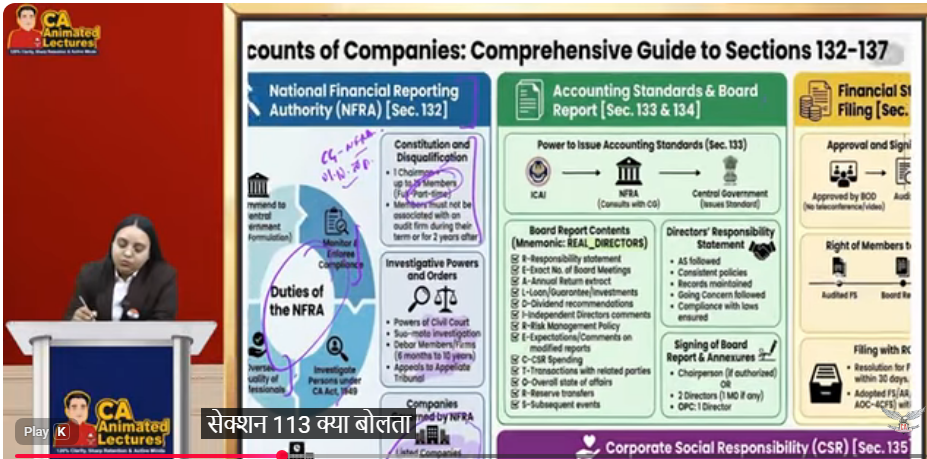
Learning CA Inter Law Through Real-Life Examples
Making CA Inter Law easier and more engaging: Studying CA Inter Law using real-life examples can make the subject much easier and more engaging for students.
Understand real provisions in actual situations: In Law, students need to understand not just the legal provisions themselves, but also how those provisions apply to actual situations.
Learning through real business examples: In the case of topics like the establishment of a company, the directors, the shareholders, the meetings, the contracts, or any other legal provisions being taught through real business examples, students can gain practical understanding of the topics being taught.
Connecting legal provisions with practical situations: For example, instead of just teaching the topic in terms of legal language, demonstrating the topic through a practical situation- that is, what a company or director does in a certain situation and what law applies to that situation- helps students understand the relationship between the provision and its application.
Simplifying complex legal terminology: Practical examples can also be helpful in simplifying complex legal terminology and understanding differences between similar provisions and the facts involved in case-based questions.
Understanding Sections and Provisions Through Case Studies
In CA Inter Law, case studies offer students a better way to understand sections and provisions within the context of specific situations. With this approach, students not only read the provisions; they also learn how to apply them to the given facts.
Identify the Legal Issue: The first step in a case study is for students to understand the actual problem or legal issue at hand.
Find the Relevant Provision: After grasping the facts, students identify which section or provision applies to the given situation.
Connect the Section with Facts: Just identifying the name of the section is not enough. Case studies help students understand how the various aspects of a provision apply to the specific facts provided.
Understand the Difference between Similar Provisions: When two provisions appear similar, case studies help clarify the differences in their actual application.
Reach a Logical Conclusion: Finally, by connecting the relevant provision with the facts, students learn to arrive at a sound conclusion.
Case studies will enable students to go from merely understanding "what the section says" to realising "how the section is applied in a particular scenario." This method is especially helpful when studying case-based problems in CA Inter Law.
From Story to Section: A Simple Approach to Learning Law
In story-based learning, instead of directly rote-learning legal provisions, students understand them through simple situations. Memorising a specific section directly for CA Inter Law can sometimes be difficult, especially when the legal language is complex. In a story-based approach, the situation is understood first, and then linked to the relevant section.
Without story-based learning | With story-based learning |
Students read the sections and legal language directly. | Students first understand the situation simply. |
Understanding the meaning of a ‘provision’ can seem difficult. | The meaning of a provision becomes clearer within the context of a story. |
Students have to remember the situation in which a section applies. | The situation is already linked to the provision. |
Confusion can arise between similar provisions. | It is easier to understand the different provisions with different situations. |
Identifying the relevant section after reading a case study in the exam can seem challenging. | Students get the opportunity to practice connecting the facts to the relevant legal provision. |

CA Inter Law Faculty at CAtestseries.org
Faculty Profile
CA Tanvi Singla is an instructor who specialises in teaching CA Inter Law at CAtestseries.org. She concentrates on delivering easy and comprehensive lessons for the students in the subject matter so that the legal concepts can be made simple in the class sessions, ensuring the students don’t go through any kind of unwanted difficulties in comprehending the provisions.
Experience and Teaching Methodology
CA Tanvi Singla has professional experience with the company known as BSR & Co. LLP, which is one of the member firms of KPMG India. Such professional experience enables her to have practical knowledge of legal issues, making it easier to relate the legal concepts to practical situations.
The teaching methodology of this faculty includes relating concepts to practical situations and cases, as opposed to just mentioning sections and provisions. The emphasis is more on the practical application of concepts and how a particular provision works. For CA Inter Corporate & Other Laws, students should look for lectures that explain provisions through practical situations, case laws and exam-oriented questions.
Enhancing Recall through Story-Based Revision Strategy
In CA Inter Law, it is not enough for students to learn concepts once; revision becomes imperative. Through story-based revision, students can easily revise lengthy legal concepts through a systematic process. Rather than revising the entire chapter repeatedly, students can mentally visualise the basic story or situation relating to a particular concept and the corresponding points.
Create a Short Story: Connect the topic's important points within a simple scenario or sequence.
Recall Without Opening the Book: Try recalling the story on your own first and see how many legal points you can remember.
Add Key Legal Points: After recalling the story, review the related sections, exceptions, conditions, or important keywords.
Use Short Revision Notes: Instead of lengthy explanations, maintain short notes that outline the story's main events and the corresponding legal points.
Repeat the Story at Intervals: Recalling the same story across different revision sessions allows for repeated review of important concepts.
The primary goal of this technique is to encourage students to actively recall important legal points through a story rather than repeatedly reading the entire content. This approach can make Law revision more structured, less exhausting, and easier to manage.

Practising Case-Based MCQs for CA Inter Law
Case-based MCQs can help CA Inter Law students familiarise themselves with the exam's question pattern. While practising these questions, students encounter various scenarios, tricky statements, and closely related answer options, which gives them insight into how questions are framed in the subject. Consistent practice will also help students know their areas of strengths and weaknesses. If a student makes errors in answering MCQ questions on a certain topic, he/she can work on that particular topic and correct their mistakes. Timed practice of solving MCQs is also helpful since it will help students make decisions within the required time limit. Therefore, MCQs practice does not merely involve checking whether one gets their answers right or wrong; it involves testing preparation levels and building confidence for the exam.
How to Identify the Right Legal Provision from a Case
For CA Inter Law case-based questions, students do not need to memorise the entire case line-by-line. It is important to first identify the key facts and keywords, as these usually lead to the relevant legal provision. Students should note the parties involved, the actions taken, and the specific point where the legal issue arises. After that, it becomes possible for them to recognise the topic or the chapter and remember the corresponding provisions. In case several provisions appear to be relevant, comparing them with the particular facts of the case becomes helpful to establish which provision corresponds to the particular case. It also becomes helpful to focus on the keywords, the exceptions, and the particular facts, as one particular detail may change the whole answer. This way, it becomes possible to teach students how to think about the answer and to come up with the particular legal provision, rather than memorise the sections randomly.
Why Application-Based Learning Matters in CA Inter Law
Instead of just memorising provisions, students gain an understanding of how they are applied in practice.
It becomes easier to identify which provision applies to a given situation.
Real-life scenarios make the law feel more practical and relatable.
Solving case-based questions helps students develop a progressively better understanding.
Reliance on rote learning decreases, and the focus shifts towards understanding concepts.
Practising with various scenarios makes it comparatively easier to handle unfamiliar questions.

Mistakes Students Should Avoid When Selecting a Law Faculty
Focusing only on faculty popularity: Don’t make social media followers, recommendations, or popularity the sole measure of teaching quality.
Skipping the demo lecture: Watch a demo lecture before enrolling so you can judge whether the faculty’s teaching style and explanation align with your understanding.
Not checking course details thoroughly: Check the lecture duration, course validity, access period, batch schedule, and other important terms before enrolling.
Ignoring the syllabus and amendments: Updates are crucial in law subjects. Ensure the course is updated according to the relevant syllabus and applicable amendments.
Focusing on fees as the only criterion: You must not make the mistake of equating the lower cost of tuition with the better course for you.
Ignoring your learning style: Never decide to take a particular professor’s course based on how popular he/she is; first evaluate his/her course according to your own learning style.
Making a last-minute decision: Postponing the selection of faculty until just before the exam can impact your preparation. It is better to compare course details and make a decision well in advance.
Not being clear about your actual requirements: Before enrolling, identify the specific area where you need support - whether it is conceptual understanding, practice, revision, flexibility, or guidance.
What to Look for in CA Inter Law Lectures
Before enrolling in CA Inter Law classes, students should clarify a few important questions. This ensures clarity in decision-making and minimises confusion regarding the course later on. While choosing the Best CA Inter Law Lectures, students should look at the faculty's teaching style, coverage of the ICAI syllabus, revision support, question practice and doubt-solving support.
Is the faculty suitable for my learning style? Check whether the faculty’s teaching approach resonates with you naturally and if you can comfortably continue learning from them.
Does the course fit my study schedule? Evaluate the lecture duration, course pace, and daily workload against your available study hours.
Will I get enough support for preparation? Check if the classes include essential support features such as study material, practice resources, revision assistance, and doubt-solving facilities.
Is the course updated for my attempt? Ensure that the syllabus, legal provisions, and applicable amendments are covered in accordance with your specific CA Inter attempt.
Is it worth my time and investment? Do not make your ultimate decision just based on the costs. Think about the quality and everything else that this course offers.
Final Tips to Make CA Inter Law Easier and More Scoring
Instead of cramming the law at the last minute, revise small portions regularly.
For every topic, separately mark important sections, keywords, and exceptions.
Do not rely solely on reading; regularly practice case-based questions and MCQs.
Create short comparison notes for provisions that frequently confuse.
Relate difficult topics to stories or real-life examples, especially when struggling to remember a specific provision or concept.
During revision, try to recall the material yourself first instead of re-reading the entire chapter.
Make ICAI’s RTPs, MTPs, past exam questions, and study material an integral part of your preparation.
In the exam, read the facts of the question carefully and, in your answer, properly link the relevant provision, its application, and the conclusion.
Instead of viewing Law only as a theory subject, prepare for it using a combination of understanding, practice, and revision.

Conclusion
Preparing for CA Inter Law solely by memorising sections and provisions can be challenging for students. Case-based and story-based learning makes the process of preparation realistic and easy, as they prepare students to learn through connections between concepts and practical examples. The knowledge about the relation between stories and sections, or cases and provisions, will help the student understand the concepts and answer unfamiliar questions. However, simply watching the lectures will not be enough, and revision and practice of case-based multiple-choice questions, ICAI material, RTPs, MTPs, and previous-year questions will also form an important part of the preparation process. Lastly, the students need to choose the CA Inter Law lectures that are in accordance with their learning habits, schedule, and requirements of preparation.