

Time Value of Money (TVM): Rs. 1,000 today is worth more than Rs. 1,000 tomorrow since today’s money can be invested to earn returns. It describes the changing value of money over time with Present value, future value, compounding and discounting.
Logic: Money → Investment → Return → Income
The value of money over time is affected by interest, inflation, risk and opportunity cost.
Who is Chesta Chawla, and how does she make difficult topics easy?
Chesta Chawla is a finance and accounting teacher who simplifies difficult concepts and provides practical content with logic. Her method of teaching helps students to learn topics.
For concepts such as Time Value of Money (TVM), use basic illustrations like Rs. 1,000 today vs. Rs. 1,000 tomorrow to explain the time-based value of money.
She doesn’t just recite the formulas but helps you understand the logic behind it.”

Example of Today vs. Tomorrow: Rs 1000
The Example of Rs 1,000 Today vs. Tomorrow
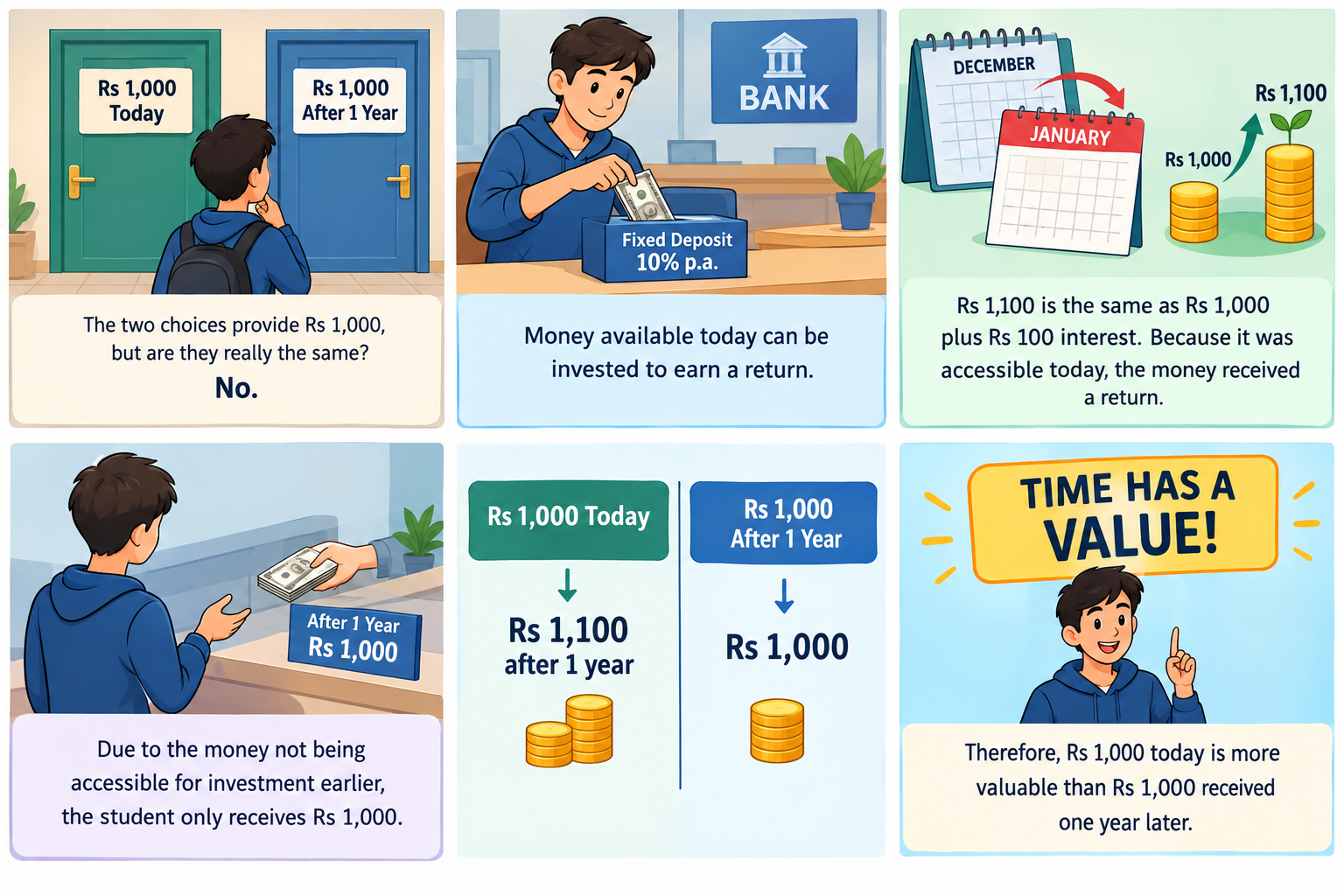
Let's simply say you have two options:
Rs 1,000 now, Rs. 1,000 a year later
Choose Rs. 1,000 right now because money can be invested and earn a profit.
10% interest rate:
Rs 1,000 × 10% = Rs 100 interest
Thus, a year later:
Rs 1,000 + Rs 100 = Rs 1,100
Consequently:
Rs 1,000 now → Rs 1,100 a year later
However, after a year, Rs 1,000 is still Rs 1,000.
In conclusion:
Due to the chance of earning a return, Rs 1,000 is now more valuable.
Reason behind Time Value of Money
An opportunity is the central concept of TVM.
Today's money can be used to generate a return or invested. We miss the chance to earn that return if we receive it later. Opportunity cost is the term for this missed chance.
Basic Reasoning
Today's Money → Investment → Return → More Money
As a result, money received today is worth more than money received later.
Animated Lecture for Rs 1,000 Today vs Tomorrow
Future Value (FV): Meaning, Formula, and Example
Future value is referred to as the amount of money that will be earned in the future when the current amount of money earns through interest or investment over some time. Formula
FV = PV × (1+r) ⁿ
Where,
FV = Future Value, PV = Present Value, r = Rate of return or interest and n = Periods
Example
Future Value of Rs 1,000 for 1 year at 10%
FV = Rs 1,000 × 1.10 = Rs 1,100
So, future value at a 10% interest rate is Rs 1,100.
Present Value (PV): Meaning, Formula, and Example
The value of money that will be received in the future today is known as its present value, or PV.
Formula:
PV = FV / (1 + r) ⁿ
or
PV = FV × 1/(1+r) ⁿ
For instance, Rs 1,100 at 10% after a year:
PV is equal to Rs 1,100 divided by 1.10.
Consequently, assuming a 10% return, Rs 1,100 after a year is now worth Rs 1,000.
Discounting is the process of determining the current value.
Discounting and Compounding
Concept | Meaning | Question It Answers | Example | Easy Memory Trick |
Compounding | Moves money from Present → Future | “What will today’s money become in the future?” | Rs 1,000 invested at 10% become Rs 1,100 after 1 year. | Going Forward |
Discounting | Moves money from Future → Present | “What is future money worth today?” | Rs 1,100 received after 1 year at 10% has a present value of Rs 1,000. | Coming Back |
Quick Revision
Compounding: Present Value → Future Value, Discounting: Future Value → Present Value
Why Does the Value of Money Decrease Over Time?
Reason | Simple Meaning | Example | Key Point |
Capacity of earning | Money earns something. | Rs 1,000 earning 10% interest = Rs 1,100 at the end of 1 year. | The money of today has earning capacity. |
Inflation | Price levels rise with time. | Rs 1,000 will not purchase as much after one year. | Inflation lowers your purchasing capacity. |
Risk | Money in the future is uncertain. | Rs. 1,000 promised after 5 years may not be received as expected. | Future money is more uncertain. |
Opportunity Cost | Postponement of money will be a loss of investment opportunity. | Suppose Rs 1,000 received today would give a return of 10%. If received 1 year later, the gain will be lost. | The gain lost is the Opportunity Cost. |
In Practical Life: Time Value of Money
We use these concepts every day in our routine life; it is not limited to the financial market for big companies
Application of TVM
Suppose a situation in which you have borrowed Rs 100,000 from a bank, but when you repay the amount borrowed from the bank, you have to pay interest on the borrowed amount; we don’t just simply pay the money back.
Why pay interest to the bank?
The bank gives us the opportunity by giving us money now to invest or start our new business. That is why we pay interest later.
Simple Interest vs. Compound Interest
When interest is compounded, the time value of money is important.
Simple Interest
The interest is charged on the original principal amount.
Illustration: Rs. 2,000 @ 20%, 2 years
Interest per year = Rs 2,000 x 20% = Rs. 4 (Principal)
Interest = 400 x 2 = 800
FV = Rs. 2,800
Compound Interest
Interest will be paid on both:
The money that is deposited initially (principal)
The interest that has been generated during the previous year
Year 1: Rs. 1,000 x 10% = Rs. 100
Amount = Rs. 1,100
Year 2: Rs. 1,100 x 10%
Total = Rs. 1,210
Thus, the future value of compound interest is Rs. 1,210.
Time Value of Money (TVM) Formula: FV and PV Explained
Future Value
FV = PV × (1 + r ) ⁿ
Present Value
PV = FV / (1 + r) ⁿ
or
PV = FV × 1/(1+r) ⁿ
Future Value of a Single Amount
If P is invested for n years at rate r: FV = P(1+r) ⁿ
Present Value of a Single Amount
If F is received after n years: PV = F/(1+r) ⁿ
Concepts Notes
Concept | Key Point |
1. Rs 1 Today ≠ Rs 1 Tomorrow | 1 today can earn a return, so it is generally more valuable. |
2. More Valuable is Earlier Money | Earlier money is generally more valuable than later money, assuming positive return and comparable risk. |
3. Compounding | Present-to-future money moves |
4. Discounting | Future → Present. |
5. Interest Rate | Higher interest rate → Higher future value. |
6. Time Period | Longer investment period → Generally Higher Future Value; it is assumed to be a positive return. |
7. Discount Rate | Higher discount rate → Lower present value of a future amount. |
TVM Importance
TVM helps us make correct financial decisions by comparing money with different years of investment returns.
Mainly used:
Investments and borrowings
Evaluation of projects and capital budgeting
Valuations of stocks
Leasing and annuities
If we don’t compare our cash flow with the TVM method from time to time, it will affect our financial decisions
Conclusion
Today’s money will be worth more than tomorrow's money in time value of money (TVM) because it can be invested and we get returns.
Discounting moves money. Future → Present, while compounding moves money from Present → Future.
TVM is important because money changes with time, and it is beneficial for investment and financial decisions.