
Material and labour variances play an important role in the concept of standard costing. They assist in comparing the standard cost with the actual cost, thereby discovering the variances.
For CA Intermediate students, the rationale of the formula becomes easy to understand once the logic is known.
The main principle involves comparing what should have been incurred against what has been incurred, taking into account various aspects such as rate and efficiency.
How CA Himanshu Singla explained material and labour variances: Formulas & Logic
With CA Himanshu Singla, simplify your understanding of difficult cost accounting theories through logical and focused lessons that will help you pass your exam. Get a better understanding of how to calculate the different variances associated with materials and labour by knowing why and how every formula works. Understand price, usage, mix, and yield variances for material costing, and rate, efficiency, and idle time variances for labour costing.

What Is Variance Analysis?
In variance analysis, the difference between standard and actual performance is determined.
"Standard" refers to the expected cost or quantity for a particular level of output. Where there is a difference between the actual cost and the standard cost for materials or labour, a variance occurs.
Primary Reasons
Performance measurement of cost
Efficiency identification
Material and labour control
Analysis of unfavourable variance
Operational efficiency improvement
Basic Principle of Variances Formulas
Before understanding variance formulas, three basic questions need to be understood as follows:
Question | Explanation |
How much were we supposed to spend? | Standard Quantity × Standard Price |
How much did we spend? | Actual Quantity × Actual Price |
What caused the variation? | Changes in price, quantity, efficiency, workforce mix, or production |
What does variance analysis do? | Breaks total variance into meaningful components |
Material Variances
Material variances compare the standard cost of materials to the actual cost of materials. Material variances are classified into:
Variance | Formula | Logic / Meaning | Example / Key Point |
Material Cost Variance (MCV) | MCV = (SQ × SP) − (AQ × AP) | Shows the difference between standard material cost and actual material cost. | Standard: 100 kg × ₹10 = ₹1,000. Actual: 110 kg × ₹11 = ₹ 1,210. MCV = ₹210 Adverse |
Material Price Variance (MPV) | MPV = AQ × (SP − AP) | Measures the effect of a change in material price on the quantity actually purchased. | AQ = 1,000 kg, SP = ₹10, AP = ₹11 → ₹1,000 Adverse. SP > AP = Favourable; SP < AP = Adverse. |
Material Usage Variance (MUV) | MUV = SP × (SQ − AQ) | Measures the cost effect of using more or less material than the standard quantity. | SQ = 1,000 kg, AQ = 1,100 kg, SP = ₹10 → ₹1,000 Adverse. |
Material Mix Variance (MMV) | MMV = SP × (Revised Standard Quantity − Actual Quantity) | Measures the effect of a change in the proportion of materials used. | Standard Mix: A 600 kg @ ₹12, B 400 kg @ ₹8 (1,000 kg total). Actual Mix: A 500 kg, B 500 kg (same 1,000 kg total). MMV(A) = ₹1,200 F, MMV(B) = ₹800 A → Net ₹400 Favourable. |
Material Yield Variance (MYV) | MYV = Standard Cost per unit of Output × (Actual Yield − Standard Yield for Actual Input) | Measures the effect on cost of actual output differing from the output that the actual input should have yielded at standard rate — i.e., whether the mix used more/less material overall than it should have to get the same output. | If 1,000 kg of standard input should yield 950 kg of output, but actual input of 1,000 kg yields only 900 kg, the 50 kg shortfall × standard cost per unit of output = Adverse. |
Labour Variances
Labour variances—and the labour variance formulas behind them—analyze differences between standard labour cost and actual labour cost.
The major labour variances are
Variance | Formula | Logic / Meaning | Example / Key Point |
Labour Cost Variance (LCV) | LCV = (SH × SR) − (AH × AR) | Shows the difference between standard labour cost and actual labour cost. | If actual labour cost exceeds standard cost → Adverse. |
Labour Rate Variance (LRV) | LRV = AH × (SR − AR) | Measures the effect of a change in labour rate per hour. | AH = 1,000, SR = ₹20, AR = ₹22 → ₹2,000 Adverse. Causes may include wage changes, overtime, or different skill levels. |
Labour Efficiency Variance (LEV) | LEV = SR × (SH − AH) | Measures the effect of working more or fewer hours than the standard hours allowed for actual output. | SH = 900, AH = 1,000, SR = ₹20 → ₹2,000 Adverse. |
Labour Idle Time Variance | Idle Time Variance = Idle Hours × SR | Measures labour cost incurred during unproductive idle hours. | 50 idle hours × ₹20 = ₹1,000 Adverse. Causes include machine breakdown, power failure, or material shortage. |
Labour Mix Variance | LMV = SR × (Revised Standard Hours − Actual Hours) | Measures the effect of using a different mix (grade composition) of skilled, semi-skilled, or unskilled workers than the standard mix at standard rate. | Revised Standard Hours = Standard Hours for that grade × (Total Actual Hours ÷ Total Standard Hours). If more skilled hours are used than the standard mix allows, cost typically rises → Adverse. |
Important Principle in Variance Formula
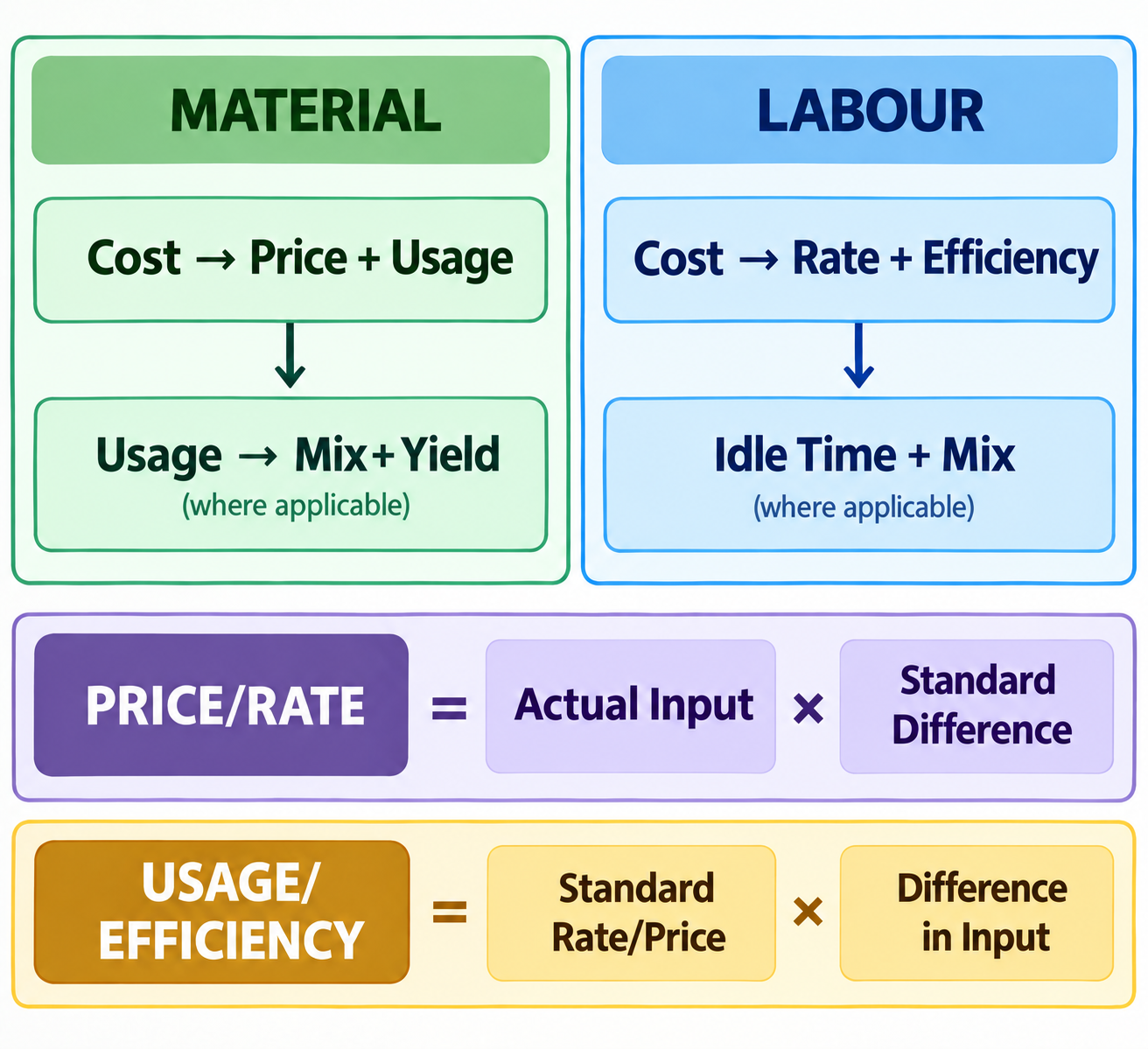
Forget about remembering the formula, and just keep this one in mind.
Price/Rate Variance
Calculate using the actual quantity/hours that are affected by price/rate variance.
MPV = AQ x Price Difference
LRV = AH x Rate Difference
Usage/Efficiency Variance
Use the formula for quantity/hours variance at standard price/rate.
MUV = SP x Quantity Difference
LEV = SR x Hours Difference
Simple Trick:
Price/Rate Variance → Actual Quantity/Hours Variance
Usage/Efficiency Variance → Standard Price/Rate Variance
Variance of Material and Labour
Basis | Material Variance | Labour Variance |
Resource | Material | Labour |
Price-related variance | Material Price Variance | Labour Rate Variance |
Quantity-related variance | Material Usage Variance | Labour Efficiency Variance |
Composition variance | Material Mix Variance | Labour Mix Variance |
Input-output variance | Material Yield Variance | Generally analyzed through efficiency/yield-related measures- (Labour does not have a distinct yield variance; efficiency variance already captures this effect) |
Idle time | Not normally applicable | Labour Idle Time Variance |
Step-by-Step Approach to Solving Variance Problems
The following method may help one avoid errors.
Step | What to Do |
1. Identify Standard Data | Note standard quantity, price, hours, rate, and output. |
2. Identify Actual Data | Note actual quantity, price, hours, rate, and output. |
3. Calculate Cost Variance | Compare Standard Cost with Actual Cost. |
4. Calculate Components | Material: Price, Usage, Mix, Yield. Labour: Rate, Efficiency, Idle Time, Mix. |
5. Determine Favorable / Adverse | Standard > Actual = Favorable; Standard < Actual = Adverse. |
6. Reconcile | Check that individual variances reconcile with the total cost variance. |
Mistakes that students should avoid
Formula Memorization—Determine whether the variance is of price, quantity, rate, efficiency, mix, or yield.
Incorrect Quantity—Price variance typically uses actual quantity, whereas usage variance uses standard quantity vs. actual quantity.
Rate vs. Efficiency Confusion—Rate = Cost per hour; Efficiency = Hours used.
Actual Output Ignored—Compute the standard quantity or hours using the actual output produced.
Idle Time Forgotten—Compute idle time variance if the number of idle hours is given.
Incorrect Favorable/Adverse Sign Interpretation—Interpret the variance in relation to its economic consequence.
Importance of Variance Analysis
It allows the management to detect deviations in costs and their cause and take corrective action.
It assists in evaluating:
Purchase and wastage of material
Efficiency and rate of wages of labour
Labour and material mix
Disruptions in production
Items that need further inquiry
E.g.: An unfavorable material usage variance could arise due to any of the following factors: Wastage, inadequate quality of material, inefficient process, defective machines
A Basic Memory Model
Conclusion
Material and labour variances can explain the reason behind the differences between actual and standard costs.
The trick is to understand the theory underlying each variance, instead of trying to memorise the formulae.