CA Inter New Scheme vs Old Scheme: Key Differences Every Student Must Know
The CA Inter New Scheme vs Old Scheme is an important topic for every CA Intermediate student. ICAI has changed the subject structure, number of papers, exam pattern, and preparation approach under the New Scheme. Many students are still confused about whether the New Scheme is easier, how old subjects are mapped, what happens to exemptions, and how they should prepare for upcoming attempts. This guide explains the major differences in a clear and student-friendly way so that you can understand the syllabus, paper pattern, conversion process, exemption rules, and preparation strategy before making your exam plan.
CA Inter New Scheme vs Old Scheme: Quick Overview
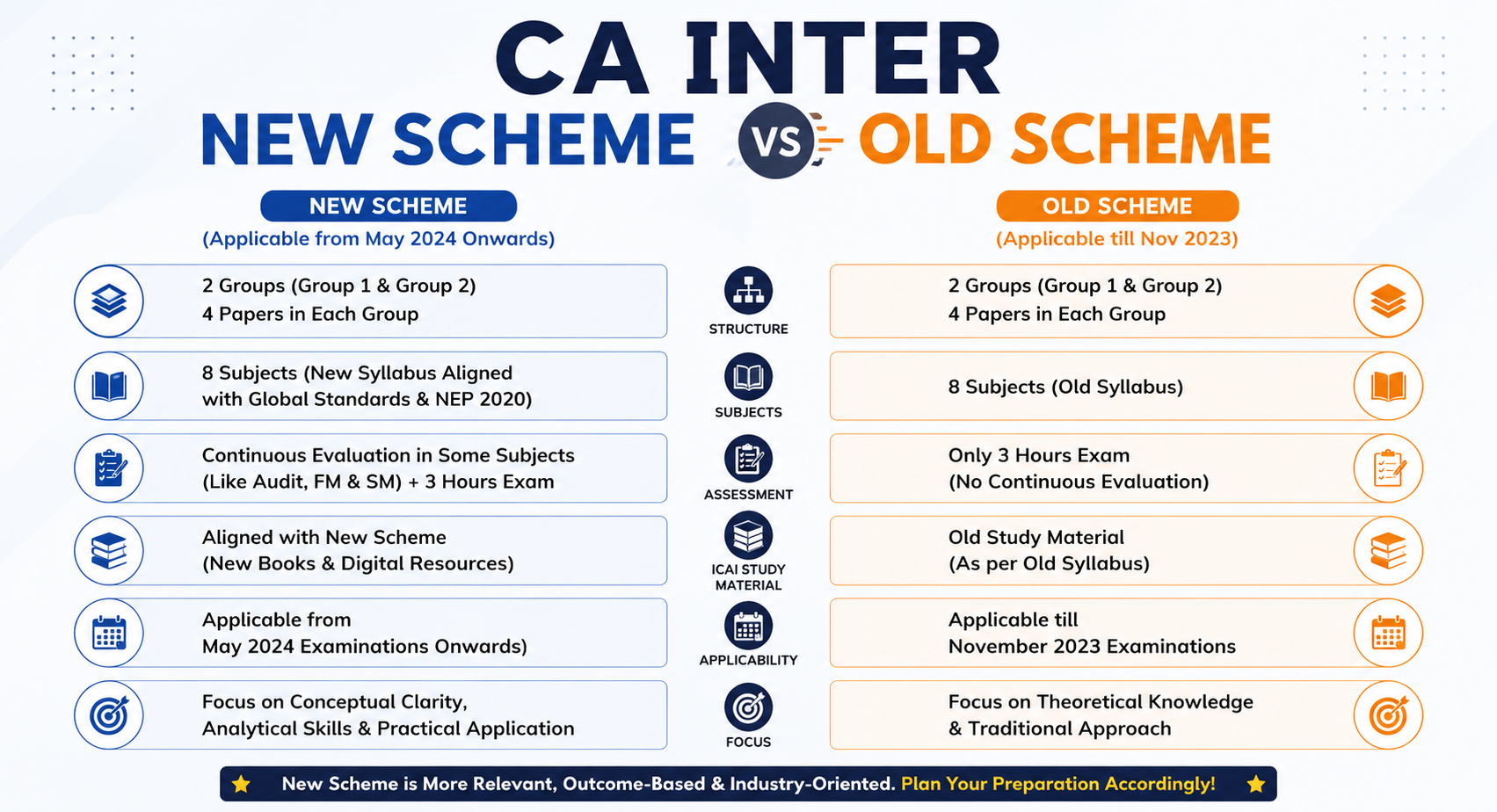
The main difference between the CA Inter Old Scheme and New Scheme is that the old structure had 8 papers, while the New Scheme had 6 papers. However, the change is not only about fewer papers. The New Scheme gives more importance to conceptual clarity, MCQ-based testing, case-based questions, and practical application. Students must now prepare with updated ICAI study material, regular chapter-wise practice, full syllabus mock tests, and strong revision planning.
Simple Comparison Table
Point of Difference | Old Scheme | New Scheme |
| Number of papers | 8 papers | 6 papers |
| Groups | 2 groups | 2 groups |
| Papers per group | 4 papers in each group | 3 papers in each group |
| Subject structure | More separate subjects | More integrated subjects |
| Exam approach | More theory-based | MCQ + descriptive + application-based |
| Preparation style | Subject-heavy preparation | Concept + practice-focused preparation |
| Best for | Existing old scheme students | Current and new CA Inter students |
What Is the CA Inter Old Scheme?
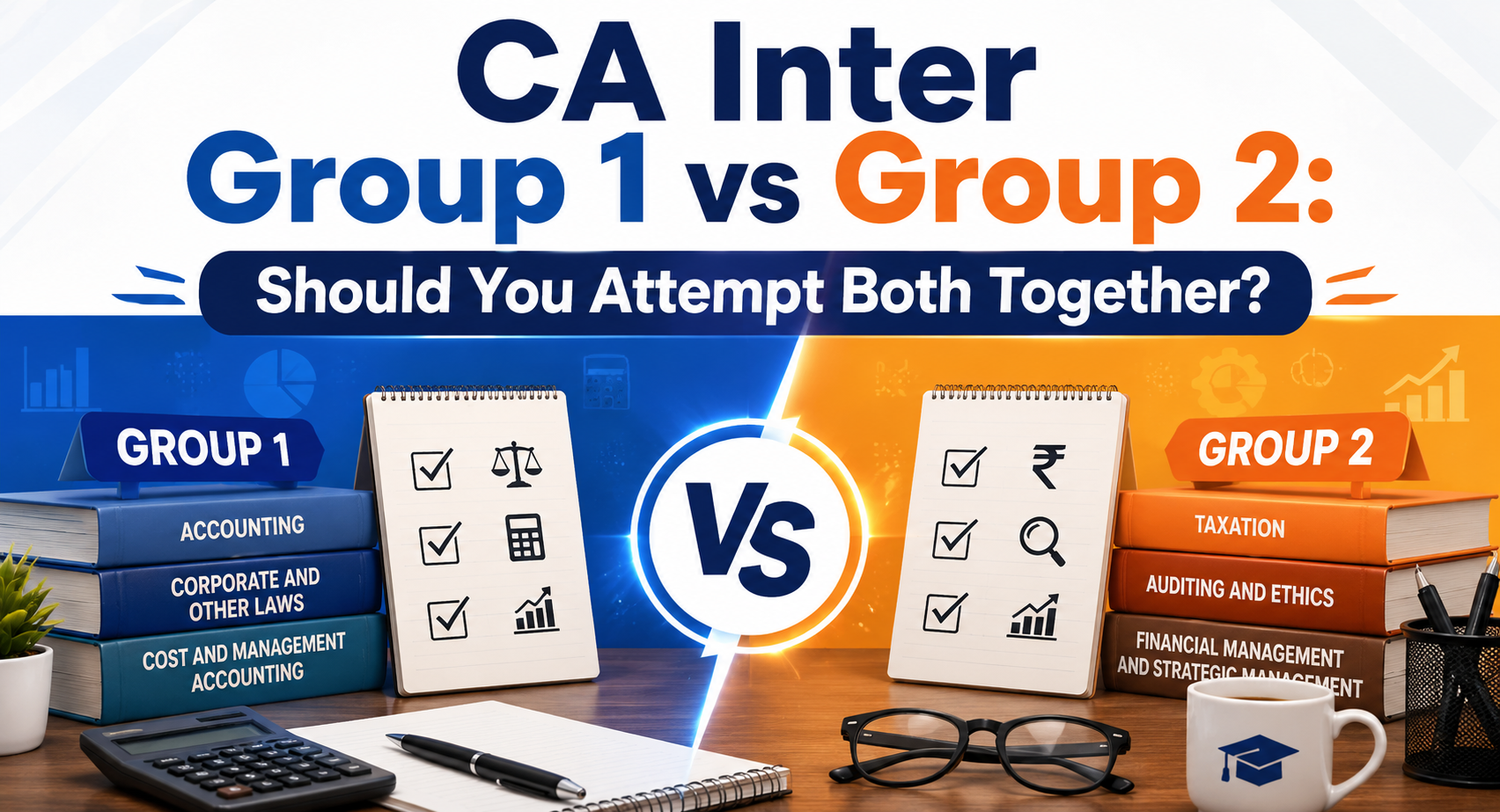
The CA Inter Old Scheme was the earlier ICAI syllabus structure where students had to study 8 papers divided into 2 groups. Each group had 4 papers, which made the syllabus wider and more subject-heavy. Students had to manage separate subjects like Accounting, Advanced Accounting, EIS, Strategic Management, Financial Management, and Economics for Finance. The preparation style under the old scheme required strong time management, regular writing practice, theory revision, and practical problem-solving.
CA Inter Old Scheme Subject Structure
Group | Papers Under Old Scheme |
| Group 1 | Paper 1: Accounting |
| Group 1 | Paper 2: Corporate and Other Laws |
| Group 1 | Paper 3: Cost and Management Accounting |
| Group 1 | Paper 4: Taxation |
| Group 2 | Paper 5: Advanced Accounting |
| Group 2 | Paper 6: Auditing and Assurance |
| Group 2 | Paper 7: Enterprise Information Systems and Strategic Management |
| Group 2 | Paper 8: Financial Management and Economics for Finance |
What Is the CA Inter New Scheme?
The CA Inter New Scheme is the updated ICAI structure where students study 6 papers divided into 2 groups. Each group now has 3 papers. The New Scheme is more focused on practical understanding, conceptual clarity, integrated subjects, MCQs, and application-based learning. Students should not assume that fewer papers mean less difficulty. The exam now requires better accuracy, deeper understanding, and consistent practice through ICAI-pattern tests and mock exams.
CA Inter New Scheme Subject Structure
Group | Papers Under New Scheme |
| Group 1 | Paper 1: Advanced Accounting |
| Group 1 | Paper 2: Corporate and Other Laws |
| Group 1 | Paper 3: Taxation |
| Group 2 | Paper 4: Cost and Management Accounting |
| Group 2 | Paper 5: Auditing and Ethics |
| Group 2 | Paper 6: Financial Management and Strategic Management |
CA Inter New Scheme vs Old Scheme: Subject-Wise Difference
The subject-wise difference between the CA Inter New Scheme and Old Scheme shows how ICAI has reorganized the syllabus. Some subjects are continued, some are revised, and some are merged with other papers. This makes the New Scheme more compact, but students still need strong preparation because the questions are more concept-driven and application-based.
Old Scheme Subjects vs New Scheme Subjects
Old Scheme Subject | New Scheme Status | What Changed |
| Accounting | Revised / integrated | Covered mainly through Advanced Accounting |
| Corporate and Other Laws | Continued | Structure and coverage updated |
| Cost and Management Accounting | Continued | Shifted to Group 2 as Paper 4 |
| Taxation | Continued | Includes Income Tax and GST |
| Advanced Accounting | Revised / shifted | Now Paper 1 in Group 1 |
| Auditing and Assurance | Revised | Now Auditing and Ethics |
| EIS and Strategic Management | Reworked | SM moved with FM; EIS removed from Inter paper structure |
| FM and Economics for Finance | Reworked | FM combined with SM; Economics removed from Inter paper structure |
Student-Friendly Meaning: In simple words, the New Scheme has fewer papers, but it is not a shortcut. Accounting and Advanced Accounting are reorganized, Costing is shifted to Group 2, Audit now includes Ethics, and Strategic Management is combined with Financial Management. Students must compare the old and new syllabus carefully before using old notes or books.
CA Inter Old Scheme vs New Scheme Paper Pattern
The paper pattern is one of the biggest changes under the CA Inter New Scheme. In the Old Scheme, students focused more on descriptive answers, theory, and practical questions. In the New Scheme, students must also prepare for MCQs and case-based questions. This means students need a balanced preparation strategy that includes concept learning, answer writing, MCQ practice, and mock test analysis.
Marks Distribution Under New Scheme
Paper | Subject | Marks | Exam Style |
| Paper 1 | Advanced Accounting | 100 | MCQ + Descriptive |
| Paper 2 | Corporate and Other Laws | 100 | MCQ + Descriptive |
| Paper 3 | Taxation | 100 | MCQ + Descriptive |
| Paper 4 | Cost and Management Accounting | 100 | MCQ + Descriptive |
| Paper 5 | Auditing and Ethics | 100 | MCQ + Descriptive |
| Paper 6 | Financial Management and Strategic Management | 100 | MCQ + Descriptive |
MCQ-Based Questions in CA Inter New Scheme: MCQ-based questions are important because they test accuracy, speed, conceptual clarity, and the ability to apply rules in practical situations. Students should not leave MCQs for the last few days. Daily MCQ practice, wrong-answer analysis, and chapter-wise testing can help students score better and avoid silly mistakes in the exam.
CA Inter Conversion from Old Scheme to New Scheme
CA Inter conversion from Old Scheme to New Scheme is important for students who were registered under the old syllabus but now need to continue under the updated ICAI structure. Students should first check their registration status, group-cleared status, exemption details, and available options on the ICAI SSP portal before making any decision.
CA Inter Conversion Process on ICAI SSP Portal
Step | Action |
| Step 1 | Login to the ICAI SSP portal |
| Step 2 | Select the student cycle |
| Step 3 | Check current course and registration status |
| Step 4 | Choose the conversion option, if available |
| Step 5 | Fill in the required details |
| Step 6 | Pay the applicable fee, if required |
| Step 7 | Submit the form and download confirmation |
| Step 8 | Access or order updated study material |
Exemption Rules: Old Scheme vs New Scheme
Exemption rules are very important for CA Inter students because many old scheme students may have cleared one paper or one group. Before planning the next attempt, students should check whether their exemption is valid, whether it is visible on the SSP portal or exam form, and how it is mapped under the New Scheme. Students should not guess their exemption status because it can directly affect the number of papers they need to attempt.
Exemption Checklist for Students
Question | Why It Matters |
| Have I cleared any group? | It affects remaining paper planning |
| Do I have a paper-wise exemption? | It may reduce exam load |
| Is my exemption still valid? | Expired exemption may not help |
| Which scheme am I registered under? | It decides the applicable syllabus |
| Which attempt am I targeting? | It helps create a study timeline |
| Have I checked ICAI updates? | Rules may change from time to time |
CA Inter New Scheme vs Old Scheme: Difficulty Level
The difficulty level depends on the student’s preparation method. The New Scheme may look easier because it has 6 papers instead of 8, but fewer papers do not mean the exam is easy. Students now need to prepare for application-based questions, MCQs, integrated topics, and deeper conceptual testing. Some students may find the New Scheme better because the paper load is reduced, while others may find it challenging because old notes may not fully match the updated syllabus.
Preparation Strategy for CA Inter New Scheme Students
CA Inter New Scheme students should start with ICAI study material because it is the base for exam preparation. After completing each chapter, students should attempt chapter-wise test papers to check understanding. Full syllabus mock tests should be taken before the exam to improve time management, answer writing, and exam confidence. MCQs should be practised separately every day, and expert answer evaluation should be used to improve presentation, structure, and ICAI-style writing.
Practical Study Plan After Switching to New Scheme
Timeline | What to Do |
| First 30 days | Understand syllabus changes, collect updated ICAI material, start concept revision |
| Next 60 days | Complete subject-wise preparation, attempt chapter-wise tests, practise MCQs |
| Final 30 days | Take full syllabus mock tests, revise weak chapters, review mistakes, improve writing speed |
CA Inter Old Scheme Students: What Should You Do Now?
Old Scheme students should first check their ICAI SSP portal status before making any decision. If you have not cleared any group, you may need to convert and start with New Scheme material. If you have cleared one group, check how it is treated under the New Scheme. If you have a paper-wise exemption, confirm its validity before applying. If you are confused about your scheme, review ICAI notifications or contact ICAI support before starting final preparation.
CA Test Series Support for CA Inter New Scheme Students
CA Test Series helps CA Inter students prepare through ICAI-pattern mock tests, chapter-wise practice tests, expert answer evaluation, and performance tracking. These tools help students understand weak areas, improve answer structure, practise MCQs, and build exam confidence. Instead of preparing randomly, students can use a structured test-based approach to improve accuracy, speed, presentation, and overall exam readiness.
Important Checklist Before Your CA Inter Attempt
Before appearing for CA Inter, students should confirm that their scheme status is checked, conversion is completed if required, exam form is filled correctly, exemption details are verified, updated study material is used, ICAI material is completed, MCQs are practised, chapter tests are attempted, full syllabus mock tests are completed, RTPs and MTPs are revised, and writing speed is improved.
Conclusion
The CA Inter New Scheme vs Old Scheme comparison shows that ICAI has changed the syllabus structure, number of papers, exam pattern, and preparation approach. Students should not compare both schemes only by paper count. The right decision depends on registration status, cleared groups, exemption validity, remaining papers, and target attempt. For better preparation, students should follow updated ICAI material, practise MCQs, attempt chapter-wise and full syllabus mock tests, and use expert evaluation to improve exam performance.