CA Inter Direct Entry Scheme: Who Qualifies and How to Register
For most students, the journey toward becoming a Chartered Accountant begins with the CA Foundation examination. However, not everyone is required to follow this route. ICAI offers an alternative pathway known as the Direct Entry Scheme, allowing eligible students and graduates to enter the CA Intermediate level without appearing for CA Foundation.
Many commerce graduates, postgraduates, and professional qualification holders are unaware that they may already qualify for direct admission into CA Intermediate. Understanding who is eligible, how the registration process works, and what happens after registration can save valuable time and help students plan their CA journey more effectively.
This guide explains the CA Inter Direct Entry Scheme, eligibility requirements, registration process, important considerations, and common mistakes to avoid.
What Is the CA Inter Direct Entry Scheme?
The Direct Entry Scheme is a route introduced by the Institute of Chartered Accountants of India (ICAI) that allows eligible candidates to register directly for CA Intermediate without first clearing the CA Foundation examination.
The scheme is designed primarily for:
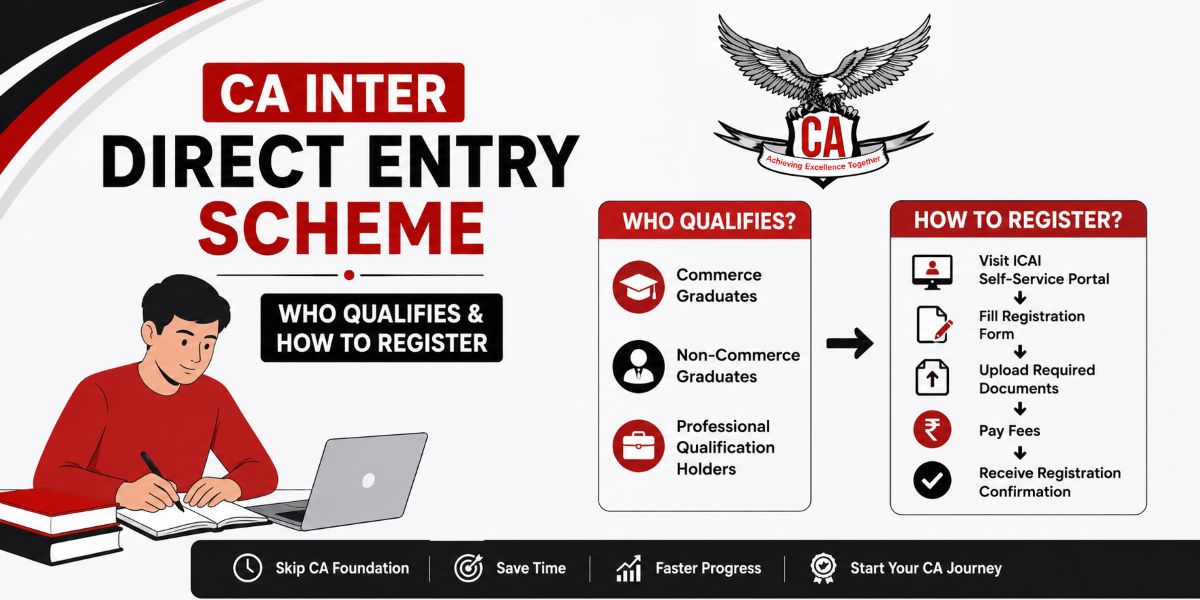
- Commerce graduates
- Commerce postgraduates
- Non-commerce graduates
- Certain professional qualification holders
Instead of starting at Foundation level, eligible candidates can directly begin Intermediate studies.
This pathway is especially beneficial for students who have already completed higher education and possess a strong academic background.
Why ICAI Introduced the Direct Entry Route
The objective of the Direct Entry Scheme is simple.
Many graduates have already studied subjects related to accounting, business, economics, taxation, and finance during their degree programs. Requiring such candidates to begin with Foundation may unnecessarily extend their journey.
The Direct Entry route helps:
- Reduce duplication of learning
- Save preparation time
- Accelerate entry into professional education
- Encourage graduates to pursue Chartered Accountancy
For many students, this route provides a faster transition into the CA course.
Who Qualifies for CA Inter Direct Entry?
Eligibility is based on educational qualifications.
Commerce Graduates and Postgraduates
Students from commerce backgrounds generally qualify if they achieve the minimum percentage prescribed by ICAI.
Common commerce degrees include:
- B.Com
- BBA
- BMS
- Commerce-related postgraduate programs
Candidates should verify the latest ICAI eligibility criteria applicable at the time of registration.
Non-Commerce Graduates and Postgraduates
Students from science, arts, engineering, management, or other academic streams may also qualify under the Direct Entry Scheme.
However, the minimum percentage requirement is generally higher than that applicable to commerce graduates.
Professional Qualification Holders
Certain professional qualifications recognized by ICAI may also provide eligibility for direct registration into CA Intermediate.
Students should review the latest ICAI notifications for updated recognition criteria.
Direct Entry Scheme vs CA Foundation Route
Many students wonder which pathway is better.
The answer depends on eligibility.
Foundation Route
Suitable for:
- Students after Class 12
- Candidates without graduation qualifications
Advantages include:
- Early entry into the CA course
- Gradual introduction to professional studies
Direct Entry Route
Suitable for:
- Graduates
- Postgraduates
- Eligible professionals
Advantages include:
- Skipping Foundation
- Faster progression to Intermediate
- Reduced overall timeline
Neither route is inherently superior. The best option depends on a student's educational background.
Benefits of Registering Through Direct Entry
The Direct Entry Scheme offers several practical advantages.
Saves Time
Students avoid the need to prepare for and clear CA Foundation.
This can significantly shorten the overall journey toward CA qualification.
Leverages Existing Academic Knowledge
Many graduates already possess familiarity with:
- Accounting principles
- Business laws
- Economics
- Financial concepts
This background often helps during Intermediate preparation.
Earlier Focus on Professional Subjects
Instead of spending time on Foundation-level topics, students can begin preparing for Intermediate-level concepts immediately.
Step-by-Step Registration Process
The registration process is relatively straightforward when completed carefully.
Step 1: Verify Eligibility
Before registering, confirm that your educational qualifications satisfy ICAI's current eligibility requirements.
Do not assume eligibility without verification.
Step 2: Access the ICAI Student Portal
Candidates must use the ICAI Self-Service Portal (SSP) for registration.
Ensure that:
- Contact information is correct
- Academic details are accurate
- Required documents are available
Step 3: Select CA Intermediate Registration
Choose the Direct Entry registration option available within the portal.
Carefully review all information before submission.
Step 4: Upload Supporting Documents
Students may be required to upload:
- Graduation mark sheets
- Degree certificates
- Identity proof
- Photograph
- Signature
Document requirements may vary depending on individual circumstances.
Step 5: Complete Fee Payment
Pay the applicable registration fees through approved payment methods.
Retain:
- Payment receipts
- Registration acknowledgments
- Reference numbers
These may be needed later.
Step 6: Receive Registration Confirmation
Once registration is approved, students receive confirmation from ICAI.
At this stage, candidates officially become CA Intermediate students through the Direct Entry route.
Documents Commonly Required
Preparing documents in advance can prevent delays.
Commonly required documents include:
- Graduation mark sheets
- Degree certificate
- Passport-size photograph
- Signature image
- Identity proof
- Contact details
Students should always confirm current requirements before submission.
What Happens After Registration?
Many students assume registration is the final step.
In reality, registration marks the beginning of serious preparation.
After registration, students should:
- Understand the Intermediate syllabus
- Develop a study plan
- Begin concept-building immediately
- Create a revision schedule
The sooner preparation begins, the greater the chances of success.
Common Mistakes Students Make
Several avoidable mistakes can slow progress.
Delaying Registration
Students sometimes wait months after graduation before registering.
This delays preparation unnecessarily.
Assuming Graduation Knowledge Is Enough
A degree provides a foundation, but CA Intermediate requires deeper understanding and exam-oriented preparation.
Ignoring Study Planning
Without a structured plan, even strong students can struggle with syllabus completion.
Underestimating Mock Tests
Mock tests help students:
- Build confidence
- Improve time management
- Identify weak topics
- Develop examination discipline
Preparing for CA Intermediate After Direct Entry
Students entering through Direct Entry often face a substantial syllabus immediately.
A structured strategy is essential.
Focus on Conceptual Clarity
Intermediate subjects require understanding rather than memorization.
Prioritize concepts before attempting extensive practice.
Create Subject-Wise Targets
Break the syllabus into manageable sections and establish realistic weekly goals.
Practice Regularly
Consistent practice improves:
- Retention
- Accuracy
- Confidence
Use Mock Examinations
Many students preparing through the Direct Entry route use chapter-wise tests and mock examinations from platforms such as CATestSeries.org to assess preparation levels and identify weak areas before the actual examination.
Is Direct Entry Easier Than Foundation?
This is a common misconception.
Direct Entry allows students to skip Foundation, but it does not make the CA qualification easier.
Students still need to:
- Master Intermediate subjects
- Complete required training components
- Meet ICAI examination standards
Success depends on preparation, discipline, and consistency—not the entry route.
Final Thoughts
The CA Inter Direct Entry Scheme provides an excellent opportunity for eligible graduates and professional qualification holders to enter the Chartered Accountancy course without appearing for CA Foundation.
For students who qualify, it can save valuable time and allow earlier focus on Intermediate-level studies. However, registration is only the first step. Success ultimately depends on careful planning, disciplined study habits, regular revision, and consistent practice.
Before registering, verify eligibility, prepare all required documents, and understand the responsibilities that come with entering directly into one of the most demanding stages of the CA journey.
Frequently Asked Questions
What is the CA Inter Direct Entry Scheme?
It is an ICAI pathway that allows eligible graduates, postgraduates, and certain professional qualification holders to register directly for CA Intermediate without appearing for CA Foundation.
Can commerce graduates apply through Direct Entry?
Yes. Eligible commerce graduates and postgraduates can register through the Direct Entry route if they meet ICAI's prescribed criteria.
Can non-commerce graduates use the Direct Entry Scheme?
Yes. Eligible non-commerce graduates may also qualify, subject to ICAI's percentage requirements.
Is CA Foundation compulsory for graduates?
No. Eligible graduates can register directly for CA Intermediate through the Direct Entry Scheme.
What documents are generally required for registration?
Graduation mark sheets, degree certificates, photograph, signature, and identity proof are commonly required.
Is Direct Entry easier than the Foundation route?
No. It simply provides a different entry path. CA Intermediate remains equally challenging regardless of how a student enters the course.
Should Direct Entry students attempt mock tests?
Absolutely. Mock tests help improve exam readiness, time management, and performance evaluation throughout preparation.