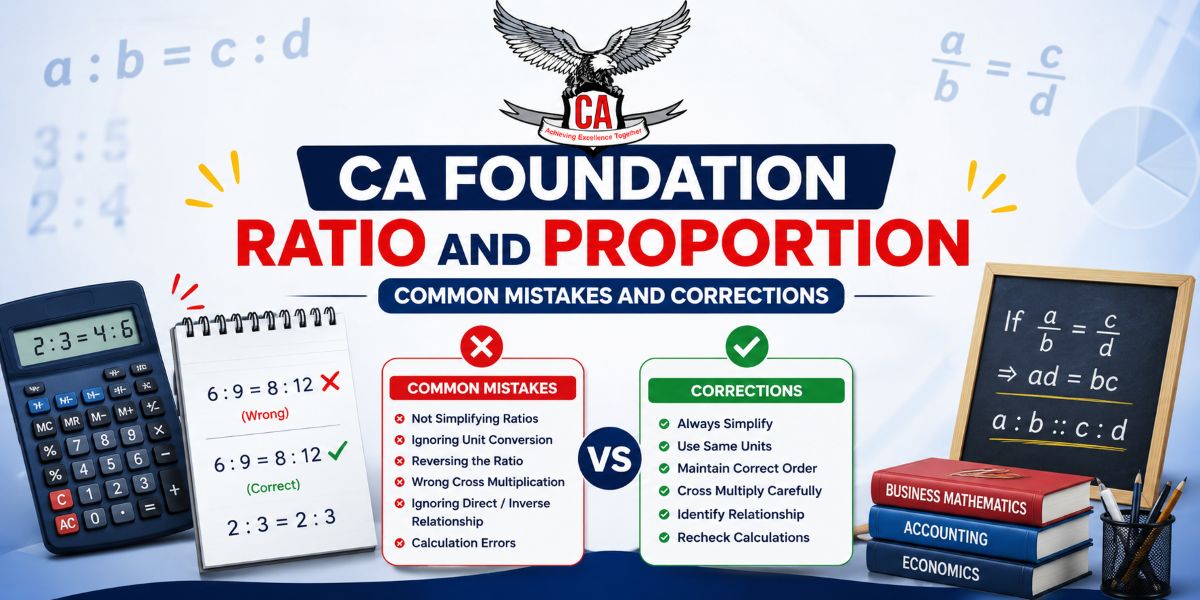
CA Foundation Ratio and Proportion: Common Mistakes and Corrections
CA Foundation Ratio and Proportion: Common Mistakes and Corrections
Ratio and Proportion is one of the most fundamental topics in CA Foundation Mathematics. At first glance, it appears simple because most students have studied it in school. However, many CA Foundation aspirants lose marks in this chapter due to small calculation mistakes, incorrect interpretations, and weak conceptual understanding.
The challenge is not the difficulty of the formulas. The challenge is applying the concepts correctly under exam conditions.
This chapter forms the foundation for several advanced quantitative topics and frequently appears in examinations. Students who master Ratio and Proportion often find other mathematical topics easier to handle.
In this guide, we'll explore the most common mistakes students make in Ratio and Proportion questions and learn practical ways to avoid them.
Why Ratio and Proportion Matters in CA Foundation
Many students treat Ratio and Proportion as a minor chapter.
This is a mistake.
The concepts learned here support several important areas, including:
- Partnership calculations
- Business Mathematics applications
- Profit-sharing problems
- Percentage relationships
- Time and work concepts
- Financial calculations
A strong understanding of ratios improves overall mathematical reasoning and helps students solve questions faster.
Understanding the Difference Between Ratio and Proportion
Before discussing mistakes, it's important to understand the distinction.
What Is a Ratio?
A ratio compares two quantities of the same kind.
For example:
If a class has 20 boys and 30 girls:
Ratio of boys to girls = 20 : 30
After simplification:
2 : 3
The ratio tells us the relationship between the two quantities.
What Is a Proportion?
A proportion states that two ratios are equal.
For example:
2 : 4 = 3 : 6
Both ratios simplify to 1 : 2.
Therefore, they are in proportion.
Many errors occur because students confuse these two concepts.
Common Mistake #1: Forgetting to Simplify Ratios
One of the most frequent mistakes is writing ratios without reducing them to their simplest form.
Example
A student writes:
24 : 36
and leaves it unchanged.
The correct answer is:
2 : 3
because both numbers are divisible by 12.
How to Correct It
Always check whether both terms can be divided by a common factor.
Develop a habit of simplifying every ratio before proceeding to the next step.
This reduces mistakes later in the calculation.
Common Mistake #2: Comparing Different Units
Students often compare quantities without converting units.
Example
A question asks for the ratio of:
5 meters and 250 centimeters
Many students incorrectly write:
5 : 250
This comparison is invalid because the units differ.
Correct Solution
Convert both quantities into the same unit.
5 meters = 500 centimeters
Ratio:
500 : 250
Simplified:
2 : 1
How to Correct It
Before calculating any ratio, verify that all quantities use the same unit.
This simple check can save valuable marks.
Common Mistake #3: Reversing the Ratio
Order matters in ratio questions.
Students frequently reverse the ratio requested in the question.
Example
A question asks:
Find the ratio of boys to girls.
Boys = 40
Girls = 60
Correct answer:
40 : 60 = 2 : 3
Some students mistakenly write:
3 : 2
because they reverse the order.
How to Correct It
Underline the phrase being asked.
Ask yourself:
"What comes first?"
Then write the ratio accordingly.
Common Mistake #4: Incorrect Cross Multiplication
Cross multiplication is essential in proportion problems.
Small arithmetic errors often lead to incorrect answers.
Example
If:
x / 8 = 12 / 16
Cross multiplication gives:
16x = 8 × 12
16x = 96
x = 6
Many students incorrectly multiply the wrong terms.
How to Correct It
Write cross products clearly.
Avoid mental calculations during exams.
Show each step systematically.
Common Mistake #5: Ignoring Direct and Inverse Relationships
Questions involving proportion often require identifying whether the relationship is direct or inverse.
Direct Proportion
If one quantity increases and the other also increases:
- More workers produce more output.
- More quantity costs more money.
Inverse Proportion
If one quantity increases while the other decreases:
- More workers require fewer days.
- Higher speed requires less time.
Common Error
Students solve inverse proportion questions using direct proportion formulas.
How to Correct It
Before solving:
Ask:
"Do both quantities move in the same direction or opposite directions?"
This immediately identifies the correct approach.
Common Mistake #6: Memorizing Instead of Understanding
Some students memorize procedures without understanding why they work.
This becomes a problem when questions are presented differently.
Example
A textbook problem may appear familiar.
An exam question may use the same concept in a business context.
Students who only memorized steps struggle to recognize the underlying principle.
How to Correct It
Focus on understanding:
- Why the ratio exists
- What the quantities represent
- How changes affect the relationship
Conceptual understanding improves adaptability.
Common Mistake #7: Rushing Through Simplification
Many mistakes occur after the correct method has already been applied.
Students solve the question correctly but make a careless simplification error.
Example
18 : 24
Correct simplification:
3 : 4
A rushed student may incorrectly write:
2 : 3
How to Correct It
Reserve a few seconds to verify the final answer.
Many marks are lost due to avoidable simplification mistakes.
A Practical Strategy to Master Ratio and Proportion
The most successful students follow a structured approach.
Step 1: Understand the Concept
Do not start with difficult questions.
Understand:
- Ratio meaning
- Proportion meaning
- Direct proportion
- Inverse proportion
Step 2: Practice Basic Questions
Build confidence with straightforward examples.
Accuracy matters more than speed initially.
Step 3: Solve Application-Based Problems
Move to:
- Partnership questions
- Business scenarios
- Word problems
This improves interpretation skills.
Step 4: Attempt Timed Practice
CA Foundation exams require speed and accuracy.
Timed practice helps develop both.
Step 5: Analyze Mistakes
Every incorrect answer reveals a weakness.
Maintain a mistake notebook containing:
- Wrong calculations
- Unit conversion errors
- Simplification mistakes
- Interpretation mistakes
This prevents repetition.
How Mock Tests Improve Performance
Many students understand Ratio and Proportion but struggle in actual exams.
The reason is often exam pressure.
Regular mock tests help students:
- Improve speed
- Reduce calculation errors
- Build confidence
- Develop time management skills
Platforms such as CATestSeries.org provide chapter-wise tests and mock examinations that help students evaluate their performance and identify recurring mistakes before the actual exam.
Exam Tips for Ratio and Proportion
Before submitting your answer:
- Check unit conversions.
- Verify ratio order.
- Simplify completely.
- Recheck cross multiplication.
- Confirm whether the relationship is direct or inverse.
- Review calculations carefully.
These checks take less than a minute but can prevent several unnecessary errors.
Final Thoughts
Ratio and Proportion is one of the most scoring topics in CA Foundation Mathematics when approached correctly.
Most mistakes occur not because the chapter is difficult, but because students overlook basic details such as simplification, unit conversion, ratio order, and proportional relationships.
The solution is consistent practice combined with conceptual understanding.
Focus on accuracy first, then speed. As your confidence grows, you'll find that Ratio and Proportion becomes one of the easiest chapters to score well in.
Frequently Asked Questions
Is Ratio and Proportion important for CA Foundation Mathematics?
Yes. It forms the foundation for several business mathematics and quantitative aptitude concepts.
What is the most common mistake in Ratio and Proportion questions?
Failing to convert quantities into the same unit before calculating the ratio.
How can I improve my accuracy in this chapter?
Practice regularly, simplify every ratio carefully, and maintain a notebook of common mistakes.
Are direct and inverse proportion questions frequently asked?
Yes. Understanding the difference is essential for solving many application-based problems.
Should I memorize formulas for Ratio and Proportion?
Understanding concepts is more important than memorization. Students who understand the logic behind ratios usually perform better.
How many questions should I practice before the exam?
Focus on quality rather than quantity. Solve enough questions to become comfortable with basic, intermediate, and application-based problems.