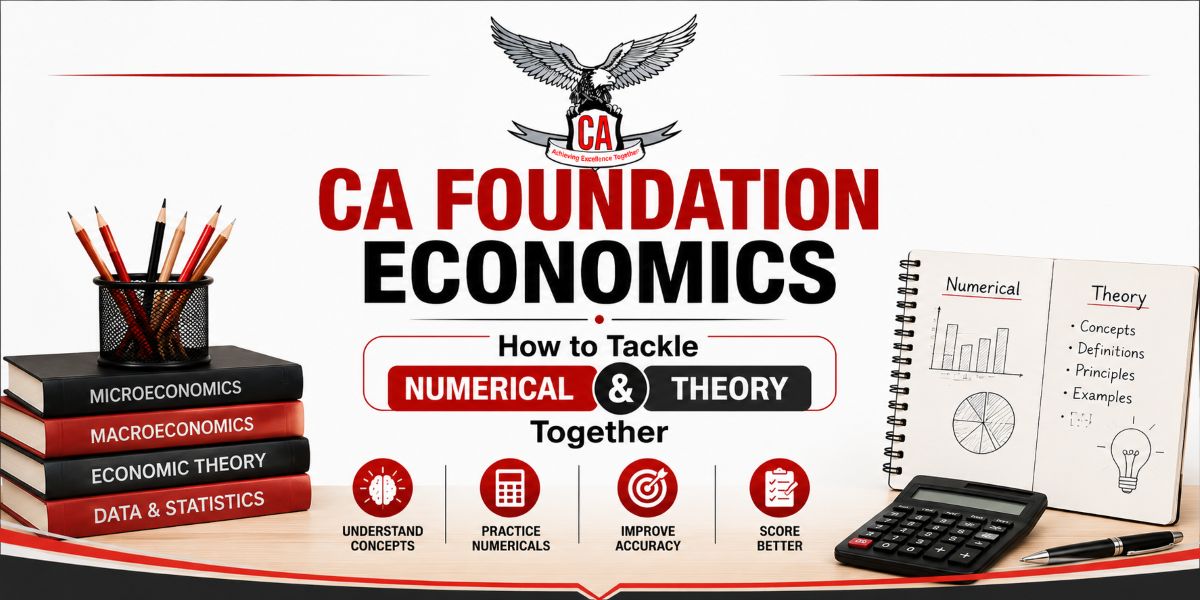
CA Foundation Economics: How to Tackle Numerical and Theory Together
Many CA Foundation students make the same mistake while preparing for Economics: they study theory and numerical questions separately.
They spend days memorizing concepts, definitions, and chapter summaries, then switch to solving numerical problems later. Unfortunately, this approach often leads to confusion, poor retention, and difficulty during exams.
Economics is not a subject where theory and numerical exist independently. The best-performing students understand that both are interconnected. Theory explains the concept, while numerical help apply and reinforce that concept.
If you want to improve your Economics preparation and score consistently, learning how to study theory and numerical together is essential.
Why Students Struggle with Economics
Economics is unique because it combines conceptual understanding with practical application.
Unlike Accounting, which is heavily numerical, or Business Laws, which is primarily theoretical, Economics requires both skills simultaneously.
The Theory-Only Approach
Some students focus entirely on understanding concepts such as:
- Demand and Supply
- Inflation
- National Income
- Market Structures
While they understand the chapters, they often struggle when calculations or data interpretation questions appear.
The Numerical-Only Approach
Other students focus mainly on formulas and calculations.
They may solve numerical questions correctly but struggle to explain the economic logic behind the answers.
Both approaches create gaps in preparation.
The solution is to integrate theory and numericals from the beginning.
Start Every Chapter with Concept Clarity
Before touching any formula, understand the concept.
Ask Basic Questions
Whenever you begin a chapter, ask:
- What does this concept mean?
- Why is it important?
- Where is it used?
- How does it affect economic decisions?
For example, while studying Demand, don't immediately memorize schedules and calculations.
Instead, understand why consumers buy more when prices fall and less when prices rise.
Once the concept becomes clear, numerical questions start making more sense.
Use Real-Life Examples
Economics exists everywhere around us.
Think about:
- Discount sales increasing demand
- Fuel price changes affecting spending habits
- Inflation increasing the cost of daily goods
Connecting theory to real-life situations improves understanding and retention.
Study Theory and Numericals Together
The most effective Economics study strategy is simple:
Learn the concept and immediately apply it through numerical practice.
Example: Elasticity of Demand
Step 1:
Understand what elasticity means.
Learn why demand changes differently for luxury goods and essential goods.
Step 2:
Study the elasticity formula.
Step 3:
Solve numerical questions related to elasticity.
This process creates a strong connection between understanding and application.
Example: National Income
Instead of studying the theory today and solving numericals next week:
- Learn National Income concepts.
- Understand the methods of calculation.
- Solve related numerical problems immediately.
This approach improves both accuracy and memory.
Create a Combined Formula and Concept Notebook
Most students maintain separate notes for theory and formulas.
A better approach is to combine them.
What to Include
For each chapter, write:
- Key concepts
- Important formulas
- One practical example
- Common mistakes
- Quick revision points
For example:
Topic: Elasticity of Demand
Concept:
Measures responsiveness of demand to price changes.
Formula:
Percentage Change in Quantity Demanded ÷ Percentage Change in Price
Example:
Fuel demand often remains stable despite price increases.
This format makes revision faster and more effective.
Practice Application-Based Questions
CA Foundation examinations increasingly test application rather than memorization.
Students must be able to:
- Interpret data
- Analyze situations
- Apply concepts
- Use formulas correctly
Why Application Matters
A student who only memorizes theory may struggle when questions are framed differently.
A student who understands the concept can adapt to various question formats.
This is why solving practical questions regularly is essential.
Develop a Smart Revision Strategy
Revision is where many students lose marks.
They reread chapters repeatedly but rarely test themselves.
The Better Approach
After completing a chapter:
- Revise concepts.
- Review formulas.
- Solve 10–15 mixed questions.
- Analyze mistakes.
This active revision process improves long-term retention.
Use Weekly Revision Sessions
Dedicate one day each week to revising previously completed chapters.
This prevents forgetting and strengthens conceptual understanding.
The Importance of Mock Tests
Many students believe mock tests should be attempted only after completing the syllabus.
This is a mistake.
Mock tests help students:
- Identify weak areas
- Improve speed
- Practice application-based questions
- Build exam confidence
Platforms such as CATestSeries.org provide chapter-wise tests and mock examinations that allow students to evaluate both conceptual understanding and numerical accuracy before the actual examination.
The goal is not just to complete tests but to learn from mistakes and improve continuously.
Common Mistakes to Avoid
Memorizing Without Understanding
Economics rewards understanding more than rote learning.
Ignoring Numericals
Many students spend too much time reading theory and not enough time applying concepts.
Practicing Formulas Without Concepts
Knowing formulas is useful only when you understand when and why to use them.
Skipping Revision
Without regular revision, concepts become difficult to recall during exams.
How Top Students Prepare Economics
Students who consistently score well in Economics usually follow a balanced approach.
They:
- Learn concepts thoroughly.
- Connect theory with practical examples.
- Solve numericals immediately after studying a topic.
- Revise regularly.
- Attempt mock tests.
- Analyze mistakes carefully.
Their focus is not on memorization but on understanding and application.
Final Thoughts
CA Foundation Economics becomes much easier when theory and numerical preparation are combined.
Theory helps you understand economic principles.
Numericals help you apply those principles in practical situations.
Separating them creates confusion. Studying them together creates clarity.
Whenever you start a new chapter, understand the concept first, connect it to real-life examples, and immediately reinforce it through numerical practice.
This approach improves retention, increases confidence, and prepares you for the type of questions ICAI commonly asks.
Most importantly, it turns Economics from a subject you memorize into a subject you genuinely understand.
Frequently Asked Questions
Should I study theory or numerical first in Economics?
Always start with concept clarity and then move to numerical practice.
How can I improve Economics numerical?
Understand the concept behind the formula and solve questions immediately after learning the topic.
Is Economics more theory-based or numerical?
It is a balanced subject that requires both conceptual understanding and practical application.
How often should I revise Economics?
Weekly revision combined with regular question practice works best.
Are mock tests important for Economics?
Yes. Mock tests improve application skills, speed, and exam confidence.
What is the biggest mistake students make in Economics?
Studying theory and numerical separately instead of integrating them during preparation.