If you're searching for the best faculty for CA Final AFM, you've probably already felt the two sides of this paper. Ask any CA Final student about AFM, and you'll get one of two reactions: excitement, because it's one of the few papers where consistent effort translates directly into marks, or nervousness. After all, "Advanced Financial Management" can feel like a maze of complex formulas. The right faculty is what turns that fear into confidence and makes AFM genuinely easier to master.
To put it plainly, both of these responses are legitimate reactions. AFM is indeed a scoring subject, not necessarily because it is a tough subject, but because it is an application-based subject. ICAI wants to know whether candidates can apply the concepts of finance and not just mug up the formulas that can earn them marks in the examination. AFM has been scoring for those students who know how to apply and solve the problems. However, AFM has also been complicated due to the fact that we've been taught finance just as we've been taught chemistry.
That's really the difference between faculty who deliver results and those who don't. AFM promotes learning through comprehension and not memory. This is precisely why serious CA Final AFM preparation depends on the right faculty, not just more notes and self-study. The ideal professor does not simply teach the syllabus but changes the way the learner perceives the subject matter.
The Right Way to Prepare for CA Final AFM
CA Final AFM is an application-based subject where simply memorising formulas may not be enough. A structured preparation strategy can help you build conceptual clarity, improve question-solving ability and prepare effectively for the examination.
The key is to follow a consistent process—from understanding concepts through video lectures to practising questions, taking mock tests and analysing mistakes.
Step | What to Do | Why It Matters |
1. Watch Video Lectures | Learn difficult concepts through visual and practical explanations. | Makes complex AFM topics easier to understand. |
2. Understand Concepts | Understand the concept before memorising the formula. | Helps you apply formulas correctly in unfamiliar questions. |
3. Learn Through Practical Examples | Connect AFM concepts with real financial situations. | Improves conceptual clarity and application. |
4. Solve Questions | Practise questions after completing every topic. | Builds confidence and improves problem-solving ability. |
5. Make Short Notes | Note important formulas, concepts and common mistakes. | Makes revision faster and more effective. |
6. Practise Difficult Topics | Give extra attention to Portfolio Management, Derivatives, Valuation and Forex. | Helps strengthen areas that require more conceptual application. |
7. Take Mock Tests | Attempt mock tests regularly under exam-like conditions. | Improves speed, accuracy and exam application. |
8. Analyse Mistakes | Review mistakes and revise your weak areas. | Prevents the same mistakes from being repeated. |
Effective CA Final AFM preparation is not about studying more—it is about studying in the right sequence. Start with video lectures and concept clarity, strengthen your understanding through practical examples and question practice, and then use mock tests to identify and improve your weaknesses..
How to Choose the Best CA Final AFM Video Lecture
Choosing the right video lecture can make a big difference in AFM preparation. Instead of selecting a lecture only because it is popular or lengthy, students should check whether it supports their learning and exam requirements.
Look for these points:
Concept-focused teaching: The lecture should explain the logic behind formulas instead of encouraging rote memorisation.
Practical examples: Difficult AFM concepts should be connected with real financial situations and exam-style problems.
Visual explanations: Topics such as derivatives, portfolio management and forex can become easier when explained through diagrams, animations or practical illustrations.
Exam-oriented approach: The lecture should help you understand how concepts can be applied in CA Final questions.
Updated content: Check whether the lectures and accompanying CA Final AFM study material are aligned with the current syllabus and requirements.
Question practice: Prefer lectures that include illustrations and question-solving rather than only theoretical explanations.
Revision support: Short revision lectures or structured explanations can be useful when preparing for the final revision.
Before choosing a lecture series, watch a demo lecture and ask yourself:
Who Is CA Anil Chawla?
With the help of his professional experience from Acuity Knowledge Partners, CA Anil Chawla brings to Advanced Financial Management both corporate industry knowledge and academic excellence. With the experience of being in the industry, he brings an element of practicality that is usually lacking in other classroom-based faculties. He does not just explain formulas in class, but also goes further to explain the relevance of the formulas in real-life situations.
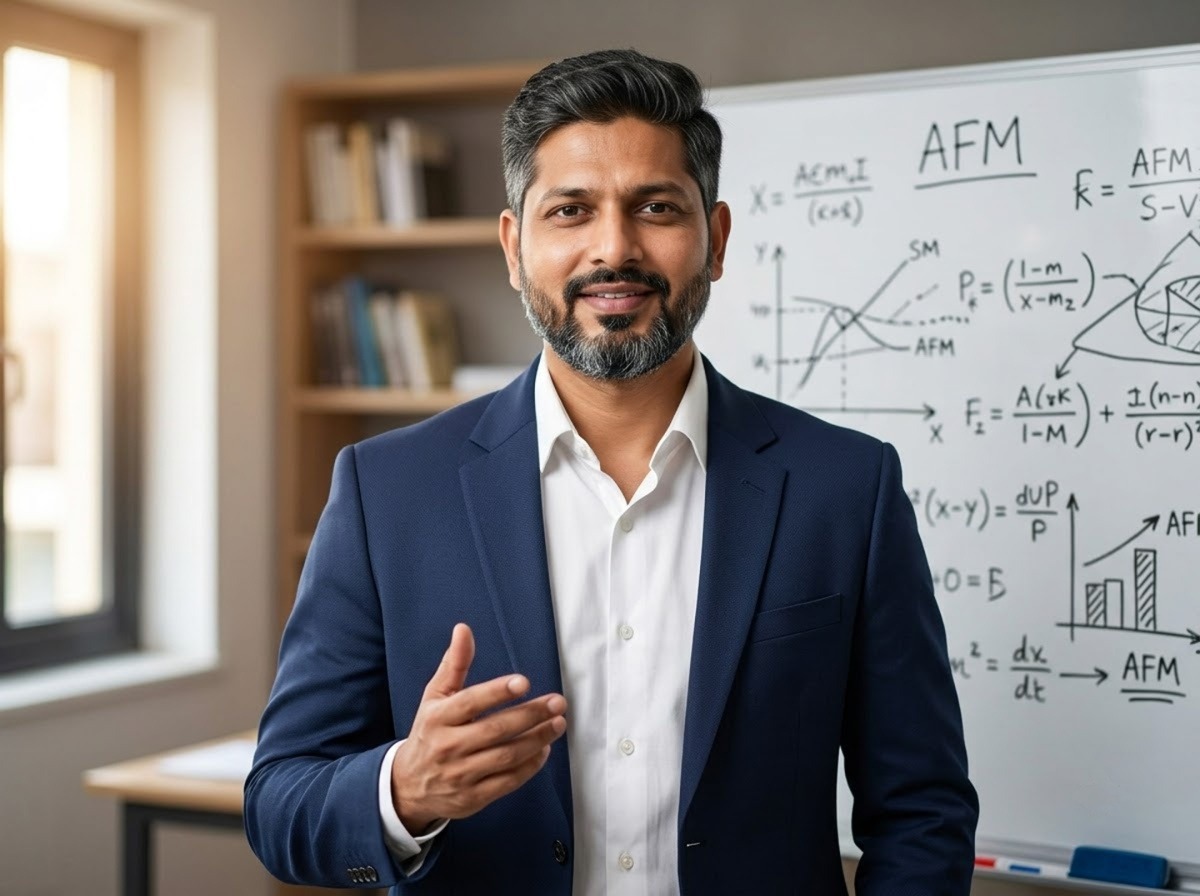
His CA Final AFM classes are built on one core belief: concept understanding should matter more than formula memorization. Through this approach, he has been able to assist many final-year CA students in developing the confidence to solve the complex numerical questions that tend to give many aspirants sleepless nights. His CA Final AFM online classes are known for more than just lectures — his study materials, practice questions, revision content, and exam preparation techniques have all stood out among students.
Highlights:
Experience in Corporate Finance at Acuity Knowledge Partners
Advanced Financial Management subject for CA Final specialist
Approach concepts first and numbers later—students remember a lot more about numerical subjects
Provide mentorship to students on strategic paper-solving techniques for AFM
His Case-Study Driven Teaching Method for CA Final AFM
What comes up again and again when students describe his CA Final AFM case study method is that he doesn't teach topics in isolation. Instead of "here's the formula for hedging with futures," it's usually framed around an actual business situation — a company with a currency exposure, an investor comparing two portfolios, a firm deciding whether a merger makes financial sense. ICAI's AFM paper is written around scenarios, not definitions, so this framing matters more than it might sound like at first — students who've gone through it describe reading a question and instinctively thinking about what's actually happening financially, with the calculation following naturally from there.
Typical AFM Teaching vs. His Approach
Typical approach | His approach |
The formula taught in isolation | Formula introduced through a real business scenario |
Student hunts for "which formula fits this question" | The student reads the scenario, and the calculation follows naturally |
Derivatives explained as abstract math | Derivatives explained the way a treasury/risk team would think |
Static slides, talking-head lectures | Animated visual explanations, paired with storytelling per chapter |
Formula sheets for revision | Tables with reasoning, plus confusing points flagged directly |
Material recycled year to year | Study material, mock questions, and revision content kept current |
Animation plays a big role in how these concepts stick. His CA Final AFM lectures use animated visuals to walk through how a payoff moves, how a cash flow changes over time, or how a portfolio's risk-return trade-off shifts — the kind of thing that's genuinely hard to picture from a static slide or a formula written on a whiteboard. Students consistently point to this as the reason concepts from earlier chapters stay fresh even months later, instead of fading the way memorized formulas usually do.
He also keeps his study material, practice questions, and revision content updated himself, rather than handing that off or letting it go stale — which matters more in AFM than most papers, since the syllabus and applicable standards shift more often here than in some of the other CA Final subjects.
Key CA Final AFM Topics Simplified by CA Anil Chawla
Not every chapter in AFM causes equal panic. A handful come up over and over as the ones students find hardest — and, unsurprisingly, they're also where a good teacher makes the biggest difference.
Topic | Why students struggle | How does he simplify it |
Portfolio Management | Feels like a list of formulas — CAPM, Sharpe, Treynor, Jensen's Alpha | Tie each ratio back to the actual investment decision it answers |
Derivatives & Risk Management | Treated as abstract math, disconnected from why a business would hedge | Explains strategies the way a real treasury/risk team would think about them |
Business Valuation & Corporate Restructuring | Multiple valuation methods (DCF, relative, asset-based) with no clear sense of when to use which | Frame each method around a real-deal scenario — why an acquirer would pick one approach over another |
Foreign Exchange & International Financial Management | Currency exposure, forward/futures pricing, and interest rate parity feel like separate, disconnected formulas | Ties them together as one connected story — how a company actually manages currency risk end-to-end |
Mutual Funds | NAV, expense ratio, and return calculations look simple individually, but get confusing when combined in a single problem | Breaks the calculation into a consistent, repeatable sequence that students can apply to any variation of the question. |

Portfolio Management
Rather than memorizing Sharpe, Treynor, and Jensen's Alpha as separate formulas, students learn to ask one question first: Which portfolio gives better returns for the risk taken?"
Every ratio becomes a different lens on that same question — exactly how ICAI frames portfolio comparison problems in the exam.
Derivatives & Risk Management
Hedging strategies are introduced through the business risk they solve — a company worried about currency movement, a firm exposed to interest rate changes — rather than as abstract payoff diagrams.
Sign errors and wrong hedge ratios (the two most common student mistakes) get addressed as part of the method itself, not left for last-minute revision.
Business Valuation & Corporate Restructuring
The starting point is always "why is this company being valued?" — that single question determines whether DCF, relative, or asset-based valuation is the right call.
Students are trained to justify their method choice, which is precisely what ICAI rewards in this chapter's answer-writing.
Foreign Exchange & International Financial Management
Currency exposure, forward pricing, and interest rate parity are taught as one connected story rather than four separate formulas: a company faces currency risk, so it uses forward pricing and IRP to work out the future rate.
Once that connection is clear, cross-topic exam questions become much easier to spot.
Mutual Funds
A fixed, repeatable sequence handles NAV, expense ratio, and return calculations even when a question combines all three.
Common calculation traps are flagged before students hit them in practice, turning an easy-to-underestimate chapter into a reliably scoring one.
Exam-Day Application Tips from His AFM Teaching Method
Understanding the concepts is one thing — getting it right under exam pressure is another. A few habits that consistently come out of his teaching:

Read the scenario properly before reaching for a formula. Students who practice with a CA Final AFM mock test built on this method are less likely to grab the wrong formula under exam pressure, because they've been trained to identify the actual financial question first.
Show your working, step by step. AFM gives generous method marks, and structured answers pick up partial credit even when the final number is slightly off.
Learn to recognize the type of question, not just the topic. Since his teaching is built around real scenarios, students get better at spotting "oh, this is a hedging question" or "this is a financing decision" quickly, which saves time.
Revise by re-understanding, not just re-reading formula sheets. Going back to why something works, rather than just what the formula is, tends to hold up much better when ICAI phrases a question in a way you haven't seen before.
None of these are exam "hacks" in the usual sense — they're really just what naturally follows from learning the subject properly in the first place.
For comprehensive preparation, we also provide CA Final AFM study notes and exam-oriented mock tests to help students revise effectively and practice under exam-like conditions.
Conclusion
AFM has a reputation for being intimidating, but it doesn't have to stay that way. The students who end up doing well in this paper aren't necessarily the ones who memorized the most formulas — they're the ones who understood what the formulas were actually for.
CA Anil Chawla's background — real corporate experience combined with a genuine teaching ability — is what makes his approach work. Case studies instead of isolated formulas, a CA Final AFM test series, and material kept current rather than recycled year after year, and a consistent focus on why something works before how to calculate it. That combination is what turns AFM from a paper students are afraid of into one they actually look forward to scoring well in.
If you're still weighing who's genuinely the best AFM teacher for CA Final, it comes down to one question: do you want to memorize this paper, or actually understand it? If it's the second one, that's really the whole case for CA Anil Chawla as the best faculty for CA Final AFM.