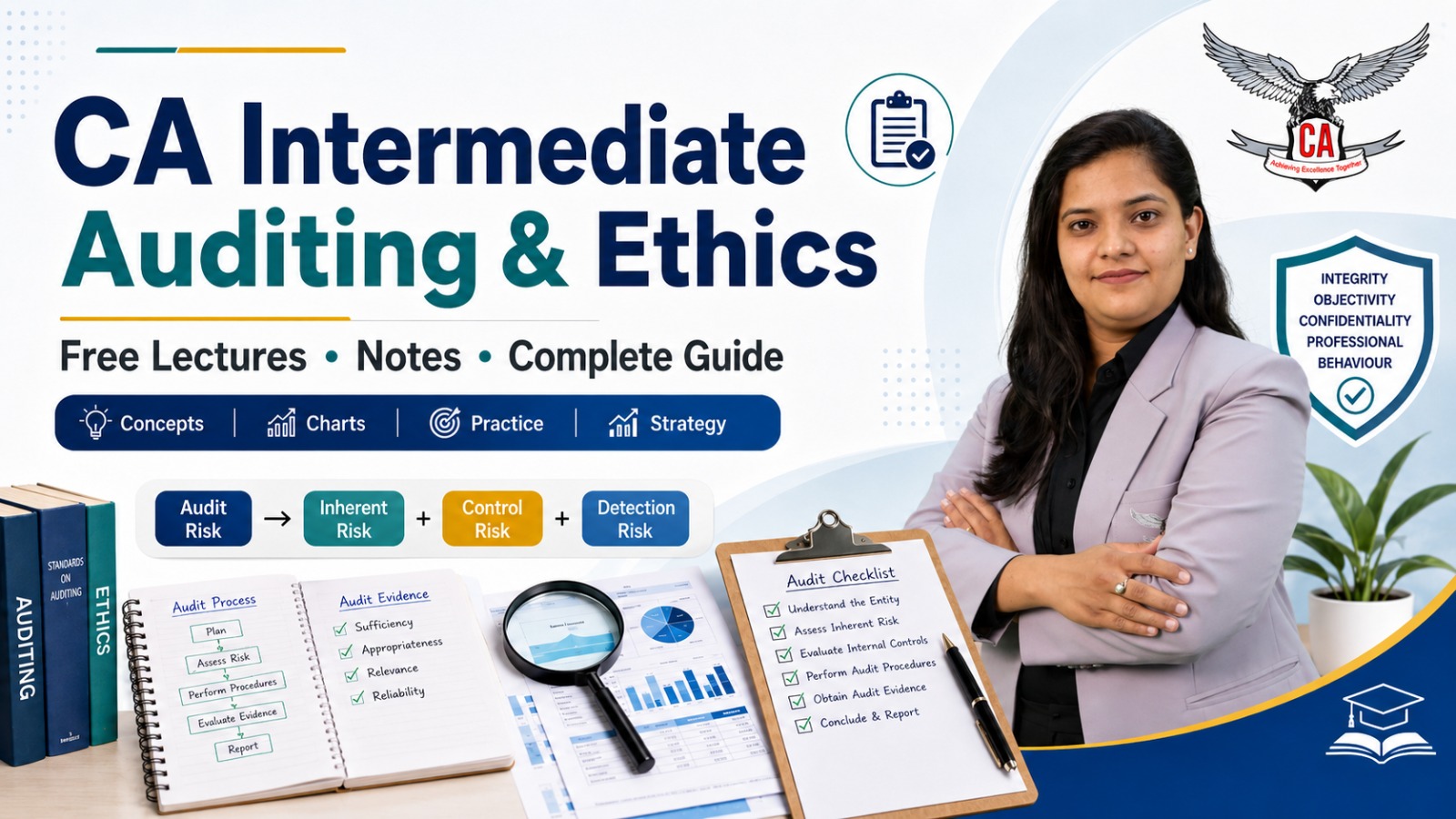
CA Inter Audit & Ethics: Free Lectures, Notes, Guide
Audit and Ethics is among the most important papers in the CA Intermediate exam. This is a paper which cannot simply be learned through remembering the contents of the book. There is a need to grasp the concepts, relate them to practice, memorise some key terms, and write answers.
CA Inter Auditing and Ethics: Free Lectures, Notes & Complete Guide
Under the Audit exam pattern, the subject is now considered as “Auditing and Ethics” (100 Marks), with a student-friendly split:
Descriptive Questions: 70%
Multiple Choice Questions (MCQ): 30%
By focusing on understanding Audit Risk, you can master this paper while building a strong foundation for your future career as a Chartered Accountant.
What is Auditing and Ethics?
Auditing refers to the process of examining financial information and related documents to ensure that financial statements are free from material misstatement. An auditor draws conclusions based on the evidence gathered.
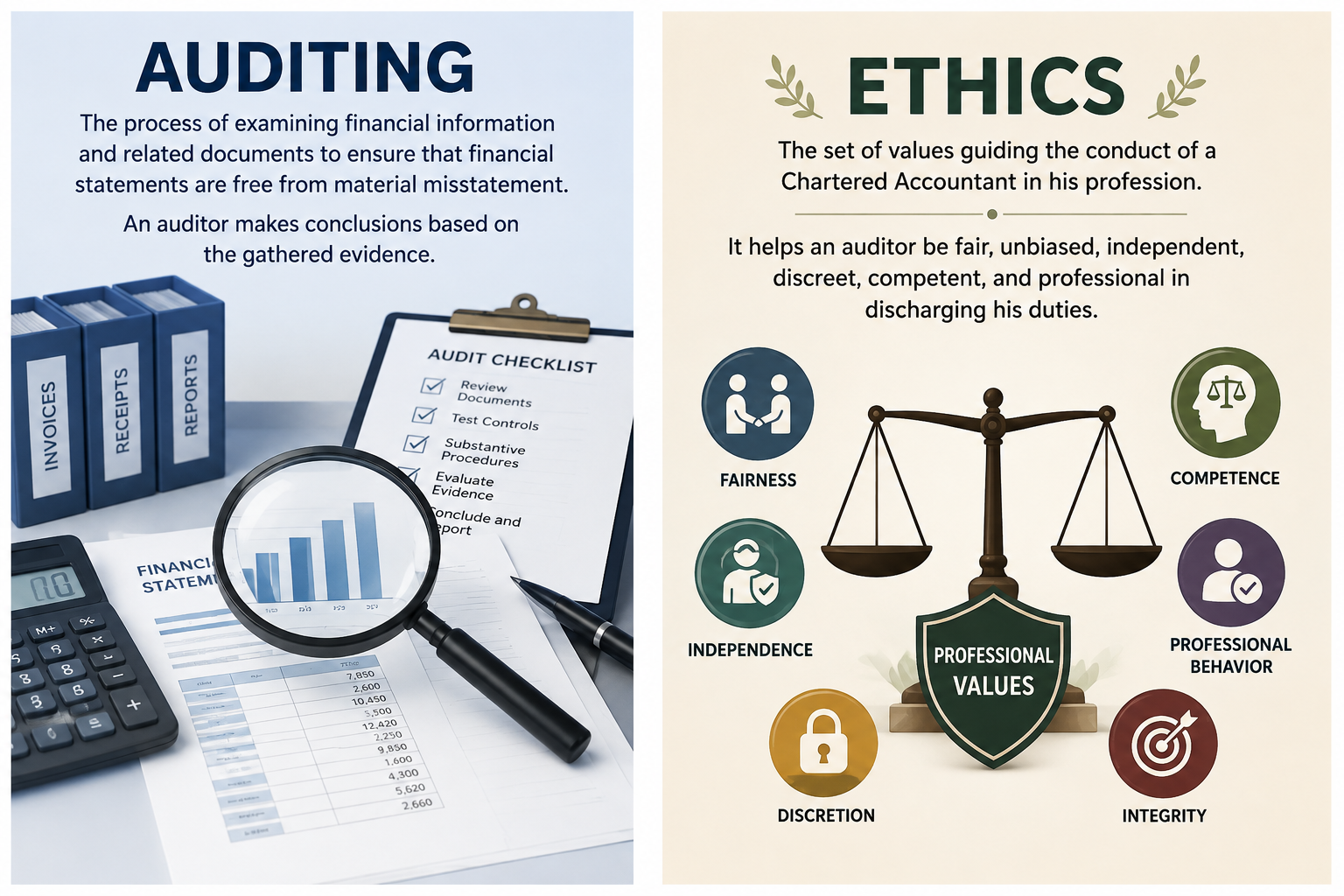
On the other hand, ethics refers to the set of values that guide a Chartered Accountant in their profession. It helps an auditor be fair, unbiased, independent, competent, and professional in discharging their duties.
In simpler terms, Auditing shows you how to examine, whereas Ethics show you how to behave when discharging that duty.
Why is Auditing Tough for Students?
Many students feel the auditing and ethics subject is tough because it involves the standard audit codes. Students sometimes forget to understand these auditing standards because there are too many standards to learn.
Why Animated Lectures Help With Auditing and Ethics
When it becomes difficult for students to understand the concept through the books, the way out is to develop a learning cycle
Learn about the concept
Imagine the concept
Practice the concept
Review the concept
Test yourself
Do it all again
Avoid Watching Only — Stay Active Through the Lecture
The biggest mistake students make is to treat the lectures as entertainment. They watch the faculty's explanation of the lecture, listen attentively, and consider that the chapter is finished.
Your mind needs to stay active throughout the lecture. You do not need to limit yourself to only listening to what the faculty is talking about, but ask yourself throughout the lecture:
What is the idea?
Why is it needed?
Where can it be applied?

How to Remain Actively Involved in Lectures
Pause the lecture when a new concept is introduced.
Attempt to explain the concept in your own words.
Write down all the key words.
Generate examples on a small scale.
Relate the concept to real-life scenarios.
Instead of reading, visualise the concept.
Highlight those portions which are hard to grasp.
Think back to the previous concept before proceeding further.
The objective of a lecture is not to fill up hours. The objective is to understand and remember the concepts being taught.
Make Use of Faculty Charts, Notes, and Strategy Material
Students nowadays have many other sources to study. The faculty pictures, handwritten notes, charts, summary charts, strategy material, revision videos and other such sources may make studying more interactive.
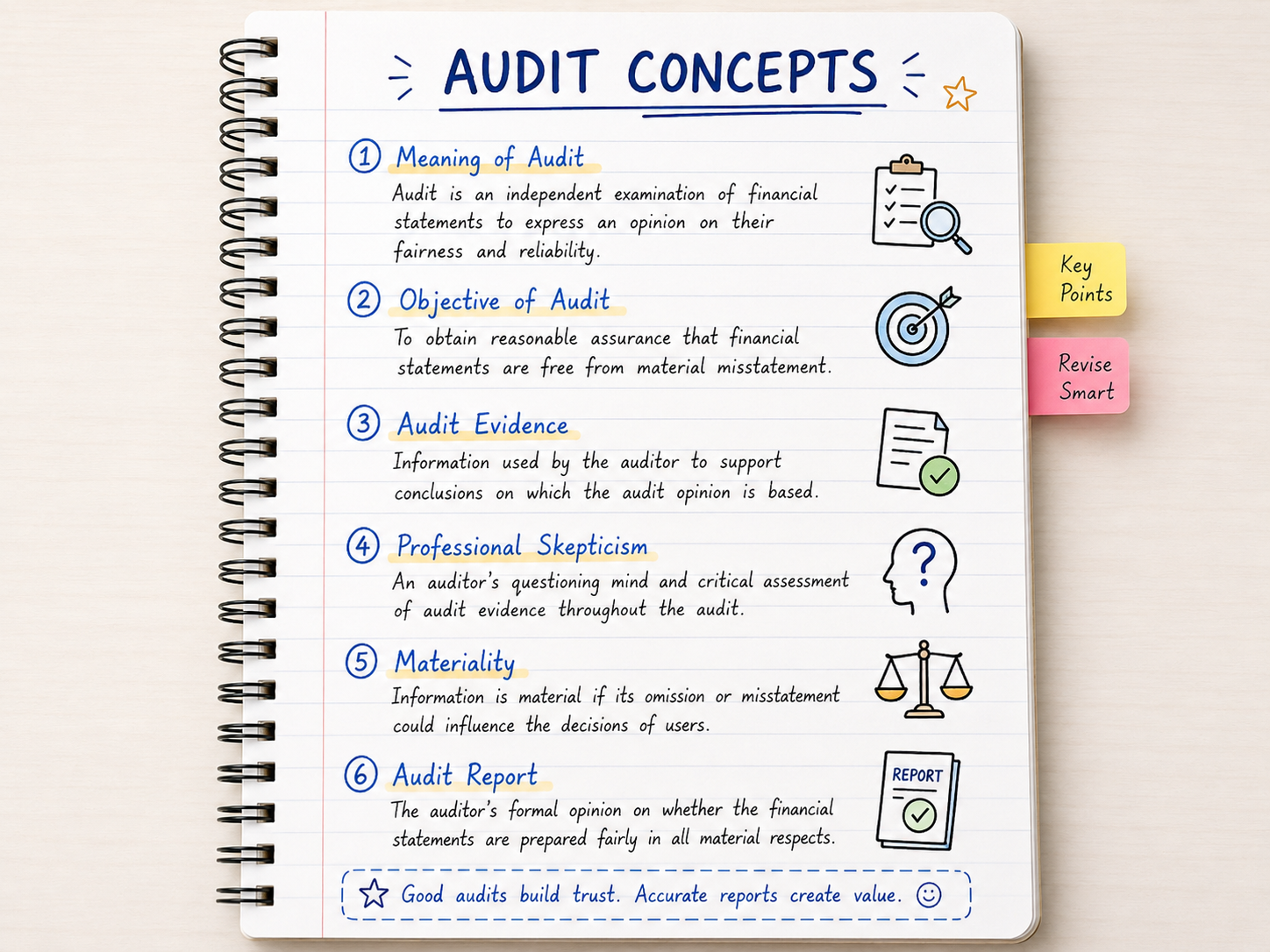
Such sources can be highly valuable when used properly. They can help students grasp hard-to-understand concepts and even revise rapidly. However, these sources are there to assist in your studies, not take their place.
Resource | Best Used For |
Faculty explanation | Understanding complex concepts |
Notes | Quick revision |
Charts | Visual revision |
Strategy charts | Deciding what and how to study |
Summary material | Reinforcing detailed concepts |
Concept Visualisation: A Better Way to Study Auditing
Several concepts in auditing might appear alike. When reading paragraphs, differentiating between them becomes hard.
Concept visualisation makes things easier to grasp. Instead of viewing a concept as paragraphs of text, try to visualise it as a flowchart, diagram, table, case study, or image.

For instance, when learning about audit risk, you visualise it as follows:
Audit Risk → Inherent Risk + Control Risk + Detection Risk
The same applies to ethics threats, which can be visualised as follows:
Threat → Evaluate → Safeguard → Reduce Threat → Take Appropriate Action
Faculty — Auditing & Professional Ethics: CA Jasmine Arora

CA Jasmine Arora is famous for making Audit a simple subject with conceptual explanations, memorisation tricks, and practical examples. She covers the ICAI syllabus systematically, so that students are competent enough to remember concepts in exams.
She has 2 years of experience as a Senior Accounts Officer at QX Global, where she received the Best Performer Award.
Exceptional personal academic record: 5 exemptions at CA Inter (77 in Audit).
Auditing & Professional Ethics Specialist.
Why Does Practice Matter in CA Inter Audit?
A student might feel like they understand a concept after listening to a lecture on it. The true measure comes when they shut the book and have to use the concept on their own. This is why practice is very important for the audit subject.
According to the ICAI, practice writing must be done in Auditing because it will help students to remember provisions and also understand what the question is asking. The ICAI also suggests the use of study material, MTPs and RTPs for practice.
Students must solve the study material, Mock Test Papers (MTPs) and Revision Test Papers (RTPs) before the exam.
The Significance of Homework in Learning
Homework is more than just another assignment given by the faculty. It acts as a bridge between learning and problem-solving for the students themselves.
In class, the faculty introduces you to the idea. In homework, you apply the idea on your own. The distinction is crucial.
Importance of Homework
It tests if you really understood the lecture.
It helps to find your weaknesses.
It helps develop independent thought.
It increases speed in writing.
It makes you less dependent on the teacher's explanations.
It prepares you for exam conditions.
Homework is your first test after having learned something. If you can understand an idea while the faculty explains it but are unable to solve or answer it on your own, you may be lacking mastery of the idea.
CA Inter Audit: Weightage and High-Focus Areas
Each topic covered under Auditing is not equally important, and students must be aware of the course structure and make use of the ICAI's guidance regarding areas which need special focus.
Topic | Weightage | Approx. Marks in Paper |
Nature, Objective and Scope of Audit | 5%–8% | 5–8 |
Audit Strategy, Planning and Programme | 5%–8% | 5–8 |
Risk Assessment and Internal Control (SA 315/330) | 8%–12% | 8–12 |
Audit Evidence & Audit Documentation (SA 500 series, SA 230) | 12%–18% | 12–18 |
Completion and Review | 5%–8% | 5–8 |
Audit Report (Modified/Unmodified Opinions) | 10%–14% | 10–14 |
Special Features of Audit of Different Entities & Audit of Banks | 12%–18% | 12–18 |
Ethics and Terms of Audit Engagements | 8%–10% | 8–10 |
Company Audit & CARO (Companies (Auditor's Report) Order) | 15%–20% | 15–20 |
Overall Paper | 100% | 100 |
High-Weightage Topics & Score Distribution
Company Audit & CARO (Companies (Auditor's Report) Order): 15–20 marks
Audit Report (Modified/Unmodified Opinions): 10–14 marks
Audit Evidence, Documentation & Sampling (SA 500 series, SA 230): 12–18 marks
Risk Assessment and Internal Control (SA 315/330): 8–12 marks
Ethics and Terms of Audit Engagements: 8–10 marks
Special Audits (Banks, Govt, Different Entities): 12–18 marks
Important Standards on Auditing (SAs)
SA 200: Overall Objectives of the Independent Auditor
SA 210: Agreeing the Terms of Audit Engagements
SA 230: Audit Documentation
SA 240: Auditor's Responsibilities Relating to Fraud
SA 315 & SA 330: Identifying/Responding to Risks of Material Misstatement
SA 500 / 501 / 505 / 530: Audit Evidence, Specific Considerations, Confirmations, and Sampling
SA 700, 705, 706: Forming an Opinion and Reporting on Financial Statements
A Comprehensive Learning Process of Auditing and Ethics
All the components can be integrated into a single process. Lecture provides the visualising aid for comprehension. Homework assesses self-study capabilities. Studying reinforces the theory. The exam tests whether you can reproduce the theory under pressure.
Lecture → Understand → Visualize → Note → Homework → Remember → Study → Exam → Analyze Errors → Retry
Stage | Main Focus | What to Do |
Stage 1 | Understanding | Lecture + concepts + visualisation |
Stage 2 | Content | ICAI material + notes + important keywords |
Stage 3 | Retention | Revision + active recall + homework |
Stage 4 | Performance | Tests + answer writing + mistake analysis |
Conclusion
Auditing & Ethics cannot be considered a topic whose success is entirely dependent on rote learning of theories. The better way is to make the entire learning process active from the very beginning.
Make use of faculty lectures, notes, charts and strategy documents to help you in your understanding process. Keep your mind active during the lecture; visualise difficult concepts, and then test yourself. This must be followed by homework, active recall, revision and testing.
Ready to build a strong foundation in Audit? Enrol in CA Jasmine Arora's Auditing & Ethics batch or download free CA Inter Audit notes to start your preparation today.