Capital Gains Tax in India applies when a taxpayer earns profit from transferring a capital asset such as shares, mutual funds, property, gold, or bonds. The tax treatment mainly depends on the asset type, holding period, and whether the gain is classified as Short-Term Capital Gain (STCG) or Long-Term Capital Gain (LTCG). Since major rules changed from 23 July 2024, understanding the revised holding periods, rates, and exemptions is essential.
What Is Capital Gains Tax in India?
Capital gains tax is charged on profit arising from the transfer of a capital asset during a financial year. Capital assets may include shares, securities, mutual fund units, land, buildings, jewellery, gold, and bonds. The taxable gain is generally calculated after deducting eligible transfer expenses, cost of acquisition, cost of improvement where permitted, and applicable exemptions.
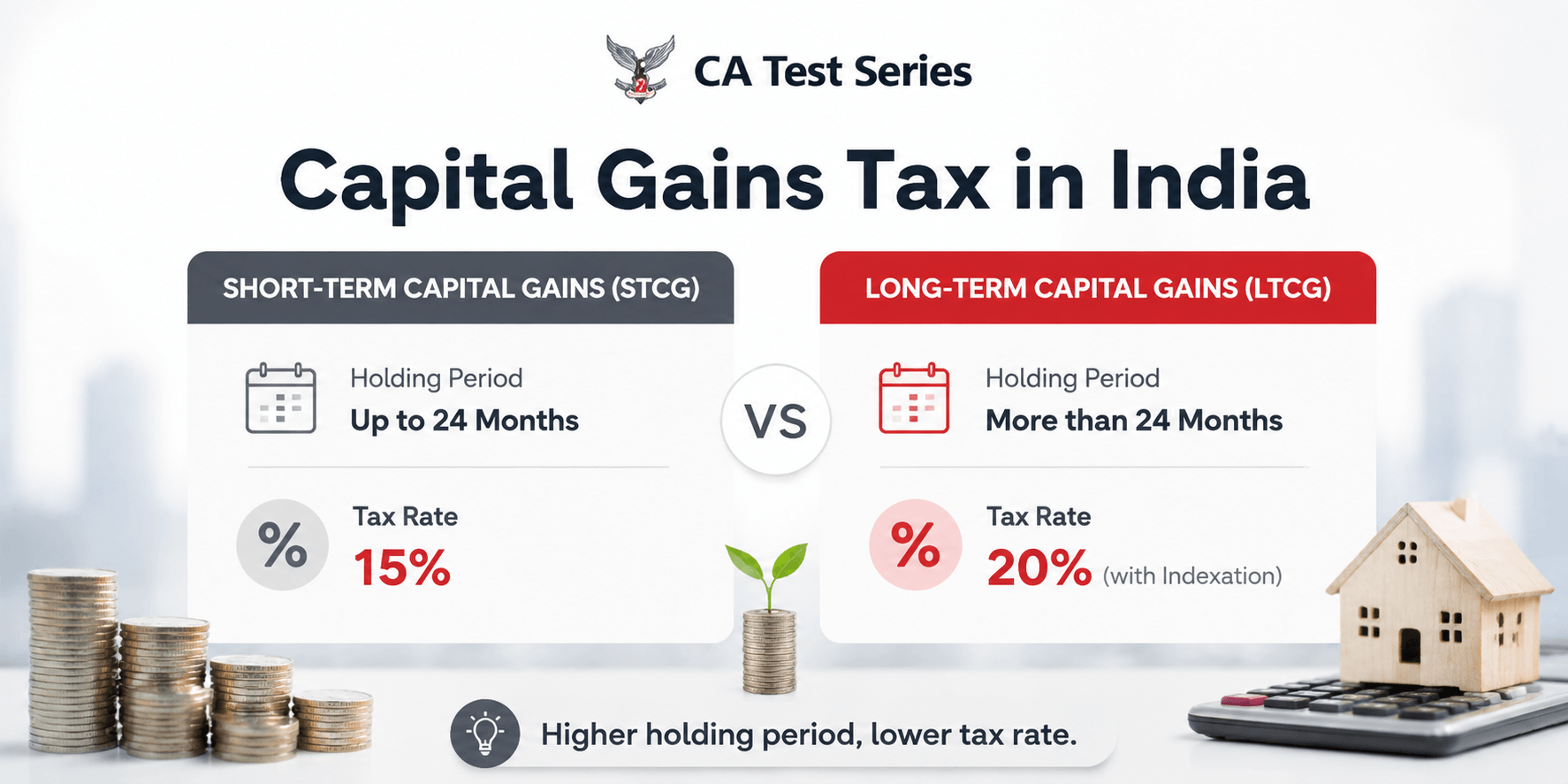
Short-Term vs Long-Term Capital Gains: The key difference between STCG and LTCG is the holding period. Listed equity shares and equity-oriented mutual funds generally become long-term after more than 12 months, while immovable property, unlisted shares, gold, and many other assets generally become long-term after more than 24 months. Gains arising within these limits are generally treated as short-term.
Capital Asset Holding Periods and Tax Rates
Correctly identifying the holding period is essential because it determines the gain classification and tax provision. Qualifying STCG under Section 111A is generally taxed at 20%, while qualifying LTCG under Section 112A is taxed at 12.5% on the amount exceeding the ₹1.25 lakh annual threshold. General LTCG is broadly taxed at 12.5% without indexation for transfers on or after 23 July 2024.
Asset Type | Short-Term | Long-Term | Typical Treatment |
Listed equity shares | 12 months or less | More than 12 months | Sections 111A/112A if eligible |
Equity mutual funds | 12 months or less | More than 12 months | Sections 111A/112A if eligible |
Immovable property | 24 months or less | More than 24 months | Normal STCG/LTCG rules |
Unlisted shares | 24 months or less | More than 24 months | Normal STCG/LTCG rules |
Gold and many other assets | 24 months or less | More than 24 months | Normal STCG/LTCG rules |
Section 111A vs Section 112 vs Section 112A: Section 111A generally applies to qualifying short-term gains from specified equity-related assets at 20%. Section 112 broadly governs long-term gains on other qualifying assets, while Section 112A applies to eligible long-term gains from listed equity shares, equity-oriented mutual fund units, and business trust units at 12.5% above the ₹1.25 lakh threshold.
Capital Gains Tax on Shares, Mutual Funds and Property
Listed shares and equity-oriented mutual funds can receive special treatment when statutory conditions are met. Qualifying STCG may be taxed at 20% under Section 111A, while qualifying LTCG under Section 112A is generally taxed at 12.5% above ₹1.25 lakh. Certain debt mutual funds may fall under Section 50AA and be treated as short-term regardless of holding period. Property held for more than 24 months generally qualifies as long-term, with current LTCG broadly taxed at 12.5% without indexation, subject to special grandfathering protection for eligible property.
How to Calculate Capital Gains Tax
Capital gain is generally calculated by deducting eligible transfer expenses, cost of acquisition, and eligible cost of improvement from the full value of consideration. After calculating the gain, classify it as STCG or LTCG, apply available exemptions, adjust eligible capital losses, and then use the correct tax rate.
Basic Capital Gains Formula: Full Value of Consideration – Eligible Transfer Expenses – Cost of Acquisition – Eligible Cost of Improvement = Capital Gain. Special valuation rules, grandfathering provisions, deemed consideration, and exemptions may change the final taxable amount.
Capital Gains Tax Exemptions in India
Important exemptions include Sections 54, 54EC, and 54F. Section 54 generally applies when LTCG from a residential house is reinvested in another residential house, Section 54EC applies when eligible LTCG from land or buildings is invested in specified bonds within six months, and Section 54F may apply when LTCG from another long-term capital asset is reinvested in qualifying residential property.
Set-Off and Carry Forward of Capital Losses
Short-Term Capital Loss can generally be set off against both STCG and LTCG, whereas Long-Term Capital Loss can be set off only against LTCG. Eligible unabsorbed losses may generally be carried forward for up to eight assessment years when the return is filed within the prescribed due date.
Loss Type | Against STCG | Against LTCG | Carry Forward |
Short-Term Capital Loss | Yes | Yes | Up to 8 assessment years |
Long-Term Capital Loss | No | Yes | Up to 8 assessment years |
Capital Gains Tax in India for CA Students
For CA students, capital gains is an application-heavy topic because one question may combine asset classification, holding period, computation, exemptions, loss set-off, and tax rates. Important provisions include Sections 45, 48, 50AA, 54, 54EC, 54F, 111A, 112, and 112A.
Common Capital Gains Mistakes in Exams: Common errors include using the wrong holding period, applying 20% to every STCG, treating the ₹1.25 lakh threshold as a general LTCG exemption, applying indexation where unavailable, missing exemption deadlines, and adjusting LTCL against STCG.
Quick Checklist for Calculating Capital Gains Tax
A reliable sequence is to identify the asset, determine the holding period, classify the gain as STCG or LTCG, calculate the gain, identify the applicable section, check exemptions, adjust eligible losses, and calculate the final tax liability.
Step 1: Classify the Asset: Identify whether the question involves shares, mutual funds, property, gold, bonds, or another capital asset because the category determines the holding period and relevant tax section.
Step 2: Compute the Gain: Calculate the gain using sale consideration, eligible transfer expenses, acquisition cost, and improvement cost before considering exemptions or capital-loss adjustments.
Step 3: Apply the Correct Tax Rule: Apply Section 111A, 112, 112A, 50AA, or the normal tax rate only after confirming the asset type, holding period, and transfer date..
Conclusion
Understanding Capital Gains Tax in India requires more than memorising STCG and LTCG rates. Taxpayers and CA students should identify the asset, determine the correct holding period, calculate the gain accurately, apply the relevant section, check exemptions, adjust eligible losses, and then determine the final tax liability. Regular practical-question practice helps CA students avoid classification and computation errors.