The exam date is fast approaching, your CA Final syllabus looks never-ending, and the pressure is getting to you – does this sound like you? Then you are the exact kind of student who can benefit from CA Final crash course lectures before exam. This article will help you choose a good crash course, select the right lectures, and make the most of the final 15 to 30 days.
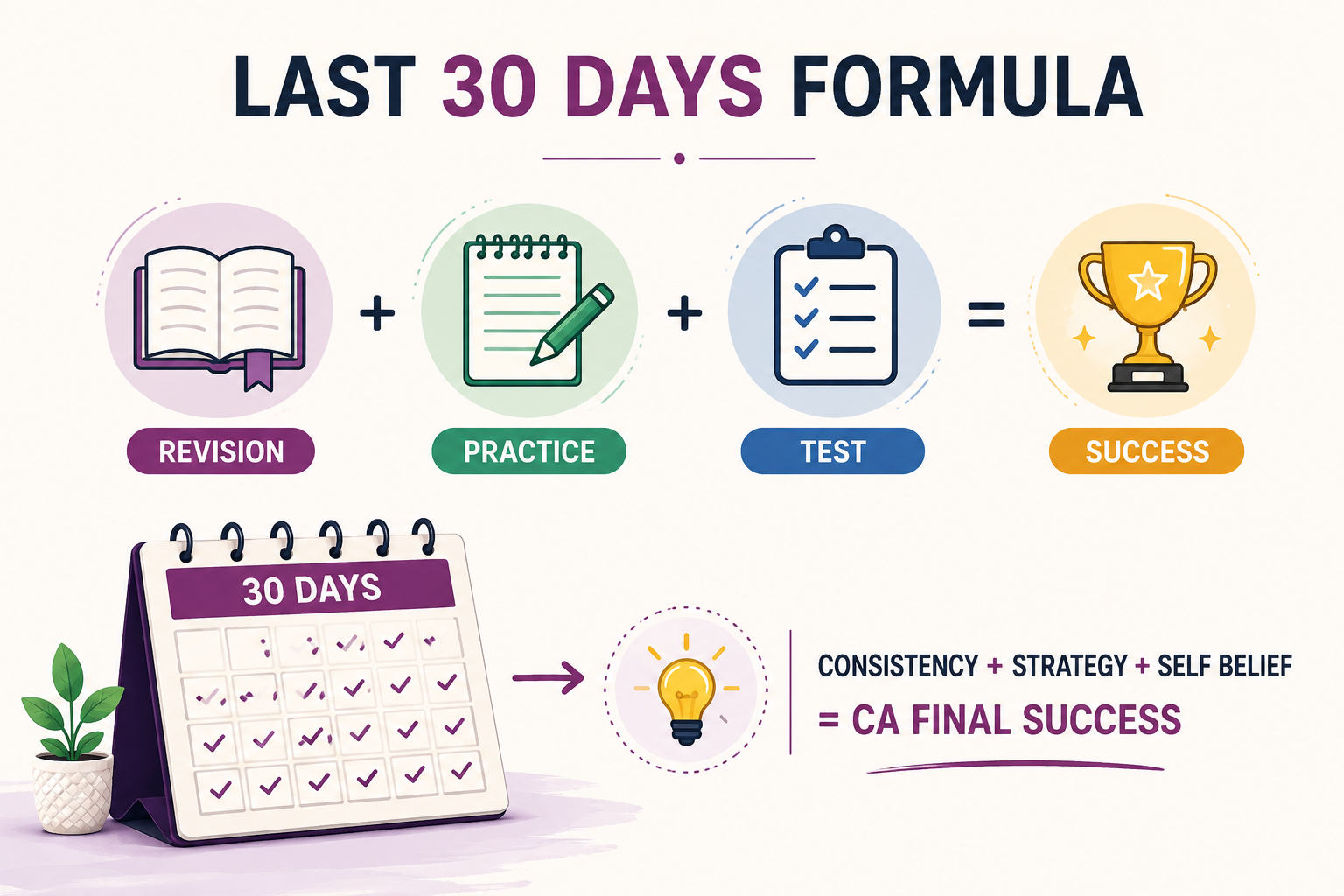
Why the Last 30 Days Matter More Than Any Other Phase
If you were to ask anyone who cracked the CA Final ranking how they did it, very few would credit it to two years of studies; rather, to one month of studies. The syllabus would be known at this stage. What will differentiate success from failure is not more knowledge but better recall and speed, and fewer careless errors made in a rush. This is what a good crash course aims to achieve.
The last stage is also the time of high anxiety. Those students who had been studying steadily for the past 18 months suddenly started panicking due to a lack of an agenda. Good CA Final revision lectures help in achieving the same.
What Is a CA Final Crash Course?
A CA Final Crash Course is a highly accelerated learning programme that aims at revising the whole CA Final syllabus (or specific high-weightage topics) within a short period. In other words, while regular classes start with the fundamentals, a crash course lecture begins with the presumption of existing knowledge to cover the following points:
Rapid recollection of concepts via summarizing notes and charts
Highly probable topics or frequently asked topics
Case law amendments concerning your current attempt
Speed problem-solving related to the practical papers such as FR, AFM, and Audit
Exam techniques including time management, presentation, etc.
The typical duration of crash courses ranges from 10 to 40 hours per topic and lasts only a couple of days, which makes it perfect for last-minute preparations before the exam.
Types of CA Final Crash Course Formats Available
There are different types of crash courses that exist today, and it becomes important for you to select the type based on your learning style and available time.
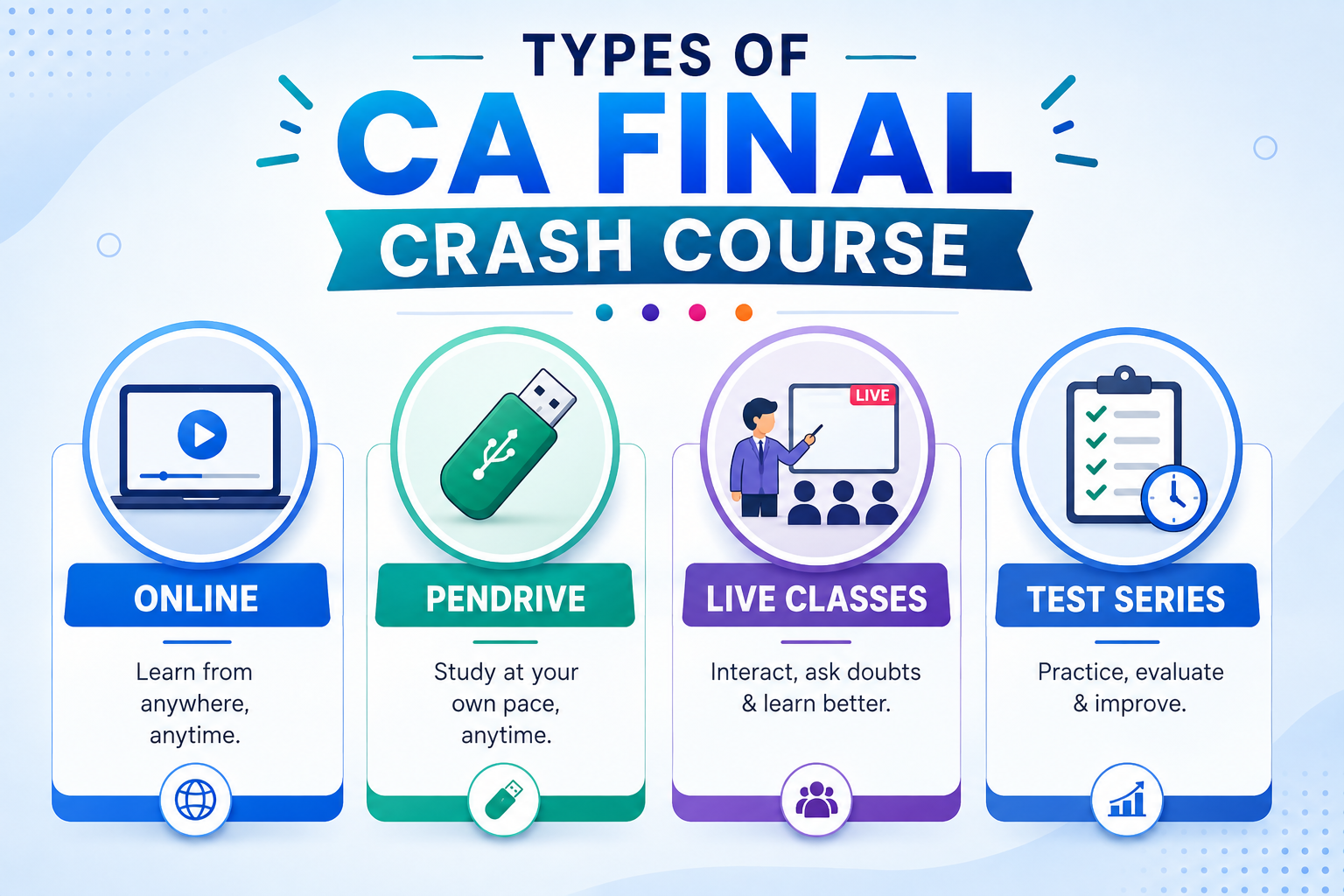
Live Batch Crash Courses
In this format, there is a predefined schedule of classes conducted every day at specific start and end dates, generally spanning between 7-15 days for every subject. The advantage is the ability to be disciplined because you are bound by the deadline of your batch. The disadvantage, however, is the lack of flexibility if you lag on a certain day.
Recorded/On-Demand Crash Courses
The format gives complete freedom of pace and scheduling, and hence, it can benefit those students who are facing tight deadlines due to their articleship as well as working professionals taking up CA Final along with their job. The danger here, however, is self-discipline and being able to complete the required classes.
Subject-wise Crash Courses
Instead of opting for a crash course covering all the subjects together, many students choose crash courses only for those subjects in which they are weak – AFM, FR, Direct Tax.
Crash Courses on Amendments Only
CA Final revision classes for the latest amendments alone, which involve only new developments such as changes under the Finance Act, new accounting standards, GST amendments, and latest case laws. These generally take 3–6 hours and are designed to assist your revision efforts rather than be a substitute for them.
Combination of Test Series with Crash Courses
There are some coaching institutes that offer a package of crash course classes along with a series of mock tests, along with the evaluation of answers. The package becomes very useful in the last month.
Why Students Turn to Crash Course Lectures Before the CA Final Exam
1. Time Is the Biggest Constraint
CA Final has one of the hardest syllabi amongst professional courses. During the last few weeks, students do not require any new learning but require quick and structured revision, which can jog their memory without spending hours going through the entire chapter again.
2. Amendment-Packed Subjects Require a Last Minute Revisions
Subjects like Direct Tax, Indirect Tax, and Financial Reporting keep changing in each attempt because of the amendments that take place due to the Finance Act or accounting standards and also the notifications of ICAI. A crash course will make sure you have all the latest information before your exams.
3. Confidence Booster
Practicing through solved questions in a crash course format is much better than just reading the subject in the last month.
4. Planned Revision Over Random Revision
Students usually revise those subjects or chapters which they like while they neglect those chapters about which they are weaker. Crash Course lectures are strategically planned to make you go through all the topics of that paper.
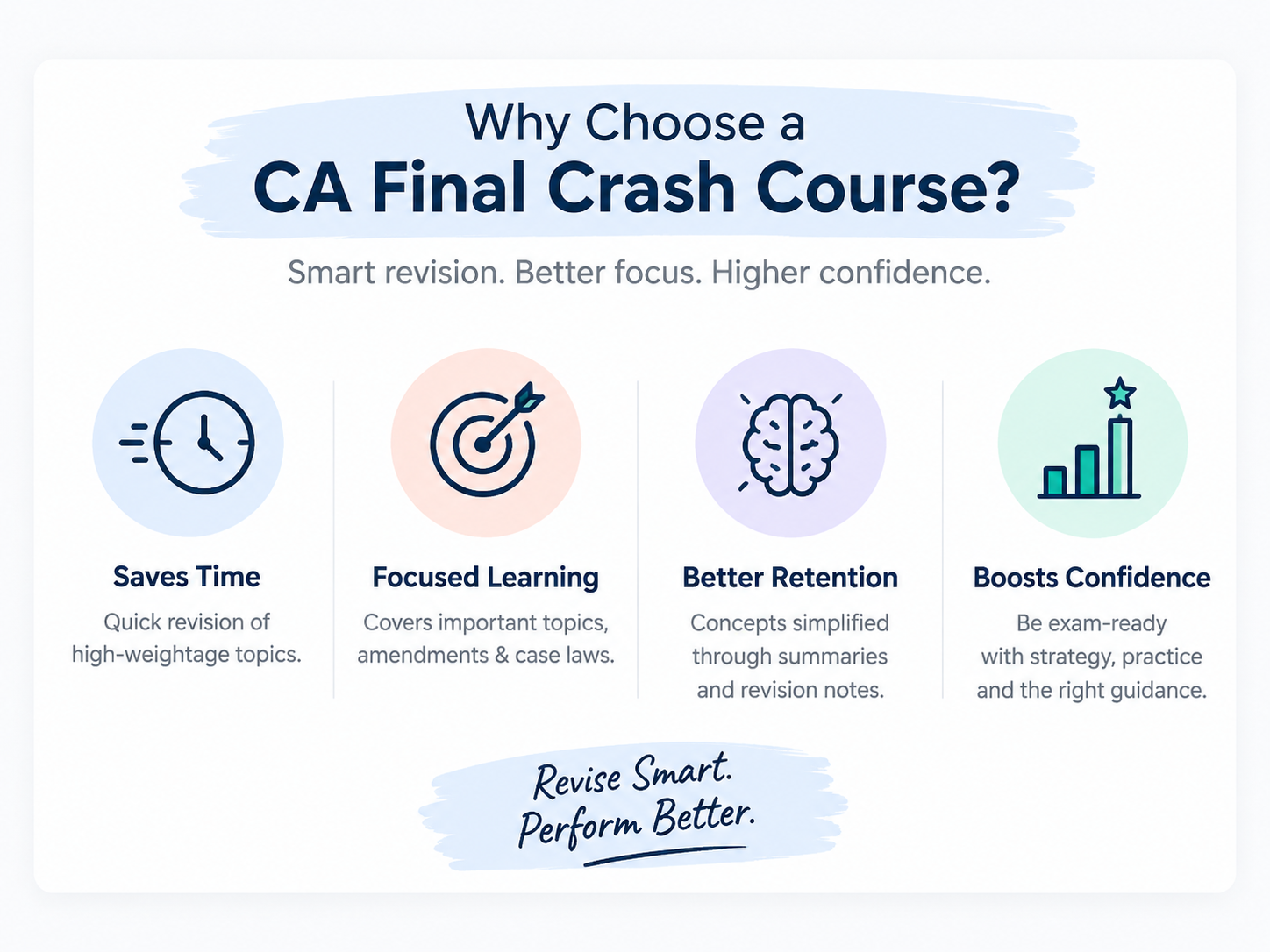
How to Choose the Right CA Final Crash Course
All crash courses are not made equal. Before opting for one, make sure that these five things are in place:
Relevant faculty — Select a faculty member according to your preferred mode of instruction rather than their popularity.
Inclusion of recent amendments — Ensure that the course is up-to-date for your particular attempt (either May/November).
Availability of practice material — Check if there is a question bank, study booklet, or RTP/MTP-based quick review notes.
Validity period for videos — Check that the validity period for video lectures allows for at least two revisions before your exams.
Support with doubt-clearing — Doubts clearing batch or forum also helps even in a crash course.
Subject-Wise Crash Course Strategy for CA Final
Subject | Area of Focus in Crash Course |
FR | Chart summaries of Ind AS, consolidation shortcuts, and previous years’ questions |
AFM | Formula sheets, calculator shortcuts, and portfolio/derivative practice |
Audit | SA-specific mnemonics, reporting formats, and case study questions |
Direct Tax Law & International Taxation | Updates from recent Finance Act, computation practice, and case law updates |
Indirect Tax Laws (GST) | Updated chart, flow charts, ITC and valuation practice |
Corporate & Economic Laws | Quick review of each section, penalty practice, and case study |
Strategic Cost Management | Formula-based problem solving and practical application of theory |
Elective Paper | Case study format and question writing practice |
Going Deeper: What Each Subject's Crash Course Should Actually Cover
The generic "go through everything really quickly" method does not apply universally across all eight papers. This is what a truly helpful crash course should be for each paper.
Financial Reporting (FR)
Financial Reporting crash courses should not try to reteach you the whole body of Ind ASs. Rather, go for crash courses that classify lectures according to thematic categories such as recognition and measurement standards, consolidation standards, and extensive disclosure standards, and then practice consolidation, business combinations, and EPS calculation thoroughly through problem-solving.
Advanced Financial Management (AFM)
Advanced Financial Management crash courses are most effective when they are focused on formulas and calculators. A good crash course for AFM should include formula sheets for portfolio management, derivatives, foreign exchange, and mergers & acquisitions, along with problem sets under time pressure to simulate the actual exam conditions.
Audit
As Audit is primarily theory-based, crash courses on Audit should cover keywords related to SAs as well as reporting formats since examiners prefer structured answers backed by SAs over plain descriptive ones. Case study-based revision will be necessary because the papers have been giving more importance to case studies than direct definitions recently.
Direct Tax Law & International Taxation
It is the paper where you need to pay utmost attention to the timing aspect. A video lecture for any previous attempt might be obsolete by now. You should look out for lectures updated for your attempt’s Finance Act and spend time on computation-related topics (Capital Gains, Business Income, Assessment), apart from going through the recent case laws quickly.
Indirect Tax Laws (GST)
In the case of GST, your crash course videos should contain a separate amendment tracker and not be part of the video content. This way, you will be able to revise them in the last 48 hours without watching any video again. Flow charts will work better for procedural topics than paragraphs.
Corporate & Economic Laws
In this paper, section recall and usage of proper terminology is rewarded. Crash course lectures must cover sections under various heads (Duties of Director, Oppression and Mismanagement, Compounding of Offences, etc.) along with penalty charts and case studies, as now ICAI is moving towards application-based questions from section-based questions.
Strategic Cost Management
In case of crash course preparation for this paper, it becomes imperative to relate the theory topics to practical problems immediately to make the students realize that they need not treat theory and practical separately, as most of the students miss marks due to such silo thinking.
Elective Paper (Case Study Paper)
As this paper is open-book and case-study-based, the benefit of a crash course lies in the format of writing answers rather than in learning the concepts in detail, as the time constraint of 4 hours with an open-book format is to be managed with utmost precision, and practice of at least 2-3 full-length cases is crucial.
A 21-Day CA Final Study Plan
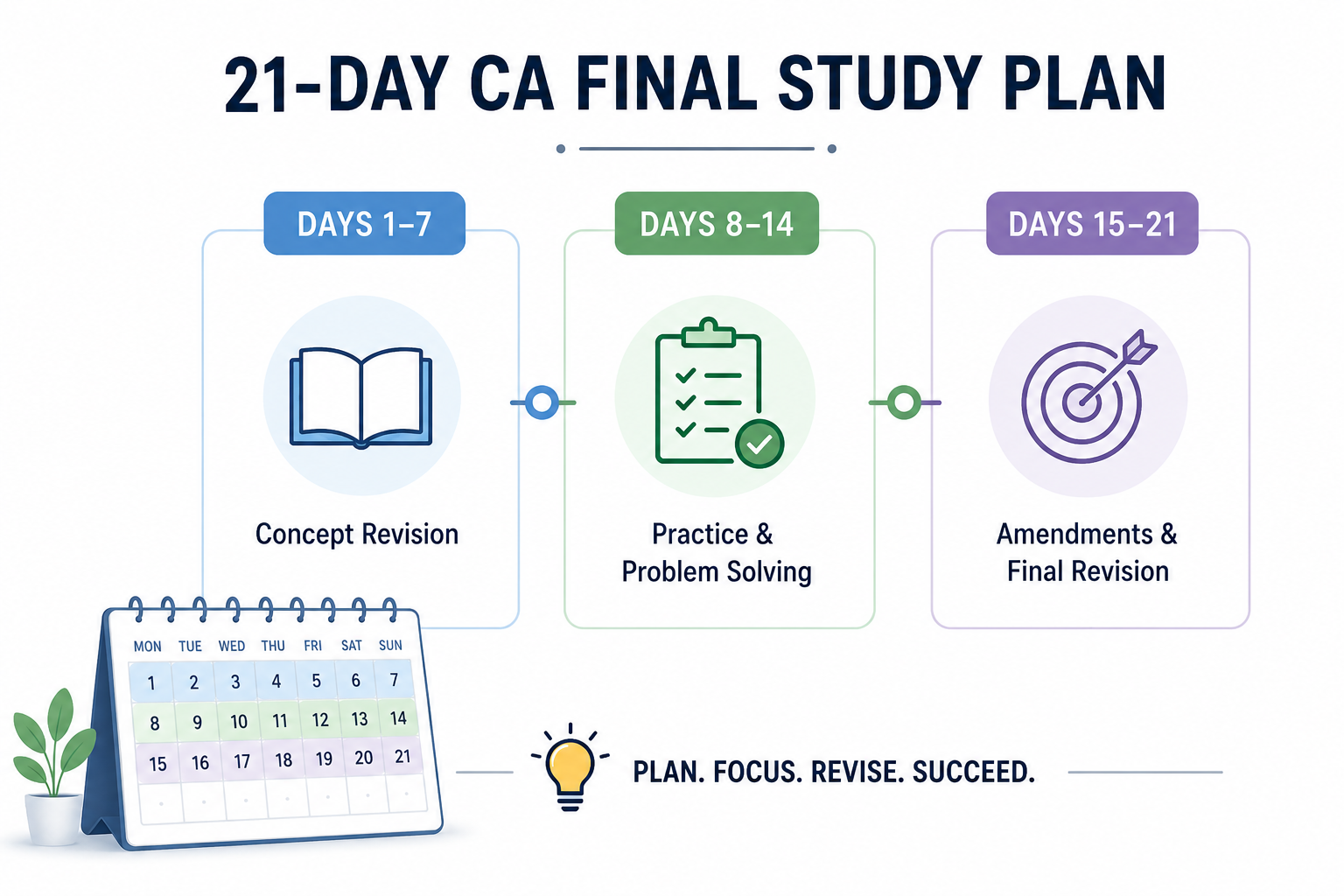
Days 1-7: Pick up two subjects and study them by means of crash course lectures at speeds of 1.25x-1.5x, except for problem-solving sessions where you take breaks.
Days 8-14: Study the next two subjects along with revising the summary notes of days 1-7 for 30-45 minutes every day.
Days 15-19: Complete your other subjects and take a complete mock test in one of the subjects.
Days 20-21: Revision only, and check your summary charts, amendment notes, and formulas, but no fresh information is to be covered.
In this way, all your subjects will have been covered twice by the time of the exam.
Sample Daily Routine During Crash Course Weeks
Structure is as important as content in this stage. Here's a sample daily schedule that most CA Final students completing their crash course lectures usually follow:
Morning (2–3 hours): View lectures of the crash course on one particular subject at an increased pace and make notes in bullet-point format.
Midday (1–2 hours): Work on practice questions or problems on the particular subject studied in the morning lectures.
Afternoon (2–3 hours): Start off on a second subject – preferably alternating subjects of a theoretical nature with those of a numerical nature to keep from getting bored.
Evening (1 hour): Revise notes from previous days – it's this repetitive process daily that helps improve retention.
Night (30–45 minutes): Look over formulas, amendments, and mnemonics right before sleep – since memory gets improved by pre-sleep review.
The duration may vary according to you, but the schedule of switching from input (lecture), output (problem solving), and reviewing (older notes) is important.
Free vs Paid Crash Courses: Which One Should You Choose?
Free crash course lectures are quite abundant on YouTube and do actually serve well when used for revising individual difficult concepts or to get an alternative perspective on some difficult concepts. But the free crash courses are generally unplanned, out of sequence for your studies, and often not updated to suit the latest attempt.
Paid crash courses will be planned to your study plan, will have the latest updates for the particular attempt, notes to download, and doubt-solving, all of which become more important in the final month than any other stage of preparation. If funds are low, a good mid-ground that most people use is: paid crash courses for amendment papers (Direct Tax, Indirect Tax, FR) and free for others. There are platforms such as CAtestseries.org that offer both updated crash course lectures and test evaluation if you do not want to put them together yourself.
Managing Stress and Burnout During Crash Course Revision
A complete syllabus crammed in a few weeks can be taxing if not managed effectively. Some practices that will go a long way include:
Ensure sleep is not compromised, especially in the last week. Poor sleep during revision results in poor memory retrieval skills at a time when speed is crucial.
Allow one catch-up day each week in case the class lectures extend beyond the expected time.
Do not compare progress with other classmates or on any online platforms. The amount of work covered in crash courses varies according to previous preparation done.
Have short breaks between classes; even a ten-minute break after watching lectures enhances memorization of information.
Exercise is important in these few weeks of revision; it may not seem relevant to CA Final, but it actually helps reduce stress related to examinations.
Common Mistakes Students Make With Crash Courses
Starting too late – A crash course is not a crash course if you take it three days before your test.
Watching without practicing – Watching lectures won’t develop speed; combine every lecture with solving problems.
Neglecting the changes – This is one of the most common mistakes in crash courses that involves watching old lectures.
Avoiding mock tests – The best combination for any crash course is conducting 2-3 mock papers.
Conclusion
Lectures offered in a crash course before the day of examination are most suitable for being a revision booster rather than a medium of learning from scratch. If used in the right manner – with dedicated lecture sessions, practical solving of problems, and genuine mock test attempts – a crash course would help you turn your last-minute preparations into an exam-winning strategy in the run-up to your CA Final attempt.
For an attempt at CA Final, try out CA Test Series' CA Final crash course along with the test series.