

In Financial Management, a business may utilise Fixed Operating Costs and borrowed funds along with its own funds. These fixed costs can magnify the effect of changes in sales on Operating Profit and the effect of changes in Operating Profit on Earnings available to equity shareholders. This is where the concept of Leverage comes into play, as it explains how one financial variable can cause a change in another.
This description of leverage is based on the pedagogy of CA Chesta Chawla, who is a Chartered Accountant and CA Inter Faculty for Financial Management (and Strategic Management) on catestseries.org, specializing in Advanced Financial Management. She worked in the corporate world at Acuity Knowledge Partners prior to becoming a teacher, and hence her pedagogy is not theoretical but based on practical experience in the business world. The pedagogy adopted by her is concept-based and exam-oriented and is characterized by the use of real-life examples to explain complicated concepts. Her general pattern of learning includes moving from a simple concept to a business example, to the formula, calculation, and finally the interpretation.
What is Leverage in Financial Management?
Leverage in Financial Management is the technique of using fixed costs or funds to magnify the effect of changes in sales or operating profit on the company’s earnings. In other words, it means that a change in some variable of a financial statement would cause a more prominent change in another variable.
A company has two types of fixed commitments in general. First are operating fixed costs, meaning rent, salaries, depreciation, and other expenses connected with operations. Second are financial fixed costs that are primarily the interests of debt holders. These costs are fixed at any level of operations and change the distribution of income between stakeholders, thus creating a magnifying effect.
How Leverage Creates a Magnifying Effect
The magnifying effect of leverage can be seen from the following simple linkages in a business:
Sales → Contribution → Operating Profit → Earnings to Equity Shareholders
As seen in the scheme above, an increase in Sales leads to an increase in Variable Costs, but Operating fixed costs stay the same. This implies that after meeting the level of contribution equal to Operating fixed costs, every further contribution dollar increases Operating Profit at a rate of 1:1.
For example, if Sales grow by 10%, the Operating Profit would generally be expected to grow by more than 10% if Operating fixed costs are substantial. Similarly, when Operating Profit changes by a certain percentage, the Earnings to Equity Shareholders change by a more significant percentage if there are high fixed financial costs, such as debt interest. Thus, Leverage is a source of a magnifying effect. However, this effect is not one-sided. While an increase in Sales leads to a larger increase in earnings for equity shareholders, a decrease in Sales leads to a larger decrease in earnings for equity shareholders.
Understanding Leverage Through a Seesaw
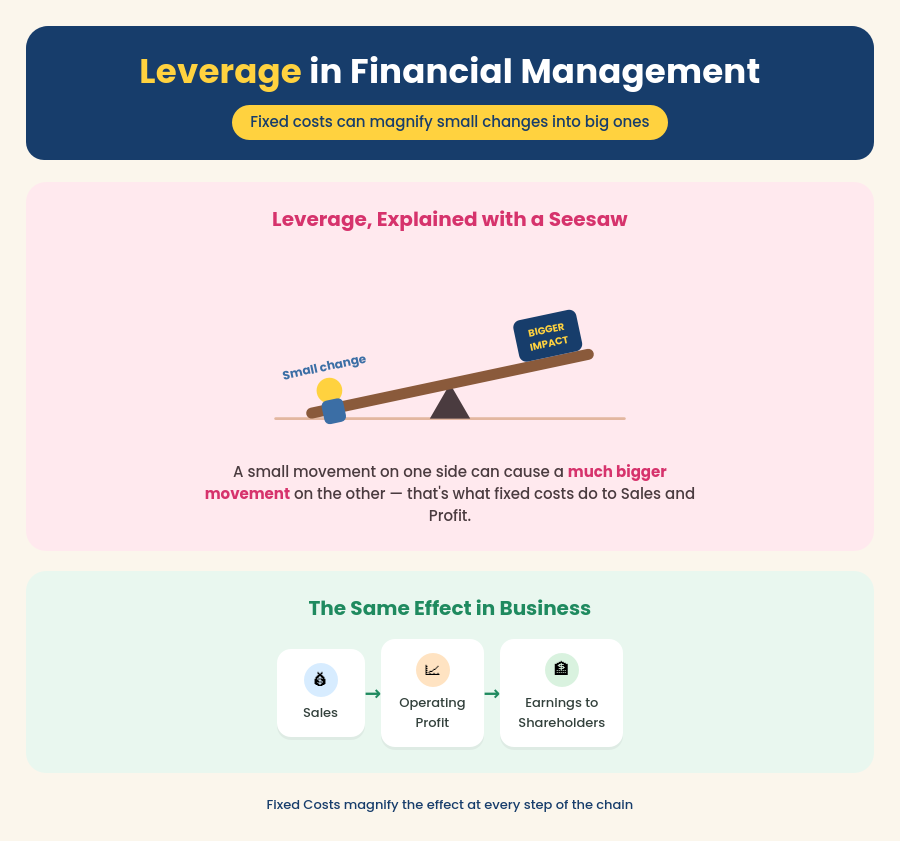
The definition of Leverage can be given as follows. The lever action can be illustrated using an example of a Seesaw. Using the small force at one end of the Seesaw, a larger force can be generated at the other end of the Seesaw.
Similarly, in a business, Fixed costs can amplify the changes in sales or operating profit. This means that, for a given quantum of change in sales, the change in operating profit would be greater.
Leverage is thus related to both the potential for profit and the risk. The more fixed costs; more will be the impact on profits for a given change in sales.
Leverage Explained Through a Seesaw
Leverage can be easily understood with an example of a seesaw. On a seesaw, a small movement on one side results in a large movement on the other side. Similarly, a small change in sales can result in a relatively bigger change in profits. This is called leverage.
Let's take a business and think of it as a seesaw. Sales is the point of initiation, and profit is the other end. A firm has fixed costs that remain the same irrespective of sales, e.g., rent, depreciation, and salaries. These costs do not change with a change in sales. As a result, when sales cross the breakeven point, the change in profits tends to be relatively greater than the change in sales.
This is what is meant by the magnifying power of leverage. For instance, a 10% increase in sales would lead to more than a 10% increase in operating profits if the firm has high operating fixed costs.
The same analogy can be used to understand financial leverage. A firm could be borrowing money at a fixed rate of interest. Earnings before interest and taxes (EBIT) have to meet this obligation. If they do, and given that EBIT changes, it will have a proportionally larger effect on the earnings available for equity shareholders.
The Seesaw Effect in Different Types of Leverage
The seesaw analogy can be elaborated further to explain the three types of leverage:
Operating Leverage: Operating leverage lies between sales and operating profits. It is the fixed costs that have to be met before reaching operating profits that magnify the change.
It is important to note that the fixed costs do not change at all with a change in sales. If sales increase by 10% after surpassing the breakeven point, the operating profit increases by more than 10%.
Financial Leverage: Financial leverage lies between operating profits and earnings available for equity shareholders. Similarly, it is the fixed financial costs that have to be met before reaching the earnings for equity shareholders that magnify the change.
Combined Leverage: Combined leverage captures the overall leverage that influences the change in sales that has to be met against the change in earnings available for equity shareholders. The relationship can be simply remembered as:
Sales → Operating Profit → Earnings to Equity Shareholders
Leverage Can Work in Both Directions
A seesaw can also move down, and so can leverage. It is not always that a change in sales will lead to a profitable change in profits. In fact, a decrease in sales could be magnified by leverage to cause a disproportionate decrease in profits.
For instance, a 10% decrease in sales would have been counterbalanced by operating profits that have also decreased by 10%. The fixed costs remain the same. So, any change in sales is magnified by the operating leverage to cause a larger change in operating profits. The financial leverage then takes over and magnifies the change by a proportionate change in earnings for equity shareholders.
Why the Seesaw Example Helps
The seesaw example helps students to grasp the concept in a hands-on manner. The analogy makes it clear that it is the fixed costs that are a problem when sales or operating profits change. They simply cannot be changed as easily as sales figures can.
So, the moment a student understands that there is a fixed component that has to be overcome in costs, the magnifying effect is easier to comprehend. Students can then move to the calculation part and remember Operating Leverage, Financial Leverage, and Combined Leverage with ease.
Types of Leverage
Leverage can be primarily categorized into 3 types based on fixed costs,
1) Operating Leverage
2) Financial Leverage
3) Combined Leverage
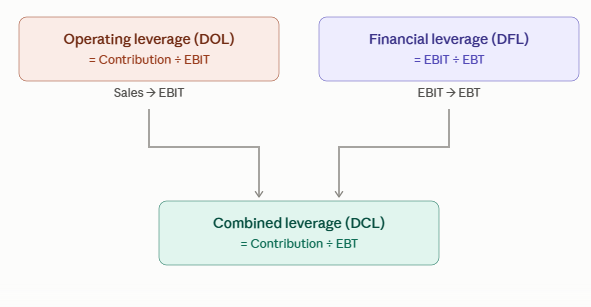
Type of Leverage | Common Term | What It Measures | Formula | Relationship |
Operating Leverage | Degree of Operating Leverage (DOL) | Effect of a change in Sales on EBIT | DOL = Contribution ÷ EBIT | Sales → EBIT |
Financial Leverage | Degree of Financial Leverage (DFL) | Effect of a change in EBIT on EBT | DFL = EBIT ÷ EBT | EBIT → EBT |
Combined Leverage | Degree of Combined Leverage (DCL) | Effect of a change in Sales on EBT | DCL = Contribution ÷ EBT | Sales → EBIT → EBT |
In Financial Management, these three are also termed as Degree of Operating Leverage (DOL), Degree of Financial Leverage (DFL), and Degree of Combined Leverage (DCL). Knowledge of this information is important in CA Inter as questions can be asked with these leverage terms or their abbreviations.
Operating Leverage Explained with an Example
Operating leverage is a significant topic in Financial Management since it is based on the extent to which the operating profit increases due to the increase in the level of sales. The phenomenon of operating leverage takes place when the company possesses certain fixed operating costs, which include costs like rent, depreciation, fixed salary, etc., that do not change with changes in sales. Illustration of Operating Leverage
Let us take an example where the sales of a company are ₹10,00,000, variable cost is ₹6,00,000, and fixed operating costs are ₹2,00,000.
First, the contribution to the company is:
Contribution = Sales - Variable Cost
= ₹10,00,000 - ₹6,00,000 = ₹4,00,000
Then, after deducting fixed operating cost, the operating profit of the company is:
EBIT = Contribution - Fixed Operating Cost
= ₹4,00,000 - ₹2,00,000 = ₹2,00,000
Thus, the operating leverage of the firm can be calculated as:
Operating Leverage = Contribution ÷ EBIT
= ₹4,00,000 ÷ ₹2,00,000 = 2 times
If operating leverage is 2 times, it implies that for 1% change in sales at the current level of sales and costs, the EBIT is expected to change by approximately 2%, provided other factors are constant.
So, if sales rise by 10%, the expected change in EBIT will be:
10% × 2 = 20%
And similarly, if sales fall, there may be an approximately 20% fall in EBIT, considering all other things constant.
Financial Leverage Example Explained
Financial leverage is related to the use of borrowed funds in a firm. Once a company takes a loan, it has to pay off a certain amount of money as interest even if its operating profit is high or low. The fixed amount of interest causes financial leverage, or increases the extent to which operating profit affects the earnings of shareholders.
Financial Leverage shows the effect of a change in Operating Profit (EBIT) on Earnings Before Tax (EBT). It arises because of fixed financial costs such as interest on debt or bonds.
Understanding Financial Leverage with an Example
Say a firm has an EBIT of ₹5,00,000 and it pays ₹2,00,000 as interest on its borrowings.
Then the profit before tax will be:
Profit Before Tax = EBIT − Interest
= ₹5,00,000 − ₹2,00,000
= ₹3,00,000
The computation of financial leverage will be:
Financial Leverage = EBIT ÷ EBT
= ₹5,00,000 ÷ ₹3,00,000
= 1.67 times
This implies that at the existing level of operations, a 1% change in EBIT may cause about a 1.67% change in earnings before tax if other things are constant.
How does Financial Leverage Work?
Assuming the company increased its EBIT by 10%,
With a financial leverage of 1.67 times, we can estimate the change in profit before tax as:
Change in Profit Before Tax = 10% × 1.67 = 16.7% approximately
This happens because the company's interest expenses are constant. So any changes in EBIT will have a bigger effect on the profit before tax since the latter remains the same. Similarly, if EBIT decreases by 10%, profit before tax may decrease by about 16.7% if all other things are equal.
Combined Leverage Example Explained
Combined leverage captures the combined impact of operating leverage and financial leverage; that is, the combined effect of fixed operating costs and fixed financial costs on the earnings of a firm. It indicates how a change in sales would ultimately result in a change in the earnings available to the equity shareholders in the company.
Combined Leverage Interpretation with Example
We can consider an example in which the sales amount to ₹10,00,000, the variable cost is ₹6,00,000, the fixed operating cost is ₹2,00,000, and the interest is ₹1,00
Contribution is calculated as follows:
Contribution = Sales - Variable Cost
= ₹10,00,000 - ₹6,00,000 = ₹4,00,000
Next, we can find EBIT using the following formula:
EBIT = Contribution - Fixed Operating Costs
= ₹4,00,000 - ₹2,00,000 = ₹2,00,000
EBT can be calculated as:
= EBIT - Interest
= ₹2,00,000 - ₹1,00,000 = ₹1,00,000
Now, combined leverage can be calculated as:
Combined leverage = Contribution ÷ EBT
= ₹4,00,000 ÷ ₹1,00,000 = 4 times
Interpretation: This means that if sales of the company change by, say, 1%, it would mean that the profit before tax of the company would change by 4%. Thus, the net profit available for equity shareholders would also change by 4% if everything else remains the same.
Teaching Method of CA Chesta Chawla
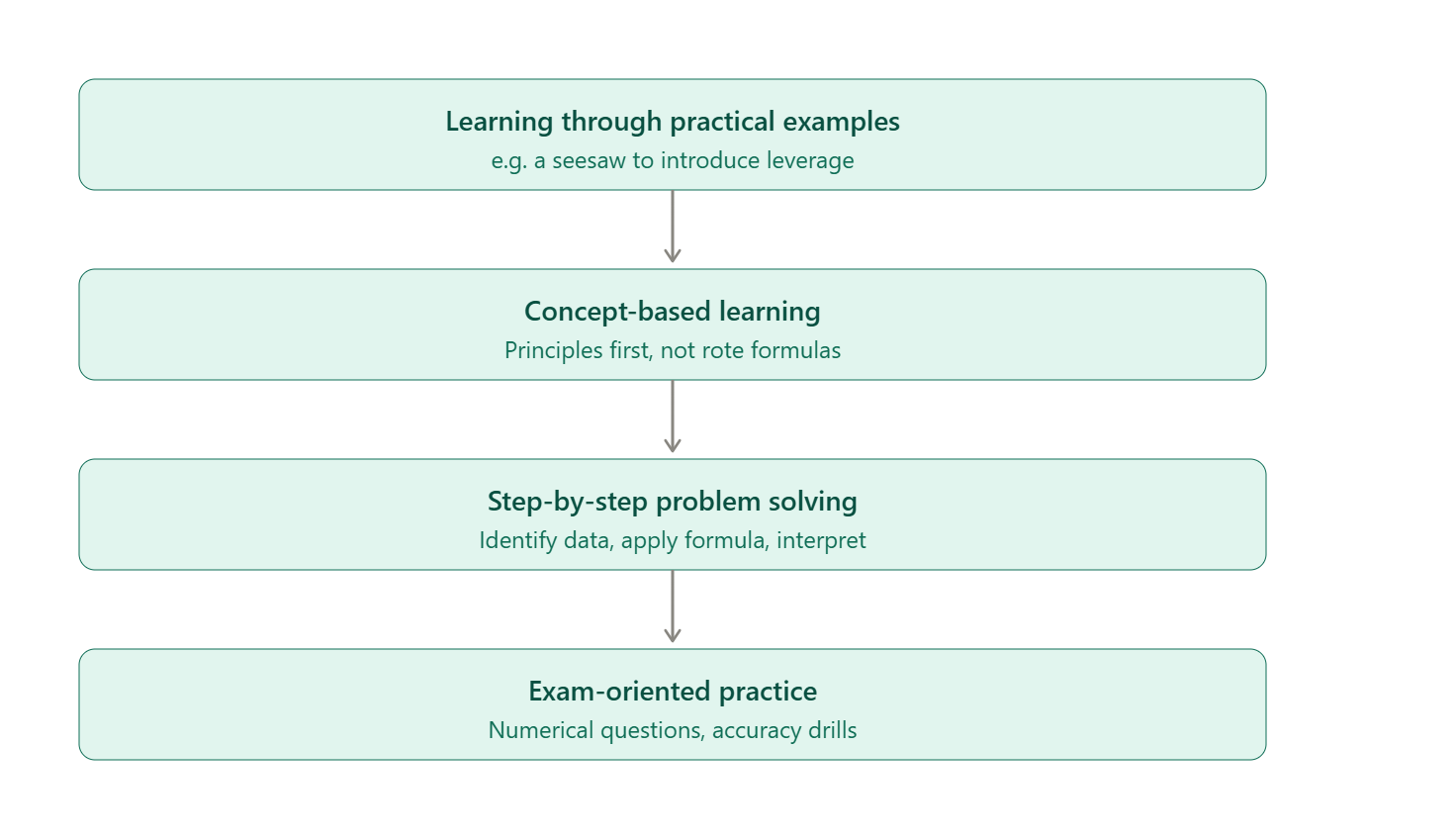
The teaching strategy employed by CA Chesta Chawla to teach Financial Management includes the application of knowledge in real life; she begins by defining the concept in layman’s terms and provides an example like that of a seesaw, which demonstrates the impact of sales changes on fixed costs, then goes on to explain the formula, and finally uses a step-by-step method of instruction wherein the student learns the meaning of operating leverage, financial leverage, and combined leverage, the data provided in the problem statement, the applicable formula, and its interpretation.

Concept-Based Learning: The focus is on learning the underlying principles of formulas rather than rote learning of the formulas themselves. Students will therefore be able to confidently apply the range of formulas related to Sales, EBIT, and EBT, having understood the principles that underlie them.
Learning Through Practical Examples: Simple business examples and analogies can be used to illustrate concepts such as leverage and make them easier to understand and apply. The students are able to conceptualize the principles of leverage by relating it to a seesaw and the magnifying effect it has on weight.
Exam-Oriented Practice: After mastering the concepts explained, the students can practice using various numerical problems to test their comprehension of the topic and to become familiar with the range of questions that can appear in the CA Inter FM examination. This will also allow them to practice calculations to eliminate any arithmetical errors.
How to Prepare for Leverage for CA Inter FM
Leverage can become easy for the students studying for CA Inter FM if they prepare it with the right perspective and practice. I would like to present my approach to preparing this chapter, which helps students understand leverage better and solve questions more easily.
1. Concept understanding: Students must understand the concept of how leverage works before jumping to formulas. We must know the flow given below and try to remember it so we can identify the three leverage types given in the chapter.
Sales → Contribution → EBIT → EBT → EPS
Operating leverage: Sales → EBIT
Financial leverage: EBIT → EBT/EPS
Combined leverage: Sales → EBT/EPS
2. Understand the formula logic: Do not learn formulas by heart. Instead, associate them with the flow we have prepared. Try to understand the relation between the numbers, and it will become easier to solve problems later.
Operating Leverage = Contribution/EBIT
Financial Leverage = EBIT/EBT
Combined Leverage = Contribution/EBT
By understanding the concepts and formula logic, one can easily solve and remember the formulas.
3. Practice: First, practice the basic questions in the chapter, and then move towards more complex ones. Try to identify Sales, Variable Cost, Contribution, Fixed Cost, EBIT, Interest, and EBT in the given question step-by-step.
4. Understand the Magnifying Effect: Financial Leverage shows how a change in EBIT can lead to a relatively larger change in earnings available to equity shareholders because of fixed financial costs such as interest.
For example, if Financial Leverage is 1.5×, a 20% change in EBIT can result in a 30% change in earnings available to equity shareholders. The complete calculation and logic of this relationship are explained in the worked Financial Leverage example below.
Conclusion
Leverage is a very important topic that is covered in the course of CA Inter FM. It becomes easy for the students to understand this chapter if they put emphasis on concept building, formulae, and numerical practice along with regular revision. The concept of leverage can be better understood by understanding the seesaw principle, which helps in effective calculation of the impact of change in fixed costs on the profits of the company. The students must be thorough with Operating Leverage, Financial Leverage, Combined Leverage, and also practice questions on these concepts step by step in order to gain confidence in the topic and score well in the examination.