Solve CA Inter Costing Questions Without Memorising Formats
Costing is a practical and numeric topic in CA Intermediate that involves understanding of concepts, application of formulas, calculations, and good time management. Depending only on answer formats may create problems for solving new or application-based questions.
Himanshu Singla’s CA classes stress conceptual learning wherein the students learn to derive the logic of every question, recognise the needed information, and solve the questions accordingly rather than depending solely on formats of answers.

Learning the Logic Behind Costing
The study of costing becomes simple if the logic behind the different cost components is studied by the students instead of memorising the formulas.
Prime Cost = Direct Material + Direct Labour + Direct Expenses
Factory cost = Prime cost + Factory overheads
Cost of production = Factory cost + Administrative overheads
Cost of sales = Cost of production + Selling & Distribution overheads
Profit = Sales - Cost of Sales
This knowledge will enable students to treat items correctly and answer application-oriented problems with more confidence.
Why It Is Not Easy To Rely On Formats Alone
When it comes to costing problems with unknown adjustments or applied concepts, memorising formats might not be sufficient.
It is necessary to know:
The meaning of every figure involved.
Where it should be placed in the format.
If it should be added or subtracted.
The effect it will have on production/stock/sales/profit.
Understand the "Why" Before Learning the "How"
Conceptual Approach Used by CA Himanshu Singla
Learn → Relate → Apply → Practice → Analyse → Do
The first step for students would be to understand the concept, relate it to the formula and cost elements, and then apply the concept with the help of practical questions.
Example:
Contribution = Sales - Variable Cost
By understanding that the contribution is the amount left to cover fixed costs and profit, the above formula becomes more understandable.
Contribution - Fixed Cost = Profit
The above method will allow students to answer various questions related to marginal costing.
Understanding Costing Principles with Practical Applications
Costing can be simplified by relating costing principles to practical business scenarios.
In the case of a company engaged in table making:
Wood, metal, nails, and paint—Direct Material
Salaries of employees—Direct Labour
Costs of factory buildings, power, and machinery repairs—Factory Overheads
Administrative overhead costs—Administration Overheads
Overheads associated with selling and distribution—Selling & Distribution Overheads
This technique will assist students in comprehending the movement of costs within the business environment and understanding costing principles instead of just memorising them.
Worked Example: Solving a Costing Question Step by Step
A company manufactured 500 units in a month:
Particulars | Amount (₹) |
Direct Material | 1,50,000 |
Direct Labour | 80,000 |
Direct Expenses | 10,000 |
Factory Overheads | 60,000 |
Administration Overheads | 40,000 |
Selling & Distribution Overheads | 30,000 |
Sales | 4,00,000 |
Solution:
Step | Working | Amount (₹) |
Prime Cost | 1,50,000 + 80,000 + 10,000 | 2,40,000 |
Factory Cost | 2,40,000 + 60,000 | 3,00,000 |
Cost of Production | 3,00,000 + 40,000 | 3,40,000 |
Cost of Sales | 3,40,000 + 30,000 | 3,70,000 |
Profit | 4,00,000 − 3,70,000 | 30,000 |
Animation Lectures for Better Conceptual Understanding
Visual and animation-based lectures can make costing concepts easier to understand by showing how different cost elements connect.
Example: Material + Labor + Direct Expenses = Prime Cost = Manufacturing Cost = Cost of Production = Cost of Sales = Profit
And: Sales – Variable Cost = Contribution = Fixed Cost = Profit
It is an effective way to help the students understand the process of cost accounting through visualization.

Notes for Concepts: Learn the Concept, Not the Format Only
A concept note needs to emphasise understanding more than just memorisation. Some of the elements that can be included in such notes are
· Important concepts and connections between them
· Important formulas and their uses
· Treatment of items
· Common mistakes made
· Short examples and applications
For instance:
Contribution = Sales – Variable cost
Contribution = Fixed cost + Profit
P/V Ratio = Contribution/Sales * 100
How to Approach an Unfamiliar Costing Question
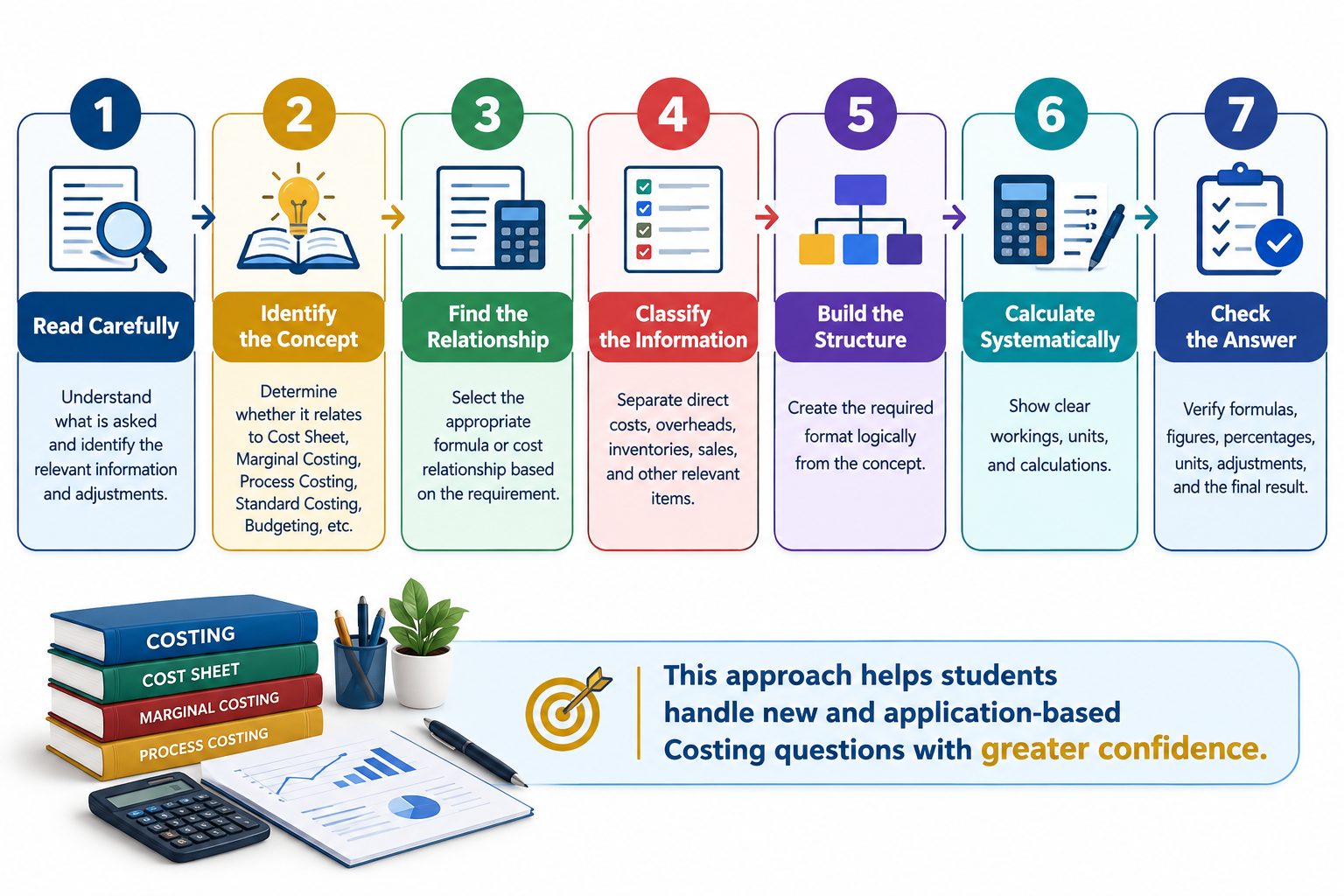
Moving from Basic Questions to Exam-Level Questions
Level | Question Type | Focus |
1 | Basic | Understanding of the concept, formula, and its basic application. |
2 | Application-Based | Using concepts for solving problems that contain additional information and modifications. |
3 | Integrated | Use of concepts that need to be combined with determination of the right approach. |
4 | Exam-Level | Dealing with modifications, calculations, presentations, and time management. |
Common Errors by Students
1. Learning by Memorisation without Comprehending—Comprehending formulas without being able to apply them.
2. Reliance on Set Format—Unable to solve problems that are in a different format.
3. Ignoring the Requirement—Solving the problem without knowing what is required.
4. Inappropriate Classification of Costs—Misclassification of direct costs and various overheads.
5. Omitting Working Notes—Failing to show working for difficult problems.
6. Lack of Practice—Practice of known problems instead of unknown ones.
7. Bad Presentations—Unsystematic presentations of the calculations and solutions.
How the Method of CA Himanshu Singla Will Work
The methodology of CA Himanshu Singla, who is a chartered accountant and faculty of cost & management accounting, is based on an idea-oriented and practical method of CA Intermediate Costing.
Learning may include conceptual explanation, practical illustration, visualisation, application, practice, mistake analysis, and revision.
Main emphasis is laid on:
· What concept is asked in the question?
· What facts are provided?
· How are numbers linked?
· What kind of calculation needs to be done?
Practice and Its Importance in Costing
Understanding the theory needs to be supplemented by consistent and diversified practice.
Students must practice:
· Conceptual questions
· Practical questions
· Integrated questions
· Exam-like questions
Keeping track of the mistakes made will enable you to pinpoint: Conceptual mistakes, mistakes in formulas/calculations, mistakes in interpretation, presentation mistakes, and time-management problems
Conclusion
It will become easy for the students to solve things if they can learn the relationship between various aspects rather than just following memorised structures.
· Understand
· Apply
· Practice
· Analyse
· Do
Concept-based learning will enable the students to apply themselves to various questions.