

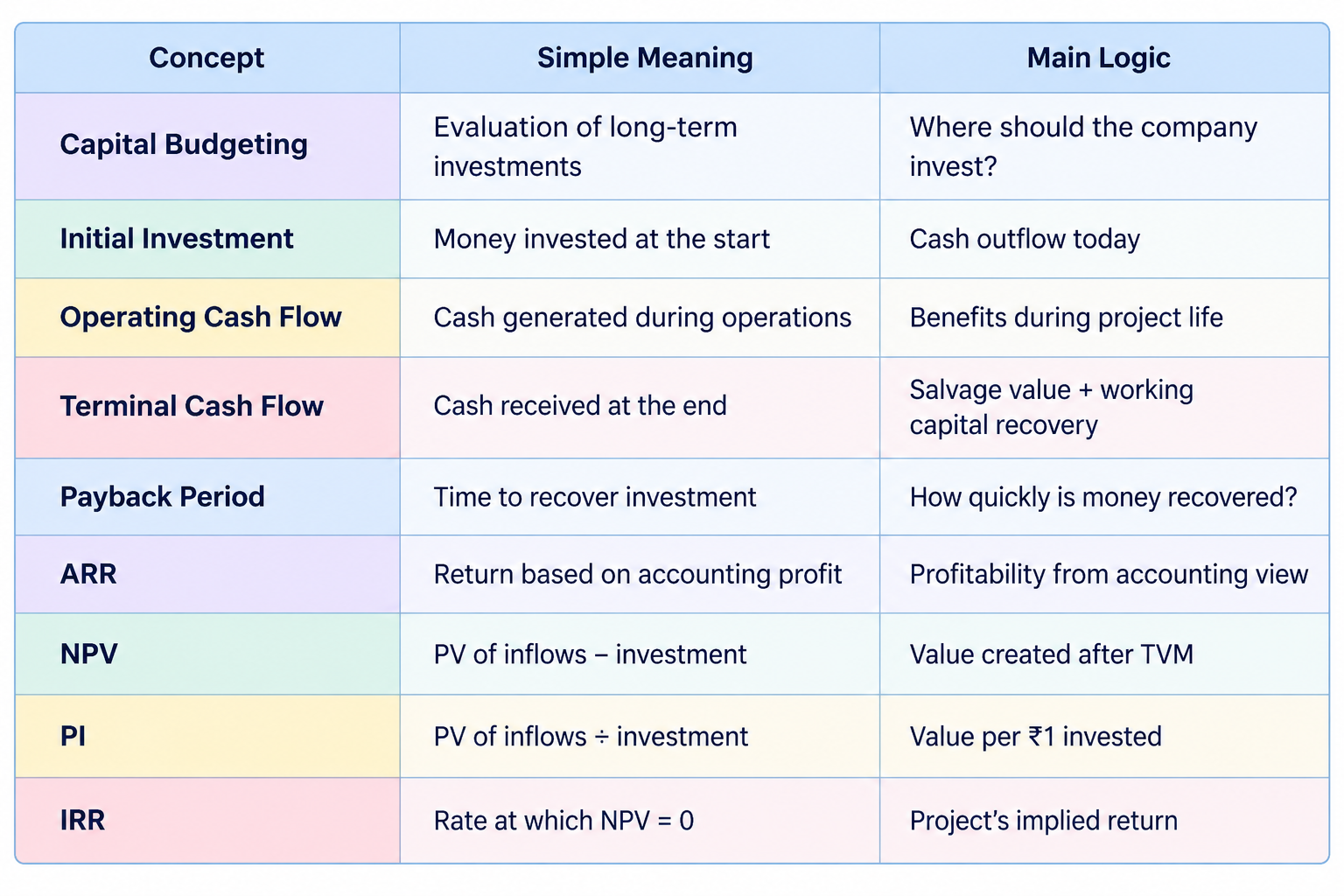
Capital budgeting is a technique that helps determine whether an organisation should undertake a long-term investment project.
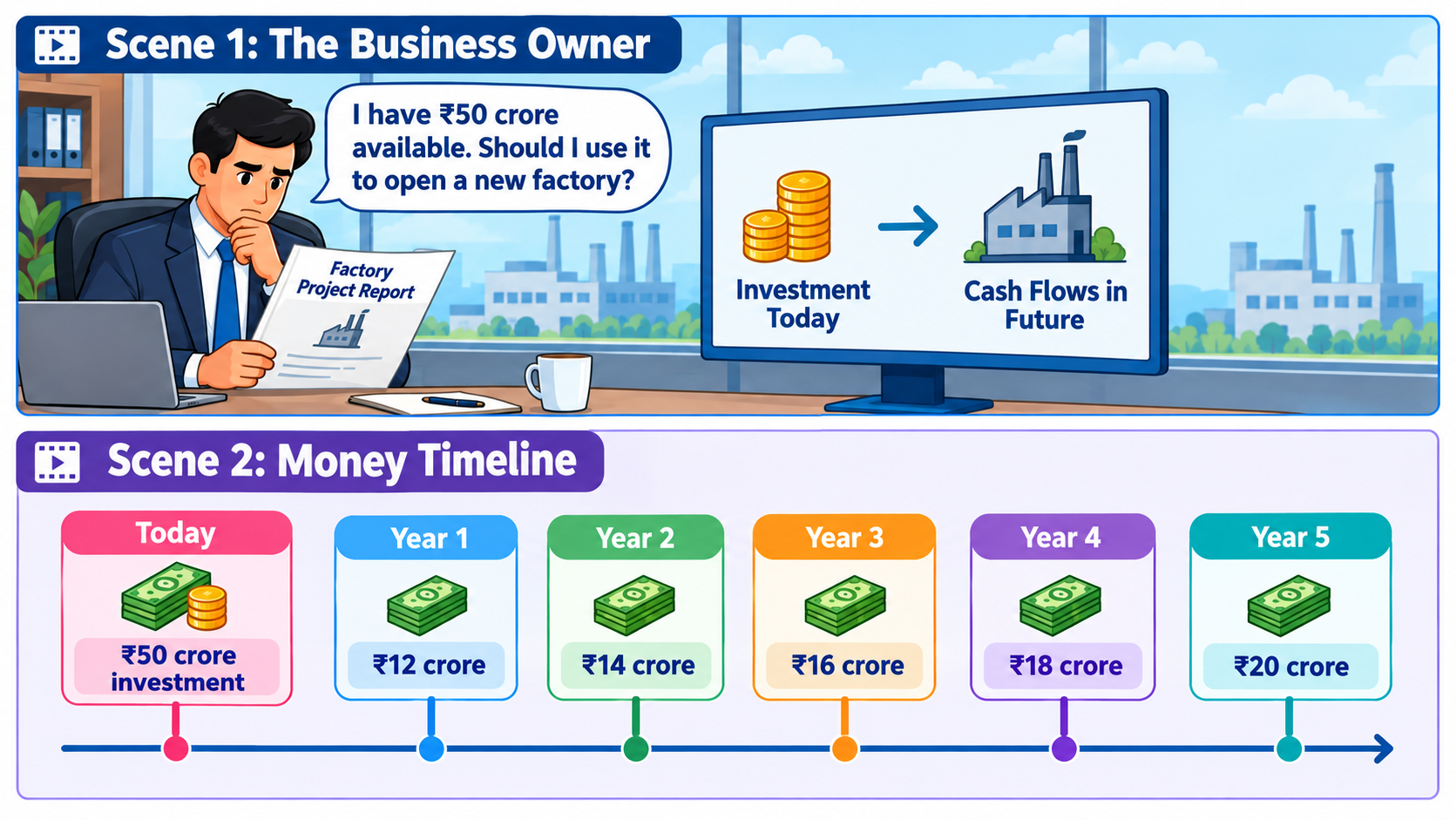
For instance, if an organisation wishes to establish a factory, then there could be an initial investment of Rs.50 crore followed by cash inflows over a period of time. But before making such an investment, the following factors need to be considered:
Amount of initial investment
Cash flow in the future
Time required for recovery
Return on investment
Viability of the project
In other words: Capital Budgeting = Whether to undertake a long-term investment or not.
This topic is a core part of capital budgeting for CA Inter students, covered under Financial Management, and frequently tested through numerical problems on NPV, IRR, and Payback Period.
CA Chesta Chawla – Faculty Profile
Lecturer – Direct Taxation and Financial Management
CA Chesta Chawla from the Institute of Chartered Accountants of India (ICAI) is an expert in direct taxation and financial management. Having corporate experience with Acuity Knowledge Partners, she makes learning easy through the use of practical examples and an exam-oriented approach.
She ensures that her teaching methodology emphasises conceptual learning rather than cramming.

Animation Lecture: The Factory Decision and Today vs. Future
What Is Capital Budgeting?
Capital budgeting is the activity involved in making plans and decisions on long-term investments of funds in projects.
Some examples are
Starting a new factory
Purchase of new machinery
Expansion of an existing factory
Replacement of old machinery
New venture
Establishment of a new branch/facility
Simple Logic: Capital Budgeting = Making decisions on how to invest capital in a project over a long period.
The term capital means capital invested in long-term facilities, and "budgeting" means planning and analysis of such investments.
Why Is Opening a New Factory a Capital Budgeting Decision?
Suppose that ABC Ltd. wishes to set up a new factory. The company’s projections show that:
Particulars | Amount |
Land | Rs.10 crore |
Building | Rs.15 crore |
Machinery | Rs.20 crore |
Installation | Rs.3 crore |
Initial working capital | Rs.2 crore |
Total Investment | Rs.50 crore |
The company is investing Rs.50 crore at present. But the factory is expected to generate cash inflows for many years to come. For instance:
Year | Projected Cash Flow | Cumulative Cash Flow (Rs. crore) |
1 | Rs.12 crore | 12 |
2 | Rs.14 crore | 26 |
3 | Rs.16 crore | 42 |
4 | Rs.18 crore | 60 |
5 | Rs.20 crore | 80 |
The investment of Rs.50 crore is recovered sometime during Year 4, since cumulative cash flow crosses Rs.50 crore between Year 3 (Rs.42 crore) and Year 4 (Rs.60 crore).
Payback period = 3 years + [Rs.50 crore - Rs.42 crore / Rs.18 crore]
= 3 years + 8/18
= 3 years + 0.44
~ 3 years and 5.3 months
Flow Diagram
Rs.50 crore Initial Capital → Uneven Annual Cash Flow → Cumulative Cash Balance Point → Payback Period ~ 3.4 Years
Time Value of Money in Capital Budgeting
TVM states that Rs.1 available now is always better than Rs.1 available in the future since the Rs.1 available now earns interest.
Illustration: Rs.10 lakh placed in an investment at 10% will be Rs.11 lakh after 1 year.
In the case of a factory investment where Rs.11 lakh is received in 1 year, and the discount rate is 10%:
PV = Rs.11 lakh / 1.10 = Rs.10 lakh
Therefore:
Future Cash Flows -> Discounting -> PV
TVM aids in the proper evaluation of future cash flows in capital budgeting.
Important Cash Flows in a Factory Project
As far as assessment of the factory project is concerned, the firm focuses on three kinds of cash flows:
Type | Meaning | Examples |
1. Initial Cash Flow | Cash outflow at the beginning of the investment project | Land, Building, Machinery, Installation, Working Capital |
2. Operating Cash Flows | Cash flow from normal business activities | Sales revenue − operating expenses − taxes, with relevant non-cash adjustments |
3. Terminal Cash Flow | Cash flow at the end of the investment project | Sale/salvage value of assets, recovery of working capital, related tax effects |
Why is cash flow more important than accounting profit?
Profit vs Cash Flow
In capital budgeting, the primary emphasis is on cash flow rather than profit because investment decisions impact cash flow of the company.
Illustration: Depreciation is a non-cash item, but it can lower your taxable income, thus impacting taxes and cash flow.
Note: Accounting Profit ≠ Cash Flow
It is important to know the difference between the two.
Major Capital Budgeting Techniques
Having calculated the cash flows of the project, the firm then uses various methods to assess the investment in the project.
Payback Period—This method calculates the time taken to recover the invested capital.
Accounting Rate of Return—Measures returns in terms of accounting profit.
NPV – Net present value of the cash inflows is calculated on the basis of the investment
PI – Calculates the present value of inflows compared to the investment.
IRR – Calculates the percentage at which the NPV will become zero.
The various methods offer alternative methods of evaluating the project.
Payback Period
The payback period calculates the duration of time needed to earn back the initial investment from the cash flow of the project.
Example
Initial cost = Rs.50 Crores
Cash flow = Rs.10 crores
Payback period = Rs.50 crores / Rs.10 crores = 5 years
Animation process
Rs.50 crore Initial cost → Rs.10 crore Annual cash flow → 5-year payback period
Important Concept: Simple Payback Period is easy to calculate, but it overlooks the Time Value of Money and the cash flows after the payback period.
Accounting Rate of Return
ARR is calculated in terms of the profitability of the project from accounting profits instead of cash flows.
Formula: ARR = (Average Accounting Profit ÷ Average Investment) x 100
Key Point: The ARR method reveals the amount of accounting profit that is generated by the investment. The calculation is easy; however, it ignores the time value of money.
Example:
Average Accounting Profit = Rs.8 crore per year
Average Investment = Rs.25 crore (assuming no salvage value, this is Initial Investment ÷ 2)
ARR = (Rs.8 crore ÷ Rs.25 crore) × 100 = 32%
Net Present Value — The Core Concept
Net Present Value is the difference between the Present Value of Cash Flow and the Initial Investment.
Formula: Net Present Value = Present Value of Cash Flow - Initial Investment
Example: Initial Investment = Rs. 50 crores
Present Value of Future Inflows = Rs.60 crores
NPV = Rs.60 crores – Rs.50 crores = Rs.10 crores
Importance of NPV: The NPV gives the value added by the project after considering the time value of money.
Profitability Index
The profitability index calculates the present value of cash inflows vis-à-vis the cost of the project.
Profitability Index Formula: Profitability Index = Present Value of Cash Inflows ÷ Present Value of Cash Outflows
Example: Initial Investment (Present Value of Cash Outflows) = Rs.50 crore
Present Value of Future Inflows = Rs.60 crore
PI = Rs.60 crore ÷ Rs.50 crore = 1.2
Point to Remember: A PI greater than 1 means the project adds value (consistent with a positive NPV)—here, for every Rs.1 invested, the project returns Rs.1.20 in present-value terms, so it's acceptable. A PI below 1 indicates the project destroys value and should be rejected.
Internal Rate of Return
IRR is the rate of interest where NPV of the project becomes zero.
In case of IRR,
Present value of cash flows = Present value of cash outflows
Animation: 8% → 10% → 12% → 14% → IRR → NPV = 0
Note: Internal Rate of Return is compared to the required rate of return (hurdle rate).
Example: Starting Capital = Rs.50 crores
When the discount rate is 10%, NPV = Rs.10 crores (positive).
When the discount rate is 16%, NPV = Rs.(2) crores (negative).
As NPV goes from positive to negative between these discount rates, the IRR will be somewhere between 10% and 16%. Using the Interpolation Method:
IRR = 10% + [10 / (10 – (-2))] * (16% – 10%) = 10% + [10/12 * 6%] = 15%
Things to Remember: When the discount rate is approximately 15%, the PV of cash flows is equal to the PV of cash outflows, making NPV zero
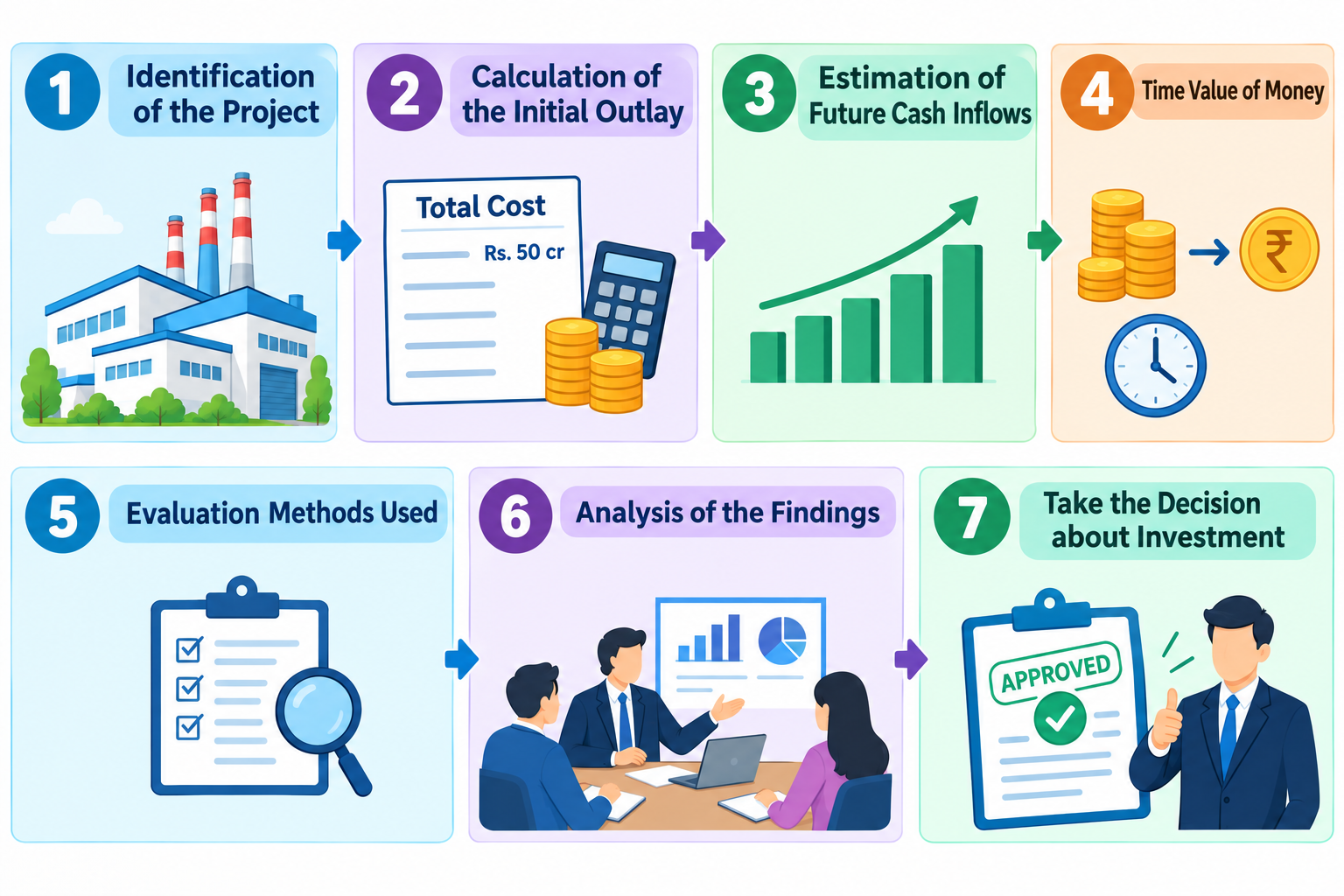
Capital Budgeting Process
Why Capital Budgeting Is Important
Capital budgeting is vital due to the high amounts of money involved in such investments and the risk involved in them.
Reason | Simple Explanation |
1. Huge Investment | Large projects need huge investment. |
2. Long-Term Commitment | Investments in land, building, and machinery cannot be undone easily. |
3. Inaccurate Information | Information about future sales, expenses, and demands can prove wrong. |
4. Time Value of Money | Money received at different times is not of the same value. |
5. Risk | The actual cash flow could be different from the estimated one. |
6. Business Impact | An additional project can influence the business. |
Concept Notes — Quick Revision
Common Student Confusions
Confusion 1: Should We Consider Profit or Cash Flow?
In capital budgeting, we should be more concerned about relevant cash flows.
Confusion 2: Why Do We Discount Future Cash Flows?
Due to the time value of money.
Confusion 3: What Does NPV Do?
NPV changes future cash flows into their present values and then compares them with the investment made.
Confusion 4: What Does Payback Period Indicate?
It indicates the time taken to recover the initial investment made.
Confusion 5: What Does IRR Indicate?
IRR is the discount rate at which NPV = 0
Confusion 6: Are All Accounting Costs Cash Costs?
No, not all costs are cash costs. Some costs, like depreciation costs, are not cash costs but are accounting costs.
Easy way to remember the concept of capital budgeting
The Process of Capital Budgeting: INVEST -> CASH FLOW -> DISCOUNT -> EVALUATION -> DECISION
Or as easy as: Invest Now -> Cash Flow Later -> Present Value -> Evaluate -> Decision.
Conclusion
Despite appearing formulaic at first, the basic concept of capital budgeting is rather easy.
Picture a corporation considering setting up a new plant. It makes an investment today and gains cash inflows in future periods. Therefore, it analyses the initial outlay, operating cash flows, and terminal cash flow using techniques such as payback, ARR, NPV, PI, and IRR.
One-line summary: Capital Budgeting = Analysis of present investment relative to future cash flows to determine the financial viability of the project.
Formulas are simply different techniques for doing the same analysis.