CA Inter Costing is one of the most scoring yet tricky subjects for CA Intermediate students. This topic is more than memorising formulas. Students are supposed to understand the concept, use the appropriate method, answer the question correctly, and show the correct workings. Many students fail to score well in exams because of small mistakes, which include applying the wrong formula, calculation mistakes, spending too much time on one question, or improper workings.
Avoiding these mistakes starts with the right teaching approach. CA Himanshu Singla teaches costing with practical examples and visual learning, focusing on when and why a particular formula should be used—not just how to apply it—so students build the exam-ready practices covered below.

Learning Formulas Without Understanding the Concept
There are some students who learn cost accounting formulas without understanding the concept. This could give rise to problems if the question is asked in a different way. A student may know the formula but still be confused about which formula to use or what each figure means.
How to avoid these mistakes
Understand the concept first and then learn the formula.
Understand the meaning of each component of the formula.
Understand when and where to use the formula.
Know where and how to apply the formula.
Not Reading the Question Carefully
Many students start solving costing questions too quickly and miss important information. Even one missed adjustment can change the final answer.
How to avoid these mistakes
Read the complete question carefully.
Underline important figures and adjustments.
Clearly state what is being asked.
Verify whether the data is on a per-unit, monthly, annual, or total basis.
Before completing your response, read the question again.
Making Mistakes in Calculations
Costing involves multiple calculations at every stage. Even when the concept is correct, a minor calculation error can change the final answer.
How to avoid these mistakes
Ensure your working notes are well-written.
Recheck the significant totals.
Do rough work if required.
Always double-check important calculations before moving on to the next question.
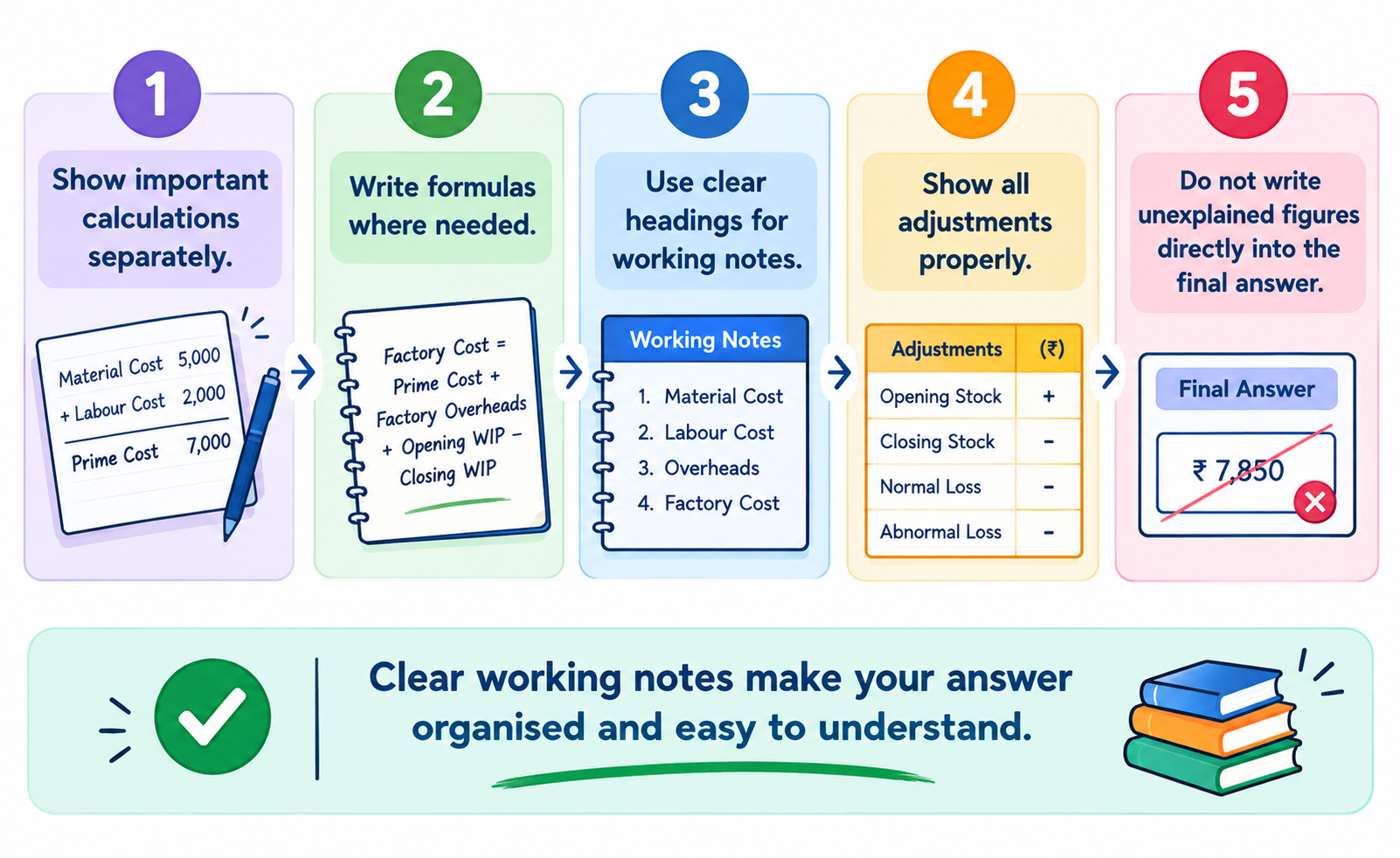
Ignoring Working Notes
Most students only write the final answer without even looking at their workings. Working out is essential since it shows your method of deriving the answer. Even when your answer is a little bit off, you can get step marks from the examiners because of the workings.
How to avoid this mistake
Confusion in Similar Concepts
Some costing concepts look similar but have different meanings. Confusion may occur between fixed and variable cost, direct and indirect cost, normal and abnormal loss, or contribution and profit. This occurs because students tend to cram instead of grasping the concepts.
How to avoid these mistakes
Make short comparison notes.
Know the differences between concepts.
Use practical examples.
Focus on how each concept is used in questions.
Not Solving Practical Problems Sufficiently
Costing requires more than just reading notes. To increase their speed, accuracy, and idea application skills, students need to practice regularly.
How to avoid these mistakes
Solve questions without looking at the solution.
Start with basic questions.
Practice exam-level questions.
Solve questions within a set time.
After each test, go over your mistakes.
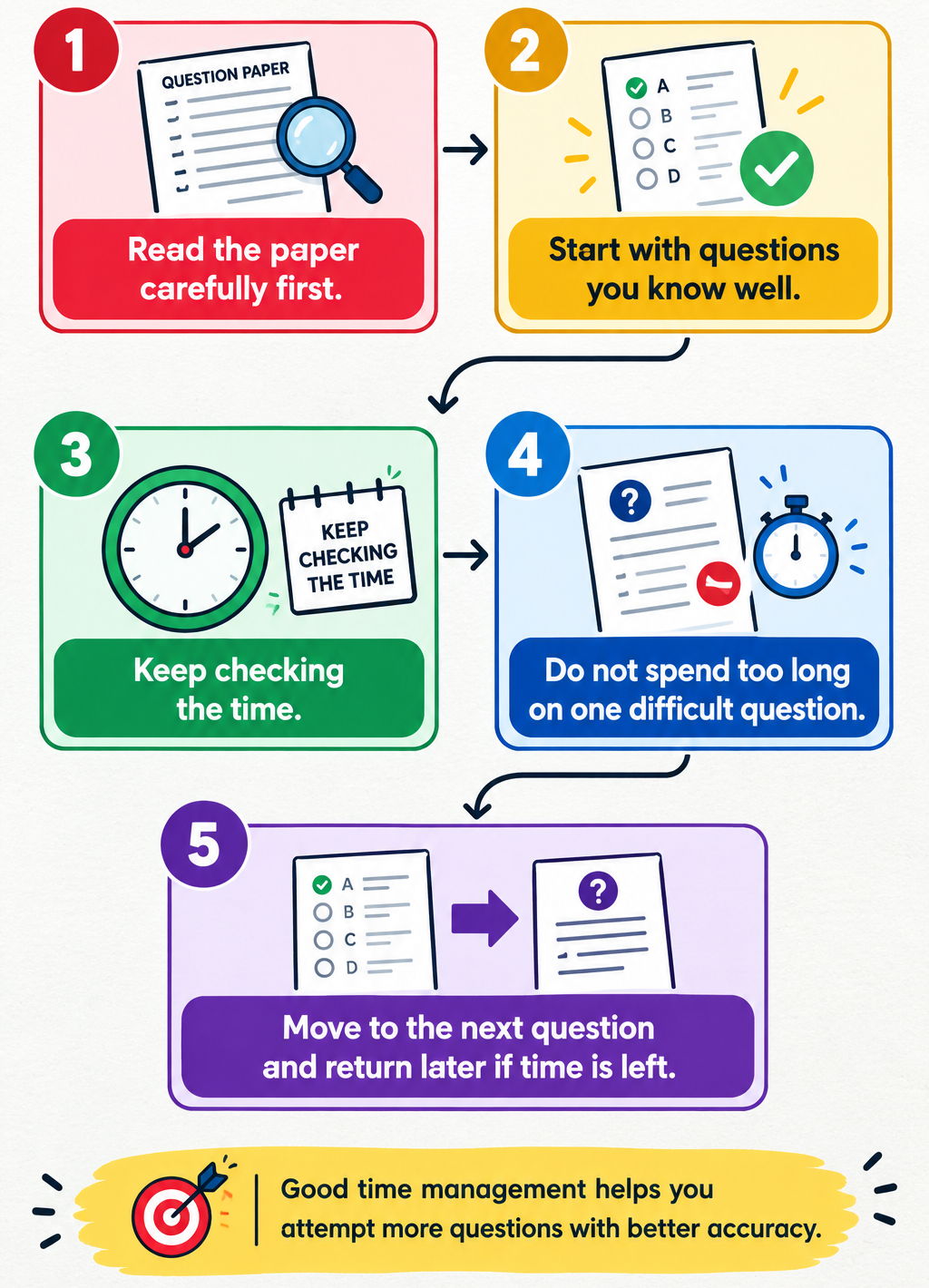
Spending Too Much Time on a Single Question
In the costing analysis, time management is essential. Some students take too much time to answer one particular difficult question and leave little time to answer other questions, which lowers their overall score even when they know the remaining answers well.
Important Formulas and Concepts Not Revised
Students study costing very well but don’t revise it. With a lot of formulas, concepts, and adjustments, it becomes hard to recall everything at the time of examination.
How to avoid these mistakes
Maintain a formula sheet.
Take brief notes for revision.
Regularly review challenging concepts.
Poor Presentation of Answers
A correct answer can lose its clarity if it is not presented properly. In costing, your solution should be neat, organized, and easy to follow.
How to avoid these mistakes
Give a proper heading
Present your working notes clearly
Write calculations step-by-step
Clearly highlight the final answer.
Keep your handwriting neat and readable.
Failure to Examine Errors Following Practice Exams
Many students check their marks after a test but do not review their mistakes. Marks show results, but mistakes show what needs improvement.
How to avoid these mistakes
Check every wrong answer carefully.
Check for formula and calculation errors.
Check if you misunderstood the question.
Identify any time management and presentation problems.
How Animation Lectures Help Students Understand Costing
Costing is quite complex, as it consists of a lot of processes, costs, and business activities. Animation and visuals assist in understanding it better. Costing by CA Himanshu Singla makes use of practical examples and animations to explain cost flows and calculations.

Animation could assist students to understand the following concepts:
Production processes.
Costs flow.
Movement of material.
Departmental activities.
Cost classification.
Various stages of production.
Cost/profit considerations.
How to Prepare for CA Inter Costing More Effectively
Preparation Step | What to Do |
Understand the Concept First | Understand the topic and logic before learning formulas. |
Practise Regularly | Solve questions regularly to improve speed and confidence. |
Make Short Notes | Keep formulas, adjustments, concepts, and mistakes in one place. |
Solve Exam-Level Questions | Practise questions with adjustments and practical applications. |
Take Timed Tests | Solve questions within a time limit to improve speed. |
Analyse Mistakes | Find out why your answer was wrong and avoid repeating the mistake. |
Revise Regularly | Revise formulas, concepts, and important questions regularly. |
Conclusion
CA Inter Costing requires conceptual clarity, practice, revision, accuracy, and presentation. Most students don't lose marks because they lack knowledge. They lose marks to avoidable habits: skipping working notes, mismanaging time, or forgetting to revise formulas before the exam. Fixing these small gaps often makes the biggest difference to your final score. If you want structured practice and expert guidance to strengthen your CA Inter Costing preparation, explore CA Himanshu Singla's costing course and notes on CATestSeries.org and start correcting these mistakes today.